


- How to Start Trading: A Step-by-Step Guide for Beginners
- Demo Trading Accounts: Safe Practice for Beginners
- Understanding How Much Capital You Need to Start Trading
- How to Set Realistic Trading Goals as a New Trader
- How to Open a Trading Account in Malaysia (Step-by-Step)
- How to Start Trading in Malaysia: A Guide for Beginners
- How to Create a Trading Plan Before You Start Trading
- What Is a Trading Account? Everything You Need to Know
- How to Learn Trading: Step-by-Step Beginner Roadmap
- What Is Stop Loss in Trading and How Does It Work?
- Why Every Trader Needs a Trading Journal
- Islamic Forex Account Explained: How Swap-Free Trading Works
- Funded Trading Account: Rules, Splits & Risks
- Master Money Management: Practical Capital Protection Rules
- Overtrading Explained: Common Causes, Signs, and How to Stop
- How Risk-Reward Ratio Works: A Guide to Trading Risk
- How to Open a Brokerage Account as a Beginner
- What Is a Cent Account Forex and How Does It Work?
- What Is an ECN Account and How Does It Work?
- What Is Cashback Forex and How Does It Work?
- Fixed Deposit vs Unit Trust: Key Differences for Investors
- Welcome Bonus Forex: What It Is and What to Watch For
- Forex Deposit Bonus: How It Works
- What Is Forex Rebate and How Does It Work?
- What Is Forex Free Credit and How Does It Work?
- Trading Webinars: Are They Worth Attending?
- Trading for Beginners PDF: What to Look For in a Good Guide
- Trading 101: How to Start Trading Safely and Effectively
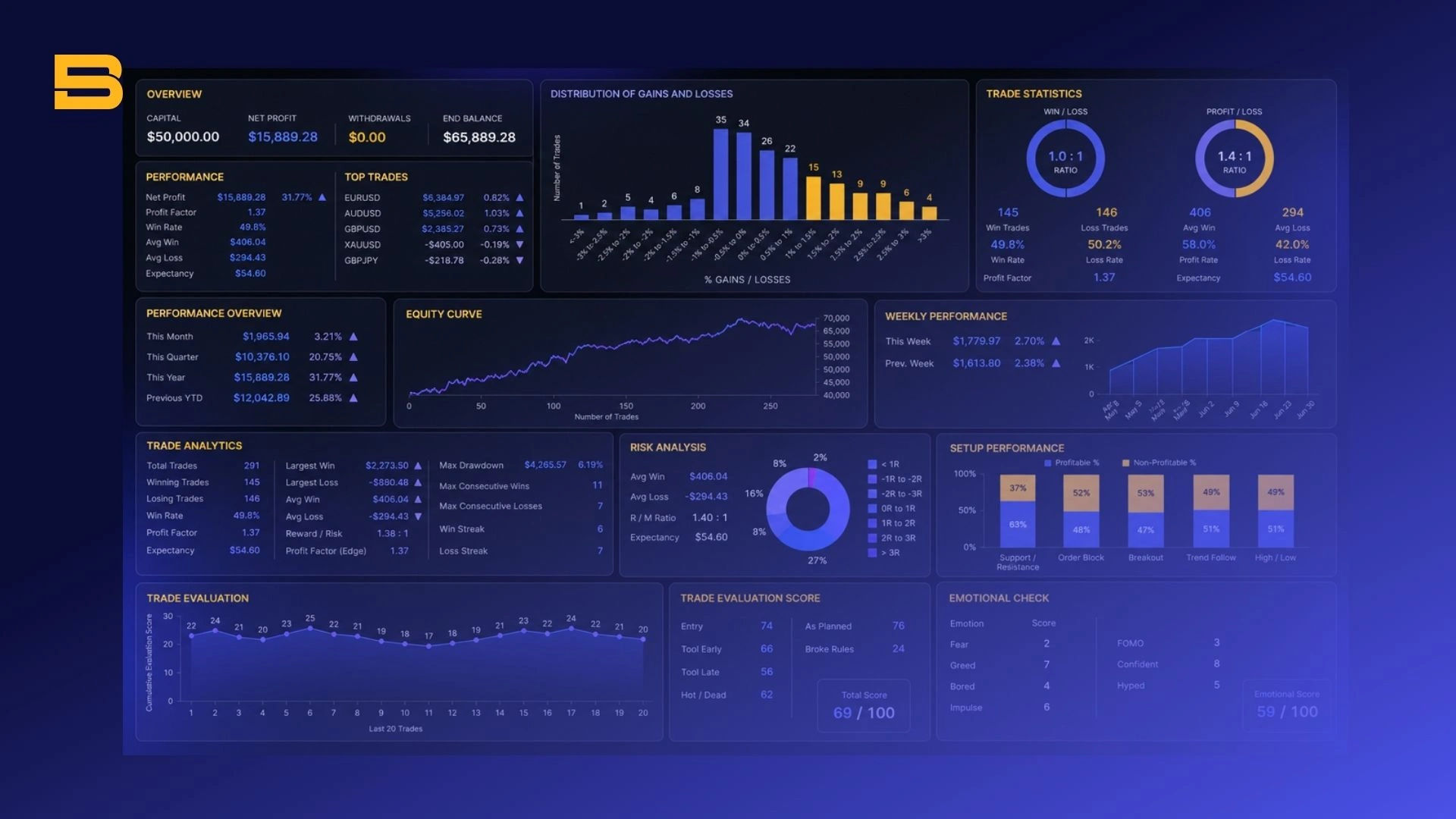
Picture this scenario: you spend three days executing clean, profitable setups. Your account balance steadily climbs, and your trading confidence reaches an all-time high. Then, in a single chaotic afternoon session, a sudden market spike triggers an impulsive trade. You double your position size to win it back, ignore your risk parameters, and watch your entire week’s profits evaporate in minutes.
When you sit down at your desk that evening, you ask yourself the same painful question every unorganized trader eventually faces: What actually went wrong?
Without record-keeping, you cannot give an objective answer. This is where keeping a systematic trading journal transforms your trading journey. Tracking your market decisions turns chaotic market exposure into a structured, repeatable skill, bridging the gap between emotional market gambling and disciplined execution.
Trading Plan vs. Trading Journal: What's the Difference?
Before diving into setup mechanics, it is critical to clarify how two foundational trading tools work together.
Think of a trading plan as your roadmap before entering the market. It establishes your baseline rules: which technical setups you trade, which timeframes you monitor, your maximum allowable position size, and your entry and exit parameters. It defines what you intend to do.
A trading journal, on the other hand, is your trip log—an exact evaluation of execution after the trade closes. It records what actually happened, measuring how closely you adhered to your original plan.
While a trading plan helps prevent bad decisions beforehand, a trading journal exposes the psychological leaks and execution errors you make in real time. You cannot refine a plan if you do not track how you execute it.
Essential Elements of a Trading Journal Template
A well-structured trading journal template does not need to be overly complicated, but it must be thorough. Tracking too few variables leaves you without actionable insights, while tracking too many creates unnecessary friction that leads to abandoned logging.
To build an efficient system, split your tracking fields into execution data and qualitative notes.
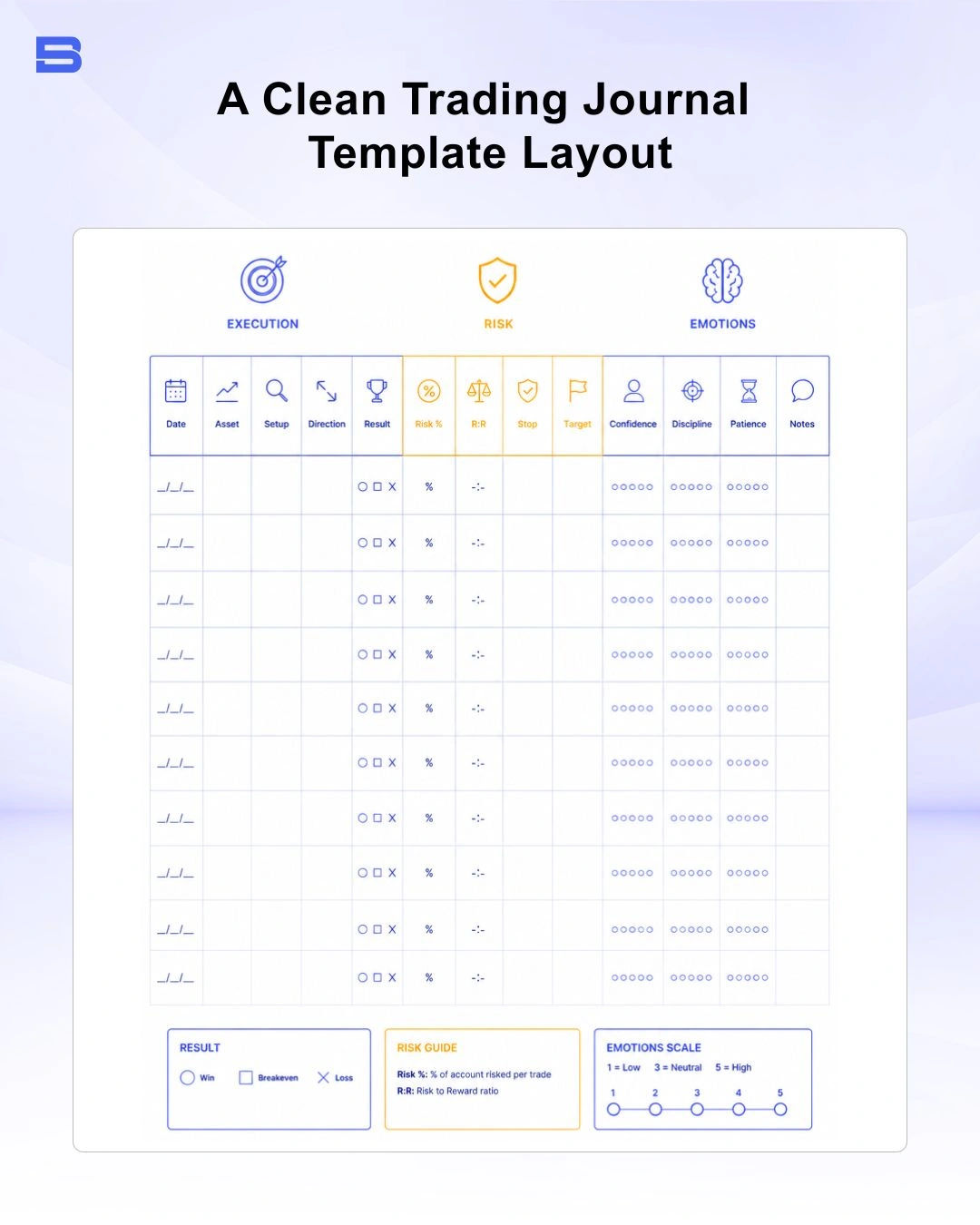
Standardizing these parameters ensures every trade provides valuable data points for future review, according to performance tracking standards maintained by the CFA Institute.
Key Metrics to Log: Beyond Profit and Loss
Focusing exclusively on net profit and loss (P&L) is one of the most dangerous traps for new traders. A trader can break every risk rule, over-leverage their balance, and still close a profitable trade due to short-term market luck. Conversely, a flawless execution following strict probabilistic parameters can still hit a stop loss.
If you evaluate performance solely by money won or lost, you risk rewarding bad habits and penalizing disciplined execution. To measure true progress, focus on these critical metrics instead.
Risk Per Trade and Position Sizing
Every logged entry must record your exact risk per trade. Professional risk frameworks recommend risking no more than 1% to 2% of your total account balance on any single position.
If your balance is $10,000, a strict 1% maximum limit caps your allowable loss at $100 per trade.
Maximum Dollar Risk = $10,000 x 0.01 = $100
Logging this metric helps identify instances of impulsive sizing before an over-leveraged loss causes severe account drawdown.
Win Rate Calculation and Risk-Reward Ratios
Your win rate calculation measures the percentage of winning trades against your total closed positions:
Win Rate (%) = Winning Trades / Total Closed Trades x 100
However, win rate alone means very little without evaluating your average risk-reward ratio. Consider two distinct trading styles over a sample of 100 trades:
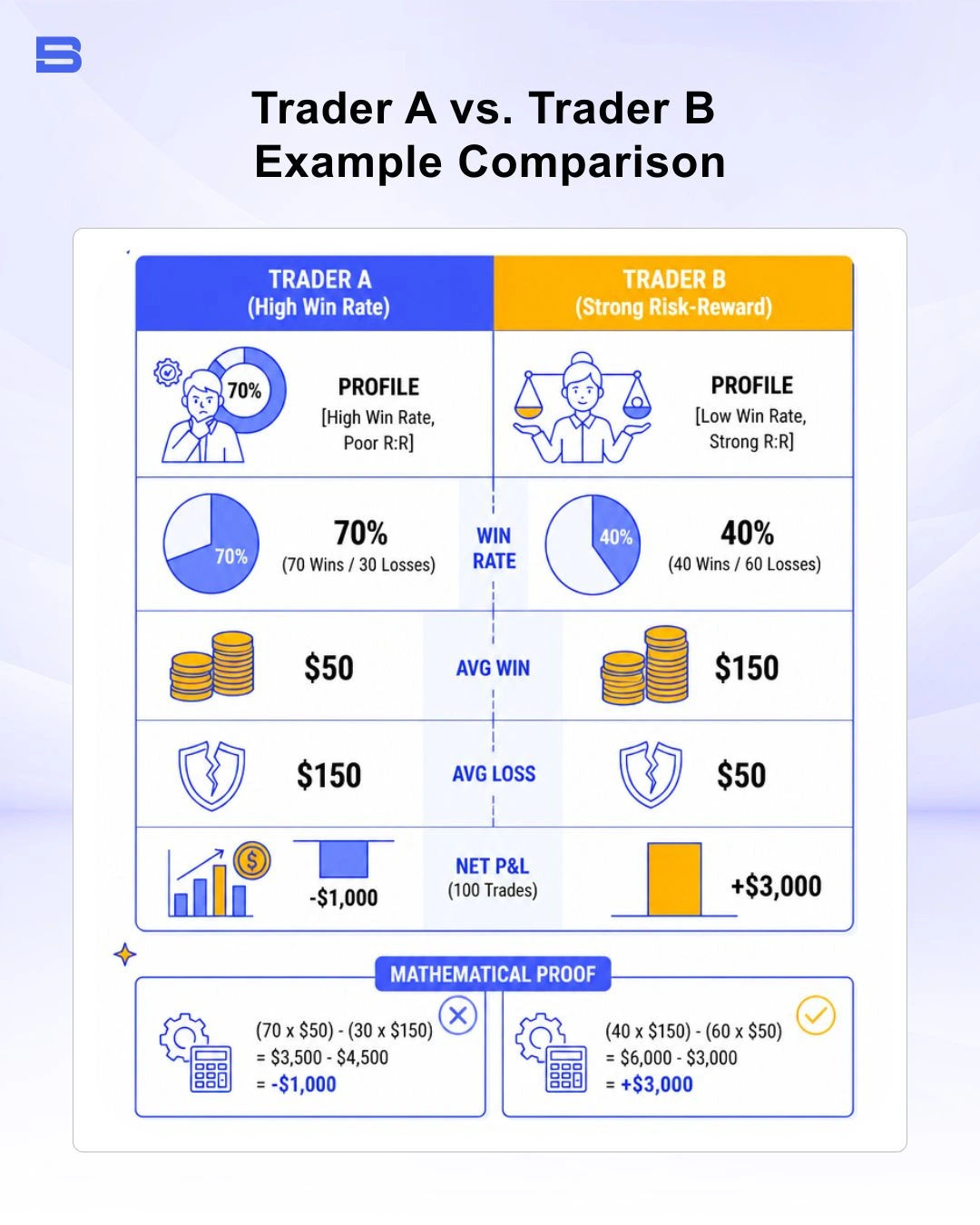
Tracking both metrics together in your journal reveals whether your trading edge relies on high precision or asymmetric payout structures.
Stop Loss Integrity
Log the initial placement of your stop loss relative to technical market structure, alongside any manual adjustments made while the trade was open.
Leverage amplifies returns when market moves align with your position, but it accelerates capital destruction just as quickly when prices turn against you—a 2.5% adverse move on a 30:1 leveraged position can wipe out a large share of your margin.
Documenting stop loss performance reveals whether you regularly move stops out of fear or cut winning trades prematurely before they reach target objectives. The Securities Commission Malaysia (SC) provides investor education resources emphasizing disciplined risk parameters and stop-loss rules to protect trading capital.
The Psychological Audit: Logging Mindset and Emotions
Trading performance is deeply connected to human psychology. Add a dedicated section to your journal to record your emotional state:
- Pre-Entry: Are you entering out of impatience, or are you chasing price due to Fear Of Missing Out (FOMO)?
- In-Trade: Do you feel anxious, restless, or tempted to interfere with your trade plan?
- Post-Exit: Do you feel satisfied with your execution quality, or frustrated by outcome bias?
Tracking psychological metrics helps you spot emotional triggers before they lead to severe capital losses.
Step-by-Step: How to Keep a Trading Journal
Integrating journaling into your daily routine should feel seamless. Follow this step-by-step workflow to maintain consistency without disrupting your trading focus.
Step 1: Pre-Market Preparation
Before opening your charting platform, write a quick pre-market entry. Note the current macroeconomic context, major news releases scheduled for the session, and your current mental state. If you feel tired or stressed, note it down—it serves as an early warning to reduce position size.
Step 2: Log the Execution Immediately
As soon as an order fills, log the hard technical parameters: asset ticker, direction, entry price, stop-loss price, profit target, and position size. Capturing this data instantly prevents reliance on memory later in the day.
Step 3: Record Trade Management Notes
If market conditions force you to modify a position—such as moving your stop to breakeven or taking partial profits—note the adjustment immediately alongside your internal reasoning.
Step 4: Conduct a Post-Trade Review
Once the trade closes, record the exit price, commission fees, and final P&L. Score your execution quality from 1 to 5 based strictly on rule adherence, regardless of whether the trade won or lost money.
Choosing Your Setup: Digital Templates vs. Automated Tools
Selecting the right medium for your trading journal depends on your style, tech preferences, and how much manual tracking you prefer.
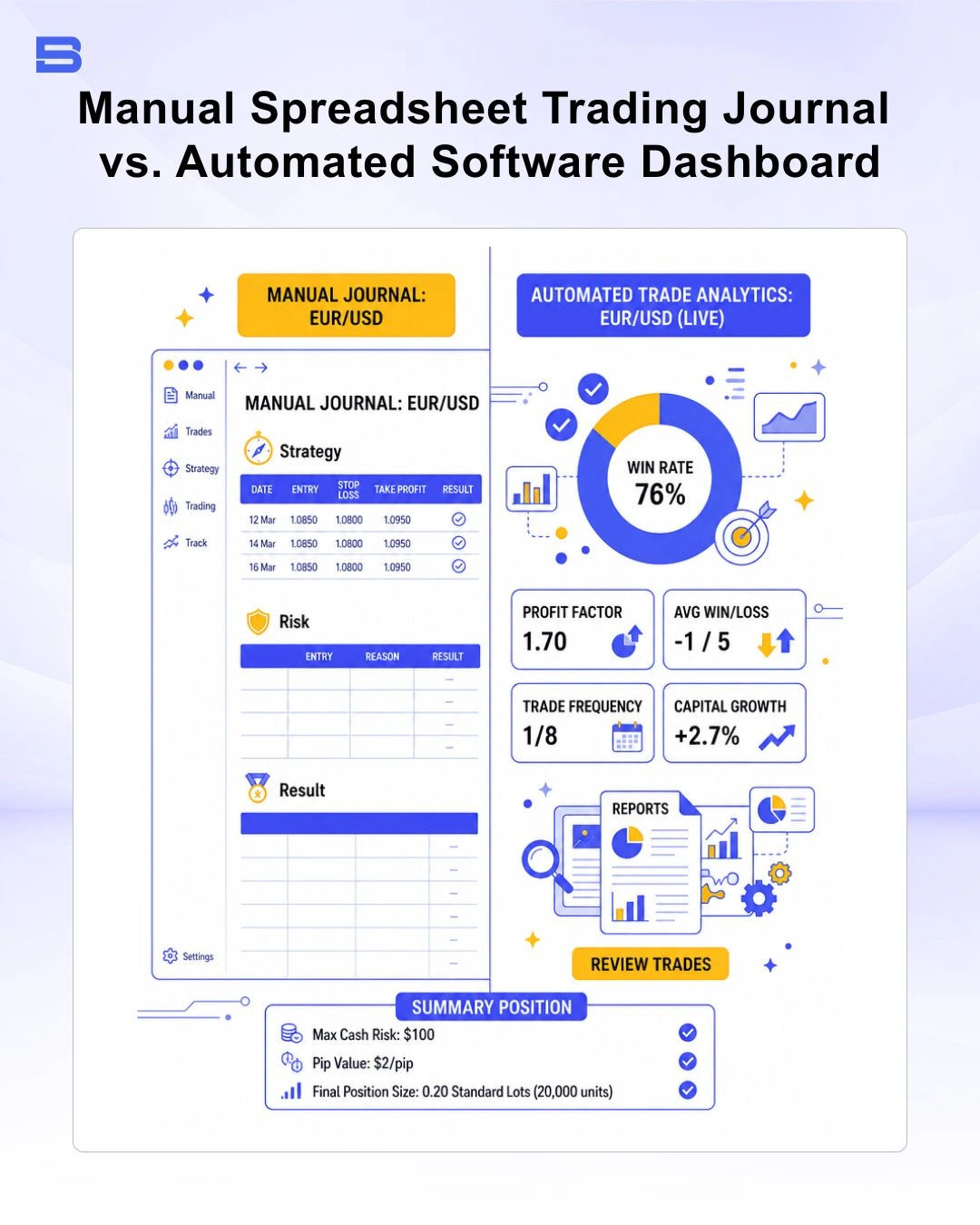
Option A: Manual Spreadsheets (Excel / Google Sheets / Notion)
Manual entries force you to interact directly with your trade metrics. Entering numbers manually reinforces accountability and makes you directly face costly execution errors.
- Pros: Fully customizable, free, highly effective for psychological logging.
- Cons: Time-consuming, prone to human calculation errors.
Option B: Dedicated Analytics Software (Auto-Sync)
Specialized journaling software connects directly to your brokerage account via Application Programming Interface (API) keys to automatically log trade entries, exits, fees, and execution timing.
- Pros: Saves time, provides instant equity curves and statistical breakdowns.
- Cons: Subscription costs, may discourage thoughtful qualitative reflection if you rely purely on automated data.
Common Journaling Pitfalls to Avoid
Maintaining a trading journal requires discipline. Avoid these common traps to ensure your logging provides actionable value:
- Logging Only Winning Trades: Omitting losses to protect your ego destroys the integrity of your dataset. Bad trades contain the most valuable performance insights.
- Failing to Review Your Data: Collecting hundreds of trade logs is useless if you never analyze them. Set aside time every weekend to calculate weekly statistics and spot recurring mistakes.
- Ignoring Behavioral Triggers: If your logs reveal that you consistently lose money during the last hour of trading or after three consecutive losses, use that insight to update your trading plan and prevent overtrading.
The Bottom Line
A trading journal is far more than a financial ledger—it is a mirror reflecting your psychological discipline, risk control, and operational consistency. Markets will always remain unpredictable, but documenting your execution gives you control over your process. Start logging your trades today, review your metrics weekly, and let real execution data guide your trading decisions.
Disclaimer: The content on this page is intended for educational and informational purposes only. It does not constitute financial, investment, tax, or legal advice, and should not be interpreted as a recommendation to buy, sell, or hold any financial instrument or asset. Trading and investing involve significant risk, including the possible loss of your entire capital. Products such as forex, CFDs, and cryptocurrencies carry additional risks due to leverage, high volatility, and limited regulatory protection in some jurisdictions. Past performance of any financial instrument does not guarantee future results. Any market views, forecasts, or opinions expressed are those of the author at the time of writing and may not reflect current market conditions. Platform features, fees, and regulatory status are subject to change — always verify information directly with the relevant provider or regulator before making any financial decision. BrokerSpecs may receive compensation from third parties featured on this site. Always conduct your own due diligence and consider seeking advice from a licensed financial professional before investing.