


- How to Start Trading: A Step-by-Step Guide for Beginners
- Demo Trading Accounts: Safe Practice for Beginners
- Understanding How Much Capital You Need to Start Trading
- How to Set Realistic Trading Goals as a New Trader
- How to Open a Trading Account in Malaysia (Step-by-Step)
- How to Start Trading in Malaysia: A Guide for Beginners
- How to Create a Trading Plan Before You Start Trading
- What Is a Trading Account? Everything You Need to Know
- How to Learn Trading: Step-by-Step Beginner Roadmap
- What Is Stop Loss in Trading and How Does It Work?
- Why Every Trader Needs a Trading Journal
- Islamic Forex Account Explained: How Swap-Free Trading Works
- Funded Trading Account: Rules, Splits & Risks
- Master Money Management: Practical Capital Protection Rules
- Overtrading Explained: Common Causes, Signs, and How to Stop
- How Risk-Reward Ratio Works: A Guide to Trading Risk
- How to Open a Brokerage Account as a Beginner
- What Is a Cent Account Forex and How Does It Work?
- What Is an ECN Account and How Does It Work?
- What Is Cashback Forex and How Does It Work?
- Fixed Deposit vs Unit Trust: Key Differences for Investors
- Welcome Bonus Forex: What It Is and What to Watch For
- Forex Deposit Bonus: How It Works
- What Is Forex Rebate and How Does It Work?
- What Is Forex Free Credit and How Does It Work?
- Trading Webinars: Are They Worth Attending?
- Trading for Beginners PDF: What to Look For in a Good Guide
- Trading 101: How to Start Trading Safely and Effectively
Understanding how to learn trading begins with recognizing that financial markets can seem overwhelming to beginners. With constantly moving prices, unfamiliar trading terminology, and the urge to place a trade immediately, it's easy to make costly decisions before developing the necessary knowledge and skills. Approaching the market like a game of chance is one of the quickest ways to lose your trading capital.
The key to how to learn trading is following a structured path rather than searching for shortcuts or guaranteed profits. Successful trading is built on developing market knowledge, practicing sound risk management, and continuously evaluating your performance. By taking a disciplined, step-by-step approach, you can build a strong trading foundation while protecting your capital as you gain real-world experience.
How to Learn Trading: A 5-Step Beginner Roadmap
Learning how to learn trading effectively requires following a structured process rather than rushing into live markets. Many beginners make the costly mistake of trading with real money before they fully understand trading platforms, order types, or the fundamentals of risk management.
The safest approach is to prioritize building knowledge and preserving capital before focusing on profits. By following a structured five-step roadmap, you can develop practical trading skills, test your strategies in a risk-free environment, and strengthen the discipline and emotional control needed before committing real capital.
Step 1: Learn Trading Foundations (Markets, Orders, and Account Types)
Before placing a trade, you must understand the environment you are operating in and the mechanics of execution. Financial markets span several primary asset classes, each with its own liquidity, trading hours, and structural rules:
- Foreign Exchange (Forex): The global currency market operating 24 hours a day during weekdays, characterized by high liquidity and leverage.
- Equities (Stocks): Ownership shares in individual public companies traded on centralized exchanges like Bursa Malaysia or the New York Stock Exchange (NYSE).
- Contracts for Difference (CFDs): Derivative contracts allowing you to speculate on price movements of underlying assets (indices, commodities, stocks) without taking physical ownership.
- Commodities: Spot or futures contracts on physical goods such as gold, crude oil, or Crude Palm Oil (FCPO).
When executing trades, order types determine how your position enters the market. A Market Order executes immediately at the current available market price, which is ideal when speed is required. Conversely, a Pending Order (such as a Limit Order or Stop Order) only executes if the asset price reaches a pre-specified level in the future, giving you exact control over your entry price.
Account structures also vary depending on your operational region. For Southeast Asian and Malaysian traders buying local equities, a Central Depository System (CDS) account is mandatory to hold securities under your name. Meanwhile, traders utilizing international margin accounts or multi-asset CFD platforms must navigate margin requirements and currency conversion costs.
Muslim traders can also access Islamic (Swap-Free) accounts, which eliminate overnight rollover interest payments to remain aligned with Shariah principles. You can verify regulatory statuses and educational resources directly through statutory regulators like the Securities Commission Malaysia (SC).
Trading Courses vs. Self-Taught Roadmap
Many beginners wonder whether they should invest in a trading course Malaysia providers offer or build their skills through free educational resources. While structured courses can help you understand trading fundamentals and provide a clear learning path, some expensive programs make unrealistic profit claims or promote "secret" strategies and proprietary indicators that rarely deliver consistent results in live markets.
In the long run, successful traders develop through continuous self-learning, hands-on practice, and disciplined execution. A trading course can teach market terminology, technical analysis, and risk management principles, but it cannot replace the experience, emotional control, and decision-making skills gained by trading in real market conditions.
Step 2: Understand Mechanics — What Is a Stop Loss and How to Set One
Understanding leverage and margin is vital for capital survival. Leverage allows you to control a large trade position with a smaller upfront deposit (margin). For instance, a 1:30 leverage ratio means $100 of margin can control a $3,000 position. While leverage magnifies gains when price moves in your favor, it accelerates losses just as quickly when the market turns against you.
Global regulators, including the Financial Conduct Authority (FCA), strictly restrict retail leverage limits to prevent rapid account liquidation.
To safeguard your account from catastrophic drawdowns, learning what is a stop loss and how to set one is non-negotiable. A stop-loss is an automated order placed with your broker to close an open position once price hits a defined threshold, capping your maximum loss on that trade.
Worked Example: Calculating Risk per Trade
Suppose you hold a $1,000 capital balance and establish a strict 1% risk per trade rule. This means your absolute loss limit on any single trade is $10 ($1,000 × 0.01).
If you purchase a stock at $100 and set your stop-loss order at $99 (a $1.00 risk per share), your maximum position size is calculated as:
Position Size = Maximum Dollar Risk / Risk Per Share =
$10 / 1.00 = 10 shares
If the stock drops to $99, your automated stop-loss triggers, closing the trade with exactly a $10 loss—leaving 99% of your total account balance fully intact.
Step 3: Paper Trading Practice (Risk-Free Execution)
Once core concepts are understood, transitioning theory into practice requires a risk-free environment. Paper trading practice through a simulated demo account allows you to interact with live price feeds without exposing real money.
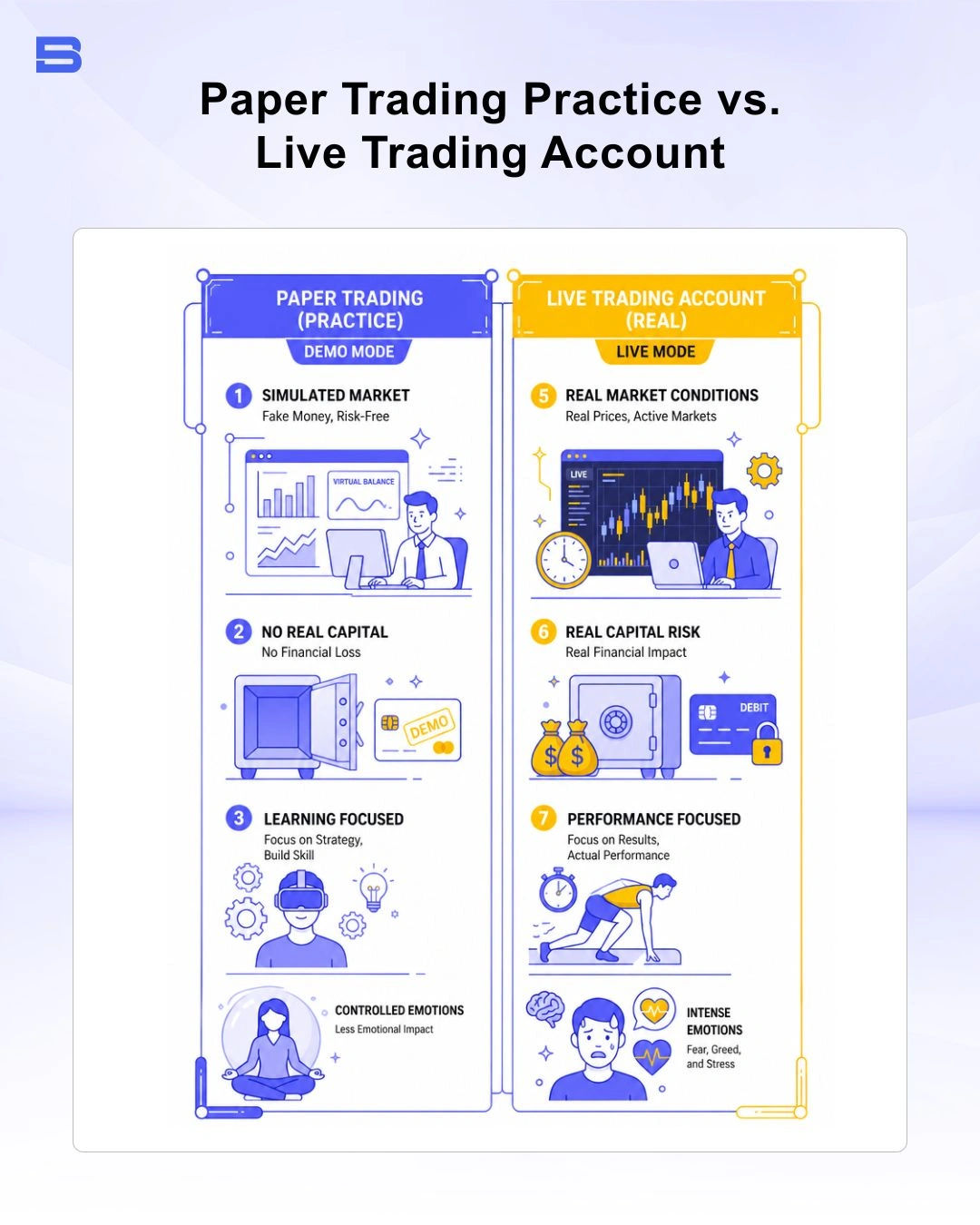
Demo environments serve specific tactical purposes:
- Platform Familiarization: Learning how to open orders, adjust market stops, and monitor live margin levels on trading software.
- Spread Analysis: Observing how the bid-ask spread widens during major economic news events.
- Strategy Testing: Verifying whether your entry and exit ideas function smoothly across fluctuating market conditions.
However, paper trading practice has a fundamental limitation: it excludes real psychological stress. Losing virtual capital triggers zero physiological anxiety. Therefore, demo trade for a defined period (e.g., two to three months) to learn mechanical execution, but avoid staying in demo mode indefinitely.
Step 4: How to Create a Trading Plan Before You Start Trading
Trading without a written blueprint forces you to make emotional decisions during fast market movements. Learning how to create a trading plan before you start trading transforms subjective guessing into an objective process.
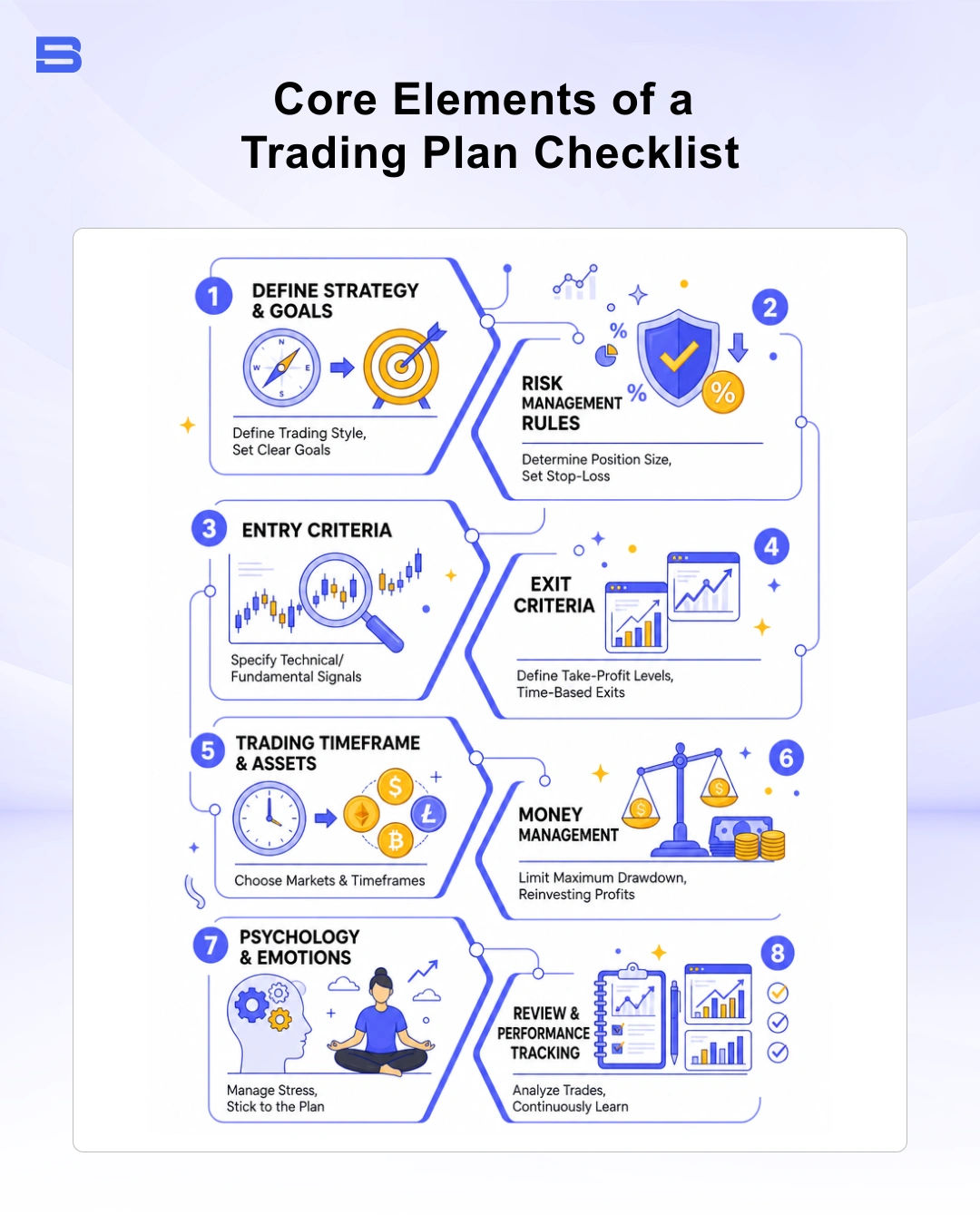
A robust trading plan acts as an operating manual containing clear parameters:
- Target Asset Classes: Specify exactly which pairs or stocks you trade (e.g., Euro and US Dollar [EUR/USD] or Bursa blue-chip stocks).
- Timeframes: Define your operating horizon, whether intraday, swing, or position holding.
- Entry Triggers: List the precise technical or fundamental conditions required to open a trade.
- Exit Conditions: Pre-define both your profit target and your automated stop-loss level before entry.
- Risk Limits: Enforce maximum daily or total portfolio risk thresholds.
Step 5: Master Risk Management and Trading Psychology
Long-term survival in financial markets depends heavily on the principles of money management in trading: a beginner's guide. Technical analysis identifies entry points, but proper risk management ensures a string of consecutive losses does not liquidate your trading account.
A foundational metric is the risk-to-reward ratio. By maintaining a minimum 1:2 risk-to-reward ratio, you aim to make $200 for every $100 placed at risk. With this math, even if you only win 40% of your total trades, your trading portfolio remains mathematically profitable over time.
Trading psychology for beginners often poses a bigger hurdle than technical charts. Emotional traps frequently disrupt execution:
- Fear of Missing Out (FOMO): Chasing prices higher after a big move has already occurred, leading to poor entries.
- Overtrading: Entering low-quality setups out of boredom or a desire for market action.
- Revenge Trading: Immediately doubling position size after a loss to make back money quickly, which often accelerates account damage.
To mitigate these psychological errors, establish a process for how to keep a trading journal to track your progress. Documenting trade screenshots, entry reasons, loss metrics, and emotional state provides objective data to refine your strategy systematically. If localized market rules apply to your region, review localized setup steps like how to start trading in Malaysia to align your execution with regulatory requirements.
Conclusion
Understanding how to learn trading is about building skills through consistency, discipline, and effective risk management rather than chasing quick profits. By mastering market fundamentals, managing position sizes carefully, and testing your strategies in a paper trading environment before risking real money, you can protect your capital while gaining valuable experience.
The most effective way to learn trading is to focus on improving your process one step at a time. With patience, continuous practice, and disciplined execution, you'll develop the confidence and skills needed for long-term success in the financial markets.
Disclaimer: The content on this page is intended for educational and informational purposes only. It does not constitute financial, investment, tax, or legal advice, and should not be interpreted as a recommendation to buy, sell, or hold any financial instrument or asset. Trading and investing involve significant risk, including the possible loss of your entire capital. Products such as forex, CFDs, and cryptocurrencies carry additional risks due to leverage, high volatility, and limited regulatory protection in some jurisdictions. Past performance of any financial instrument does not guarantee future results. Any market views, forecasts, or opinions expressed are those of the author at the time of writing and may not reflect current market conditions. Platform features, fees, and regulatory status are subject to change — always verify information directly with the relevant provider or regulator before making any financial decision. BrokerSpecs may receive compensation from third parties featured on this site. Always conduct your own due diligence and consider seeking advice from a licensed financial professional before investing.