



Related Tags
A trader stumbles upon a headline promotion promising to instantly double their trading balance upon making an initial deposit. It sounds like an effortless path to doubling position sizes and building capital. However, when attempting to withdraw accumulated profits, the trader discovers strict volume thresholds locking their account equity. Understanding how a forex deposit bonus operates—and the hidden math that governs these promotions—is essential before accepting any credit incentive.
What Is a Forex Deposit Bonus?
A forex deposit bonus is a promotional incentive offered by brokerage firms that adds extra trading credit to your account when you deposit funds. This promotional offer serves as non-withdrawable margin credit designed to increase your total account leverage and trading capacity, rather than providing direct, liquid cash.
When you fund an account, the brokerage applies a percentage-based match—ranging anywhere from 20% to 100%—to your deposited capital. For instance, if you deposit $1,000 under a 50% deposit match offer, your trading platform will display $1,000 in cash equity and $500 in bonus credit, giving you a total usable margin of $1,500.
It is crucial to distinguish between real cash equity and bonus credit. Real cash equity represents your actual deposited capital, which can be withdrawn subject to standard account terms. In contrast, bonus credit functions strictly as leverage-boosting virtual equity. In most cases, bonus credit cannot be withdrawn until you fulfill mandatory lot turnover quotas set by the broker.
Common Types of Forex Deposit Incentives
Brokerages structure their trading credit promotions through several distinct mechanisms:
- Welcome bonus forex: Promotional credit awarded exclusively to new clients funding an account for the first time.
- Reload bonus forex: Promotional matches applied to subsequent deposits made by existing account holders.
- Forex free credit: Instant promotional margin granted upon deposit to temporarily expand available trading equity.
How Do Forex Deposit Bonuses Work in Practice?
To evaluate a forex deposit bonus, you must look past the initial promotional percentage and analyze its underlying mechanics. Broker credit promotions generally fall into two operational categories: margin boost credit and loss-absorbing credit.
A margin boost bonus simply inflates your available leverage. It allows you to open larger position sizes by increasing your total margin pool. However, this type of credit disappears the moment your real cash equity hits zero. If market movements wipe out your deposited capital, the bonus credit is immediately canceled, triggering a margin stop-out.
Conversely, a loss-absorbing bonus allows your account balance to dip into the virtual credit pool during drawdowns. This buffer helps absorb real market losses, giving your positions extra breathing room before a margin stop-out occurs.
Understanding Trading Volume and Lot Turnover Requirements
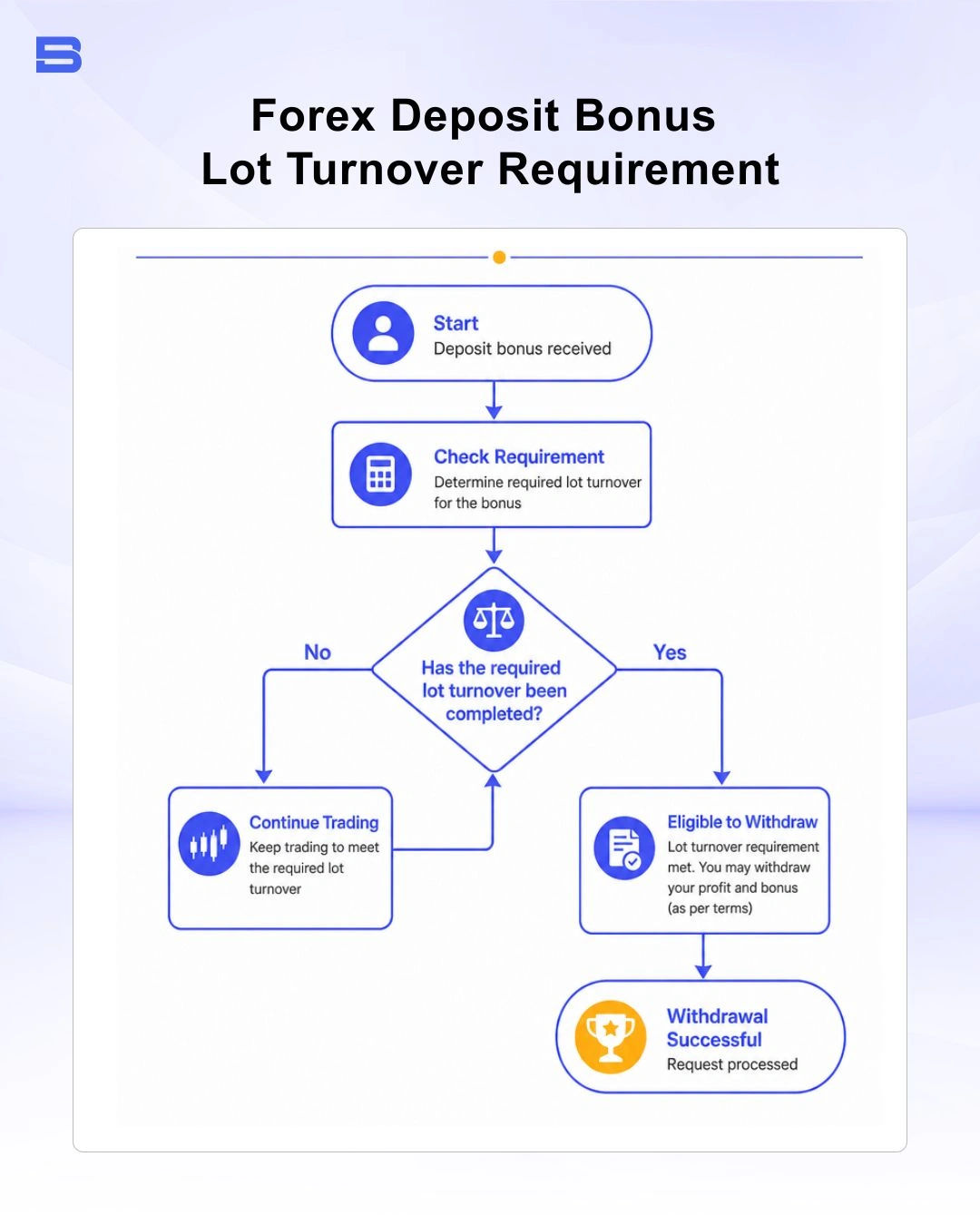
To convert bonus credit into withdrawable cash, brokerages enforce strict trading volume targets. These rules require you to execute a specific number of standard lots within a designated timeframe.
Brokerages typically calculate required turnover using formulas tied directly to the bonus amount:
Required Standard Lots = Bonus Credit Received / 2 or 5
Under a standard formula where every $100 of bonus credit requires 20 standard lots of volume, a $500 credit forces you to trade 100 standard lots. On Euro and US Dollar (EUR/USD), executing 100 standard lots equals $10,000,000 in total transactional turnover.
The Hidden Math: Lot Turnover vs. Equity Wipeout Risk
The volume required to unlock credit introduces structural trading risks that can quickly erode an account balance. Higher trading activity increases transaction costs from spreads and commissions, while exposing capital to sudden market volatility.
Consider a trader who deposits $500 and receives a 100% match ($500 bonus credit), bringing their starting equity to $1,000. To clear the $500 bonus for withdrawal, the terms specify a turnover requirement of 100 standard lots within 60 days.
If the average spread cost on EUR/USD is 1.5 pips ($15 per standard lot), completing the required 100 lots results in $1,500 in friction costs alone. Over-trading to meet this target increases exposure to spread costs and leverage risks, significantly raising the likelihood of a margin stop-out (when the broker automatically closes your positions because your account equity has fallen too low) long before satisfying the turnover quota.
Can You Withdraw a Forex Deposit Bonus?
You cannot withdraw promotional credit immediately after funding your account. Brokerage agreements mandate that you fulfill all lot turnover requirements before any credit conversion occurs.
Furthermore, attempting to withdraw your initial cash deposit before meeting the lot threshold typically results in the immediate cancellation of all active bonus credit. If an open trade relies on that promotional credit to maintain its margin, removing your cash equity can instantly trigger a margin call or position liquidation.
Regional Regulation: Why Top Regulators Ban Deposit Bonuses
Financial oversight bodies worldwide treat promotional trading incentives as high-risk mechanisms that encourage retail over-leveraging and improper risk management. As a result, Tier-1 regulatory authorities maintain strict bans on monetary trading incentives.
A regulatory ban on forex bonuses is active across multiple major jurisdictions:
- Financial Conduct Authority (FCA - UK): Prohibits all retail trading bonuses and promotional credit schemes under strict client protection rules.
- Australian Securities and Investments Commission (ASIC): Restricts non-monetary and monetary incentives to prevent retail traders from taking excessive market risk.
- European Securities and Markets Authority (ESMA / CySEC): Imposes a total ban on retail credit bonuses across EU member states.
- Monetary Authority of Singapore (MAS): Restricts promotional offers designed to stimulate retail margin trading.
Because Tier-1 regulators prohibit these promotions, brokers offering large deposit matches operate primarily under Tier-3 offshore jurisdictions. These offshore entities often provide limited statutory oversight and weaker legal recourse for retail investors.
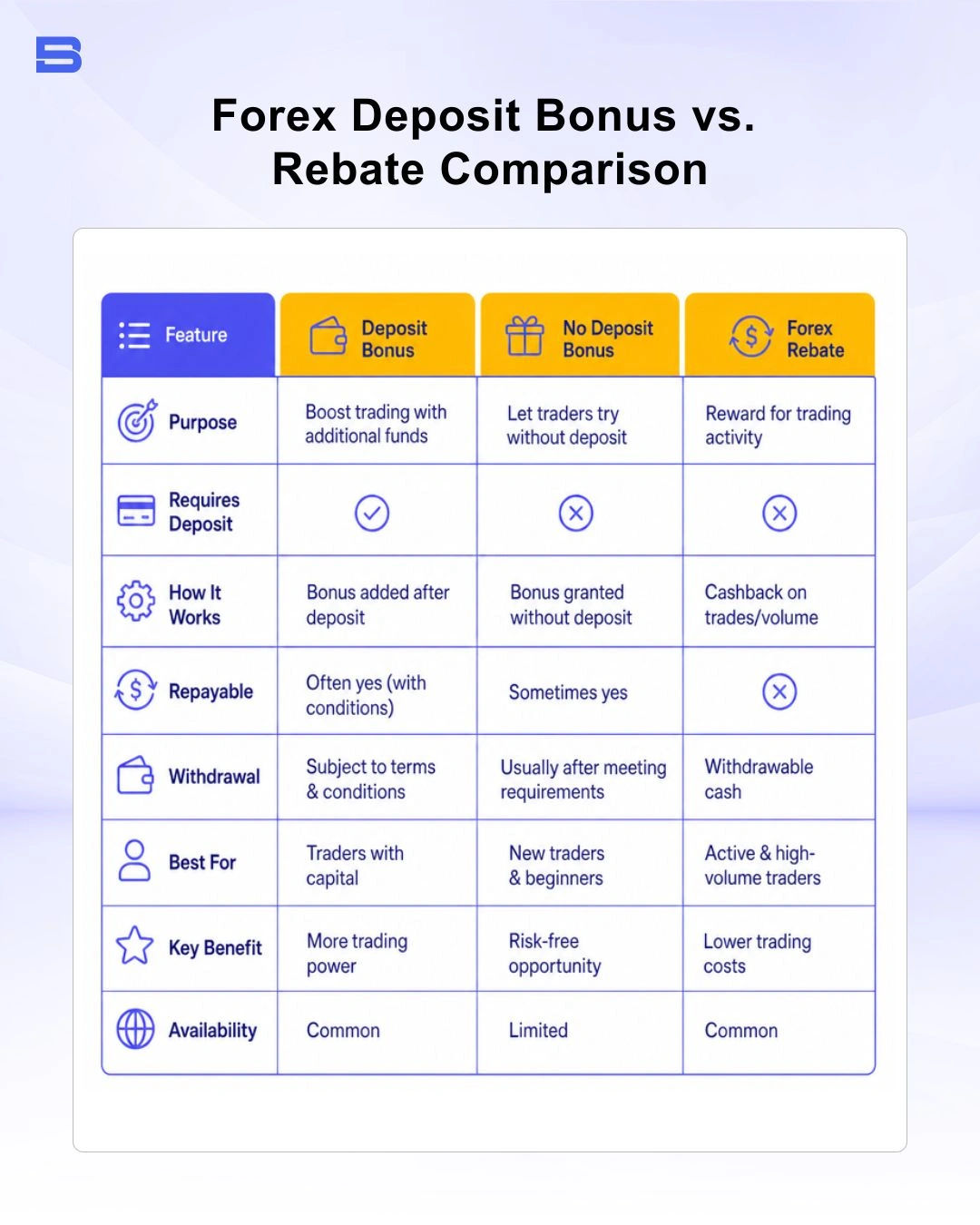
Forex Deposit Bonus vs. No Deposit Bonus
Deposit-based promotions differ substantially from zero-deposit introductory offers in terms of capital commitments, lot volume conditions, and overall risk exposure.
Deposit Bonus vs. Cashback, Forex Rebate, and Credit Schemes
The following comparison illustrates how upfront promotional credit differs from volume-based rebate models:
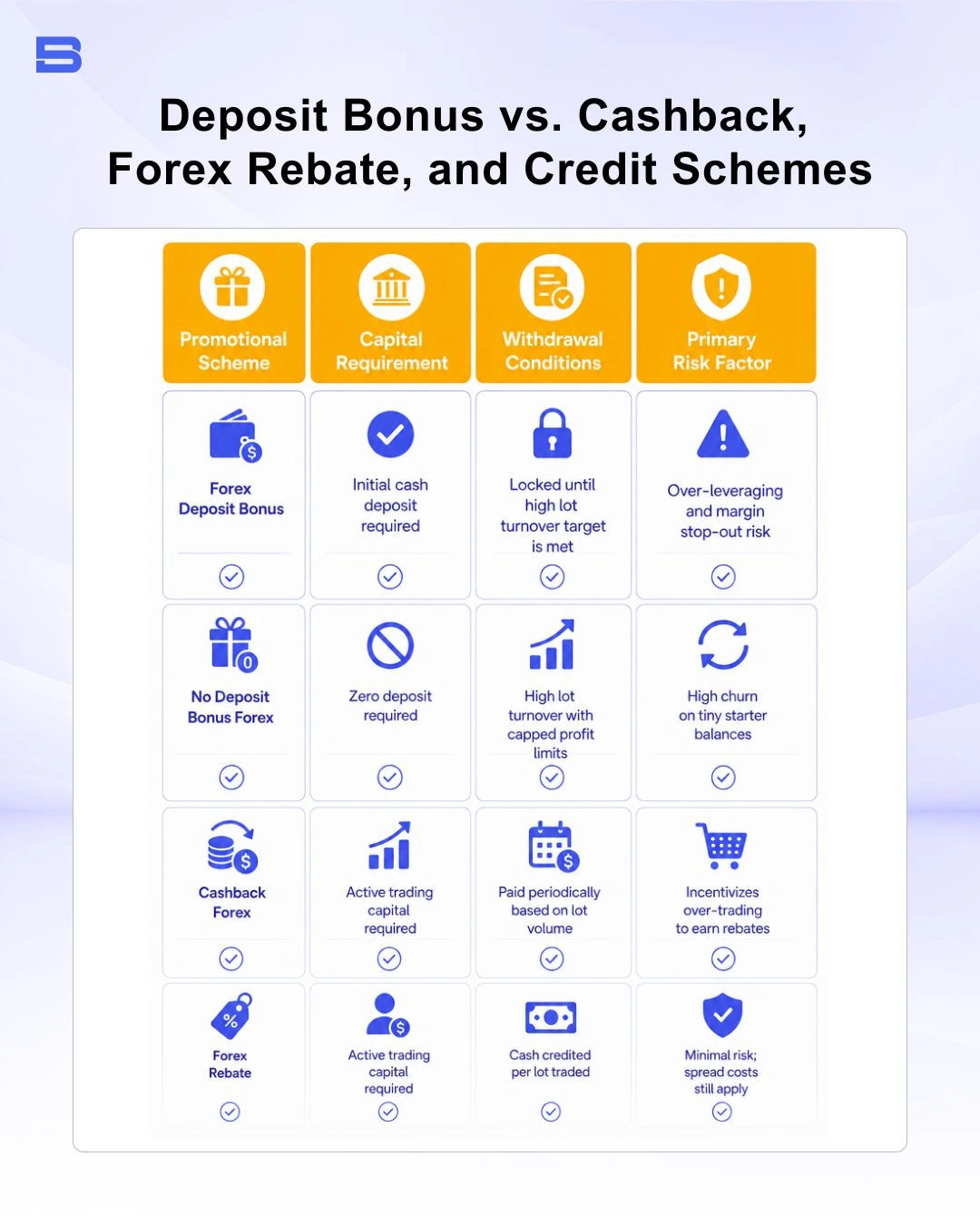
A no-deposit bonus forex promotion grants small, upfront trading credits without requiring an initial deposit. However, these offers carry tight profit caps and strict turnover rules. In contrast, cashback forex and forex rebate models return a portion of your paid spreads after trades are executed, providing direct cash adjustments rather than locked margin credit.
The Bottom Line
A forex deposit bonus can temporarily expand your margin capacity, but it does not represent free capital. The mandatory lot turnover quotas and withdrawal restrictions associated with credit promotions often encourage excessive trading volumes that can undermine your trading plan. Understanding these promotional mechanics, transaction costs, and regulatory constraints ensures you evaluate credit offers objectively while keeping capital preservation as your top priority.
- How to Start Trading: A Step-by-Step Guide for Beginners
- Demo Trading Accounts: Safe Practice for Beginners
- Understanding How Much Capital You Need to Start Trading
- How to Set Realistic Trading Goals as a New Trader
- How to Open a Trading Account in Malaysia (Step-by-Step)
- How to Start Trading in Malaysia: A Guide for Beginners
- How to Create a Trading Plan Before You Start Trading
- What Is a Trading Account? Everything You Need to Know
- How to Learn Trading: Step-by-Step Beginner Roadmap
- What Is Stop Loss in Trading and How Does It Work?
- Why Every Trader Needs a Trading Journal
- Islamic Forex Account Explained: How Swap-Free Trading Works
- Funded Trading Account: Rules, Splits & Risks
- Master Money Management: Practical Capital Protection Rules
- Overtrading Explained: Common Causes, Signs, and How to Stop
- How Risk-Reward Ratio Works: A Guide to Trading Risk
- How to Open a Brokerage Account as a Beginner
- What Is a Cent Account Forex and How Does It Work?
- What Is an ECN Account and How Does It Work?
- What Is Cashback Forex and How Does It Work?
- Fixed Deposit vs Unit Trust: Key Differences for Investors
- Welcome Bonus Forex: What It Is and What to Watch For
- Forex Deposit Bonus: How It Works
- What Is Forex Rebate and How Does It Work?
- What Is Forex Free Credit and How Does It Work?
- Trading Webinars: Are They Worth Attending?
- Trading for Beginners PDF: What to Look For in a Good Guide
- Trading 101: How to Start Trading Safely and Effectively
Disclaimer: The content on this page is intended for educational and informational purposes only. It does not constitute financial, investment, tax, or legal advice, and should not be interpreted as a recommendation to buy, sell, or hold any financial instrument or asset. Trading and investing involve significant risk, including the possible loss of your entire capital. Products such as forex, CFDs, and cryptocurrencies carry additional risks due to leverage, high volatility, and limited regulatory protection in some jurisdictions. Past performance of any financial instrument does not guarantee future results. Any market views, forecasts, or opinions expressed are those of the author at the time of writing and may not reflect current market conditions. Platform features, fees, and regulatory status are subject to change — always verify information directly with the relevant provider or regulator before making any financial decision. BrokerSpecs may receive compensation from third parties featured on this site. Always conduct your own due diligence and consider seeking advice from a licensed financial professional before investing.