


- How to Start Trading: A Step-by-Step Guide for Beginners
- Demo Trading Accounts: Safe Practice for Beginners
- Understanding How Much Capital You Need to Start Trading
- How to Set Realistic Trading Goals as a New Trader
- How to Open a Trading Account in Malaysia (Step-by-Step)
- How to Start Trading in Malaysia: A Guide for Beginners
- How to Create a Trading Plan Before You Start Trading
- What Is a Trading Account? Everything You Need to Know
- How to Learn Trading: Step-by-Step Beginner Roadmap
- What Is Stop Loss in Trading and How Does It Work?
- Why Every Trader Needs a Trading Journal
- Islamic Forex Account Explained: How Swap-Free Trading Works
- Funded Trading Account: Rules, Splits & Risks
- Master Money Management: Practical Capital Protection Rules
- Overtrading Explained: Common Causes, Signs, and How to Stop
- How Risk-Reward Ratio Works: A Guide to Trading Risk
- How to Open a Brokerage Account as a Beginner
- What Is a Cent Account Forex and How Does It Work?
- What Is an ECN Account and How Does It Work?
- What Is Cashback Forex and How Does It Work?
- Fixed Deposit vs Unit Trust: Key Differences for Investors
- Welcome Bonus Forex: What It Is and What to Watch For
- Forex Deposit Bonus: How It Works
- What Is Forex Rebate and How Does It Work?
- What Is Forex Free Credit and How Does It Work?
- Trading Webinars: Are They Worth Attending?
- Trading for Beginners PDF: What to Look For in a Good Guide
- Trading 101: How to Start Trading Safely and Effectively

Entering the financial markets for the first time can feel overwhelming when faced with technical jargon, account setups, and platform choices. Before you can execute your first trade, it helps to know exactly what is a trading account and how it fits into the broader brokerage relationship.
What Is a Trading Account and How Does It Work?
A trading account is a specialized financial account provided by a brokerage that allows you to buy, sell, hold, and manage financial assets such as stocks, currencies, commodities, and derivatives.
When you open a trading account, it functions as an execution engine. You deposit funds into the account, place orders via the broker’s trading software, and the broker routes those orders to the relevant exchange or market maker.
The Core Mechanics of a Trade
The trade lifecycle follows four core steps:
- Capital Deposit: You transfer funds from your personal bank account into your broker's segregated client account.
- Order Placement: You submit a buy or sell instruction (such as a market or limit order) through your trading terminal.
- Execution & Routing: The broker executes the trade in the market at the best available price.
- Settlement: Cash is debited or credited, and the transaction is recorded in your account ledger.
Scenario: Imagine depositing $1,000 into your trading account to purchase $250 worth of shares in a public company. Your cash balance drops to $750, while your portfolio ledger immediately reflects ownership of the newly acquired shares, minus any applicable brokerage commission.
Trading Account vs. Brokerage Account: What’s the Difference?
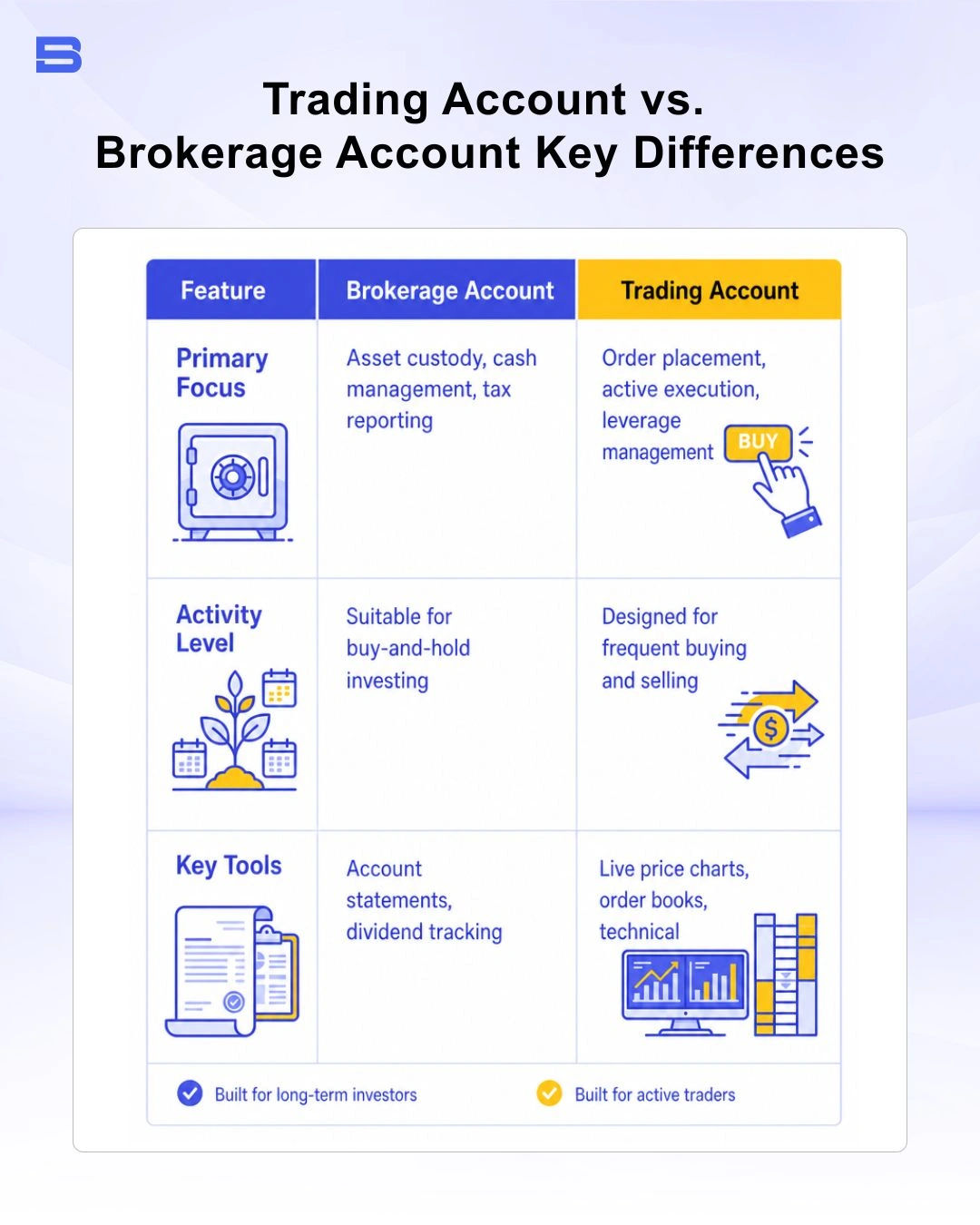
While many investors use the terms interchangeably, a subtle functional distinction exists between a brokerage account and a trading account.
- Trading Account: The active execution portal or sub-account used specifically to send orders to the market.
- Brokerage Account: The overarching umbrella account maintained with a financial firm. It holds your cash, manages tax reporting, and stores your long-term assets.
Trading Account vs. CDS or Demat Account: What is the Difference?
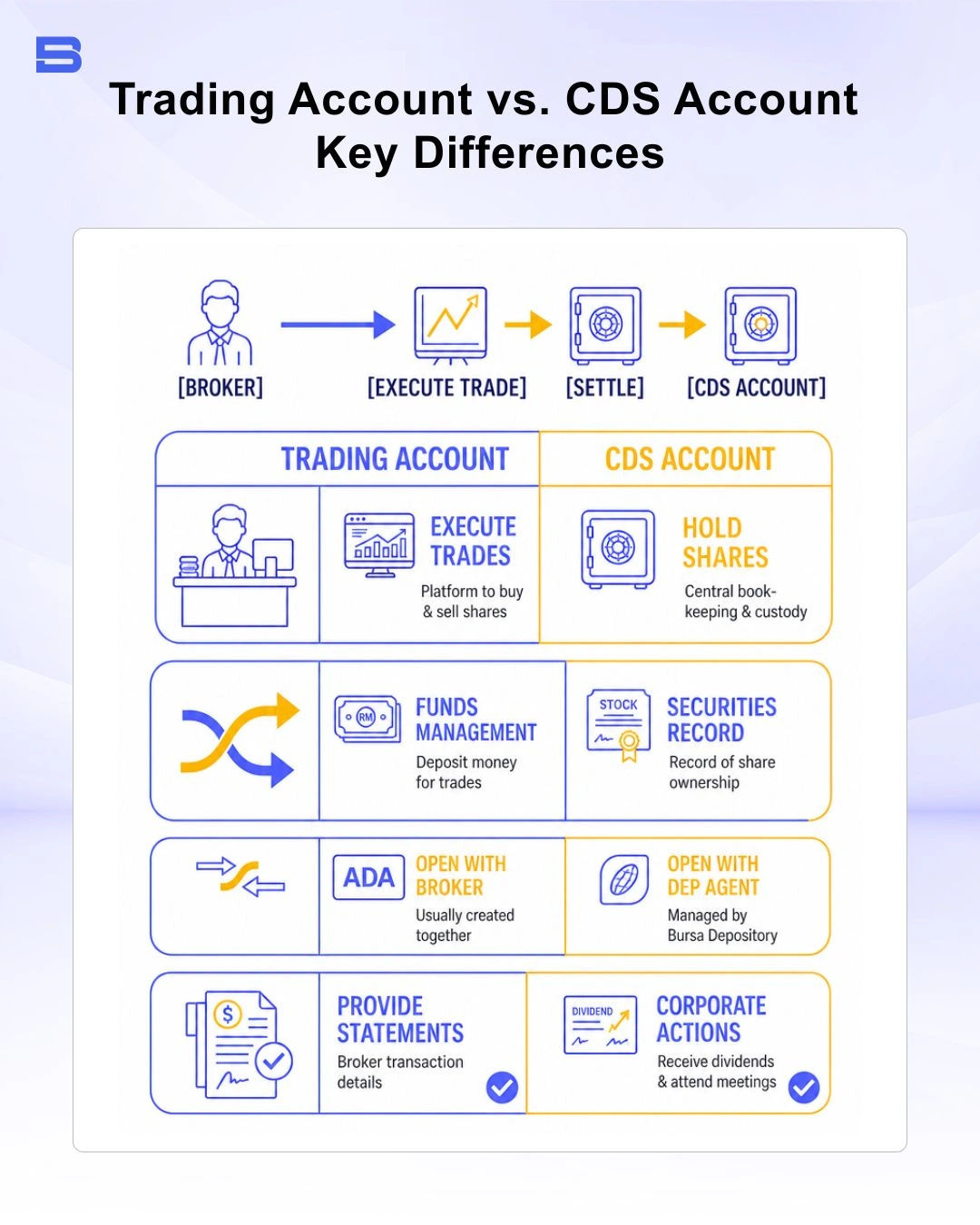
If you trade physical equities in markets like Malaysia or India, you will encounter custodial systems such as Central Depository System (CDS) accounts or Demat accounts. It is critical to understand that a trading account executes transactions, whereas a custody account holds ownership of the assets.
For instance, when buying shares on Bursa Malaysia, your trading account executes the order, but your CDS account in Malaysia acts as the official electronic vault holding title to those shares.
Trading Account Types Explained
Different financial markets and strategies require specific account structures.
Cash vs. Margin Accounts
- Cash Account: You can only trade using the exact amount of settled cash available in your account. If you deposit $500, your maximum purchasing power is $500.
- Margin Account: Allows you to borrow funds from your broker using your existing capital as collateral. While what is margin trading can amplify potential returns, it also accelerates potential losses if the market moves against your position.
Standard, ECN, Cent & Micro Accounts
For retail forex and CFD traders, execution models dictate cost structures:
- Standard Account: Typically offers zero commissions with wider spreads built into the asset price.
- ECN account: Connects traders directly to interbank liquidity providers, offering ultra-raw spreads in exchange for a fixed commission per lot traded.
- Cent account forex: Denominates balances in cents rather than dollars (e.g., $10 appears as 1,000 cents), allowing beginners to practice real-market trading with minimal dollar risk.
Islamic (Swap-Free) Accounts
Designed to align with Shariah principles, an Islamic forex account eliminates overnight interest (swap rates). Instead of earning or paying interest on positions held overnight, accounts may incur a fixed administrative fee.
Demo vs. Live Accounts & Proprietary/Funded Accounts
- Demo Account: A risk-free virtual environment funded with simulated capital, allowing beginners to test platforms and strategies without risking money.
- Live Account: Real-money trading where profits and losses affect actual capital.
- Funded trading account: Provided by proprietary trading firms, where qualified traders manage the firm's capital after passing an evaluation process.
Key Trading Account Fees to Watch For
Now that you know what a trading account is, it's worth understanding the fees attached to it. To protect your profit margins, monitor these common operational costs charged by brokers:
- Spreads: The gap between the buying (ask) and selling (bid) price.
- Commissions: A flat or percentage-based fee charged per trade execution.
- Overnight Swaps: Interest charged or paid for holding leveraged positions past the daily market close.
- Inactivity Fees: Monthly charges applied if no trades are placed over a defined period (e.g., 6–12 months).
- Deposit/Withdrawal Fees: Conversion or handling charges applied when moving funds into or out of your trading account.
How to Open a Trading Account: Step-by-Step
Setting up an account can usually be completed online in a few steps:
- Select a Regulated Broker: Verify that the broker holds a valid license from an established regulatory authority.
- Complete Verification (KYC): Submit identification documents, such as a national ID or passport, alongside proof of address (e.g., a utility bill or bank statement).
- Fund Your Account: Transfer capital using bank wire, credit card, or local payment gateways. Minimum deposit requirements vary widely, ranging from $0 to $500 depending on the broker.
If you are based in Malaysia, you can follow our dedicated guide on how to open a trading account in Malaysia for region-specific registration steps.
Is a Trading Account Safe? Key Risks and Safety Checks
The safety of your funds depends heavily on your broker's regulatory framework and your personal risk management.
Regulatory Protection vs. Offshore Brokers
Tier-1 authorities—such as the Securities Commission Malaysia (SC) or the U.S. Securities and Exchange Commission (SEC)—enforce strict rules, including segregated client accounts (keeping customer funds separate from broker operational funds) and compensation schemes. Unregulated offshore entities often lack these safeguards.
Key Operational and Market Risks
- Leverage Amplification: Operating on high leverage increases exposure, meaning small market swings can lead to rapid capital depletion.
- Platform Outages & Slippage: Technical failures or sudden volatility spikes can cause orders to execute at prices different from your requested entry point.
Final Thoughts
Both accounts play essential roles in the financial market ecosystem, yet they serve entirely distinct operational purposes. A Brokerage Account acts as the secure vault for your assets, focusing primarily on long-term custody, cash management, dividend tracking, and tax reporting—making it the ideal choice for traditional buy-and-hold investors.
In contrast, a Trading Account functions as the active execution engine, built for placing orders, managing leverage, and navigating real-time price charts and order books, which caters directly to frequent traders. Ultimately, while a brokerage account safeguards and tracks your overall holdings, a trading account provides the speed, tools, and access necessary to actively buy and sell securities in the open market.
Disclaimer: The content on this page is intended for educational and informational purposes only. It does not constitute financial, investment, tax, or legal advice, and should not be interpreted as a recommendation to buy, sell, or hold any financial instrument or asset. Trading and investing involve significant risk, including the possible loss of your entire capital. Products such as forex, CFDs, and cryptocurrencies carry additional risks due to leverage, high volatility, and limited regulatory protection in some jurisdictions. Past performance of any financial instrument does not guarantee future results. Any market views, forecasts, or opinions expressed are those of the author at the time of writing and may not reflect current market conditions. Platform features, fees, and regulatory status are subject to change — always verify information directly with the relevant provider or regulator before making any financial decision. BrokerSpecs may receive compensation from third parties featured on this site. Always conduct your own due diligence and consider seeking advice from a licensed financial professional before investing.