


- How to Start Trading: A Step-by-Step Guide for Beginners
- Demo Trading Accounts: Safe Practice for Beginners
- Understanding How Much Capital You Need to Start Trading
- How to Set Realistic Trading Goals as a New Trader
- How to Open a Trading Account in Malaysia (Step-by-Step)
- How to Start Trading in Malaysia: A Guide for Beginners
- How to Create a Trading Plan Before You Start Trading
- What Is a Trading Account? Everything You Need to Know
- How to Learn Trading: Step-by-Step Beginner Roadmap
- What Is Stop Loss in Trading and How Does It Work?
- Why Every Trader Needs a Trading Journal
- Islamic Forex Account Explained: How Swap-Free Trading Works
- Funded Trading Account: Rules, Splits & Risks
- Master Money Management: Practical Capital Protection Rules
- Overtrading Explained: Common Causes, Signs, and How to Stop
- How Risk-Reward Ratio Works: A Guide to Trading Risk
- How to Open a Brokerage Account as a Beginner
- What Is a Cent Account Forex and How Does It Work?
- What Is an ECN Account and How Does It Work?
- What Is Cashback Forex and How Does It Work?
- Fixed Deposit vs Unit Trust: Key Differences for Investors
- Welcome Bonus Forex: What It Is and What to Watch For
- Forex Deposit Bonus: How It Works
- What Is Forex Rebate and How Does It Work?
- What Is Forex Free Credit and How Does It Work?
- Trading Webinars: Are They Worth Attending?
- Trading for Beginners PDF: What to Look For in a Good Guide
- Trading 101: How to Start Trading Safely and Effectively

Entering a trade for the first time can be thrilling, but watching market volatility drag your account balance into negative territory quickly brings a stark reality to light: entering orders without an exit plan is a direct route to capital loss. Long-term profitability in the financial markets rarely depends on predicting price direction with perfect accuracy. Instead, it hinges on your ability to control capital downside when you are wrong and maximize upside when you are right.
This is where the risk-reward ratio becomes one of the most important risk management tools in your trading arsenal. By defining your acceptable loss relative to your target profit before executing an order, you take control of your portfolio rather than letting market noise dictate your results.
What Is the Risk-Reward Ratio in Trading?
At its core, the risk-reward ratio compares the potential financial loss you accept on a trade against the potential financial gain you aim to achieve. It quantifies the price distance between your entry point and your protective exit point relative to the distance to your target exit point.
Risk-Reward Ratio = Potential Loss / Potential Profit
Traders write and discuss this relationship using two common mathematical conventions, which frequently confuse beginners:
- Risk-to-Reward Ratio (Risk: Reward): Expressed as a fraction or colon format where risk is the numerator. For instance, a 1:2 ratio means you risk $1 to potentially make $2. Represented as a single decimal number, a 1:2 risk-to-reward ratio equals 0.5.
- Reward-to-Risk Ratio (Reward: Risk): Expressed as potential profit relative to risk. That same trade reversed in notation reads as a 2:1 reward-to-risk ratio (or 2.0).
Both formats describe the same trade geometry. Throughout this guide, we use the standard industry notation of Risk: Reward (1:X), where the first number represents your unit of risk, and the second represents your potential payout.
How to Calculate the Risk-Reward Ratio (Formula & Examples)
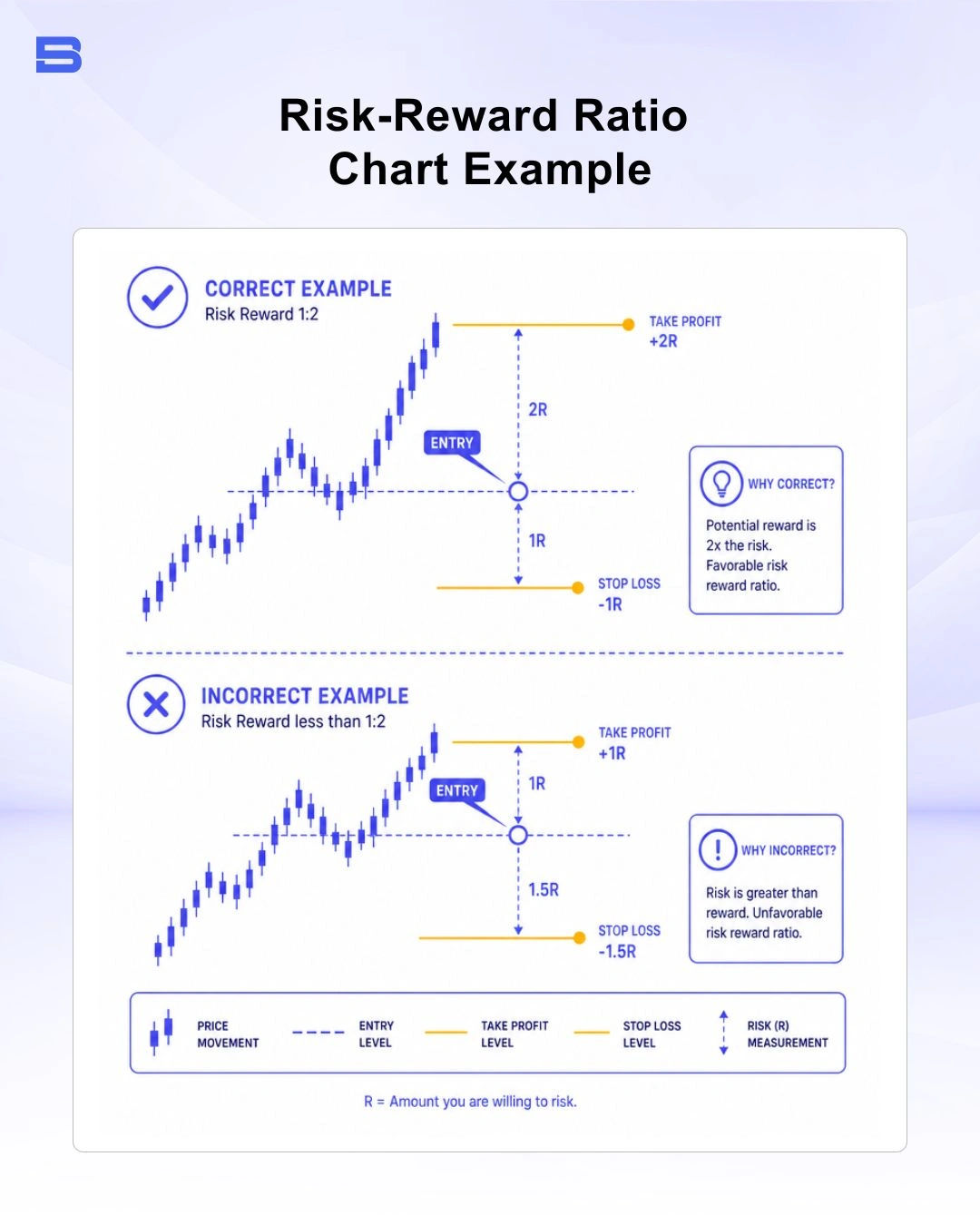
Calculating your ratio requires identifying three precise price levels before opening a trade: your entry price, your stop-loss price, and your take-profit price.
The fundamental calculation formula is:
Risk-to-Reward Ratio = (Entry Price - Stop-Loss) / (Take-Profit Price - Entry Price)
Let's look at how this works in a real-world stock trading scenario.
Stock Trading Worked Example
Suppose you analyze a US stock trading at $100.00. You decide to buy 100 shares, bringing your total position size to $10,000.
- Entry Price: $100.00
- Stop-Loss Level: $95.00 (Risk = $5.00 per share, or $500 total)
- Take-Profit Level: $110.00 (Reward = $10.00 per share, or $1,000 total)
Applying the formula:
Risk-to-Reward Ratio = ($100.00 - $95.00) / ($110.00 - $100.00) = ($5.00) / ($ 10.00) = ½ or 1:2
In this setup, your potential payout is double your total dollar risk.
Using Stop-Loss and Take-Profit Orders to Set Your Ratio
A theoretical risk-reward ratio remains useless if you do not enforce it using automated broker execution. Setting a physical stop loss order and take-profit target at the exact moment you enter a position removes emotional hesitation during live market execution.
However, real-world execution costs skew theoretical ratios. In fast-moving markets or leveraged forex trading, two major friction points degrade your actual risk-reward math:
- Bid-Ask Spreads & Commissions: If a currency pair has a two-pip spread, buying means you immediately start two pips in negative territory. A trade targeting 20 pips of profit with a 10-pip stop loss actually requires a 22-pip price move to reach your profit target while giving you only an eight-pip buffer before hitting your stop.
- Slippage: During high-volatility events, high-frequency price moves can cause your stop-loss order to fill at a price worse than specified. If market gaps skip your $95.00 stop-loss and execute at $93.00, your planned $500 risk instantly expands to $700, ruining your pre-calculated ratio.
What Is a Good Risk-Reward Ratio?
A common myth propagated in online trading communities is that every trade must strictly adhere to a 1:2 or 1:3 ratio to be profitable. In practice, there is no single "ideal" ratio that guarantees success for all trading styles.
What constitutes a "good" ratio depends entirely on your specific trading strategy, market conditions, and overall probability of success.
Understanding 1:1, 1:2, and 1:3 Ratios
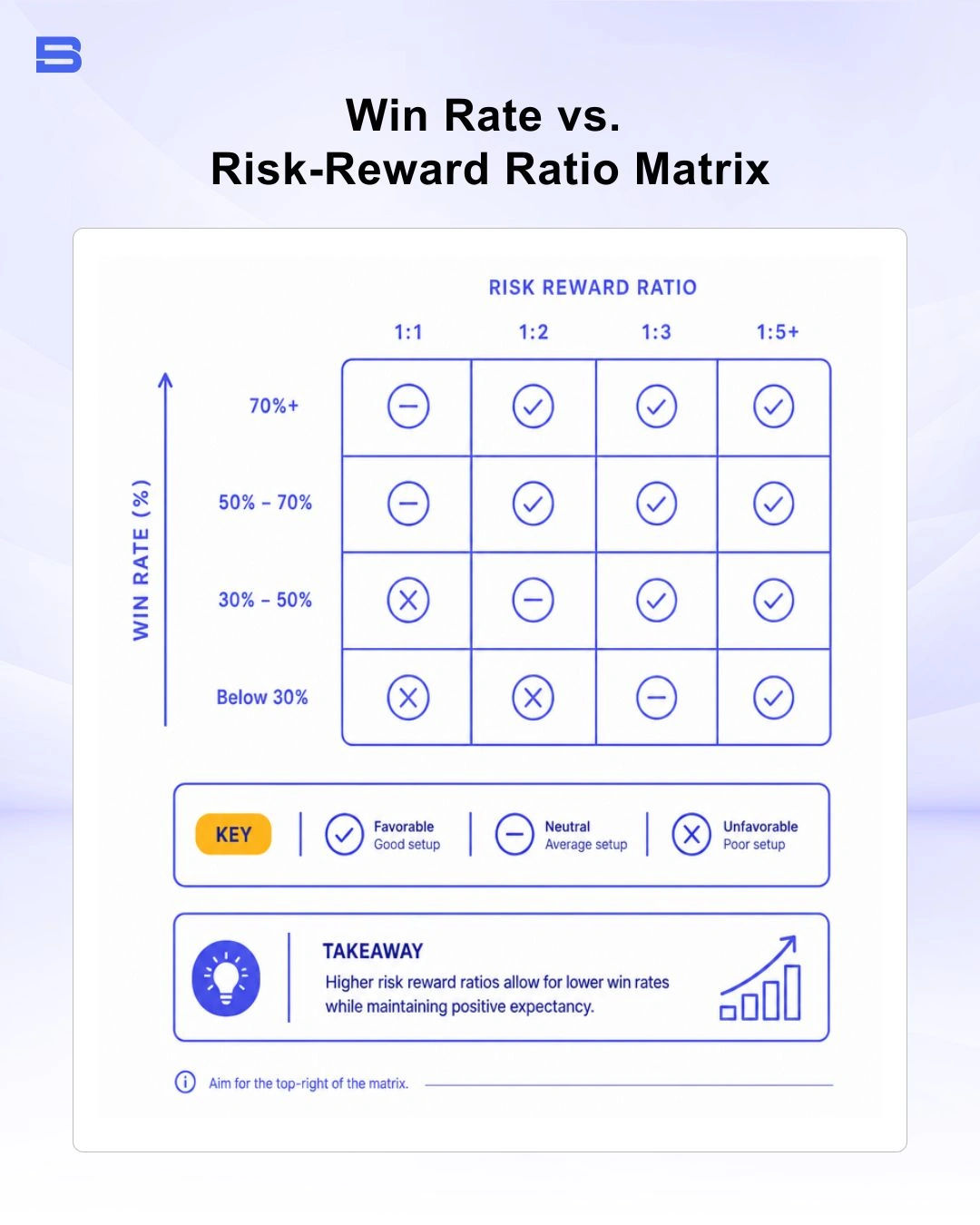
- 1:1 Ratio: Requires a win rate higher than 50% to achieve profitability after accounting for transaction commissions. While easier to hit target prices, a single streak of bad luck can destroy accumulated gains.
- 1:2 Ratio: Widely considered the baseline entry benchmark for retail traders. It provides a comfortable safety net, allowing you to lose more trades than you win while keeping your trading equity intact.
- 1:3 Ratio: Offers substantial upside potential. With a 1:3 ratio, you can be wrong seven out of ten times and still end up in profit. However, profit targets placed three units away are hit less frequently, which requires greater emotional patience to handle frequent small losses.
Risk-Reward Ratio vs. Win Rate: Finding the Right Balance
A common beginner mistake is viewing the risk-reward ratio in absolute isolation. A high ratio is entirely meaningless if your strategy achieves a target price only 5% of the time. Conversely, a 90% win rate can still wipe out an account if your average loss is 20 times larger than your average gain.
Your long-term performance is determined by the mathematical interplay between your Risk-Reward Ratio and your Win Rate.
The Trading Expectancy Equation
To verify whether your system yields a statistical edge over time, professionals calculate their Trading Expectancy as described by CFA Institute's investment management curriculum. Expectancy measures the average dollar amount you expect to win (or lose) per dollar risked across a series of trades.
E = Win Rate x Average Reward - (Loss Rate x Average Risk)
Expectancy Scenario 1: High Ratio, Low Win Rate
- Win Rate: 35% (Loss Rate = 65%)
- Average Payout: $300 (Risk = $100, Ratio = 1:3)
- Calculation: E = (0.35 x $300) - (0.65 x $100) = $105 - $65 = +$40
- Result: Positive expectancy. You earn an average of $40 per trade, despite losing 65% of the time.
Expectancy Scenario 2: Low Ratio, High Win Rate
- Win Rate: 70% (Loss Rate = 30%)
- Average Payout: $50 (Risk = $100, Ratio = 1:0.5)
- Calculation: $E = (0.70 x $50) - (0.30 x $100) = $35 - $30 = +$5
- Result: Positive expectancy, but generating only $5 per trade while carrying significant risk if market volatility abruptly drops your win rate.
How Risk-Reward Ratio Fits into Money Management
Establishing a target ratio is only the first half of protecting your trading portfolio; integrating this framework into strict money management principles completes the picture.
A fixed 1:2 ratio will not protect your account if you risk 30% of your total balance on a single setup. A sequence of three consecutive losses would erase nearly 66% of your total starting equity, requiring a 200% gain just to break even.
Connecting Risk-Reward Ratio to Position Sizing
Professional risk management ties your stop-loss distance directly to a fixed account risk model—typically risking no more than 1% to 2% of total account capital on any single trade.
If you have a $10,000 trading account and follow a strict 1% risk rule, your maximum allowed loss per trade is $100.
- Wide Stop-Loss Scenario (Volatile Market): If market volatility requires a $10 stop-loss distance on a stock, your position size is capped at 10 shares ($100 max risk / $10 stop distance). Your 1:2 take-profit level must target a $20 gain ($200 profit).
- Tight Stop-Loss Scenario (Calm Market): If technical support allows a tight $2 stop-loss distance, your position size expands to 50 shares ($100 max risk / $2 stop distance). Your 1:2 take-profit level requires only a $4 gain to deliver that same 200 dollar profit.
By adjusting your position size relative to price volatility, your dollar risk stays identical regardless of how close or far your stop loss sits from your entry.
Incorporating Risk-Reward Ratio into Your Trading Plan
To embed risk-reward discipline into your daily trading workflow, apply this checklist before placing any market order:
- Map Technical Structure First: Identify key support, resistance, or market structure levels on your chart before calculating potential returns. Never place a stop loss at an arbitrary dollar figure just to force a pretty $1:3$ ratio on paper.
- Measure Distance: Note the pip or dollar distance from entry to stop loss (Risk) and entry to take profit (Reward).
- Evaluate Trade Validity: If the structural setup offers less than your trading plan's required minimum baseline ratio (e.g., lower than 1:1.5), decline the setup.
- Calculate Position Size: Divide your maximum fixed dollar risk (e.g., 1% of equity) by your stop-loss distance to determine exact lot or share sizing.
- Set Automated Execution: Submit your entry order alongside simultaneous, active stop-loss and take-profit orders with your broker.
Conclusion
Mastering the risk-reward ratio transforms trading from a speculative guessing game into a structured probability business. By defining your potential loss before order execution, ensuring your potential gains outweigh your downside, and pairing your targets with strict position sizing, you build a sustainable path toward portfolio survival and long-term trading growth.
Disclaimer: The content on this page is intended for educational and informational purposes only. It does not constitute financial, investment, tax, or legal advice, and should not be interpreted as a recommendation to buy, sell, or hold any financial instrument or asset. Trading and investing involve significant risk, including the possible loss of your entire capital. Products such as forex, CFDs, and cryptocurrencies carry additional risks due to leverage, high volatility, and limited regulatory protection in some jurisdictions. Past performance of any financial instrument does not guarantee future results. Any market views, forecasts, or opinions expressed are those of the author at the time of writing and may not reflect current market conditions. Platform features, fees, and regulatory status are subject to change — always verify information directly with the relevant provider or regulator before making any financial decision. BrokerSpecs may receive compensation from third parties featured on this site. Always conduct your own due diligence and consider seeking advice from a licensed financial professional before investing.