


- How to Start Trading: A Step-by-Step Guide for Beginners
- Demo Trading Accounts: Safe Practice for Beginners
- Understanding How Much Capital You Need to Start Trading
- How to Set Realistic Trading Goals as a New Trader
- How to Open a Trading Account in Malaysia (Step-by-Step)
- How to Start Trading in Malaysia: A Guide for Beginners
- How to Create a Trading Plan Before You Start Trading
- What Is a Trading Account? Everything You Need to Know
- How to Learn Trading: Step-by-Step Beginner Roadmap
- What Is Stop Loss in Trading and How Does It Work?
- Why Every Trader Needs a Trading Journal
- Islamic Forex Account Explained: How Swap-Free Trading Works
- Funded Trading Account: Rules, Splits & Risks
- Master Money Management: Practical Capital Protection Rules
- Overtrading Explained: Common Causes, Signs, and How to Stop
- How Risk-Reward Ratio Works: A Guide to Trading Risk
- How to Open a Brokerage Account as a Beginner
- What Is a Cent Account Forex and How Does It Work?
- What Is an ECN Account and How Does It Work?
- What Is Cashback Forex and How Does It Work?
- Fixed Deposit vs Unit Trust: Key Differences for Investors
- Welcome Bonus Forex: What It Is and What to Watch For
- Forex Deposit Bonus: How It Works
- What Is Forex Rebate and How Does It Work?
- What Is Forex Free Credit and How Does It Work?
- Trading Webinars: Are They Worth Attending?
- Trading for Beginners PDF: What to Look For in a Good Guide
- Trading 101: How to Start Trading Safely and Effectively

Imagine executing five consecutive winning trades, watching your trading account balance expand, and feeling entirely in control of the market. On the sixth trade, a sudden news release causes the price to spike against your position, wiping out every single bit of those accumulated profits along with half of your initial capital.
This scenario happens to thousands of market participants every day. Exceptional chart analysis and perfect entry timing are meaningless if you do not have a structured approach to managing your capital when price turns against you.
What Is Money Management in Trading?
Money management in trading is the system of practical rules that governs how much capital you allocate, risk, and preserve on every individual trade to ensure long-term account survival.
While market analysis focuses on predicting where price might go, money management focuses strictly on capital preservation. The primary goal is keeping you solvent long enough to let a mathematical trading edge play out over dozens or hundreds of executed orders.
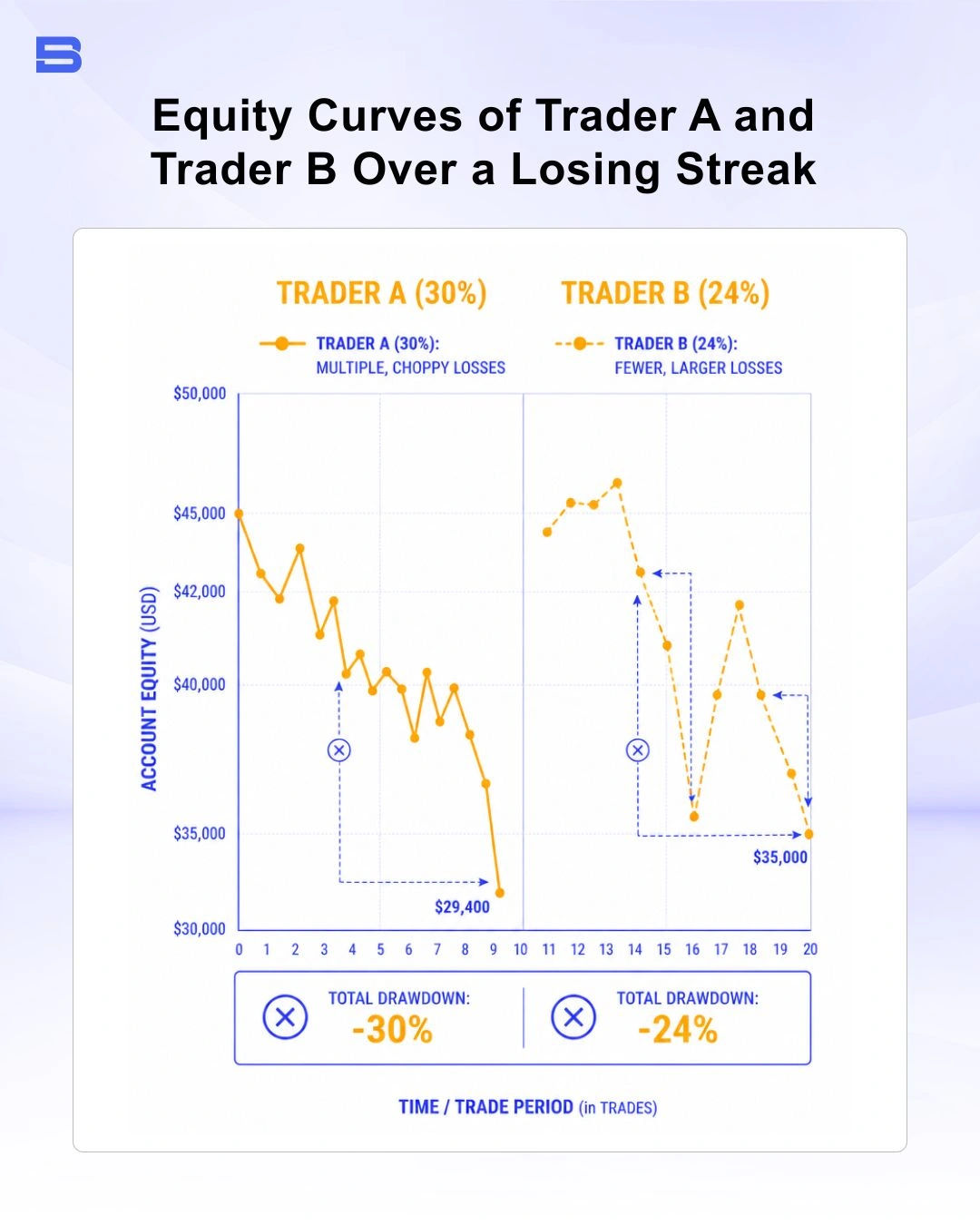
Consider two traders, Trader A and Trader B, who both use an identical strategy with a 50% win rate and a 1:2 risk-reward ratio over ten trades. Trader A risks an arbitrary 15% of total capital on every setup. Trader B strictly limits risk to 2% per trade.
When a standard four-trade losing streak hits, Trader A loses nearly 30% of their account equity, inducing panic and forced liquidation. Trader B experiences a manageable cumulative drawdown of under 24%, keeping their trading account fully intact to capture the subsequent winning trades.
The Mathematical Reality of Drawdown
When an account suffers a loss, the percentage gain required just to break even grows exponentially. Most market participants assume that a 20% loss requires a 20% gain to recover, but the mathematical reality is far harsher on diminished equity.
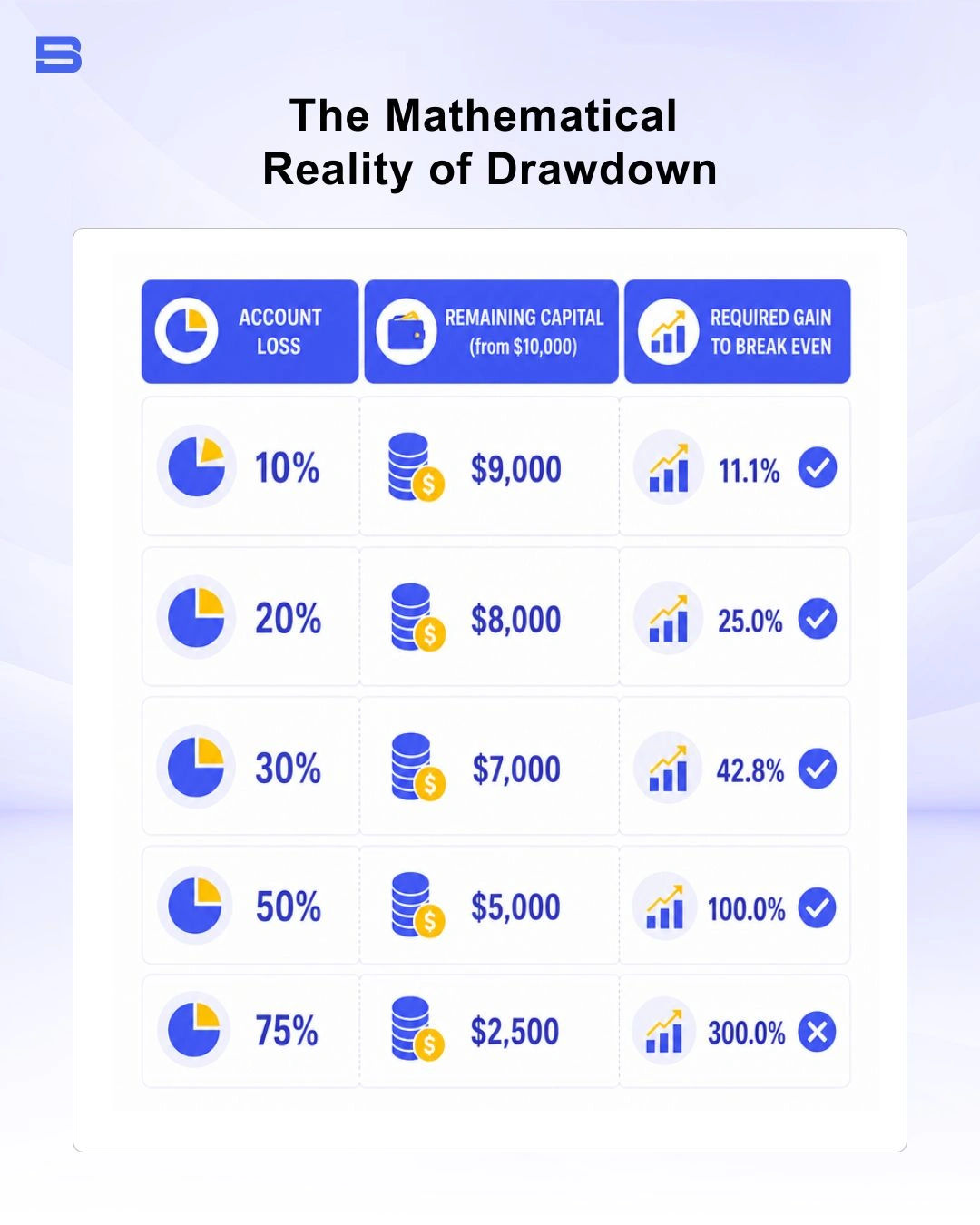
A 50% drawdown requires your remaining capital to double just to return to the starting line. By enforcing strict exposure limits, you avoid entering the exponential curve where recovery becomes mathematically improbable.
Money Management vs Risk Management: What Is the Difference?
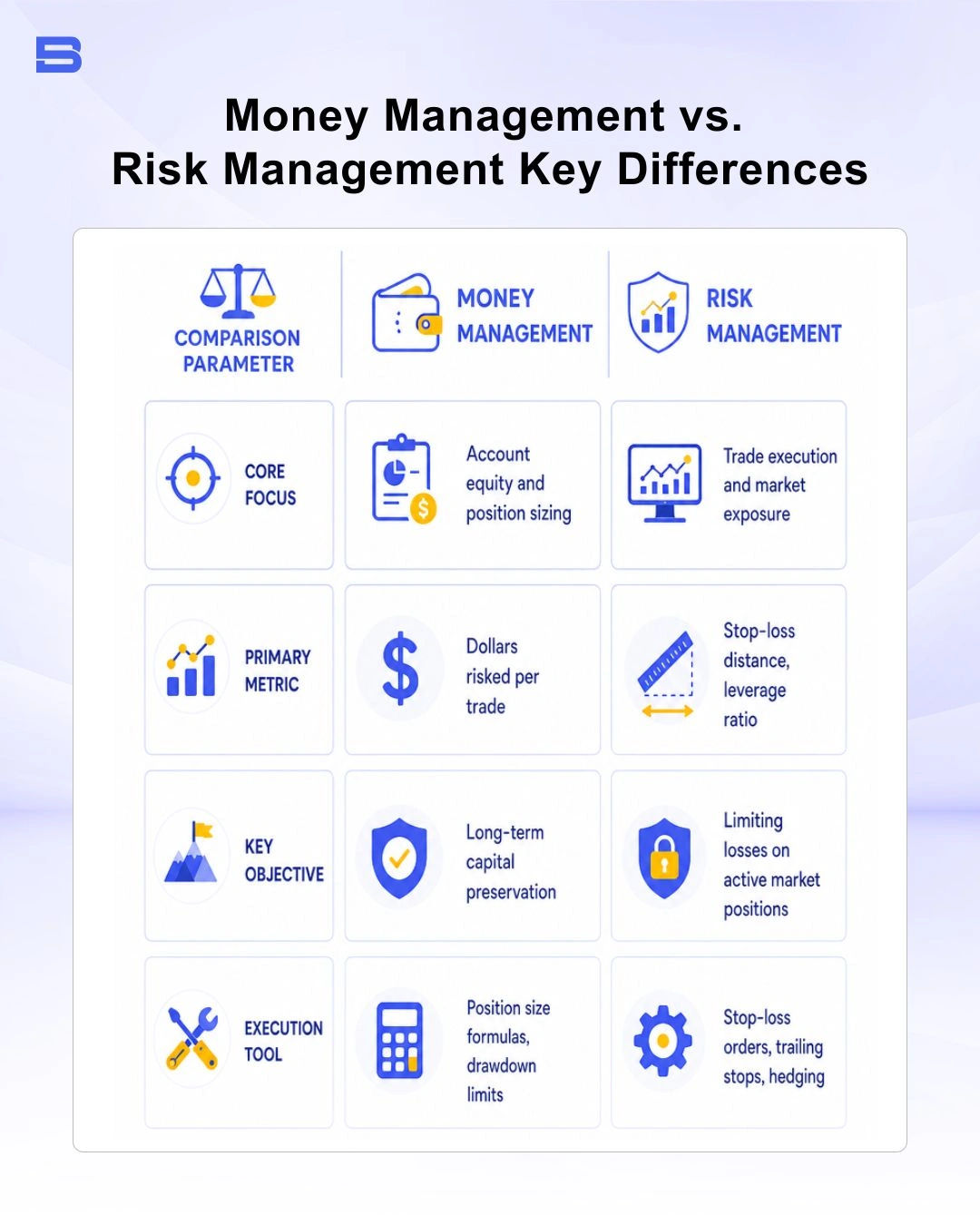
Although traders often use these terms interchangeably, money management and what is risk management represent distinct components of capital protection.
Money management addresses portfolio-level capital allocation and position sizing. Risk management focuses on trade-level controls, market exposure, and trade execution mechanics.
Integrating both disciplines creates a complete defensive system. Money management tells you how many units or lots to buy, while risk management determines where to exit if the trade idea fails.
Assessing Risk Tolerance for Realistic Position Sizing
Determining your personal risk tolerance is the foundational step before opening any live position. True risk tolerance is not based on how much profit you hope to gain, but on how much loss you can comfortably absorb without making emotional errors.
A practical method to evaluate risk tolerance is testing your reaction to potential drawdown scenarios. If losing $500 on a single position causes stress or urges you to constantly check your phone, your position size is far too large for your capital base.
The 1% and 2% Capital Preservation Rules
Professional capital allocation frequently relies on the 1% or 2% rule. Under this guideline, you never risk more than 1% or 2% of your total account balance on any single market position.
If your trading account holds $10,000, risking 1% means your maximum allowable loss on a trade is $100. Should a trade hit your protective exit, your account balance decreases to $9,900, leaving you fully capable of placing future trades without psychological distress.
Adhering to these conservative thresholds ensures that even an extended series of ten consecutive losses results in a total drawdown of less than 10% to 18% of your overall equity.
Position Sizing Formulas for Capital Protection
Calculating correct position sizing prevents you from picking arbitrary lot sizes that expose your balance to sudden market shocks.
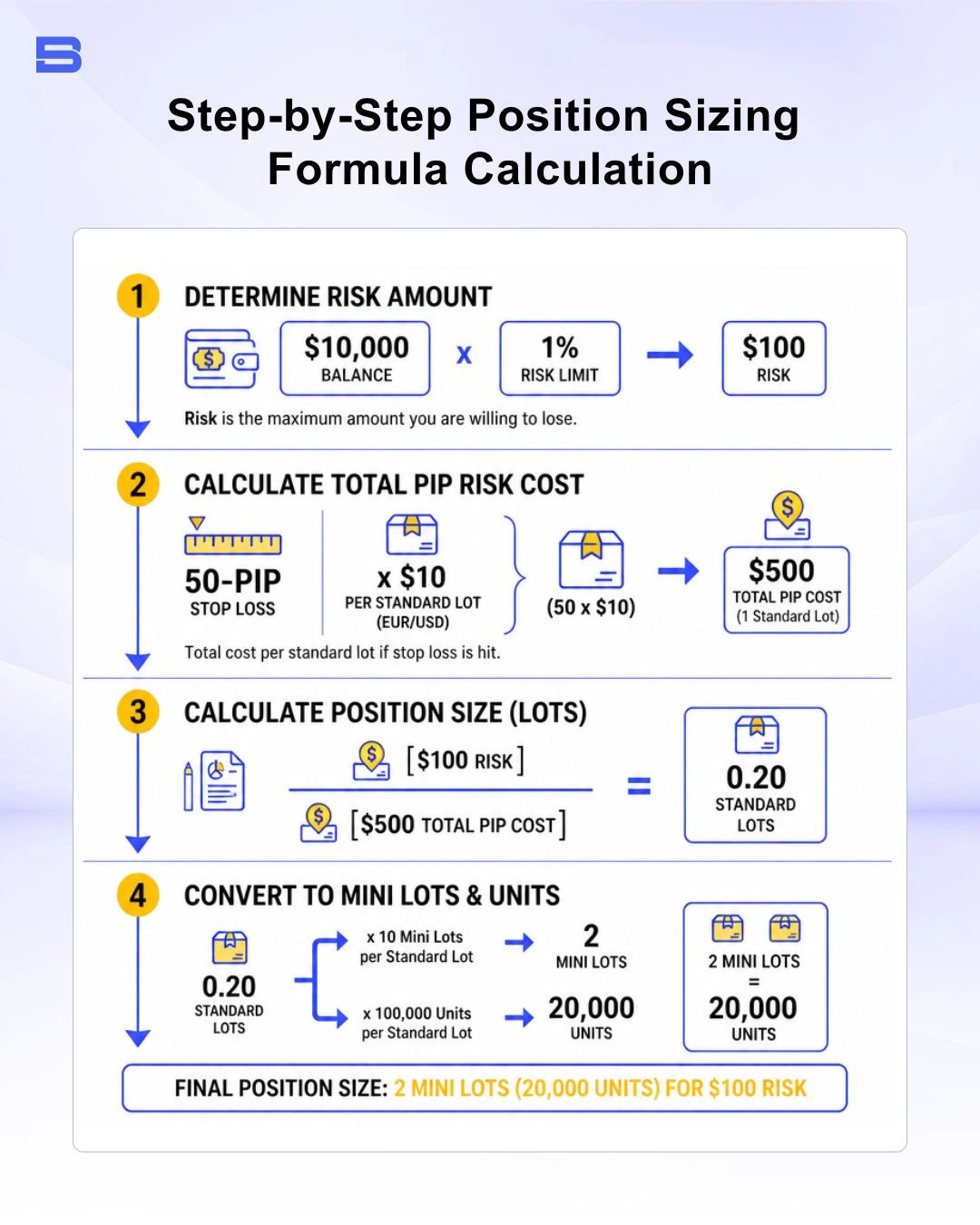
To determine your precise position size, divide your total dollar risk by the distance to your protective stop loss in points or pips.
Position Size (Lots) = (Account Balance x Risk %) / (Stop Loss Distance in Pips x Pip Value)
For example, take a $10,000 balance with a 1% risk limit ($100 risk) and a 50-pip stop loss on EUR/USD, where 1 standard pip equals $10 per standard lot. The calculation yields $100 / (50 x 10) = 0.20 standard lots — equivalent to 2 mini lots, or 20,000 units.
What Is the Risk-Reward Ratio and How to Calculate It
The risk-reward ratio measures the potential downside loss relative to the anticipated upside gain on a trade setup. Calculating this metric before entering a position ensures you are only taking trades that offer sufficient mathematical compensation.
If you risk $100 to target a profit of $200, your trade features a 1:2 risk-reward ratio. According to performance standards outlined by the CFA Institute, maintaining a positive risk-reward profile significantly reduces the win rate required to maintain profitability over time.
With a 1:2 risk-reward ratio, you only need to win 34% of your trades to break even. This mathematical truth alleviates the pressure of trying to predict market movements correctly on every trade.
How Stop-Loss Placement Protects Margin
Setting a protective stop loss is the primary mechanism to protect your account margin from catastrophic shifts in market direction. However, stop-loss orders must be placed based on market structure rather than arbitrary dollar amounts.
Identify key support and resistance levels, swing highs and lows, or other technical price boundaries before placing a stop-loss order. Positioning the stop just beyond these structural levels can help reduce the likelihood of being stopped out by normal market fluctuations while maintaining a predefined level of risk.
This approach is widely used in technical analysis and is consistent with CFA Institute guidance on trade risk management, although stop-loss placement should also consider market volatility and position size. Once the technical distance is established, adjust your lot size downward or upward so the monetary value of that distance equals your exact 1% or 2% risk limit.
Placing stops too close to entry prices to inflate lot sizes usually results in premature stop-outs from normal market noise, eroding your capital through unnecessary small losses.
Controlling Leverage and Margin Hazards
Financial leverage allows traders to control large market positions with a relatively small initial deposit. While leverage amplifies prospective returns when the market moves in your favor, it accelerates capital destruction just as quickly when price moves against you.
The Securities Commission Malaysia (SC) warns that leveraged products, such as Contracts for Difference (CFDs), are complex financial instruments that can magnify both gains and losses. The SC advises investors to fully understand the risks associated with leverage, margin requirements, and potential losses before trading these products. To help prevent excessive leverage, the SC also prescribes minimum margin requirements for CFDs.
Using 100:1 leverage means a minor 1% move against your trade position results in a 100% loss of the allocated margin, triggering immediate liquidation or margin calls. Keeping effective leverage low protects your account against unexpected price slippage and sudden economic announcements.
Psychological Discipline: Overcoming Overtrading and Revenge Trading
Strict capital controls act as an essential buffer against the psychological traps that plague retail trading. The two most damaging emotional reactions in live markets are overtrading and revenge trading.
Overtrading occurs when a trader opens positions without a valid setup, usually driven by boredom or FOMO (fear of missing out). Revenge trading happens immediately after taking a loss, where the trader recklessly jumps back into the market with larger lot sizes to instantly recoup lost capital.
Enforcing a daily maximum loss limit—such as 3% of your total account equity—provides an automatic circuit breaker. When that threshold is reached, trading stops for the day, forcing you to step away from the chart and prevent emotional decision-making from destroying your balance.
Integrating Money Management into Your Trading Plan
A comprehensive trading plan must incorporate explicit money management rules before you open your brokerage platform.
Establishing these rules in advance removes guesswork during volatile market conditions when emotions run high.
- Account Risk Cap: Limit single-trade exposure to a maximum of 1% or 2% of total equity.
- Maximum Open Risk: Restrict total active market risk across all open trades to no more than 5% or 6%.
- Daily Drawdown Limit: Stop trading immediately for 24 hours if equity falls by 3% in a single day.
- Minimum Reward Threshold: Accept setups only if the prospective technical reward provides at least a 1:1.5 or 1:2 ratio.
- Position Sizing Check: Calculate lot sizes strictly through the position size formula before clicking buy or sell.
Conclusion: The Bottom Line
Long-term survival and consistency in financial markets are rarely determined by finding a flawless entry strategy. Markets remain inherently unpredictable, and even high-probability technical setups fail regularly.
By prioritizing capital preservation through systematic position sizing, conservative leverage, and strict drawdown limits, you shield your equity against unexpected volatility. Mastering money management ensures that a series of losses remains a minor operational cost rather than a catastrophic event, giving you the runway needed to achieve sustainable trading success.
Disclaimer: The content on this page is intended for educational and informational purposes only. It does not constitute financial, investment, tax, or legal advice, and should not be interpreted as a recommendation to buy, sell, or hold any financial instrument or asset. Trading and investing involve significant risk, including the possible loss of your entire capital. Products such as forex, CFDs, and cryptocurrencies carry additional risks due to leverage, high volatility, and limited regulatory protection in some jurisdictions. Past performance of any financial instrument does not guarantee future results. Any market views, forecasts, or opinions expressed are those of the author at the time of writing and may not reflect current market conditions. Platform features, fees, and regulatory status are subject to change — always verify information directly with the relevant provider or regulator before making any financial decision. BrokerSpecs may receive compensation from third parties featured on this site. Always conduct your own due diligence and consider seeking advice from a licensed financial professional before investing.