


- How to Start Trading: A Step-by-Step Guide for Beginners
- Demo Trading Accounts: Safe Practice for Beginners
- Understanding How Much Capital You Need to Start Trading
- How to Set Realistic Trading Goals as a New Trader
- How to Open a Trading Account in Malaysia (Step-by-Step)
- How to Start Trading in Malaysia: A Guide for Beginners
- How to Create a Trading Plan Before You Start Trading
- What Is a Trading Account? Everything You Need to Know
- How to Learn Trading: Step-by-Step Beginner Roadmap
- What Is Stop Loss in Trading and How Does It Work?
- Why Every Trader Needs a Trading Journal
- Islamic Forex Account Explained: How Swap-Free Trading Works
- Funded Trading Account: Rules, Splits & Risks
- Master Money Management: Practical Capital Protection Rules
- Overtrading Explained: Common Causes, Signs, and How to Stop
- How Risk-Reward Ratio Works: A Guide to Trading Risk
- How to Open a Brokerage Account as a Beginner
- What Is a Cent Account Forex and How Does It Work?
- What Is an ECN Account and How Does It Work?
- What Is Cashback Forex and How Does It Work?
- Fixed Deposit vs Unit Trust: Key Differences for Investors
- Welcome Bonus Forex: What It Is and What to Watch For
- Forex Deposit Bonus: How It Works
- What Is Forex Rebate and How Does It Work?
- What Is Forex Free Credit and How Does It Work?
- Trading Webinars: Are They Worth Attending?
- Trading for Beginners PDF: What to Look For in a Good Guide
- Trading 101: How to Start Trading Safely and Effectively
You sit down at your desk after work, open your banking app, and watch your hard-earned savings earn a fixed interest rate that barely keeps pace with local inflation. You know you want your capital to work harder, but the financial market feels like an overwhelming maze of acronyms, strict regulations, and technical charts.
Taking your first steps into financial markets does not require an advanced finance degree. Whether you want to purchase local shares on Bursa Malaysia, speculate on global currency pairs, or invest in global tech giants, starting your trading journey in Malaysia requires understanding local rules, selecting the right platforms, and establishing clear risk controls.
Learn how to start trading in Malaysia with this beginner's guide covering broker selection, account setup, costs, and your first trade.
Step 1: Understand the Legal and Regulatory Landscape in Malaysia
Before depositing a single Ringgit, you should understand how Malaysia's financial markets are regulated. Two key authorities oversee different parts of the financial system. The Securities Commission Malaysia (SC) regulates and develops Malaysia's capital market, including securities, derivatives, fund management, licensed capital market intermediaries, exchanges, clearing houses, and other capital market activities.
Meanwhile, Bank Negara Malaysia (BNM), the country's central bank, oversees Malaysia's foreign exchange policy and supervises the financial system, including banks and the wholesale foreign exchange market.
The SC licenses stockbroking and derivatives (futures) broking activities under the Capital Markets and Services Act (CMSA). Digital Asset Exchanges operate as Recognized Market Operators (RMOs) and are regulated by the SC under its digital asset framework rather than being licensed in the same manner as brokers.
Meanwhile, Bank Negara Malaysia (BNM) administers Malaysia's Foreign Exchange Policy (FEP) under the Financial Services Act 2013 (FSA 2013), which sets out approvals, restrictions, and directions governing certain foreign exchange transactions involving residents and non-residents.
Local brokers licensed by the Securities Commission Malaysia (SC) operate under Malaysia's capital market laws and regulatory framework. If a dispute arises, eligible retail investors may be able to seek independent mediation or adjudication through the Securities Industry Dispute Resolution Center (SIDREC), provided the broker is a SIDREC member and the claim meets SIDREC's eligibility requirements.
Conversely, international forex brokers and Contract for Difference (CFD) providers often operate under international jurisdictions like the Financial Conduct Authority (FCA) in the UK or the Australian Securities and Investments Commission (ASIC) in Australia. While these international brokers offer broader global market access, they do not hold an SC Malaysia capital market license.
To shield your capital from fraudulent schemes, always consult the SC Malaysia Investor Alert List before registering with any broker operating locally or targeting Malaysian investors.
Step 2: Choose Your Market (Bursa Malaysia vs. Global Markets)
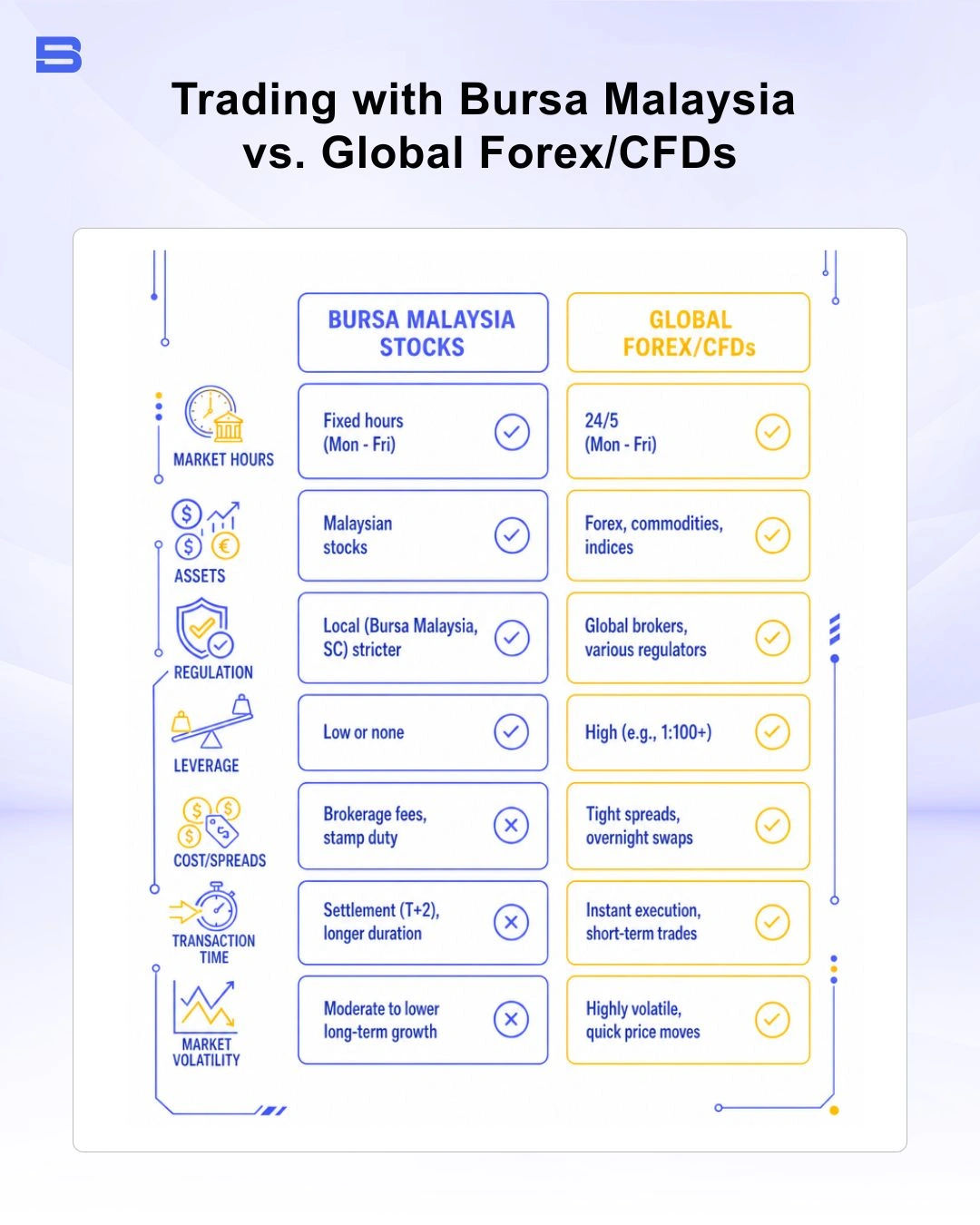
Your trading style and goals determine which asset class aligns best with your portfolio. Malaysian traders generally choose between local equities on Bursa Malaysia and international multi-asset instruments.
Bursa Malaysia Equities & Derivatives
Trading local stocks means owning equity shares in Malaysian listed companies such as Maybank or Top Glove. More experienced investors can also trade exchange-listed derivatives on Bursa Malaysia Derivatives, including the FTSE Bursa Malaysia Kuala Lumpur Composite Index Futures, which tracks the FTSE Bursa Malaysia KLCI Index, and Crude Palm Oil Futures (FCPO).
- Pros: Regulated locally, backed by tangible assets, predictable market hours (9:00 AM – 5:00 PM MYR).
- Cons: Market liquidity is limited compared to global exchanges; short-selling options are restricted for retail traders.
Global Forex, Stocks, and CFDs
Global platforms grant access to US indices (S&P 500, Nasdaq), international shares (Apple, Tesla), foreign currencies, and commodities.
- Pros: 24-hour trading windows, high market liquidity, ability to trade both rising and falling markets via leverage.
- Cons: Currency exposure Ringgit Malaysia and US Dollar (MYR/USD conversion volatility), higher risk due to financial leverage, lack of local SC dispute coverage.
Shariah-Compliant Trading Options
Malaysia is a global hub for Islamic finance. Approximately 78% of securities listed on Bursa Malaysia are classified as Shariah-compliant (as of 2026) by the Securities Commission Malaysia's Shariah Advisory Council (SAC). If you trade forex or CFDs, consider brokers that offer swap-free (Islamic) accounts, which remove conventional overnight swap interest. Keep in mind that some brokers may instead charge fixed administrative fees, so it's important to review the account terms carefully.
Learning how to start trading in Malaysia is easier than ever, and understanding how to buy shares in Malaysia and how to start investing in Malaysia is the first step toward building long-term financial confidence.
Step 3: Calculate Your Starting Capital & Understand Costs
A common misconception among beginner traders is that you need tens of thousands of Ringgit to start investing. In reality, Bursa Malaysia does not impose a minimum cash investment amount. Most stocks are traded in board lots of 100 shares, so your starting capital depends on the share price.
For many lower-priced stocks, you can begin investing with approximately RM100 to RM500, excluding brokerage fees and other trading charges. While many global online brokers accept initial deposits starting at $10 to $100.
However, operational trading costs directly impact your overall returns. You must account for several fee components:
- Brokerage Fees: Typically charged as a percentage of the trade value or a minimum flat fee, whichever is higher. Among Malaysian online brokers, commission rates commonly range from 0.05% to 0.08%, with minimum charges of approximately RM8 to RM12 per online trade (rates current as of 2026, subject to change by broker), although fees vary by broker and promotional pricing. (Source: official brokerage fee schedules published by major Malaysian brokers.)
- Clearing Fees: Bursa Malaysia charges a clearing fee of 0.03% of the transaction value, capped at RM1,000 per contract. This fee applies to both the buyer and seller and forms part of the transaction settlement costs.
- Stamp Duty: Shares traded on Bursa Malaysia are subject to stamp duty of RM1 per RM1,000 (0.1%) of the transaction value, with a maximum stamp duty of RM1,000 per contract note under the Stamp Duty (Remission) Order gazetted by the Ministry of Finance Malaysia (in effect for contract notes executed from July 13, 2023 to July 12, 2028).
- Sales and Services Tax (SST): Most taxable financial services in Malaysia are subject to an 8% SST. However, brokerage fees for trading shares listed on Bursa Malaysia are specifically exempt under the Royal Malaysian Customs Department's Service Tax Policy (No 1/2025).
Worked Calculation: Total Cost of a Bursa Stock Trade
Let's calculate the total fees required to purchase 1,000 shares of a local stock priced at RM2.00 per share using a standard online trading account.
Purchase Setup:
1,000 shares × RM2.00 = RM2,000
Total Value Transaction Fee Breakdown:
1. Brokerage Fee (0.08% or min RM8):
RM2,000 × 0.0008 = RM1.60 -> (Minimum RM8.00 applies)
2. Clearing Fee (0.03%):
RM2,000 × 0.0003 = RM0.60
3. Stamp Duty (RM1.00 per RM1,000 or fraction thereof):
RM2,000 / 1,000 × RM1.00 = RM2.00
Total Transaction Cost:
RM8.00 + RM0.60 + RM2.00 = RM10.60
Effective Entry Cost:
RM2,000 + RM10.60 = RM2,010.60
This math proves why small trades suffer higher relative drag from minimum brokerage fees. Understanding these friction costs prevents unexpected slippage in your profit margins.
Step 4: Select a Platform and Open Your Account
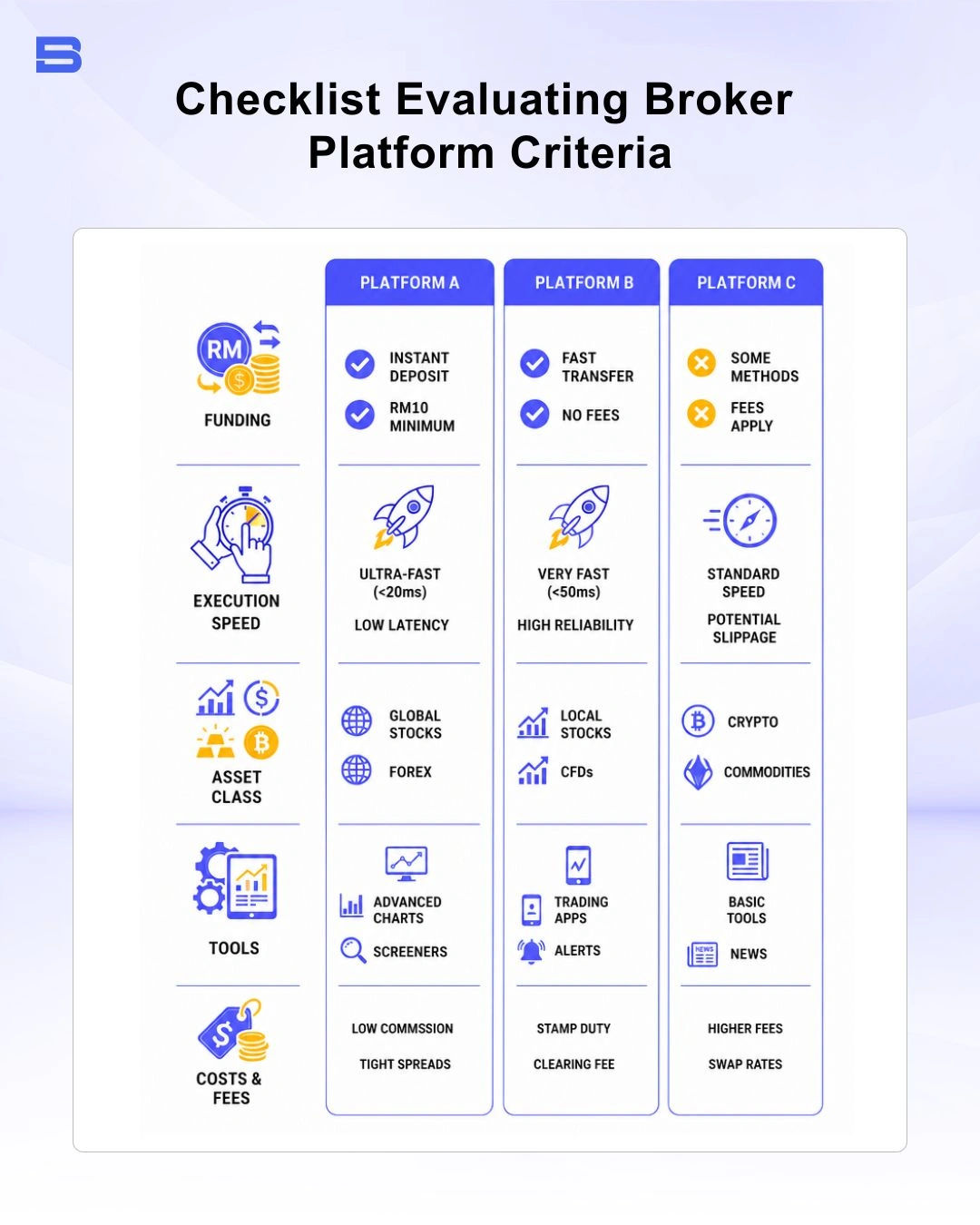
Choosing the right platform requires balancing fee structures, regulatory oversight, usability, and funding convenience.
Direct CDS vs. Nominee CDS Account
When trading local shares, you must choose between two account structures:
- Direct CDS Account: Shares are registered directly in your name with Bursa Malaysia Depository through a Central Depository System (CDS) account. As the registered shareholder, you retain voting rights and receive corporate action notices and entitlements directly from the company or its share registrar, either by post or electronically, depending on the company's communication arrangements.
- Nominee CDS Account: Registered under the brokerage firm on your behalf. Brokerage management handles corporate actions automatically, often charging lower handling fees, though you waive direct voting rights.
Local MYR Funding Methods
For seamless operations, select platforms supporting local Malaysian payment gateways. Most local and foreign brokers catering to Malaysian users accept:
- FPX (Financial Process Exchange): Direct online banking transfers via Maybank2u, CIMB Clicks, Public Bank, or RHB.
- Local Bank Transfer / E-Wallets: Fast funding options in MYR without incurring high international wire transfer fees.
KYC Registration Requirements
To complete identity verification (Know Your Customer), prepare the following documents:
- Front and back color copy of your MyKad (or Passport for non-citizens)
- Proof of residential address (utility bill, bank statement issued within the past three months)
- Active Malaysian bank account statement for fund withdrawal linkage
Step 5: Execute Your First Trade & Manage Risk
Before committing real funds, spend time on a demo trading account to familiarize yourself with order execution interface mechanics. Once you transition to live trading, focus on controlling capital downside.
Risk Control Essentials
- Position Sizing: Never risk more than 1% to 2% of your total account balance on a single trade order.
- Stop-Loss Orders: Always set automated exit triggers to cap potential losses if price movements turn negative.
- Manage Leverage Wisely: While high leverage multiplies gains, it equally amplifies downside exposure. With 30:1 leverage, a 2.5% market move against your position wipes out 75% of your allocated margin capital.
Understanding how to start trading in Malaysia helps beginners make informed decisions, manage risks, and build a stronger trading foundation.
Final Thoughts
Whether your goal is to buy shares in Malaysia or diversify into other markets, knowing how to start investing in Malaysia with the right knowledge, regulated broker, and risk management strategy can help you trade with greater confidence. Begin by testing your strategy on a risk-free demo account, practice disciplined position sizing, and scale up your portfolio as your market experience grows.
Disclaimer: The content on this page is intended for educational and informational purposes only. It does not constitute financial, investment, tax, or legal advice, and should not be interpreted as a recommendation to buy, sell, or hold any financial instrument or asset. Trading and investing involve significant risk, including the possible loss of your entire capital. Products such as forex, CFDs, and cryptocurrencies carry additional risks due to leverage, high volatility, and limited regulatory protection in some jurisdictions. Past performance of any financial instrument does not guarantee future results. Any market views, forecasts, or opinions expressed are those of the author at the time of writing and may not reflect current market conditions. Platform features, fees, and regulatory status are subject to change — always verify information directly with the relevant provider or regulator before making any financial decision. BrokerSpecs may receive compensation from third parties featured on this site. Always conduct your own due diligence and consider seeking advice from a licensed financial professional before investing.