



Related Tags
Entering the financial markets for the first time can feel daunting, with complex charts, rapid price movements, and unfamiliar terminology. Trading 101 provides a practical foundation by focusing on how markets work, managing downside risk, and developing consistent trading habits.
Rather than chasing quick profits, beginners should prioritize understanding asset mechanics, controlling risk, and building disciplined practices for long-term success.
What Is Trading 101?
Trading 101 is the foundational study of exchanging financial instruments—such as equities, currencies, and commodities—to profit from short- to medium-term price changes.
Unlike holding assets long term, active market trading relies on price movements caused by shifting market demand and economic data.
Basic Trading Terms You Need to Know
To navigate order screens and market analysis, you need to understand three basic concepts:
- Leverage: Borrowed capital provided by a broker to increase trade size. While leverage magnifies potential profits, it accelerates capital losses just as quickly when market movements go against your entry price.
- Spread: The difference between the buy price (ask) and sell price (bid) offered by a platform. This gap represents the primary transaction cost charged by liquidity providers.
- Margin: The initial deposit required in your balance to open and maintain a leveraged position.
Going Long vs. Going Short
Financial markets allow participants to trade in both directions depending on market sentiment:
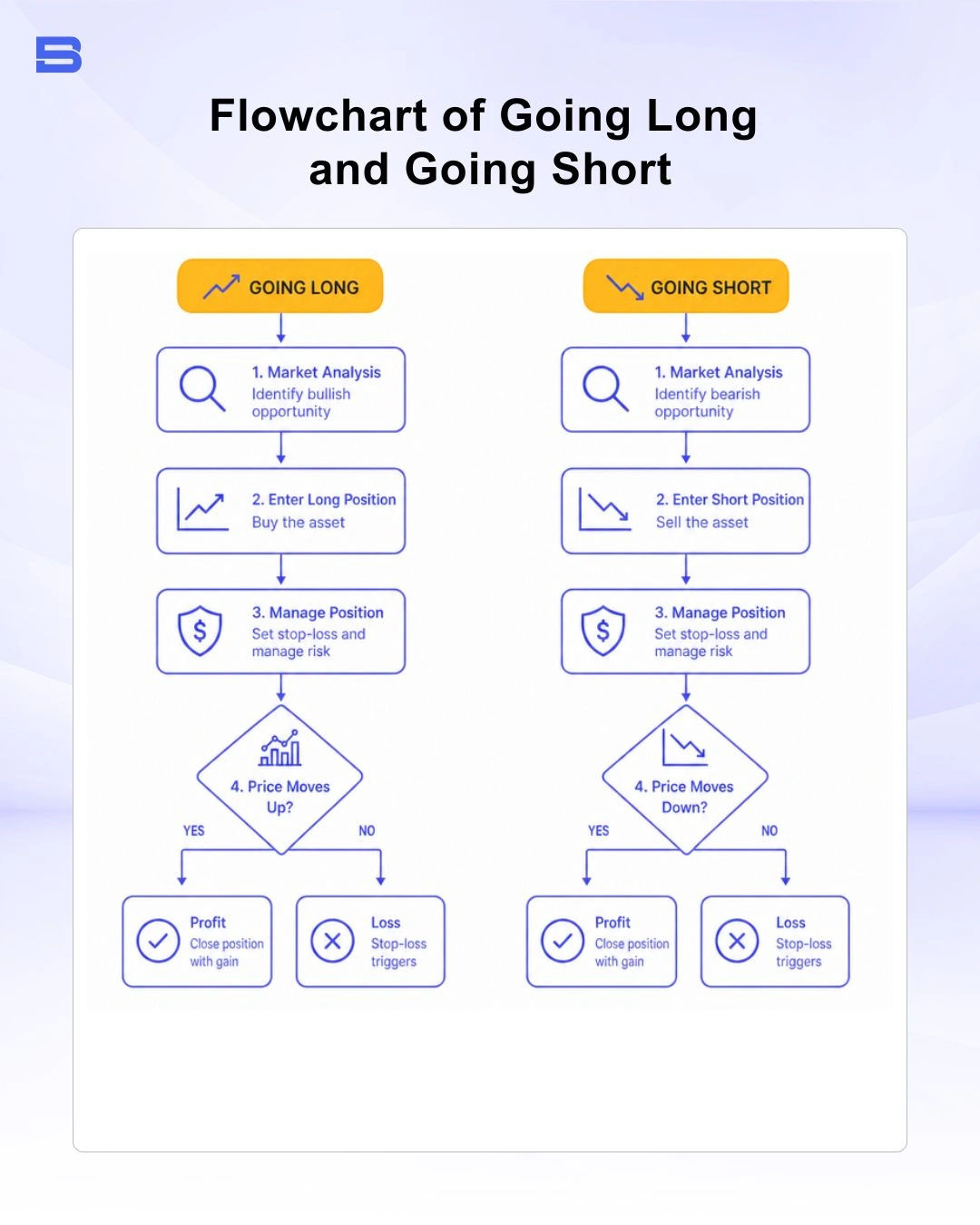
- Going Long (Buying): You open a position expecting the market price to rise, selling later at a higher price to lock in the difference.
- Going Short (Selling): You open a position expecting the market price to decline, buying back the asset later at a lower price to secure a gain from falling values.
Trading vs. Investing: Key Differences
Trading 101 helps beginners understand the key differences between trading and investing, from time horizons and risk profiles to how capital is deployed.
Traders seek to profit from short-term price movements using technical analysis and disciplined risk controls, while investors focus on business fundamentals and economic growth, holding assets through short-term market fluctuations to pursue long-term wealth creation.
How to Start Trading in Malaysia: Step-by-Step
Setting up an active trading setup requires proper infrastructure, regulatory verification, and order execution knowledge.
- Select a Regulated Environment: Ensure any brokerage service operates under recognized statutory oversight. In Malaysia, local stock market activities are governed by the Securities Commission Malaysia (SC) and Bursa Malaysia, while foreign currency transactions fall under regulatory frameworks monitored by Bank Negara Malaysia (BNM).
- Complete Identity Verification (eKYC, or electronic Know Your Customer): Open a local account, submit official identification documents, and satisfy mandatory anti-money laundering requirements. You can review the step-by-step process in our guide on how to open a trading account in Malaysia.
- Fund Your Base Account: Transfer capital using supported local payment methods or bank wire transfers, making sure to deposit only risk capital you can afford to lose.
- Execute Market Orders: Select your targeted financial instrument, select your position sizing, set your protective parameters, and send your trade order.
Market vs. Limit Orders
When placing trades, execution methods dictate entry speed and price precision:
- Market Orders execute immediately at the best available market price. While instant execution is assured, final entry pricing may vary slightly during high market volatility.
- Limit Orders execute only when the price reaches your specific chosen level. Execution is not guaranteed if market prices bounce away before touching your order limit.
Risk Management for Beginners
Trading 101 doesn't stop at terminology — capital preservation must take priority over profit seeking from your very first trade.
Capital preservation must take priority over profit seeking from your very first trade. Without effective defensive guidelines, even high-win-rate strategies can be wiped out by a single unmanaged market drop.
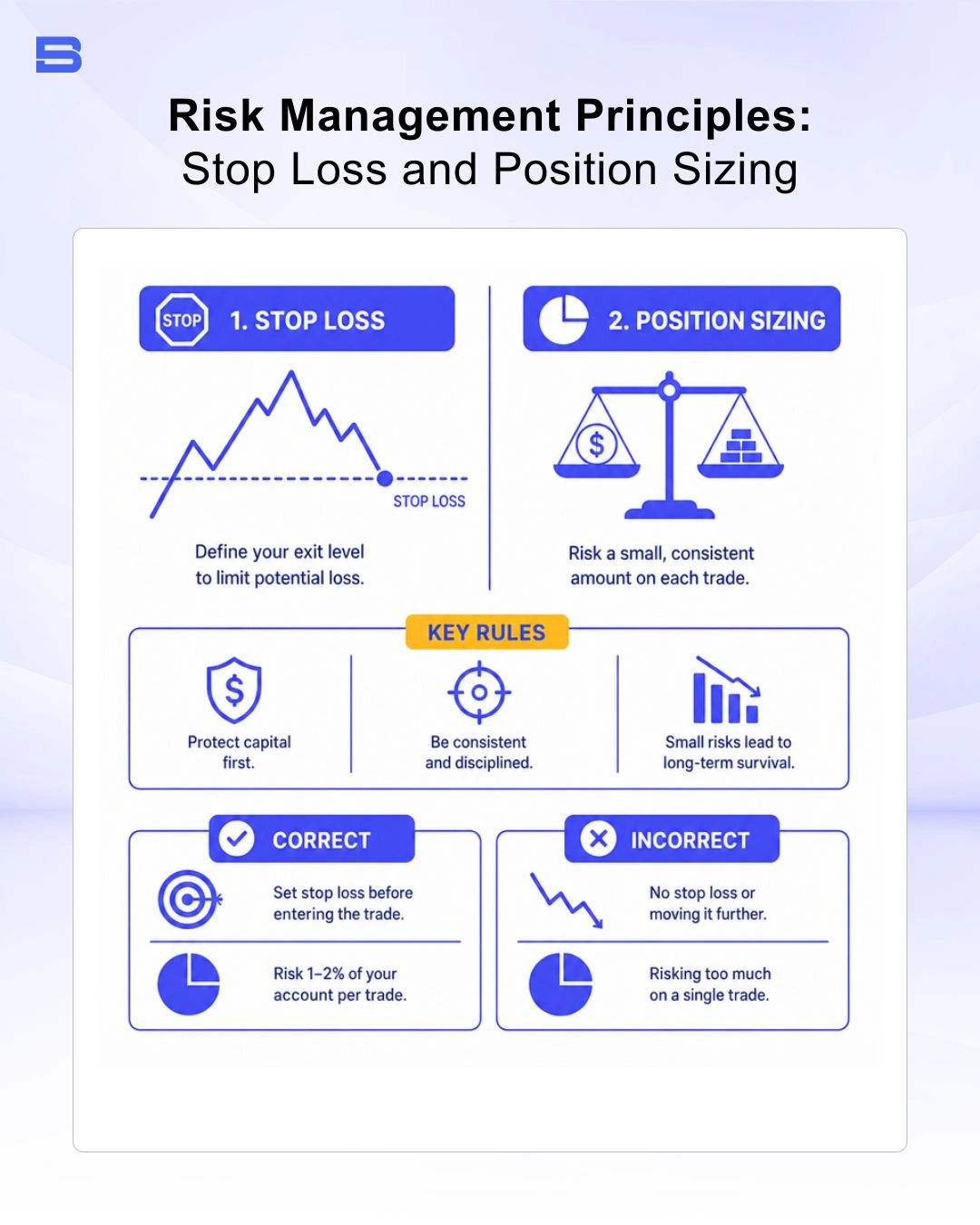
To limit overall portfolio impact, set automated risk boundaries before entering any trade:
- Automated Protection: Always place an explicit stop loss order with your broker. This tool automatically closes an open position once price moves against you past a pre-set threshold.
- Capital Allocation Rules: Apply strict money management limits to every position. A commonly used guideline among traders is to risk no more than 1% to 2% of total account balance on a single trade, although the appropriate limit depends on the trader's strategy, risk tolerance, and portfolio exposure.
Worked Example: Position Sizing in Action
Suppose you hold an active account balance of $1,000 (approximately RM4,080–RM4,100, depending on the exchange rate). Applying a conservative 1.5% maximum risk tolerance means you would aim to limit the potential loss to $15 on any single trade.
If you buy a stock at $10.00 and set a protective stop-loss order at $9.50, your planned risk per share is $0.50. Dividing the maximum risk of $15 by $0.50 gives a maximum position size of 30 shares.
If the stock reaches the stop price, the stop order is triggered and becomes a market order. If executed at $9.50, the planned loss would be approximately $15, leaving about $985 in the account before trading costs and any execution-price differences. Because stop orders do not guarantee the stop price, the actual loss may be higher or lower depending on market conditions and execution.
How to Become a Trader: Essential Roadmap
Transitioning from beginner mechanics to operational consistency requires systematic planning and regular progress tracking.
1. Build a Detailed Trading Plan
Never execute trades on market emotion or social media headlines. Outline your entry signals, exit thresholds, risk percentage, and target markets inside a clear trading plan.
2. Maintain a Trading Journal
Document every completed transaction inside a dedicated trading journal. Log entry prices, trade sizing, exit outcomes, and your rationale to spot execution errors and refine your edge over time.
3. Practice on Demo Environments
Before committing real balance funds, test your execution consistency inside a simulated demo platform to master platform controls and order dynamics without risking money.
The Bottom Line
Trading 101 starts with curiosity, discipline, and a strong focus on risk management. Learn the underlying market mechanics, assess risk-to-reward ratios, and set realistic capital goals. By prioritizing risk control and continuous learning, you can build a solid foundation for trading safely and effectively.
- How to Start Trading: A Step-by-Step Guide for Beginners
- Demo Trading Accounts: Safe Practice for Beginners
- Understanding How Much Capital You Need to Start Trading
- How to Set Realistic Trading Goals as a New Trader
- How to Open a Trading Account in Malaysia (Step-by-Step)
- How to Start Trading in Malaysia: A Guide for Beginners
- How to Create a Trading Plan Before You Start Trading
- What Is a Trading Account? Everything You Need to Know
- How to Learn Trading: Step-by-Step Beginner Roadmap
- What Is Stop Loss in Trading and How Does It Work?
- Why Every Trader Needs a Trading Journal
- Islamic Forex Account Explained: How Swap-Free Trading Works
- Funded Trading Account: Rules, Splits & Risks
- Master Money Management: Practical Capital Protection Rules
- Overtrading Explained: Common Causes, Signs, and How to Stop
- How Risk-Reward Ratio Works: A Guide to Trading Risk
- How to Open a Brokerage Account as a Beginner
- What Is a Cent Account Forex and How Does It Work?
- What Is an ECN Account and How Does It Work?
- What Is Cashback Forex and How Does It Work?
- Fixed Deposit vs Unit Trust: Key Differences for Investors
- Welcome Bonus Forex: What It Is and What to Watch For
- Forex Deposit Bonus: How It Works
- What Is Forex Rebate and How Does It Work?
- What Is Forex Free Credit and How Does It Work?
- Trading Webinars: Are They Worth Attending?
- Trading for Beginners PDF: What to Look For in a Good Guide
- Trading 101: How to Start Trading Safely and Effectively
Disclaimer: The content on this page is intended for educational and informational purposes only. It does not constitute financial, investment, tax, or legal advice, and should not be interpreted as a recommendation to buy, sell, or hold any financial instrument or asset. Trading and investing involve significant risk, including the possible loss of your entire capital. Products such as forex, CFDs, and cryptocurrencies carry additional risks due to leverage, high volatility, and limited regulatory protection in some jurisdictions. Past performance of any financial instrument does not guarantee future results. Any market views, forecasts, or opinions expressed are those of the author at the time of writing and may not reflect current market conditions. Platform features, fees, and regulatory status are subject to change — always verify information directly with the relevant provider or regulator before making any financial decision. BrokerSpecs may receive compensation from third parties featured on this site. Always conduct your own due diligence and consider seeking advice from a licensed financial professional before investing.