


- How to Start Trading: A Step-by-Step Guide for Beginners
- Demo Trading Accounts: Safe Practice for Beginners
- Understanding How Much Capital You Need to Start Trading
- How to Set Realistic Trading Goals as a New Trader
- How to Open a Trading Account in Malaysia (Step-by-Step)
- How to Start Trading in Malaysia: A Guide for Beginners
- How to Create a Trading Plan Before You Start Trading
- What Is a Trading Account? Everything You Need to Know
- How to Learn Trading: Step-by-Step Beginner Roadmap
- What Is Stop Loss in Trading and How Does It Work?
- Why Every Trader Needs a Trading Journal
- Islamic Forex Account Explained: How Swap-Free Trading Works
- Funded Trading Account: Rules, Splits & Risks
- Master Money Management: Practical Capital Protection Rules
- Overtrading Explained: Common Causes, Signs, and How to Stop
- How Risk-Reward Ratio Works: A Guide to Trading Risk
- How to Open a Brokerage Account as a Beginner
- What Is a Cent Account Forex and How Does It Work?
- What Is an ECN Account and How Does It Work?
- What Is Cashback Forex and How Does It Work?
- Fixed Deposit vs Unit Trust: Key Differences for Investors
- Welcome Bonus Forex: What It Is and What to Watch For
- Forex Deposit Bonus: How It Works
- What Is Forex Rebate and How Does It Work?
- What Is Forex Free Credit and How Does It Work?
- Trading Webinars: Are They Worth Attending?
- Trading for Beginners PDF: What to Look For in a Good Guide
- Trading 101: How to Start Trading Safely and Effectively

Entering live financial markets for the first time can feel intimidating. Many beginners spend months practicing on demo accounts with zero financial risk, only to experience real anxiety or rushed decision-making the moment real capital is placed on the line.
A cent account forex setup addresses this psychological hurdle by allowing you to trade in live market conditions using fractional amounts of capital. Instead of risking significant savings while learning position sizing or testing a strategy, you operate in an environment where $10 functions as 1,000 cents.
What Is a Cent Account in Forex Trading?
A cent account forex setup is a specialized live trading account type in which your balance, margin requirements, and trade transactions are measured and displayed in cents rather than standard currency units.
The primary purpose of a cent account is to serve as a stepping stone between risk-free paper trading (demo accounts) and full-scale standard-lot trading. It allows beginner traders to gain real-money execution experience, face authentic market psychology, and test automated trading algorithms with minimal exposure.
When using a cent account, you interact with identical live market charts, order execution types, and pricing quotes as institutional or standard traders. The fundamental distinction lies strictly in how your balance and contract sizes are denominated. To better understand how account setups fit into your overall trading framework, review our guide on what is a trading account.
How Does a Forex Cent Account Work?
To understand how a cent account forex works, you need to examine two core mechanics: the balance display and lot size scaling.
Balance Display Mechanics
When you transfer real currency into a cent account, your broker automatically multiplies the nominal value by 100 to convert dollars to cents (often denominated as USC).
- A $10 Deposit: Displays as 1,000 USC (US Cents) on your MetaTrader or platform dashboard.
- A $50 Deposit: Displays as 5,000 USC.
- A $100 Deposit: Displays as 10,000 USC.
Your overall buying power remains mathematically identical to your original deposit, but position values are scaled down proportionally to limit downside while learning.
Position Sizing and Pip Value Math
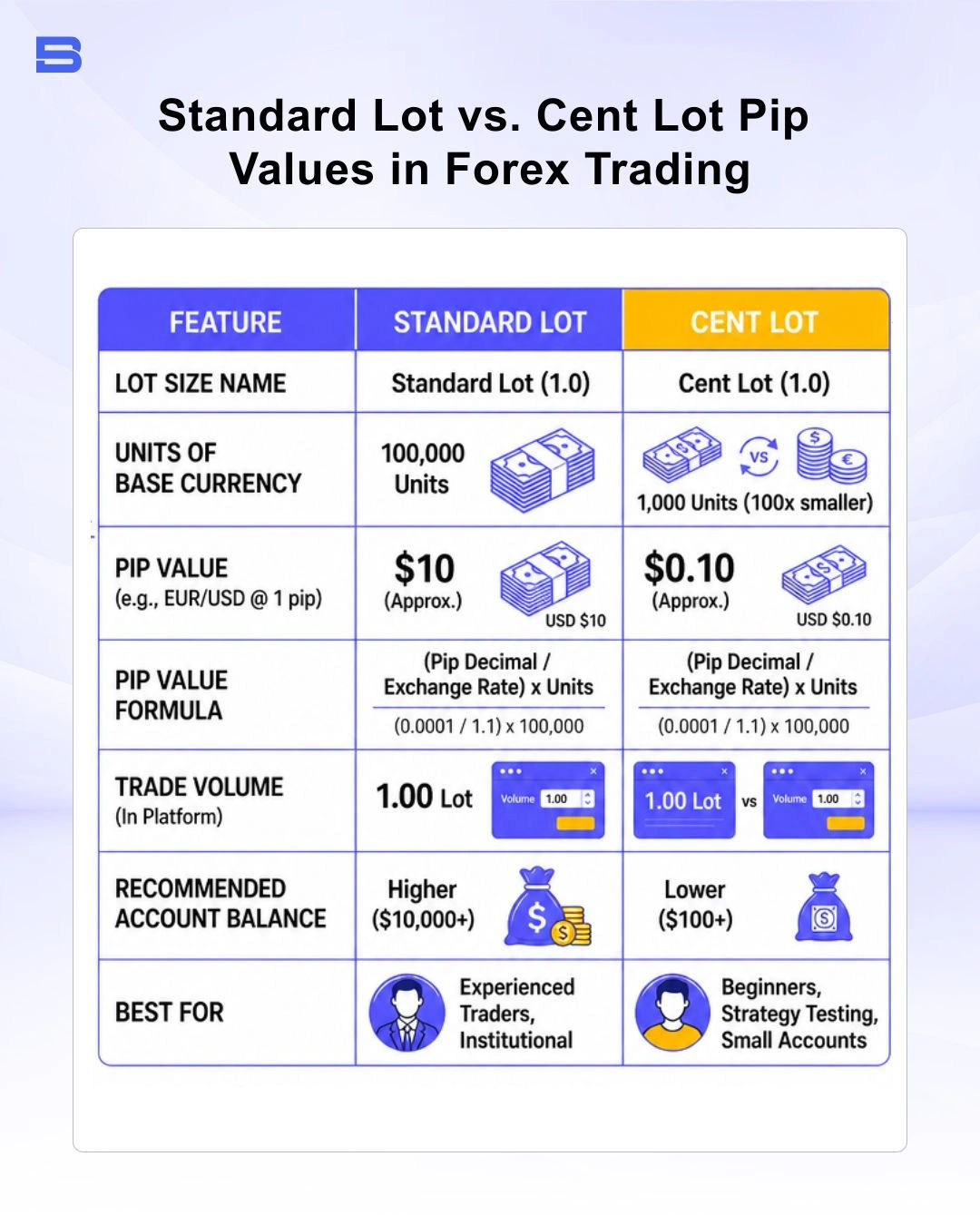
Standard forex trading operates on "lots." On a standard account, 1.0 standard lot represents 100,000 units of currency. On a cent account, 1.0 "cent lot" represents 100,000 cents, which equals 1,000 units of base currency, equivalent to a standard micro lot.
When trading Euro and US Dollar (EUR/USD) on a standard account, a 0.01 lot trade carries a pip value of roughly $0.10 per pip (a pip is the smallest standard price move a currency pair can make).
On a cent account in forex, a minimum position size of 0.01 cent lot represents 10 units of currency, yielding a pip value of 0.1 USC ($0.001) per pip.
Worked Calculation Scenario:
Imagine you deposit $10 (showing as 1,000 USC) and open a 0.01 cent lot position on EUR/USD.
If the market moves 50 pips against your position, your account balance drops by:
50 pips x 0.1 USC/pip = 5.0 USC
In real dollar terms, a 50-pip adverse move results in a loss of $0.05 (5 cents). The same 50-pip move on a 0.01 standard lot account would cost $5.00—wiping out half of a $10 deposit instantly.
Under leverage regulations overseen by global regulators like the US Commodity Futures Trading Commission (CFTC), margin rules control maximum exposure to protect retail participants. Scaled position sizes on cent accounts allow beginners to stay comfortably within margin requirements without triggering forced liquidations.
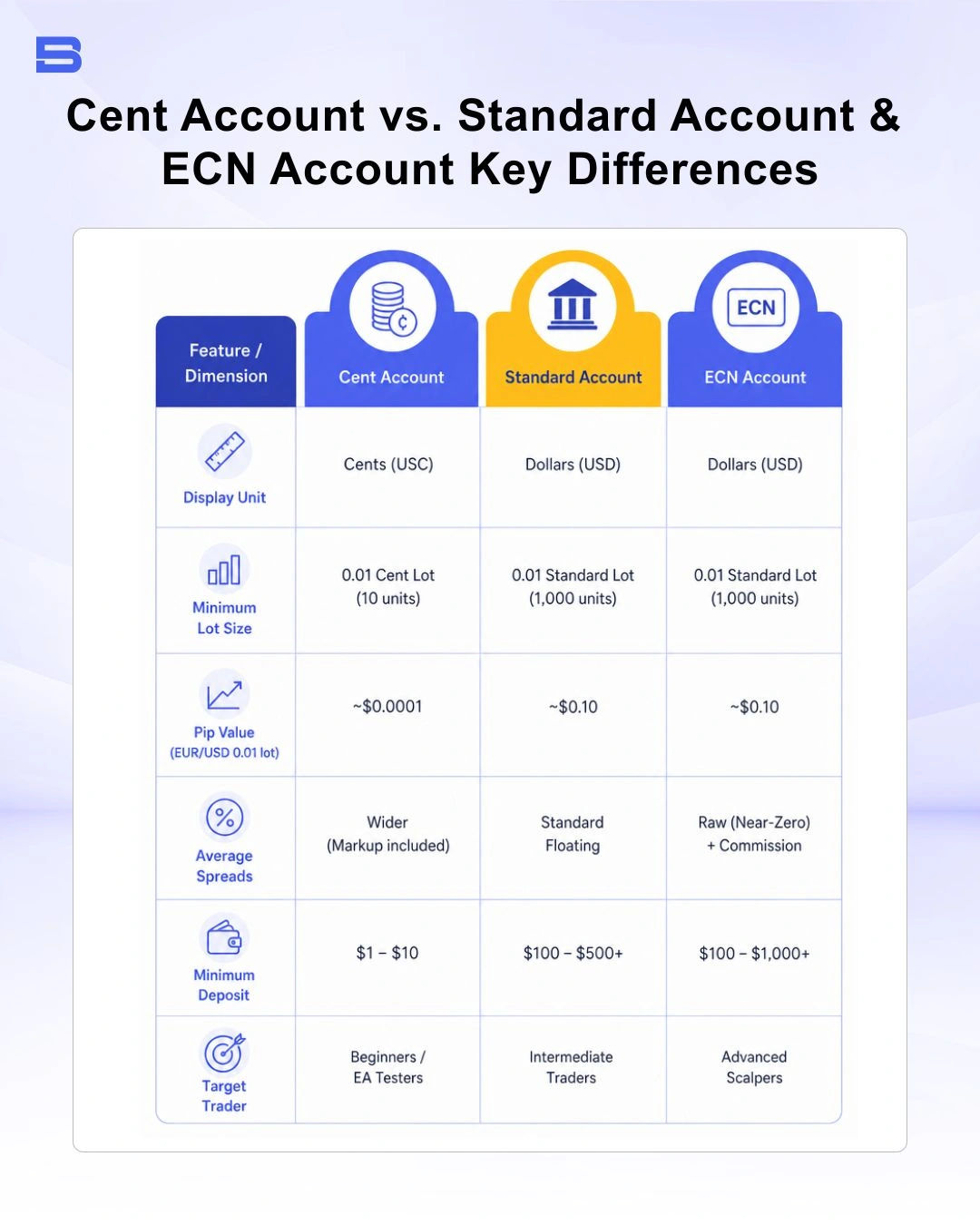
Cent Account vs Standard Account: Key Differences
While both account types access real interbank market prices, their target users, order sizes, and execution terms differ significantly.
Traders looking for direct liquidity routing with minimal spread markups should also evaluate what is an ECN account to determine which execution model aligns with their strategy.
Pros and Cons of Forex Cent Accounts
Cent accounts forex offer balanced trade-offs that every beginner must weigh objectively before depositing funds.
The Advantages (Pros)
- Real Psychological Conditioning: Trading $10 of real money builds emotional discipline that simulated paper money cannot replicate. Losses feel real, teaching you to respect stop-loss limits.
- Accessible Entry Barrier: You can practice position sizing and money management principles with as little as $1 to $10.
- Ideal Environment for Testing: Algorithmic traders use cent accounts to test automated Expert Advisors (EAs) in live conditions without risking significant capital.
The Risks & Drawbacks (Cons)
- Wider Spreads and Broker Markup: Brokers usually charge wider floating spreads or higher markups on cent accounts to cover the operational cost of processing tiny trades.
- Execution Limits: Order limits, maximum open trade counts, and slippage may be higher on cent servers compared to institutional liquidity pools.
- Minimal Profits: Generating a 10% return on a 1,000 USC ($10) balance yields only 100 USC ($1.00). Traders expecting meaningful wealth creation will quickly find cent accounts limiting.
- Risk of Developing Bad Habits: Because monetary risk is minimal, traders sometimes treat cent accounts carelessly, taking erratic risks they would never attempt on larger accounts.
Before placing live trades, take time to evaluate your personal financial boundaries by reading how to assess your risk tolerance.
Cent Account vs Demo Account: Which Should You Choose?
A demo account uses virtual currency to simulate market movements. While demo trading is essential for learning basic trading platform mechanics (such as placing market orders, setting stop losses, and viewing charts), it lacks psychological friction.
When you trade virtual funds, fear and greed do not influence your decisions. Closing a losing position on a demo account carries no actual financial consequence.
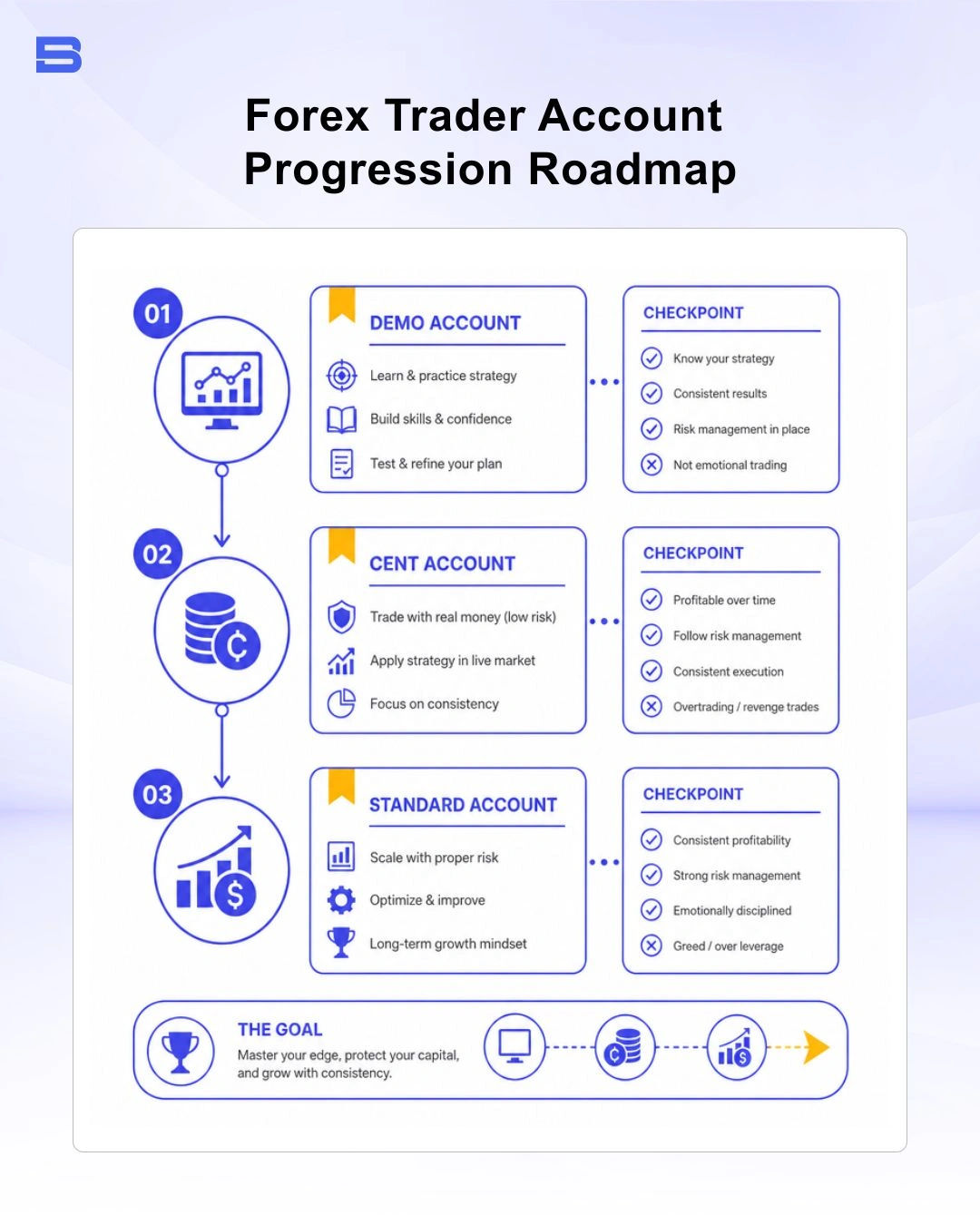
Transitioning to a cent account introduces real monetary stakes. Experiencing even a $0.50 loss forces you to follow your written trading plan under true market execution conditions (including real-time spread widening and slippage). Beginners should generally use demo accounts for two to four weeks to master software operation, then shift to a cent account to develop trading discipline.
How to Open a Cent Account and Next Steps
Starting a cent account requires standard regulatory identity checks to ensure account safety and compliance.
- Select a Regulated Broker: Ensure your chosen broker is licensed by recognized authorities. For traders based in Southeast Asia, verifying broker regulatory compliance with bodies such as the Securities Commission Malaysia (SC) helps ensure platform legitimacy and segregation of client funds.
- Complete Identity Verification (KYC): Upload proof of identity (passport or national ID) and proof of address (utility bill or bank statement).
- Select Account Type: Choose "Cent" or "Standard Cent" during the registration workflow on MetaTrader 4 or MetaTrader 5.
- Deposit Initial Funds: Deposit a manageable starting amount (such as $10 to $20) via bank transfer, credit card, or local payment gateway.
- Configure Risk Limits: Keep leverage conservative (e.g., 1:30 or 1:50) to prevent accidental over-exposure.
If you are localizing your registration setup, check our step-by-step guide on how to open a trading account in Malaysia. Once you build consistent risk management habits on a cent account, you can evaluate moving toward standard accounts or exploring a funded trading account.
Is a Cent Account Right for You?
A cent account forex structure offers a valuable bridge between simulated demo trading and full-scale market participation. By displaying balances in cents and scaling contract sizes down to micro levels, it provides real-market execution experience without exposing your savings to major losses. Use cent accounts to build trading discipline, refine your risk management rules, and test strategies before scaling up your capital.
Disclaimer: The content on this page is intended for educational and informational purposes only. It does not constitute financial, investment, tax, or legal advice, and should not be interpreted as a recommendation to buy, sell, or hold any financial instrument or asset. Trading and investing involve significant risk, including the possible loss of your entire capital. Products such as forex, CFDs, and cryptocurrencies carry additional risks due to leverage, high volatility, and limited regulatory protection in some jurisdictions. Past performance of any financial instrument does not guarantee future results. Any market views, forecasts, or opinions expressed are those of the author at the time of writing and may not reflect current market conditions. Platform features, fees, and regulatory status are subject to change — always verify information directly with the relevant provider or regulator before making any financial decision. BrokerSpecs may receive compensation from third parties featured on this site. Always conduct your own due diligence and consider seeking advice from a licensed financial professional before investing.