



Related Tags
Imagine checking your brokerage account one morning and seeing a stock in your portfolio drop from $400 to $100 overnight. Your stomach sinks for a second until you notice that your share count just jumped from 10 to 40, leaving your total investment at the exact same $4,000. That sudden shift is a stock split, a routine corporate event that changes how a company divides its shares without altering what your stake is worth.
How a Stock Split Works Behind the Scenes
A stock split is a corporate action in which a company divides its existing shares into multiple new shares to lower the trading price. Think of it like slicing a whole pizza into eight pieces instead of four: you end up with more slices, yet the total amount of pizza stays identical.
Companies announce splits using ratios such as 2-for-1, 3-for-1, or 10-for-1. In a 2-for-1 split, every single share you hold becomes two shares, and the market price per share adjusts to roughly half of its prior level.
Behind the scenes, the company increases its total number of authorized and issued shares while reducing the par value per share (the nominal value assigned to each share) proportionally. Existing treasury shares (shares the company has bought back and still holds) are typically adjusted under the same ratio so the overall ownership structure remains balanced.
How Does a Stock Split Affect Your Shares?
When a stock split takes effect, your broker automatically updates both your share quantity and your average purchase price, known as your cost basis. You do not need to file paperwork or pay transaction fees for this adjustment to happen.
Consider a clear example using a 4-for-1 split across two different markets:
- U.S. market scenario: An investor owns 100 shares bought at $400 each, giving a total position of $40,000. After a 4-for-1 split, the investor holds 400 shares with an adjusted cost basis of $100 per share, keeping the total value at $40,000.
- Malaysian market scenario: A trader holds 1,000 shares on Bursa Malaysia purchased at RM8.00 each, totaling RM8,000. Following a 4-for-1 split, the account shows 4,000 shares at an adjusted cost basis of RM2.00 per share, preserving the same RM8,000 value.
Because your total cost basis does not change, a standard forward split does not trigger an immediate capital gains tax event in most jurisdictions. You only realize a taxable gain or loss when you eventually sell your shares in the open market.
Stock Split Dates: The Four Milestones
Every stock split follows four milestone dates that determine when your account updates, although the order of the last two can differ by exchange and split size:
- Announcement date: The company publicly reveals the split ratio and timeline.
- Record date: The cutoff date used to identify which registered shareholders qualify for the new shares.
- Ex-date (ex-split date): The first trading day the stock begins trading at its new, split-adjusted price, which works differently from an ex-dividend date that determines cash payout eligibility.
- Distribution date: The date your brokerage account officially credits the additional shares to your holdings.
Understanding these dates helps you avoid confusion if you buy or sell shares during the transition window. If you purchase shares after the record date but before the ex-date, the right to the split shares transfers to you automatically at settlement.
Why Companies Split Their Stock (and What It Doesn't Change)
Boards of directors usually approve a forward stock split after a prolonged rally pushes the share price out of reach for everyday investors. Lowering the nominal price per share makes it easier for retail buyers with smaller budgets to accumulate whole shares.
This accessibility matters even more on exchanges that enforce minimum trading lot sizes. On Bursa Malaysia, equities trade in standard board lots of 100 units, meaning a stock priced at RM15.00 requires RM1,500 per lot before fees, whereas a 3-for-1 split lowers that entry threshold to RM500 per lot.
Does a Stock Split Make a Stock Cheaper?
However, a lower share price does not make a company fundamentally cheaper or more valuable. Total market cap, revenue, earnings, and your percentage ownership in the business remain completely unchanged, unlike a capital-raising private placement that issues new equity to outside investors and dilutes existing stakes.
Stock Split vs. Bonus Issue: How They Differ
Investors in Malaysia and Singapore often confuse a stock split with a bonus issue, since both increase your share count while lowering the market price per share. The difference lies in how the company accounts for the change on its balance sheet, whereas a dividend in specie distributes actual assets or shares of another company to shareholders.
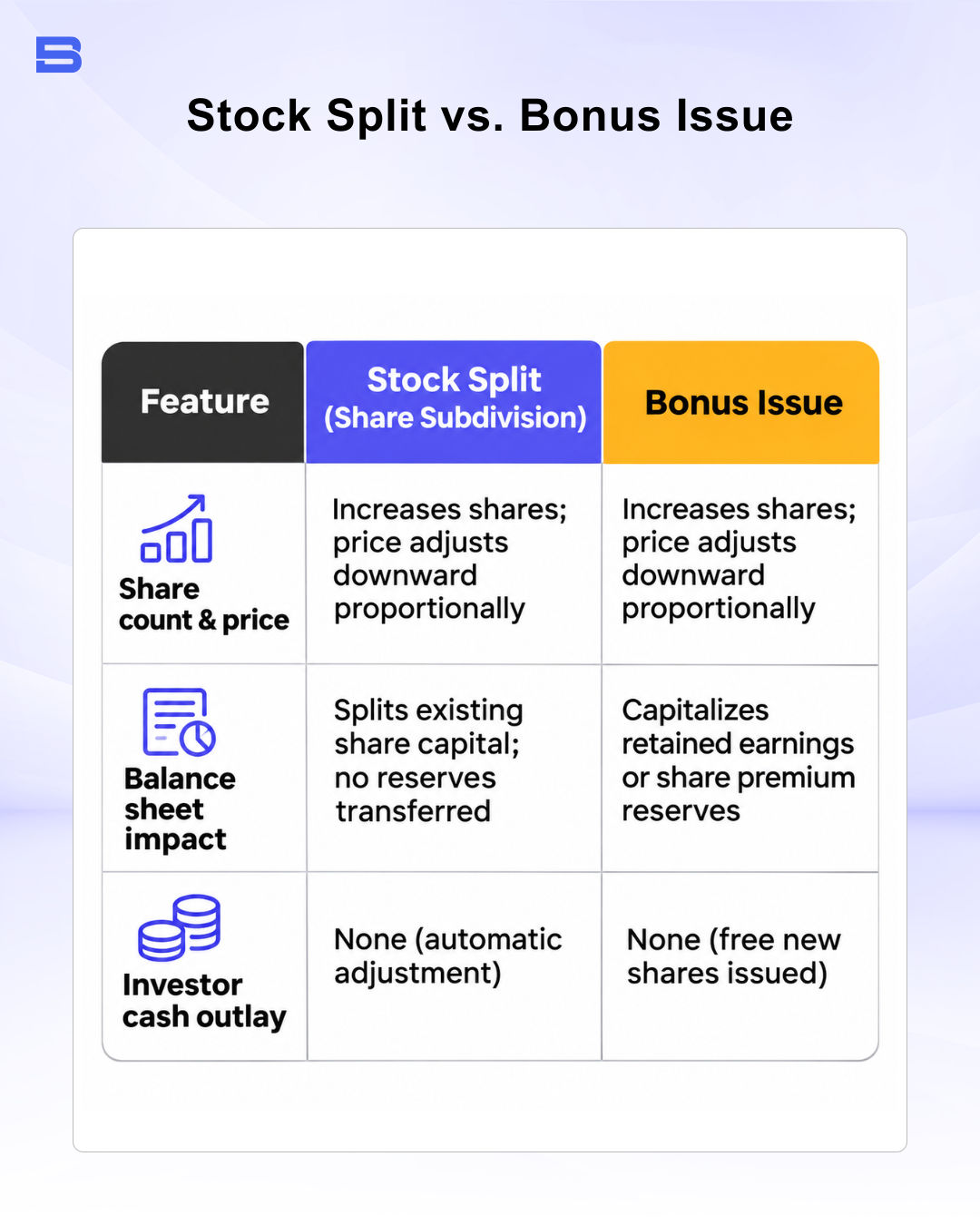
Both corporate actions leave your total portfolio value unchanged on the ex-date. Checking the company’s circular (the formal notice it sends to shareholders) tells you whether management is simply subdividing shares or turning accumulated reserves (earnings the company has kept in the business) into new shares.
Reverse Stock Split: When Shares Consolidate
While a forward split divides shares to reduce the price, a reverse stock split consolidates multiple existing shares into a single higher-priced share. For example, in a 1-for-10 reverse split, 1,000 shares trading at $0.40 become 100 shares trading at $4.00.
| Type | Share count | Price per share | Notes |
|---|---|---|---|
| Forward split | More shares | Lower | Total value unchanged |
| Reverse split | Fewer shares | Higher | Total value unchanged on day one |
| Bonus issue | More shares | Lower | Company capitalizes accumulated reserves |
A reverse split may signal pressure rather than strength, because companies often use it when the share price has fallen too low. Major exchanges such as the NYSE and Nasdaq require listed companies to maintain a minimum bid price of $1.00 per share, so struggling firms often execute reverse splits to avoid delisting.
According to the U.S. Securities and Exchange Commission (SEC), a company may declare a reverse stock split to raise a low share price or to regain compliance with an exchange’s minimum bid price. Your total value stays the same on day one, yet the SEC notes that investors may lose money as trading prices fluctuate after the split.
Key Risks and Misconceptions About Stock Splits
It is easy to assume that a stock split automatically leads to quick profits, especially when financial headlines celebrate big-name split announcements. In reality, splitting a stock creates both potential liquidity benefits and real risks you need to weigh carefully.
Watch out for three common traps before buying into split hype:
- Confusing a lower price with a bargain: A $50 post-split share is not "cheaper" than a $200 pre-split share if the company's price-to-earnings valuation ratio stays identical.
- Post-split volatility and pullbacks: Some stocks may rally on speculative excitement between the announcement and the ex-date, and prices can pull back once short-term traders take profits.
- Mixing up splits with dilutive corporate actions: Unlike a rights issue that asks you to pay cash to avoid dilution, or a special dividend that pays out surplus cash, a split adds zero new capital to the business.
On Bursa Malaysia, a listed company generally needs approval from Bursa Malaysia and its shareholders for a share split, and it typically issues a circular so investors can review the terms objectively. Always evaluate a company's earnings growth, debt levels, and valuation before committing capital around a split.
Same Business, More Slices
A stock split reshapes the packaging of a company's shares by increasing the share count and lowering the nominal price, making the stock easier to trade in standard lots without changing its underlying business value. Treat any split announcement as a prompt to examine the company's fundamentals and risk profile rather than a signal to buy blindly.
- What Is Trading and How Does Trading Work?
- Trading Fundamentals: A Guide for Beginners
- Trading vs. Investing: What Are the Key Differences?
- Trading Terms and Terminologies Every Beginner Should Know
- Common Trading Mistakes Beginners Make and How to Avoid
- Understanding Risk and Reward in Trading: A Complete Guide
- Guide to the Different Types of Financial Markets
- Investment Basics: Definition, Strategies, and How to Invest
- Benefits of Investing: Financial Growth and Security
- What Is Swing Trading? A Practical Guide For Beginners
- What Is Spot Trading? A Guide for Beginners
- What Are Futures in Trading? A Guide for Beginners
- Understanding Bull Markets: Growth & Strategy
- How to Read a Candlestick Chart: A Guide for Beginners
- Is Trading Gambling? The Truth About Risk
- Pip in Forex: How It Works & How to Calculate It
- What Is the Bid-Ask Spread in Trading? A Guide for Beginners
- What Is a Margin Call? A Guide for Beginners
- Market Volatility Explained: What It Is and How to Trade It
- Drawdown in Trading: Meaning, Math, and Risk
- Understanding Slippage in Trading: Causes and Control
- Forex Lot Size Explained: Standard, Mini & Micro
- Trailing Stop vs Stop Loss: Essential Risk Strategy
- How Asset Allocation Works: Strategies Explained
- Understanding Market Trading Hours & Sessions
- Market Makers Explained: A Trader's Guide
- Portfolio Diversification: A Strategy Guide
- Capital Gains Explained: How Investment Taxes Work
- Stock Market Circuit Breakers: How Trading Halts Work
- What Is an IPO? How Initial Public Offerings Work
- What Is a Secondary Market? A Complete Guide
- What Is a Stock Exchange? Functions and Overview Explained
- Understanding Ticker Symbols: A Market Guide
- How Clearing Houses Work in Financial Markets
- Stock Market After Labor Day: Trends and What To Expect
Disclaimer: The content on this page is intended for educational and informational purposes only. It does not constitute financial, investment, tax, or legal advice, and should not be interpreted as a recommendation to buy, sell, or hold any financial instrument or asset. Trading and investing involve significant risk, including the possible loss of your entire capital. Products such as forex, CFDs, and cryptocurrencies carry additional risks due to leverage, high volatility, and limited regulatory protection in some jurisdictions. Past performance of any financial instrument does not guarantee future results. Any market views, forecasts, or opinions expressed are those of the author at the time of writing and may not reflect current market conditions. Platform features, fees, and regulatory status are subject to change — always verify information directly with the relevant provider or regulator before making any financial decision. BrokerSpecs may receive compensation from third parties featured on this site. Always conduct your own due diligence and consider seeking advice from a licensed financial professional before investing. Portions of this article were prepared with the assistance of AI tools and reviewed by our editorial team before publication.