


Related Tags
Imagine opening your brokerage app and seeing a surprise cash payout announcement from a stock you hold, worth several times its usual quarterly check. That unexpected windfall is often a special dividend, a rare distribution that sits outside a company’s normal payout schedule. While an extra deposit looks exciting on screen, understanding how it changes your share price helps you avoid costly assumptions.
What Is a Special Dividend?
A special dividend is a one-off cash or asset distribution that a company pays to shareholders outside its regular dividend schedule.
Unlike a regular dividend, which follows a predictable quarterly, semi-annual, or annual rhythm, a special payout is a single event with no promise of repeating. A company’s board of directors approves it only when specific financial circumstances arise, such as unusually strong profits or surplus cash reserves. Because it is non-recurring, you should treat it as a one-time capital return rather than ongoing passive income.
Cash vs. Non-Cash Special Distributions
Most companies distribute the payout in cash, depositing a fixed amount per share directly into your brokerage or bank account. Occasionally, a firm issues a dividend in specie, distributing shares of a spun-off subsidiary or physical assets instead of cash, which differs from a bonus issue that simply divides existing equity into more shares. In rare wind-down scenarios, a board may also declare a liquidating dividend to return remaining capital before closing the business.
Why Companies Pay Special Dividends
Companies usually declare a one-off payout when they hold more cash than they can profitably reinvest into daily operations. Under corporate governance and capital distribution frameworks overseen by regulators like the Securities Commission Malaysia (SC), boards must decide whether retaining surplus funds or returning them serves shareholders best.
Several common business events trigger this decision:
- Asset or subsidiary sales: Selling a major business division often generates a large lump sum of cash that the company does not need for core operations.
- Windfall earnings: Commodity producers, banks, or manufacturers sometimes experience temporary booms that leave cash reserves well above normal operating targets.
- Capital structure adjustments: Returning excess cash reduces idle balance-sheet liquidity and can improve return-on-equity ratios without taking on new debt.
Mature, cash-generative blue chip stocks often prefer a special payout when management wants to reward investors without raising the baseline expectation for future quarterly dividends. While a company could also repurchase stock and hold treasury shares, the distribution delivers immediate cash equally to every eligible shareholder.
Special Dividend vs. Regular Dividend: What Is the Difference?
Comparing the distribution against a standard payout helps you separate reliable income streams from temporary windfalls. Both distributions reward equity holders, yet they differ sharply in predictability, size, and market impact.
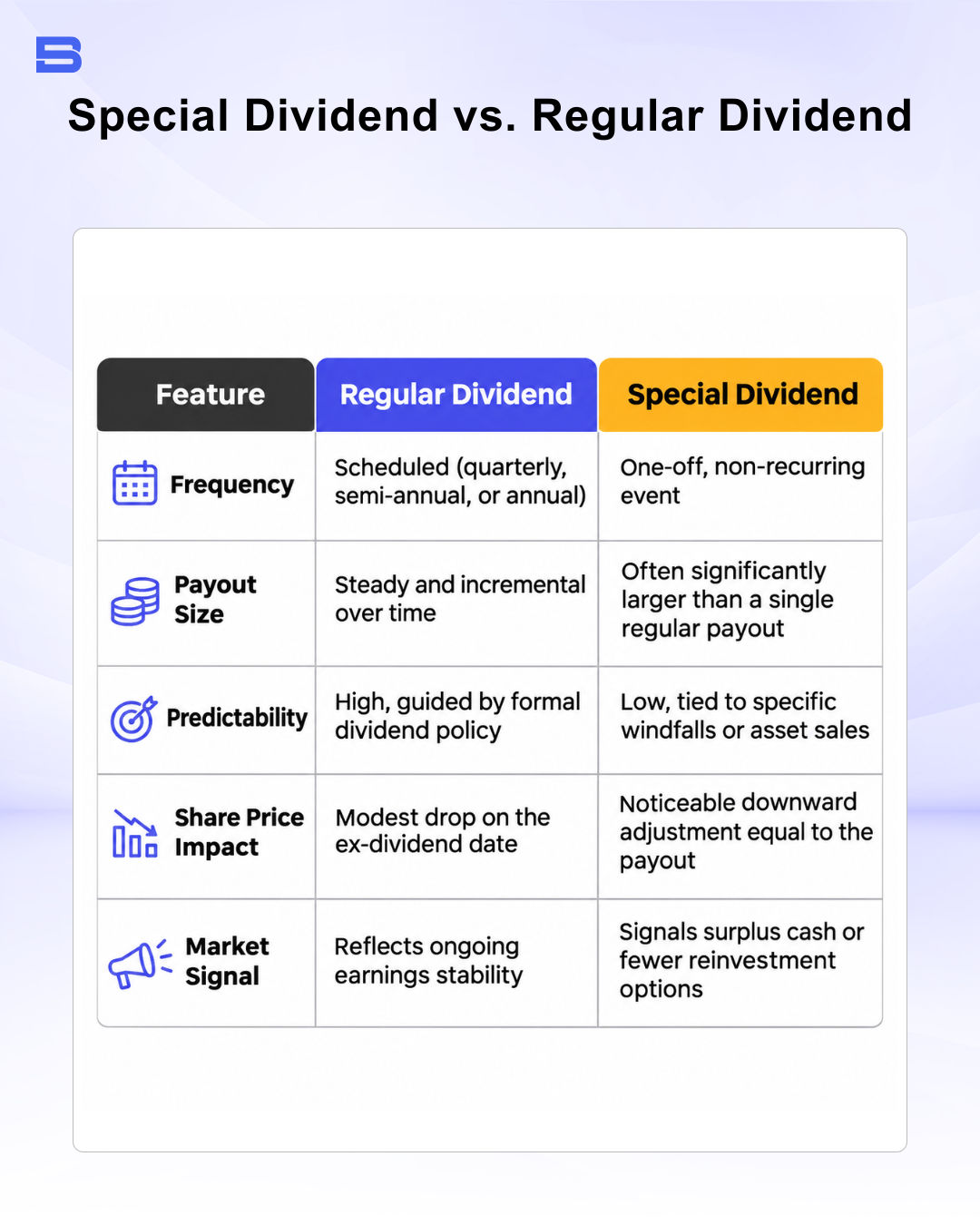
| Feature | Special | Regular |
|---|---|---|
| Frequency | Single event with no promise of repeating | Predictable quarterly, semi-annual, or annual schedule |
| Approval trigger | Unusually strong profits or surplus cash reserves | Follows the set payout schedule |
| Income reliability | Treat as a one-time capital return | Reliable income stream |
Shareholder priority also matters when a company distributes surplus cash. Investors holding preference shares typically receive their fixed dividend entitlements first, whereas ordinary shareholders receive the bulk of one-off special distributions once those obligations are met.
How a Special Dividend Affects Share Price and Your Portfolio
What happens to stock price after a special dividend? The market price adjusts downward to reflect the cash leaving the company, so the payout is not instant free money. Under exchange rules enforced by bodies such as Bursa Malaysia and the U.S. Securities and Exchange Commission (SEC), you must own the shares before the ex-dividend date (the first trading day on which new buyers no longer receive the payout) to qualify for the payout, while the declaration date, record date, and payment date govern eligibility and settlement.
Unlike a stock split, which increases your share count while lowering the price per share, the cash payout leaves your share count unchanged and converts part of the share’s value into cash.
Suppose you hold 1,000 shares of a company trading at RM5.00 per share, giving your position a total value of RM5,000. The board declares a RM0.50 per share one-off payout, totaling RM500 in cash for your holding.
On the ex-dividend date, the exchange adjusts the reference share price downward by RM0.50 to RM4.50, leaving you with RM4,500 in stock plus RM500 in cash, or RM5,000 in combined value before market fluctuations.
Are Special Dividends Taxable?
Tax rules depend on where the issuing company is listed and your personal tax residency. In Malaysia, corporate payouts under the single-tier tax system are generally tax-exempt in the hands of individual shareholders, though you should always verify current Inland Revenue Board rules. By contrast, if you hold U.S. or foreign stocks, your broker typically deducts non-resident dividend withholding tax from a special cash payout just as it would for a regular dividend.
Risks and Drawbacks of Special Dividends for Investors
While a large cash payout feels rewarding, these one-off payouts carry practical drawbacks that can catch inexperienced investors off guard. Looking past the headline payout figure helps you weigh those risks objectively.
First, a one-off payout temporarily inflates trailing dividend yield percentages on stock screeners, making routine dividend stocks look far higher-yielding than they actually are. If you buy a stock purely because a screener shows a 12% yield after a single windfall distribution, you risk disappointing income over the following year.
Second, automatic enrollment in a dividend reinvestment plan may convert your special cash payout into extra shares at post-announcement prices unless you opt out beforehand.
Third, paying out a large lump sum reduces the company’s cash buffer for research, expansion, or unexpected downturns. Investors sometimes interpret a big one-off payout as a warning that management lacks profitable growth projects internally. If the company later faces a cash crunch, it may need a rights issue (new shares offered to existing shareholders) or private placement (new shares sold to selected investors). Either can dilute existing holdings, so the short-term payout benefit can quickly erode.
Not Free Money: Look Past the Headline Payout
A special dividend is a helpful way for a cash-rich company to return surplus funds directly to shareholders, but it is not free money. Because the share price adjusts downward on the ex-dividend date and trailing yields can look artificially high, you should always look beyond the headline payout. Evaluate the company’s core earnings strength, cash reserves, and long-term growth outlook before deciding whether the stock fits your portfolio.
- What Is Trading and How Does Trading Work?
- Trading Fundamentals: A Guide for Beginners
- Trading vs. Investing: What Are the Key Differences?
- Trading Terms and Terminologies Every Beginner Should Know
- Common Trading Mistakes Beginners Make and How to Avoid
- Understanding Risk and Reward in Trading: A Complete Guide
- Guide to the Different Types of Financial Markets
- Investment Basics: Definition, Strategies, and How to Invest
- Benefits of Investing: Financial Growth and Security
- What Is Swing Trading? A Practical Guide For Beginners
- What Is Spot Trading? A Guide for Beginners
- What Are Futures in Trading? A Guide for Beginners
- Understanding Bull Markets: Growth & Strategy
- How to Read a Candlestick Chart: A Guide for Beginners
- Is Trading Gambling? The Truth About Risk
- Pip in Forex: How It Works & How to Calculate It
- What Is the Bid-Ask Spread in Trading? A Guide for Beginners
- What Is a Margin Call? A Guide for Beginners
- Market Volatility Explained: What It Is and How to Trade It
- Drawdown in Trading: Meaning, Math, and Risk
- Understanding Slippage in Trading: Causes and Control
- Forex Lot Size Explained: Standard, Mini & Micro
- Trailing Stop vs Stop Loss: Essential Risk Strategy
- How Asset Allocation Works: Strategies Explained
- Understanding Market Trading Hours & Sessions
- Market Makers Explained: A Trader's Guide
- Portfolio Diversification: A Strategy Guide
- Capital Gains Explained: How Investment Taxes Work
- Stock Market Circuit Breakers: How Trading Halts Work
- What Is an IPO? How Initial Public Offerings Work
- What Is a Secondary Market? A Complete Guide
- What Is a Stock Exchange? Functions and Overview Explained
- Understanding Ticker Symbols: A Market Guide
- How Clearing Houses Work in Financial Markets
- Stock Market After Labor Day: Trends and What To Expect
Disclaimer: The content on this page is intended for educational and informational purposes only. It does not constitute financial, investment, tax, or legal advice, and should not be interpreted as a recommendation to buy, sell, or hold any financial instrument or asset. Trading and investing involve significant risk, including the possible loss of your entire capital. Products such as forex, CFDs, and cryptocurrencies carry additional risks due to leverage, high volatility, and limited regulatory protection in some jurisdictions. Past performance of any financial instrument does not guarantee future results. Any market views, forecasts, or opinions expressed are those of the author at the time of writing and may not reflect current market conditions. Platform features, fees, and regulatory status are subject to change — always verify information directly with the relevant provider or regulator before making any financial decision. BrokerSpecs may receive compensation from third parties featured on this site. Always conduct your own due diligence and consider seeking advice from a licensed financial professional before investing. Portions of this article were prepared with the assistance of AI tools and reviewed by our editorial team before publication.