



Related Tags
A sudden loss on a clean setup hurts, but what happens next often determines whether your trading account survives the week. Imagine closing a position at a loss out of nowhere, feeling a surge of frustration, and immediately jumping back in with a larger lot size just to win your money back.
That impulsive, emotionally charged response is known as revenge trading, and it is one of the fastest ways retail traders destroy their capital through this impulsive behavior.
What Is Revenge Trading?
Revenge trading is an emotional impulse to quickly recover financial losses by taking immediate, higher-risk trades outside a structured plan. When you enter a revenge trade, your decision-making shifts from objective market analysis to personal vindication. Instead of evaluating probability, risk-to-reward ratios, or market structure, you trade to settle a score with the market.
This behavior manifests through clear mechanical mistakes: ignoring entry criteria, abandoning stop-loss discipline, drastically increasing position size, and overleveraging. Rather than accepting a loss as a normal operational cost of trading, revenge trading treats every drawdown as a personal insult that must be rectified instantly.
Is Revenge Trading the Same as Overtrading?
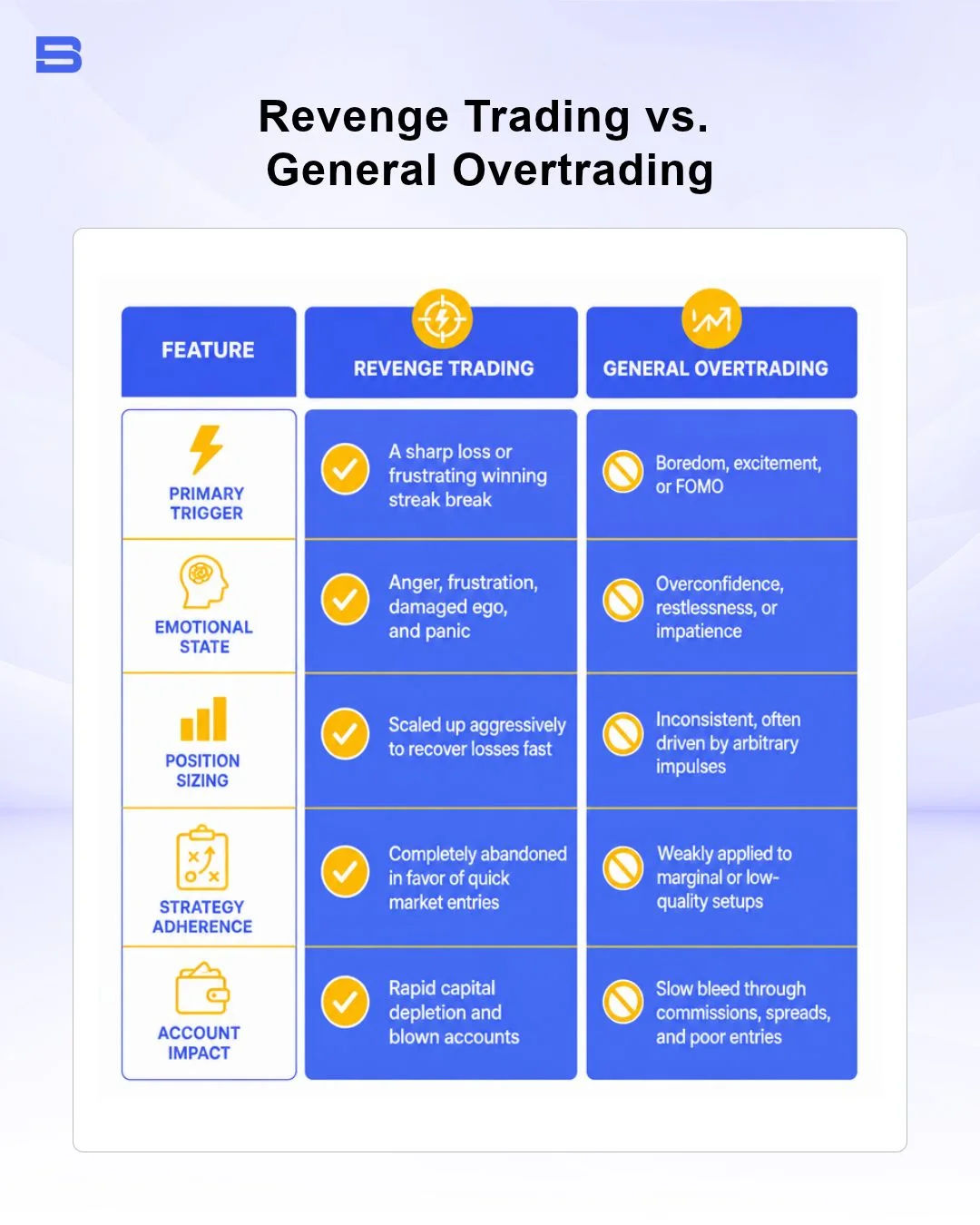
While both behaviors involve taking excessive market exposure, revenge trading is a specific, emotionally driven subset of general overtrading. Understanding the difference helps you diagnose which habit is harming your performance.
For a broader look at managing excessive trade frequency, explore our full guide on overtrading.
The Psychology Behind Revenge Trading
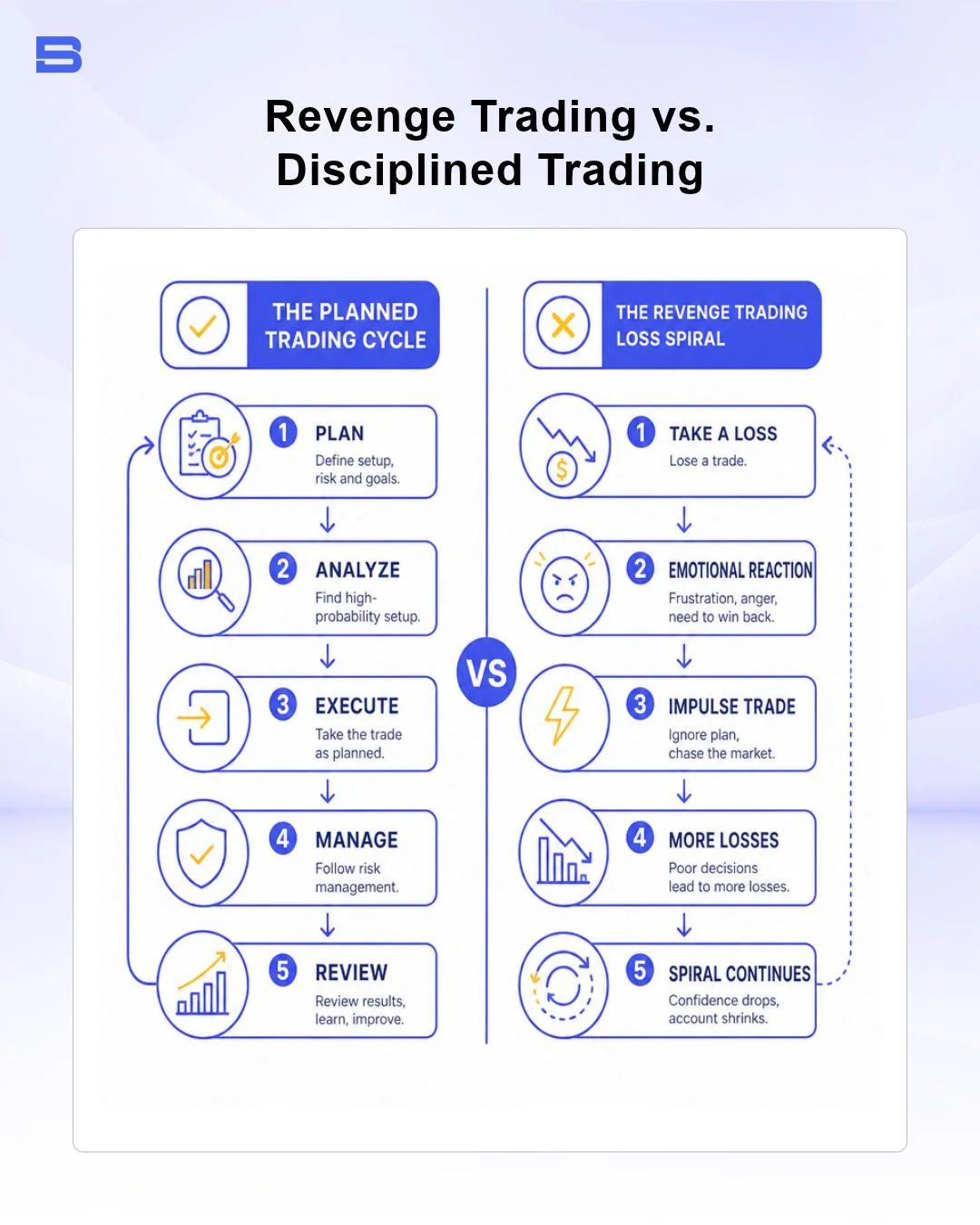
To stop revenge trading, you must understand why your brain reacts so aggressively to market losses. Human psychology is inherently wired to resist losing. Research published by institutions like the CFA Institute highlights behavioral finance concepts such as loss aversion—the psychological reality that the pain of losing money is twice as powerful as the pleasure of making an equivalent gain.
What Triggers the Revenge Trade Impulse?
The psychological trigger for a revenge trade is rarely just the loss itself; it is the feeling of powerlessness that follows. Key triggers include:
- Sudden Volatility or Slippage: Slippage or sudden market spikes can trigger an immediate feeling that the market is "unfair," driving an impulse to regain control.
- Broken Winning Streaks: After a series of profitable trades, overconfidence bias sets in. The first loss feels like an anomaly that must be fixed right away.
- Social Media and Peer Pressure: Seeing curated profits on social media makes normal drawdowns feel unbearable, forcing traders to force setups that aren't there.
Shifting Mindset: Discipline Over Emotion
Professional trading requires viewing losses not as failures, but as statistical expenses. Just as a retail store treats inventory as a cost of doing business, a trader must treat controlled losses as the price of acquiring market exposure.
Building a long-term mindset means shifting focus away from outcome bias on a single trade and toward consistent execution across a series of 100 trades.
Step-by-Step Rules to Stop Revenge Trading
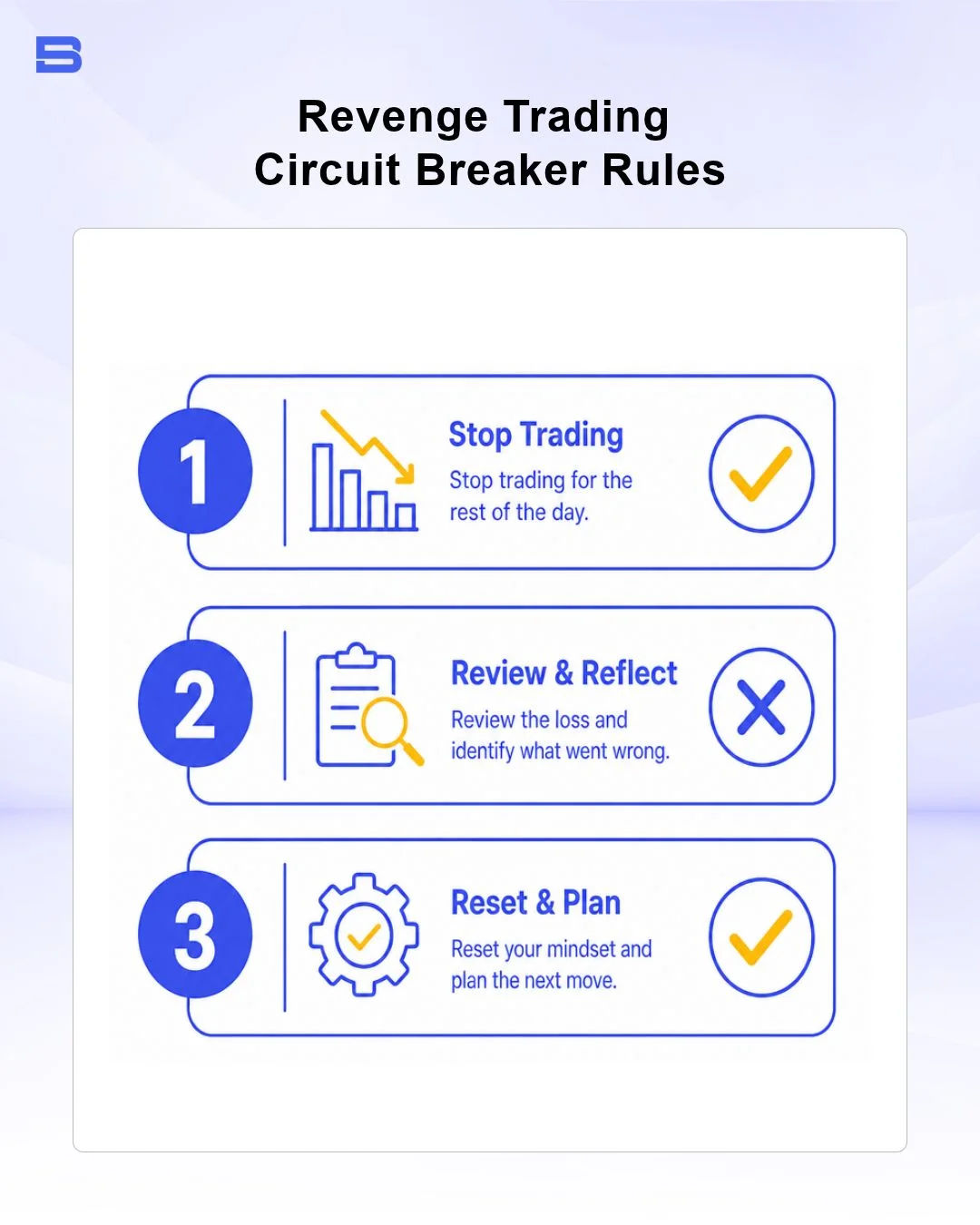
Relying on willpower alone during an emotional spiral rarely works. You need mechanical circuit breakers in place before you take your first position.
Rule 1: The 3-Loss Circuit Breaker
Implement a strict rule: if you hit three consecutive losing trades in a single session, close your platform immediately. Three consecutive losses signal either that your strategy is out of sync with current market conditions or that emotional fatigue is impairing your judgment. Stepping away stops a minor drawdown from turning into an account-ending loss.
Rule 2: Mandatory Cooldown Periods
Establish a mandatory 15-to-30 minute cooldown period after any trade exit—winning or losing. Cortisol and adrenaline levels spike during active trade management. Forcing a timer away from the terminal gives your nervous system time to settle, ensuring your next trade is based on technical criteria rather than residual chemical arousal.
Rule 3: Enforce Hard Daily Loss Caps & Reduced Position Sizing
Setting structural limits protects your trading account when emotions flare. Regulatory guidelines from authorities like the Securities Commission Malaysia (SC) continuously emphasize risk disclosure and capital protection principles for retail market participants.
Consider a practical risk scenario:
- Account Equity: RM10,000
- Max Daily Loss Limit (2%): RM200
- Standard Risk Per Trade (1%): RM100
If you take two consecutive losses and reach your RM200 daily limit, your platform or broker's daily loss limit locks your account for the day. Furthermore, if you experience a significant drawdown, scale your position size down by 50% on subsequent trades. Cutting lot size lowers financial stress, allowing you to rebuild confidence through proper execution without risking major capital. Learn how to structure your position sizing around your account equity before your next trading session.
The Bottom Line
Revenge trading is a natural emotional response to losing money, but letting it dictate your execution guarantees long-term failure. Protecting your trading capital requires treating losses as standard operational costs and enforcing mechanical circuit breakers before taking trades.
Long-term market survival is not about winning back every loss immediately; it is about executing your risk management strategy consistently over hundreds of trades.
- How to Start Trading: A Step-by-Step Guide for Beginners
- Demo Trading Accounts: Safe Practice for Beginners
- Understanding How Much Capital You Need to Start Trading
- How to Set Realistic Trading Goals as a New Trader
- How to Open a Trading Account in Malaysia (Step-by-Step)
- How to Start Trading in Malaysia: A Guide for Beginners
- How to Create a Trading Plan Before You Start Trading
- What Is a Trading Account? Everything You Need to Know
- How to Learn Trading: Step-by-Step Beginner Roadmap
- What Is Stop Loss in Trading and How Does It Work?
- Why Every Trader Needs a Trading Journal
- Islamic Forex Account Explained: How Swap-Free Trading Works
- Funded Trading Account: Rules, Splits & Risks
- Master Money Management: Practical Capital Protection Rules
- Overtrading Explained: Common Causes, Signs, and How to Stop
- How Risk-Reward Ratio Works: A Guide to Trading Risk
- How to Open a Brokerage Account as a Beginner
- What Is a Cent Account Forex and How Does It Work?
- What Is an ECN Account and How Does It Work?
- What Is Cashback Forex and How Does It Work?
- Fixed Deposit vs Unit Trust: Key Differences for Investors
- Welcome Bonus Forex: What It Is and What to Watch For
- Forex Deposit Bonus: How It Works
- What Is Forex Rebate and How Does It Work?
- What Is Forex Free Credit and How Does It Work?
- Trading Webinars: Are They Worth Attending?
- Trading for Beginners PDF: What to Look For in a Good Guide
- Trading 101: How to Start Trading Safely and Effectively
Disclaimer: The content on this page is intended for educational and informational purposes only. It does not constitute financial, investment, tax, or legal advice, and should not be interpreted as a recommendation to buy, sell, or hold any financial instrument or asset. Trading and investing involve significant risk, including the possible loss of your entire capital. Products such as forex, CFDs, and cryptocurrencies carry additional risks due to leverage, high volatility, and limited regulatory protection in some jurisdictions. Past performance of any financial instrument does not guarantee future results. Any market views, forecasts, or opinions expressed are those of the author at the time of writing and may not reflect current market conditions. Platform features, fees, and regulatory status are subject to change — always verify information directly with the relevant provider or regulator before making any financial decision. BrokerSpecs may receive compensation from third parties featured on this site. Always conduct your own due diligence and consider seeking advice from a licensed financial professional before investing. Portions of this article were prepared with the assistance of AI tools and reviewed by our editorial team before publication.