



Related Tags
Imagine checking your brokerage account after market close and seeing a corporate filing from a stock you own. The company plans to issue millions of new shares to private buyers at a discount, and the share price drops the next morning.
This corporate action is a private placement, and it often catches retail investors off guard. Understanding how it works helps you tell whether a company is raising cash for expansion or plugging a shortfall at your expense.
What Is a Private Placement? Understanding Private Placement Meaning and Purpose
A private placement is a capital-raising method where a company sells new securities directly to selected institutional or accredited investors rather than the public. Instead of launching a public offering on a stock exchange, the company negotiates directly with a small group of large buyers.
Companies often choose this route for speed and lower fees. While an IPO can take months of regulatory preparation, this route can sometimes close within weeks and bring in strategic institutional shareholders.
However, faster fundraising is not always positive for existing investors. Some companies rely on this route because weak earnings make bank loans expensive, meaning the new cash may simply cover operating losses rather than fund growth.
How a Private Placement of Shares Works Step by Step
This process follows a structured sequence designed to secure funds quickly while meeting exchange rules. Most listed companies go through four core stages:
- Board and shareholder approval: Directors approve the fundraising proposal using either an existing general shareholder mandate or a specific shareholder resolution.
- Placement agent bookbuilding: An investment bank or licensed placement agent markets the shares privately to eligible buyers.
- Price fixing and discount cap: The issuer sets the offer price, typically at a discount. Under Bursa Malaysia Listing Requirements, general-mandate placements usually allow up to 10% of issued shares to be placed at no more than a 10% discount to the five-day volume-weighted average price (VWAP).
- Subscription and listing: Buyers pay for the new ordinary shares or preference shares, and the exchange lists them alongside existing stock.
Retail investors usually learn about the deal only after the terms are announced to the exchange.
Who Can Participate? Accredited and Sophisticated Investors
Regular retail investors are generally excluded from buying directly into the placement. Regulators limit participation to institutions and wealthy individuals presumed to have the financial cushion to absorb losses.
In Malaysia, the Securities Commission Malaysia (SC) defines eligible sophisticated investors under the Capital Markets and Services Act 2007 (CMSA) to include licensed institutions, high-net-worth entities, and individuals with net personal assets exceeding RM3 million or gross annual income above RM300,000. In the United States, U.S. Securities and Exchange Commission (SEC) Regulation D (Rules 506(b) and 506(c)) limits most placements of this kind to accredited investors meeting specific income, net worth, or professional license criteria.
Key Disclosure Documents: Private Placement Memorandum vs Prospectus
Because the placement is exempt from full public offering registration, the issuer does not publish a retail prospectus. Instead, buyers receive a private placement memorandum (PPM) or information memorandum outlining deal terms and risk factors.
A PPM undergoes less regulatory pre-vetting than a public prospectus. This lowers issuance costs for the company, but buyers must conduct deeper due diligence on their own.
How a Private Placement Affects Existing Shareholders and Share Dilution
When a company issues new shares to outside buyers without offering them to you, your proportional stake shrinks. This reduction in ownership percentage and voting power is share dilution, unlike a stock split, which multiplies everyone’s shares equally without altering ownership stakes.
Consider a numerical example. Suppose Company A has 100 million shares trading at RM1.00, earns RM10 million in annual net profit, and you hold 1 million shares (1.00% ownership).
Before the deal, Company A’s Earnings Per Share (EPS) was RM0.10 (RM10 million divided by 100 million shares). Suppose Company A conducts a 10% placement, issuing 10 million new shares at RM0.90 each to raise RM9 million.
Total shares rise to 110 million, your stake drops to 0.91%, and immediate EPS falls to RM0.091 (RM10 million divided by 110 million shares). Unless Company A deploys that RM9 million to generate over RM1 million in extra annual profit, your EPS stays diluted.
In the short term, share prices often drift toward the discounted placement price as incoming buyers hold a lower cost basis. Longer-term performance depends on whether the new capital drives real earnings growth.
Private Placement vs Rights Issue vs IPO: Key Differences
Companies use different equity actions depending on whether they prioritize speed or existing shareholder participation. Unlike a bonus issue or dividend reinvestment plan, which distribute shares to current holders, the placement directs new stock exclusively to external buyers.
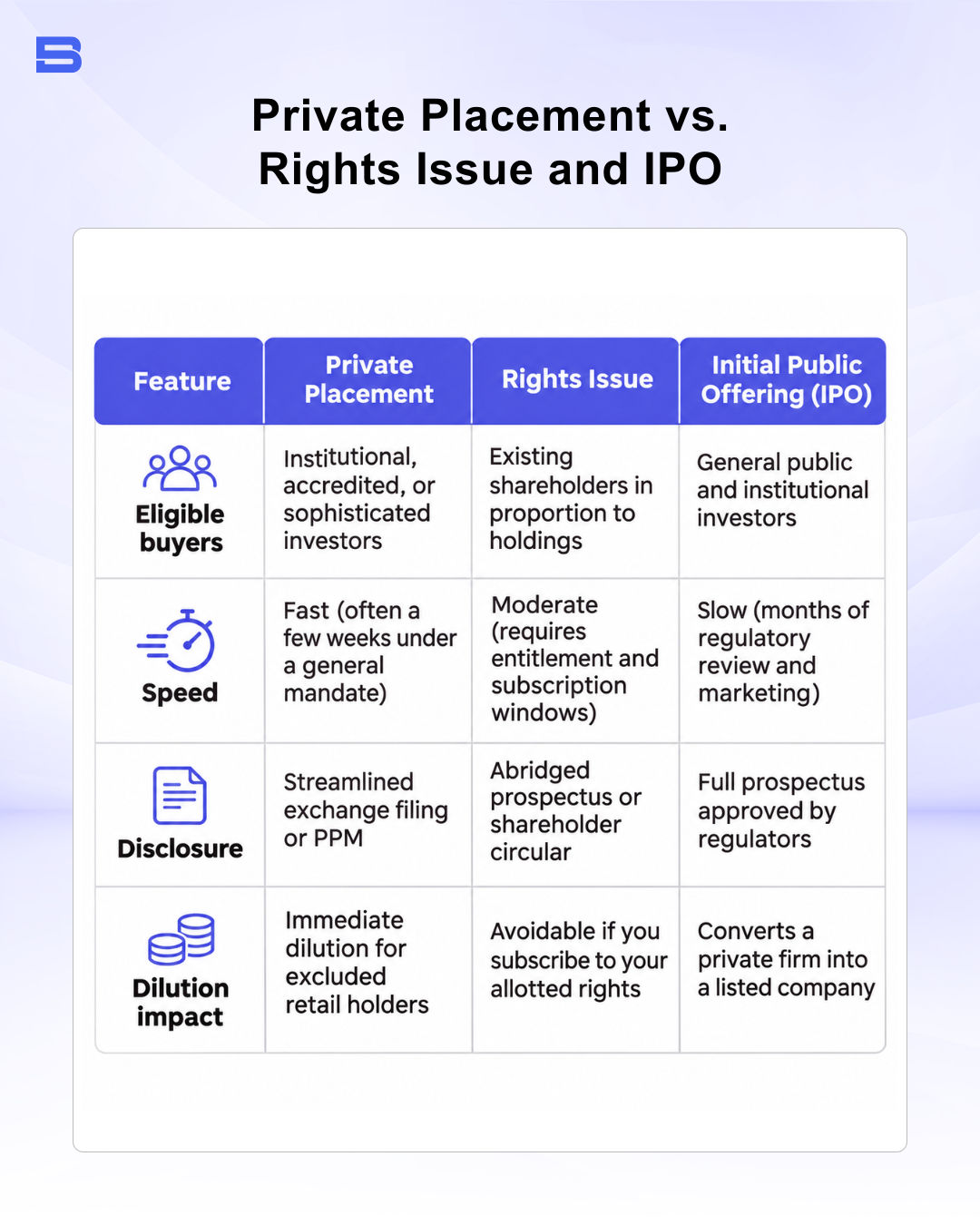
Choosing a rights issue lets you buy discounted new shares to protect your ownership stake. This deal removes that option in exchange for faster fundraising.
How to Evaluate a Private Placement Announcement Before Reacting
Seeing this kind of filing does not mean you should immediately sell your shares or buy more after the price falls. Before reacting, check four details in the company’s exchange announcement:
- Utilization of proceeds: Verify whether the cash funds revenue-generating expansion, such as new equipment or acquisitions, rather than routine working capital or debt repayment.
- Issue price discount: Compare the offer price to the market price, as steep discounts near regulatory caps can trigger heavier short-term selling.
- Placement size: A 5% to 10% share increase causes modest dilution, whereas a 20% or larger issue that requires a specific shareholder resolution sharply reduces existing voting power and EPS.
- Placee identity: Reputable institutional funds often signal long-term confidence, while short-term traders may sell quickly once shares list.
Remember that the deal raises capital rather than paying you out like a dividend. Weighing management’s capital track record against immediate dilution helps you decide if the stock still fits your goals.
Weigh the Proceeds Against the Dilution
This method lets companies raise capital quickly from institutional and accredited investors, but it creates immediate share dilution for retail shareholders. Reviewing how management plans to deploy the proceeds, the pricing discount, and the incoming buyers helps you judge whether the deal strengthens or weakens your investment.
- What Is Trading and How Does Trading Work?
- Trading Fundamentals: A Guide for Beginners
- Trading vs. Investing: What Are the Key Differences?
- Trading Terms and Terminologies Every Beginner Should Know
- Common Trading Mistakes Beginners Make and How to Avoid
- Understanding Risk and Reward in Trading: A Complete Guide
- Guide to the Different Types of Financial Markets
- Investment Basics: Definition, Strategies, and How to Invest
- Benefits of Investing: Financial Growth and Security
- What Is Swing Trading? A Practical Guide For Beginners
- What Is Spot Trading? A Guide for Beginners
- What Are Futures in Trading? A Guide for Beginners
- Understanding Bull Markets: Growth & Strategy
- How to Read a Candlestick Chart: A Guide for Beginners
- Is Trading Gambling? The Truth About Risk
- Pip in Forex: How It Works & How to Calculate It
- What Is the Bid-Ask Spread in Trading? A Guide for Beginners
- What Is a Margin Call? A Guide for Beginners
- Market Volatility Explained: What It Is and How to Trade It
- Drawdown in Trading: Meaning, Math, and Risk
- Understanding Slippage in Trading: Causes and Control
- Forex Lot Size Explained: Standard, Mini & Micro
- Trailing Stop vs Stop Loss: Essential Risk Strategy
- How Asset Allocation Works: Strategies Explained
- Understanding Market Trading Hours & Sessions
- Market Makers Explained: A Trader's Guide
- Portfolio Diversification: A Strategy Guide
- Capital Gains Explained: How Investment Taxes Work
- Stock Market Circuit Breakers: How Trading Halts Work
- What Is an IPO? How Initial Public Offerings Work
- What Is a Secondary Market? A Complete Guide
- What Is a Stock Exchange? Functions and Overview Explained
- Understanding Ticker Symbols: A Market Guide
- How Clearing Houses Work in Financial Markets
- Stock Market After Labor Day: Trends and What To Expect
Disclaimer: The content on this page is intended for educational and informational purposes only. It does not constitute financial, investment, tax, or legal advice, and should not be interpreted as a recommendation to buy, sell, or hold any financial instrument or asset. Trading and investing involve significant risk, including the possible loss of your entire capital. Products such as forex, CFDs, and cryptocurrencies carry additional risks due to leverage, high volatility, and limited regulatory protection in some jurisdictions. Past performance of any financial instrument does not guarantee future results. Any market views, forecasts, or opinions expressed are those of the author at the time of writing and may not reflect current market conditions. Platform features, fees, and regulatory status are subject to change — always verify information directly with the relevant provider or regulator before making any financial decision. BrokerSpecs may receive compensation from third parties featured on this site. Always conduct your own due diligence and consider seeking advice from a licensed financial professional before investing. Portions of this article were prepared with the assistance of AI tools and reviewed by our editorial team before publication.