



Related Tags
Suppose you are comparing two shares from the same listed company, hoping to build a steady stream of passive income without riding wild daily price swings. One share class rises and falls with every earnings surprise, while the other promises a fixed dividend payout before common shareholders receive a cent. Understanding how preference shares work helps you weigh predictable cash flow against long-term capital growth before committing your capital.
Preference Shares Meaning: How Preferred Stock Works
Preference shares are a class of company stock that pays fixed dividends and holds priority over ordinary shares during profit distributions and liquidation. In financial markets, analysts often describe them as a hybrid instrument because they blend characteristics of both equities and corporate bonds.
Like ordinary shares, preference shares represent ownership equity on a company's balance sheet and usually have no fixed maturity date. Like bonds, however, they typically pay a predetermined dividend calculated as a percentage of the share's par value.
Knowing this structure matters because your rights as a shareholder depend heavily on which share class you hold. When a company faces tight cash flow or restructures its balance sheet, priority rules determine who gets paid first and who absorbs losses first.
How Preference Share Dividends Work in Practice
Preference shareholders stand ahead of common stockholders whenever the board of directors declares a dividend. Before a company can distribute profits to ordinary investors, it must first pay the agreed fixed rate to preference holders, which builds on the basics of how dividends work.
Consider a company with 10,000 preference shares issued at a $100 par value carrying a 6% annual dividend rate, alongside 100,000 ordinary shares. Each preference share entitles its holder to $6 per year, requiring $60,000 in total preference payouts.
If the company generates $100,000 in distributable profit for the year, preference shareholders receive their full $60,000 first. Only the remaining $40,000 is available for ordinary shareholders, working out to $0.40 per ordinary share.
If profits fall to $50,000, preference holders receive the entire $50,000 and ordinary shareholders receive nothing. Investors comparing dividend stocks still need to track the ex-dividend date to qualify for payouts, and check whether the issuer offers a dividend reinvestment plan or pays strictly in cash.
Types of Preference Shares You May Encounter
Companies customize preference shares with specific clauses before listing them on a stock exchange. On markets like Bursa Malaysia, retail investors frequently encounter instruments such as Redeemable Convertible Preference Shares (RCPS) and Irredeemable Convertible Preference Shares (ICPS) during corporate fundraising exercises.
Cumulative vs. Non-Cumulative Preference Shares
Cumulative preference shares protect your income if a company temporarily suspends dividends during a downturn. Any missed payments accumulate as arrears and must be paid in full before ordinary shareholders can receive future dividends. Non-cumulative preference shares carry no such catch-up right, meaning any skipped dividend is permanently forfeited.
Convertible Preference Shares and Participating Rights
Convertible preference shares allow you to swap your preferred stock into a preset number of ordinary shares after a specified date. This feature lets you capture upside if the company's common stock rallies significantly. Participating preference shares go a step further by granting extra dividends on top of the fixed rate when company profits exceed a stated threshold.
Redeemable Preference Shares and Call Features
Redeemable preference shares give the issuing company the right to buy back your shares at a predetermined call price after a set date. Issuers often exercise this option when market interest rates drop so they can refinance at a lower cost, which caps how much your shares can appreciate.
Ordinary Shares vs Preference Shares: Key Differences for Investors
Choosing between ordinary shares and preference shares comes down to whether you prioritize voting influence and uncapped growth or steadier dividend priority. Ordinary shares grant voting rights at annual general meetings and benefit directly from corporate actions like a stock split, whereas preference shares usually carry no voting power unless dividends fall into arrears.
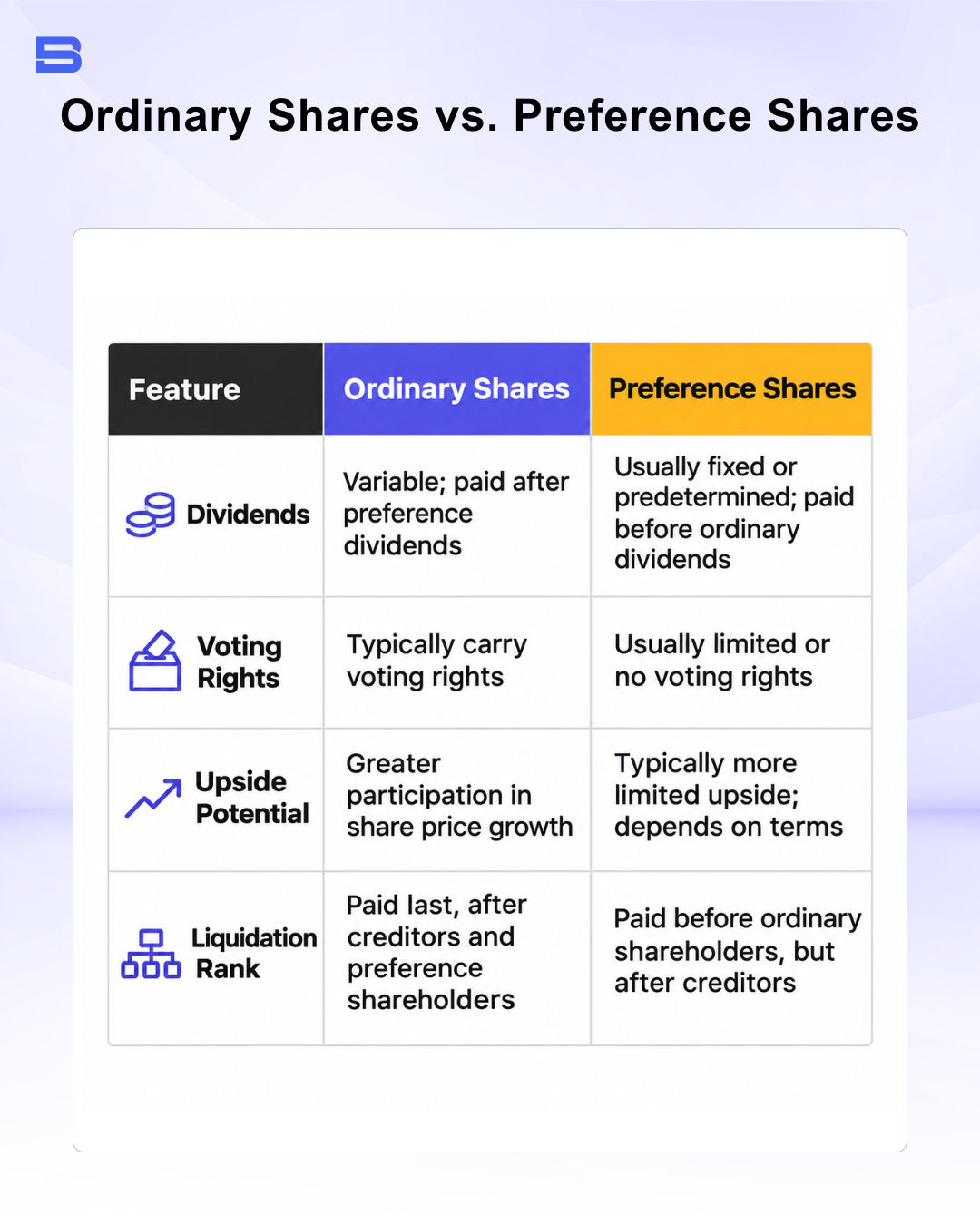
According to investor guidance from the U.S. Securities and Exchange Commission (SEC), preferred stockholders rank senior to common stockholders for dividends and assets, yet generally give up standard voting rights and full participation in rapid share-price rallies. You should review the offering prospectus carefully to see how each class behaves across market cycles.
Key Risks and Trade-Offs of Preference Shares
While preference shares offer predictable payout priority, they are not risk-free and can lose value in several ways. First, preference dividends are not legally guaranteed like bond coupons, meaning a board of directors can defer or cancel payouts if earnings deteriorate.
Second, your capital upside remains capped because the market price tends to hover near the par or redemption value rather than climbing with corporate earnings. Third, preference shares are sensitive to interest-rate changes, so rising central bank rates often push their market prices down to keep yields competitive with newly issued fixed-income securities.
Fourth, liquidation preference only places you ahead of ordinary shareholders, not ahead of secured lenders, banks, or bondholders. As capital market disclosures overseen by the Securities Commission Malaysia (SC) highlight, preference shareholders still face the risk of losing their entire invested capital if an insolvent company's assets cannot cover its senior debts.
Steady Income at the Cost of Growth and Votes
Preference shares bridge the gap between bonds and ordinary stocks by offering priority on fixed dividends in exchange for capped price growth and no voting rights. Weighing that steady income profile against interest-rate sensitivity and insolvency risk helps you decide whether they fit your portfolio.
- What Is Trading and How Does Trading Work?
- Trading Fundamentals: A Guide for Beginners
- Trading vs. Investing: What Are the Key Differences?
- Trading Terms and Terminologies Every Beginner Should Know
- Common Trading Mistakes Beginners Make and How to Avoid
- Understanding Risk and Reward in Trading: A Complete Guide
- Guide to the Different Types of Financial Markets
- Investment Basics: Definition, Strategies, and How to Invest
- Benefits of Investing: Financial Growth and Security
- What Is Swing Trading? A Practical Guide For Beginners
- What Is Spot Trading? A Guide for Beginners
- What Are Futures in Trading? A Guide for Beginners
- Understanding Bull Markets: Growth & Strategy
- How to Read a Candlestick Chart: A Guide for Beginners
- Is Trading Gambling? The Truth About Risk
- Pip in Forex: How It Works & How to Calculate It
- What Is the Bid-Ask Spread in Trading? A Guide for Beginners
- What Is a Margin Call? A Guide for Beginners
- Market Volatility Explained: What It Is and How to Trade It
- Drawdown in Trading: Meaning, Math, and Risk
- Understanding Slippage in Trading: Causes and Control
- Forex Lot Size Explained: Standard, Mini & Micro
- Trailing Stop vs Stop Loss: Essential Risk Strategy
- How Asset Allocation Works: Strategies Explained
- Understanding Market Trading Hours & Sessions
- Market Makers Explained: A Trader's Guide
- Portfolio Diversification: A Strategy Guide
- Capital Gains Explained: How Investment Taxes Work
- Stock Market Circuit Breakers: How Trading Halts Work
- What Is an IPO? How Initial Public Offerings Work
- What Is a Secondary Market? A Complete Guide
- What Is a Stock Exchange? Functions and Overview Explained
- Understanding Ticker Symbols: A Market Guide
- How Clearing Houses Work in Financial Markets
- Stock Market After Labor Day: Trends and What To Expect
Disclaimer: The content on this page is intended for educational and informational purposes only. It does not constitute financial, investment, tax, or legal advice, and should not be interpreted as a recommendation to buy, sell, or hold any financial instrument or asset. Trading and investing involve significant risk, including the possible loss of your entire capital. Products such as forex, CFDs, and cryptocurrencies carry additional risks due to leverage, high volatility, and limited regulatory protection in some jurisdictions. Past performance of any financial instrument does not guarantee future results. Any market views, forecasts, or opinions expressed are those of the author at the time of writing and may not reflect current market conditions. Platform features, fees, and regulatory status are subject to change — always verify information directly with the relevant provider or regulator before making any financial decision. BrokerSpecs may receive compensation from third parties featured on this site. Always conduct your own due diligence and consider seeking advice from a licensed financial professional before investing. Portions of this article were prepared with the assistance of AI tools and reviewed by our editorial team before publication.