



Related Tags
Entering the financial markets for the first time can feel overwhelming when faced with thousands of individual stocks to research. Many investors want exposure to overall market growth without the stress and time commitment of picking individual corporate winners and losers. Exchange-Traded Funds (ETFs) offer a practical solution by allowing you to purchase a broad basket of assets through a single transaction on a stock exchange.
This guide walks you through exactly how to buy ETFs in Malaysia — from choosing an account to placing your first order. In short: you buy an ETF by opening a CDS or brokerage account, funding it in Ringgit, and placing an order for your chosen ETF ticker on Bursa Malaysia or a foreign exchange. The full step-by-step process is below.
What Is an ETF and How Does It Work?
When you purchase one unit of an ETF, you do not directly own individual shares of the underlying companies. Instead, you buy a proportional interest in the entire pooled basket of assets managed by the fund provider.
ETFs track the performance of a specific target index or asset class. For example, an ETF designed to track a stock index will hold shares in the index's constituent companies in the same proportions.
This structure provides immediate portfolio diversification, spreading your investment across dozens or hundreds of companies in one order. Because ETFs trade continuously throughout the market day, you can buy and sell units at real-time market prices, giving you high flexibility and liquidity compared to traditional pooled funds.
ETF vs Unit Trust in Malaysia: What's the Difference?
While both ETFs and unit trusts pool investor funds to purchase diversified portfolios, their structure, trading mechanisms, and fee frameworks differ significantly: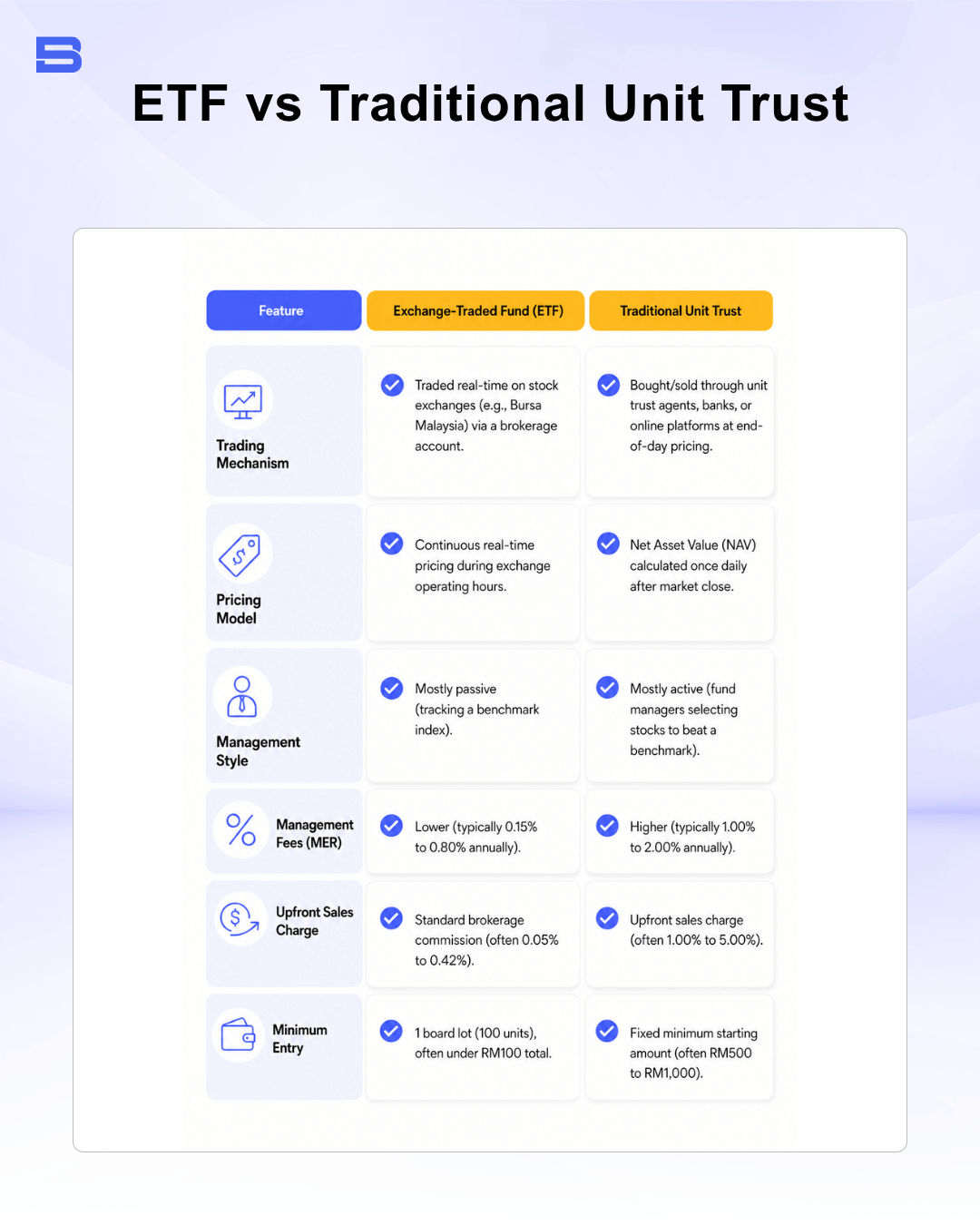
Listed ETFs in Malaysia (Bursa Malaysia & Global Access)
Malaysian investors can access both domestic ETFs listed on Bursa Malaysia and international ETFs listed on major global stock exchanges like the New York Stock Exchange (NYSE) or Nasdaq.
Local Bursa Malaysia Index ETFs
Bursa Malaysia hosts a growing selection of locally listed ETFs regulated by the Securities Commission Malaysia (SC). These funds cover local equity indices, regional markets, fixed income, and commodities:
- Equity Index Trackers: Funds that track the KLCI Index (FTSE Bursa Malaysia KLCI), providing instant exposure to the top 30 largest listed companies in Malaysia.
- Shariah-Compliant ETFs: Locally listed funds structured to adhere strictly to Islamic financial principles, screened by the Securities Commission Malaysia's Shariah Advisory Council.
- Regional & Commodity ETFs: Bursa Malaysia also features ETFs offering exposure to gold bullion, foreign stock indices (such as China or ASEAN equity pools), and fixed-income sukuk instruments.
Buying US and Global ETFs from Malaysia
If you want to invest in global tech giants, broad international indices like the S&P 500, or sector-specific global trends, you can buy foreign-listed ETFs directly through local or international brokerages operating in Malaysia.
Global ETFs listed on major foreign exchanges often have higher trading volumes and lower Management Expense Ratios (MER) than smaller domestic funds, though this can vary by fund and exchange.
How to Invest in ETFs in Malaysia (Local vs. Foreign)
Once you understand how to buy ETFs in Malaysia through either route, choosing the right account structure is the next step.
CDS Account vs. Foreign Brokerage Account
To buy ETFs listed directly on Bursa Malaysia, you need a Direct or Nominee Direct Central Depository System (CDS) account linked to a local stockbroker. A CDS account records your ownership of securities traded on the local exchange.
To purchase overseas ETFs (such as US-listed funds), you need a brokerage account that offers international market access. This can be a local Malaysian broker with a global trading desk or a licensed international multi-asset brokerage platform.
How to Buy ETFs in Malaysia: Step-by-Step
Setting up your portfolio requires a straightforward four-step roadmap:
- Choose Your Investment Platform: Decide whether to trade directly through a stock brokerage (for full control over individual ETF orders) or an automated robo-advisor platform (which automatically builds and rebalances an ETF portfolio for you).
- Open and Verify Your Account: Complete the online registration and Know Your Customer (KYC) verification by submitting your Identification Card (IC) or passport along with proof of address and bank account details.
- Fund Your Account: Transfer Ringgit (MYR) to your brokerage account via FPX online banking. If purchasing foreign ETFs, your brokerage will convert MYR into US Dollars (USD) or the respective trading currency at the prevailing exchange rate.
- Search and Execute Your Order: Locate the target ETF using its ticker symbol (e.g., 0820EA for a local fund or VOO for a US S&P 500 ETF), specify the number of units or lot sizes, select your order type (Market or Limit order), and confirm the transaction.
Key Costs, Risks, and Important Considerations
While ETFs are generally cost-efficient investment vehicles, holding them involves several distinct cost layers and financial risks. Understanding these costs is just as important as knowing how to buy ETFs in the first place.
Understanding Costs: A Worked Example
Consider a hypothetical investment of RM10,000 into a global equity ETF via a local brokerage service:
- Brokerage Commission: An initial entry fee charged by your broker (e.g., 0.10% or a minimum flat fee of RM8.00). On RM10,000, a 0.10% fee equals RM10.
- Currency Exchange Conversion Spread: When converting MYR to USD to buy foreign ETFs, brokers apply a FX spread (typically 0.3% to 1.0%). A 0.5% spread on RM10,000 incurs an implicit entry cost of RM50 (these percentages are illustrative examples only—actual brokerage commissions, FX spreads, and MERs vary by provider and fund.)
- Management Expense Ratio (MER): An ongoing annual fee deducted directly from the fund's Net Asset Value by the ETF manager (e.g., 0.08% annually for standard US index ETFs). This costs RM8 per year on a RM10,000 holding.
- Dividend Withholding Tax: Foreign dividend distributions are subject to local tax rules. For instance, US-sourced dividends paid to non-US investors (including Malaysians) face a standard 30% foreign withholding tax at the source before payout, as set out under U.S. Internal Revenue Service (IRS) rules for non-resident aliens.
Risks to Keep in Mind
- Market Risk: ETFs reflect the performance of their underlying assets; if the overall stock market declines, the value of your ETF will fall accordingly.
- Currency Risk: Investing in foreign ETFs exposes your returns to exchange rate movements between the Ringgit and foreign currencies like the USD.
- Tracking Error: The risk that an ETF’s actual performance slightly deviates from its benchmark index due to management fees, rebalancing delays, or cash drag.
Comparing ETFs with Malaysian REITs and Other Assets
ETFs share structural similarities with other exchange-traded assets, but serve distinct portfolio roles. For instance, a Real Estate Investment Trust (REIT) trades like a stock or ETF, but focuses specifically on income-generating real estate properties and distributes most of its income as dividends.
Whichever asset you choose, the fundamentals of how to buy ETFs in Malaysia remain the same: open an account, fund it, and place your order. Evaluating your individual investment goals and overall risk tolerance will help you determine how to allocate capital effectively across equities, real estate, fixed income, and broad-market ETFs.
- What Can You Trade? A Guide to Forex, Stocks, and More
- CFD Trading for Beginners
- What is CFD Trading and How Does It Work?
- Forex vs. Stocks: Which Market Suits You Best?
- How to Diversify a Portfolio Across Asset Classes
- How Dividend Stocks Work: Yields, Risks, and Strategies
- Silver Trading Explained: A Guide for Retail Investors
- Precious Metals Trading: A Complete Guide for Beginners
- Natural Gas Trading: A Guide to the Market
- Structured Warrants Malaysia: How They Work and Risks
- What Is the KLCI Index and How to Trade It
- Gold Investment in Malaysia: A Complete Guide for Beginners
- What Is Kijang Emas and How to Invest in It
- Value Investing Explained: How to Find Undervalued Stocks
- How to Trade Bitcoin Safely: A Complete Market Guide
- Growth Investing Explained: Strategies, Metrics, and Risks
- What Is Digital Gold Malaysia and How to Invest
- Crypto Trading Strategies for Beginners
- Gold vs Bitcoin: Key Differences, Risks, and Strategies
- Sukuk: A Guide for Beginners to Islamic Bonds
- What Is FCPO (Crude Palm Oil Futures) and How to Trade It
- How to Identify and Invest in Shariah-Compliant Stocks
- Timber Investment: Is It Worth It?
- Gold ETF Malaysia: A Guide for Beginners
- What Are Malaysian Government Securities (MGS)?
- Corporate Bonds Malaysia: A Guide for Beginners
- China A-Shares Trading Guide for Malaysian Investors
- What Is a Silver ETF and How to Invest in It?
- How to Trade XRP: A Practical Guide for Retail Investors
- How to Trade Solana (SOL): A Guide for Beginners
- What Are Gold Futures and How Do They Work?
- Money Market Fund in Malaysia: A Guide for Beginners
- Property Investment Malaysia: Direct Real Estate or M-REITs?
- What Is Binance Coin and How Does It Work?
- Green Sukuk: A Guide for Beginners to Islamic ESG Investing
- What Is Shiba Inu (SHIB) and How to Trade It
- What Is USDT? A Complete Guide to Tether for Beginners
- What Is Dogecoin and How to Trade It Safely for Beginners
- Cardano: A Guide for Beginners to Trade This Cryptocurrency
- Polkadot: A Guide to Trading This Cryptocurrency
- Tron: A Guide for Beginners to Trading This Cryptocurrency
- What Is Litecoin (LTC)? A Guide to Trading Digital Silver
- What Is Chainlink (LINK) and How to Trade It
- How to Trade Pepe Coin: Spot, Leverage, and Risk Management
- Near Protocol: A Guide to Trading This Cryptocurrency
- Trading Polygon Crypto: A Practical Guide for Beginners
- Trade Toncoin: Understanding the TON Ecosystem and Risks
- Cosmos Crypto: Ecosystem Architecture, Tokenomics, and Risks
- Stellar Crypto: A Guide to Trading This Cryptocurrency
- Avalanche Crypto Explained: A Practical Guide for Traders
- What Is Worldcoin? How to Trade WLD and Manage Risk
- Aptos: A Guide for Beginners to Trading This Cryptocurrency
- Sui Crypto Explained: Tokenomics and Trading Guide
- Celestia: A Guide to Trading This Cryptocurrency
- Decentraland: A Guide to Trading This Cryptocurrency
- What Is Arbitrum? How to Trade the Leading Layer 2 Network
- Sei Crypto: A Guide to Trading This Cryptocurrency
- What Is Injective Protocol and How to Trade INJ Safely
Disclaimer: The content on this page is intended for educational and informational purposes only. It does not constitute financial, investment, tax, or legal advice, and should not be interpreted as a recommendation to buy, sell, or hold any financial instrument or asset. Trading and investing involve significant risk, including the possible loss of your entire capital. Products such as forex, CFDs, and cryptocurrencies carry additional risks due to leverage, high volatility, and limited regulatory protection in some jurisdictions. Past performance of any financial instrument does not guarantee future results. Any market views, forecasts, or opinions expressed are those of the author at the time of writing and may not reflect current market conditions. Platform features, fees, and regulatory status are subject to change — always verify information directly with the relevant provider or regulator before making any financial decision. BrokerSpecs may receive compensation from third parties featured on this site. Always conduct your own due diligence and consider seeking advice from a licensed financial professional before investing.