



Related Tags
Imagine sitting at a coffee shop in Kuala Lumpur, scrolling through your phone, and purchasing shares of Apple, Microsoft, or Nvidia in just a few taps.
For Malaysian investors, holding equities in world-leading technology, healthcare, and consumer giants is no longer reserved for institutional funds. You can legally and directly trade American equities from Malaysia using either local Securities Commission-regulated platforms or international brokerage accounts.
Can Malaysians Buy US Stocks Directly?
Yes, Malaysian residents can legally buy and own US stocks directly from Malaysia. Bank Negara Malaysia (BNM) Foreign Exchange Notices allow resident individuals to invest in foreign currency assets overseas, provided you utilize your own funds or remain within permitted borrowing limits.
When you invest in overseas financial markets, your assets are managed under an international custody model rather than direct domestic registration. Currency conversion spreads and international wire fees will apply during funding, so calculating these transactional overheads before executing trades is essential for maintaining net returns.
CDS Account vs. Custody Account Structure
If you have traded local shares on Bursa Malaysia, you are likely familiar with a Central Depository System (CDS) account managed by Bursa Malaysia Depository Sdn Bhd. However, CDS accounts function exclusively for domestic Malaysian securities.
When purchasing US stocks, foreign equities are held under a custodian account structure managed by licensed financial custodians or clearing brokerages. Your broker holds the foreign shares on your behalf in an omnibus or segregated client account registered with depository entities such as the Depository Trust Company (DTC) in the United States.
Which Broker Lets You Buy US Stocks in Malaysia?
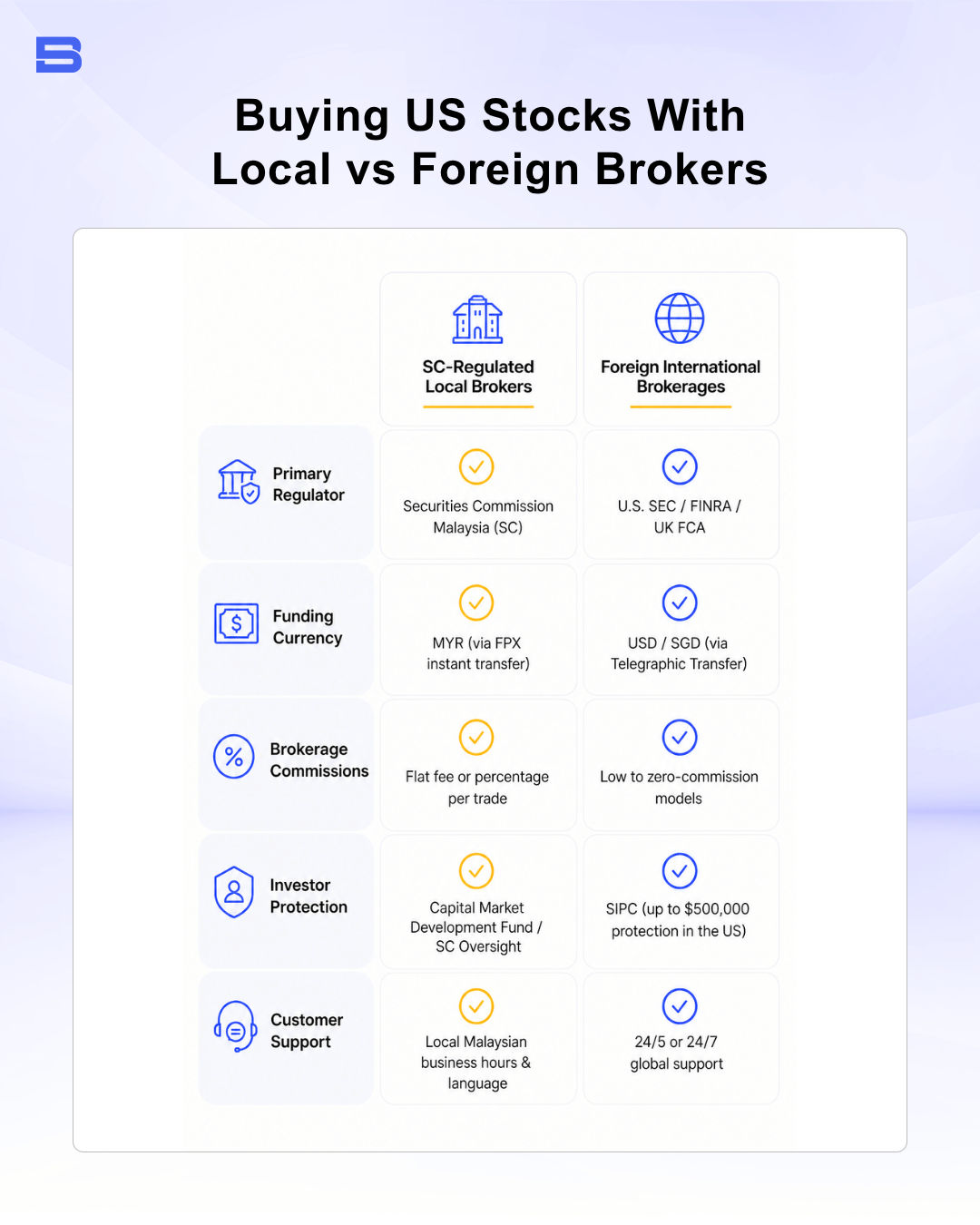
Malaysian retail investors generally choose between two primary categories of platforms: local brokerages regulated by the Securities Commission Malaysia (SC) and foreign international brokerages. Local platforms regulated by the SC provide familiar Financial Process Exchange (FPX) bank transfers in Malaysian Ringgit (MYR) and local investor support.
Foreign international platforms, overseen by Tier-1 regulators such as the US Securities and Exchange Commission (SEC) or the UK Financial Conduct Authority (FCA), often provide access to advanced trading tools and direct market access.
Before opening an account, you will need to complete Know Your Customer (KYC) identity verification. Brokerage platforms typically require three standard documents: a clear copy of your MyKad or international passport, proof of residential address issued within the last three months (such as a utility bill or bank statement), and a valid Malaysian bank account for deposits and withdrawals.
Step-by-Step Guide: How to Buy US Stocks in Malaysia
Opening an account and placing your first foreign trade is a straightforward process once your identity verification is approved. Follow these four practical steps to get started:
- Select a Regulated Broker and Complete Registration: Choose an established platform aligned with your budget and regulatory preferences, then upload your MyKad and proof of address for account verification.
- Complete the US W-8BEN Tax Form: During onboarding, your broker will prompt you to complete Form W-8BEN. This mandatory document certifies that you are a non-US resident for tax purposes.
- Fund Your Account in MYR or USD: Deposit funds using online banking FPX for local brokers, or via telegraphic transfer/multi-currency accounts for foreign platforms. Keep an eye on currency exchange rates between MYR and USD.
- Search and Execute Your Order: Locate your target company using its ticker symbol (e.g., AAPL for Apple, NVDA for Nvidia). Select your order type—a Market Order for immediate execution or a Limit Order to set a maximum buy price—and confirm the transaction.
US Market Trading Hours in Malaysia Time (MYT)
Because Wall Street operates in Eastern Time (ET), Malaysian investors trade during night hours. Understanding the session timing prevents missed order execution windows:
- Daylight Saving Time (March to November): Regular market hours run from 9:30 PM to 4:00 AM MYT.
- Standard Time (November to March): Regular market hours run from 10:30 PM to 5:00 AM MYT.
Value Investing vs Growth Investing in US Stocks
Building an international portfolio requires aligning your strategy with your personal risk tolerance and financial timeline. Investors exploring global markets usually lean toward either value investing or growth investing strategies.
Value investing involves searching for mature, financially sound companies that trade below their calculated intrinsic value, often offering stable earnings and regular cash dividends.
Growth investing focuses on high-expansion companies that reinvest their earnings into rapid innovation and market acquisition, trading at higher price-to-earnings multiples with significant potential upside alongside higher market volatility.
US ETFs vs. Individual US Stocks
If picking individual stocks feels overwhelming, Exchange-Traded Funds (ETFs) offer immediate diversification across entire sectors or stock indexes. What is ETF investing? An ETF is a basket of securities trading on a public stock exchange, allowing you to own proportional shares in hundreds of leading companies through a single trade.
For Malaysian investors, comparing asset classes with global trading instruments, combining local foundations like unit trusts or ASNB investments with international allocations like US ETFs, or yield-generating dividend stocks helps establish a balanced multi-asset portfolio.
Tax Implications: Dividend Withholding Tax and Capital Gains
Understanding taxation rules helps ensure you retain as much of your investment growth as possible. The tax treatment for Malaysian retail investors trading US equities is divided into two distinct categories:
- Capital Gains Tax (0%): Malaysia does not impose capital gains tax on foreign stock trading profits for individual retail investors. Furthermore, the United States Internal Revenue Service (IRS) does not tax capital gains for non-resident foreign investors who submit a valid Form W-8BEN.
- Dividend Withholding Tax (30%): The US government levies a standard 30% withholding tax on cash dividends paid by US corporations to foreign individual investors. This tax is withheld automatically by your broker before the dividend payment reaches your account balance.
Navigating Global Markets
Buying US stocks from Malaysia is a legal, accessible, and structured process once you select a licensed broker, complete Form W-8BEN, and understand foreign exchange spreads. By balancing foreign stock allocations with domestic financial planning, you can effectively diversify your wealth across the world's largest equity markets.
- What Can You Trade? A Guide to Forex, Stocks, and More
- CFD Trading for Beginners
- What is CFD Trading and How Does It Work?
- Forex vs. Stocks: Which Market Suits You Best?
- How to Diversify a Portfolio Across Asset Classes
- How Dividend Stocks Work: Yields, Risks, and Strategies
- Silver Trading Explained: A Guide for Retail Investors
- Precious Metals Trading: A Complete Guide for Beginners
- Natural Gas Trading: A Guide to the Market
- Structured Warrants Malaysia: How They Work and Risks
- What Is the KLCI Index and How to Trade It
- Gold Investment in Malaysia: A Complete Guide for Beginners
- What Is Kijang Emas and How to Invest in It
- Value Investing Explained: How to Find Undervalued Stocks
- How to Trade Bitcoin Safely: A Complete Market Guide
- Growth Investing Explained: Strategies, Metrics, and Risks
- What Is Digital Gold Malaysia and How to Invest
- Crypto Trading Strategies for Beginners
- Gold vs Bitcoin: Key Differences, Risks, and Strategies
- Sukuk: A Guide for Beginners to Islamic Bonds
- What Is FCPO (Crude Palm Oil Futures) and How to Trade It
- How to Identify and Invest in Shariah-Compliant Stocks
- Timber Investment: Is It Worth It?
- Gold ETF Malaysia: A Guide for Beginners
- What Are Malaysian Government Securities (MGS)?
- Corporate Bonds Malaysia: A Guide for Beginners
- China A-Shares Trading Guide for Malaysian Investors
- What Is a Silver ETF and How to Invest in It?
- How to Trade XRP: A Practical Guide for Retail Investors
- How to Trade Solana (SOL): A Guide for Beginners
- What Are Gold Futures and How Do They Work?
- Money Market Fund in Malaysia: A Guide for Beginners
- Property Investment Malaysia: Direct Real Estate or M-REITs?
- What Is Binance Coin and How Does It Work?
- Green Sukuk: A Guide for Beginners to Islamic ESG Investing
- What Is Shiba Inu (SHIB) and How to Trade It
- What Is USDT? A Complete Guide to Tether for Beginners
- What Is Dogecoin and How to Trade It Safely for Beginners
- Cardano: A Guide for Beginners to Trade This Cryptocurrency
- Polkadot: A Guide to Trading This Cryptocurrency
- Tron: A Guide for Beginners to Trading This Cryptocurrency
- What Is Litecoin (LTC)? A Guide to Trading Digital Silver
- What Is Chainlink (LINK) and How to Trade It
- How to Trade Pepe Coin: Spot, Leverage, and Risk Management
- Near Protocol: A Guide to Trading This Cryptocurrency
- Trading Polygon Crypto: A Practical Guide for Beginners
- Trade Toncoin: Understanding the TON Ecosystem and Risks
- Cosmos Crypto: Ecosystem Architecture, Tokenomics, and Risks
- Stellar Crypto: A Guide to Trading This Cryptocurrency
- Avalanche Crypto Explained: A Practical Guide for Traders
- What Is Worldcoin? How to Trade WLD and Manage Risk
- Aptos: A Guide for Beginners to Trading This Cryptocurrency
- Sui Crypto Explained: Tokenomics and Trading Guide
- Celestia: A Guide to Trading This Cryptocurrency
- Decentraland: A Guide to Trading This Cryptocurrency
- What Is Arbitrum? How to Trade the Leading Layer 2 Network
- Sei Crypto: A Guide to Trading This Cryptocurrency
- What Is Injective Protocol and How to Trade INJ Safely
Disclaimer: The content on this page is intended for educational and informational purposes only. It does not constitute financial, investment, tax, or legal advice, and should not be interpreted as a recommendation to buy, sell, or hold any financial instrument or asset. Trading and investing involve significant risk, including the possible loss of your entire capital. Products such as forex, CFDs, and cryptocurrencies carry additional risks due to leverage, high volatility, and limited regulatory protection in some jurisdictions. Past performance of any financial instrument does not guarantee future results. Any market views, forecasts, or opinions expressed are those of the author at the time of writing and may not reflect current market conditions. Platform features, fees, and regulatory status are subject to change — always verify information directly with the relevant provider or regulator before making any financial decision. BrokerSpecs may receive compensation from third parties featured on this site. Always conduct your own due diligence and consider seeking advice from a licensed financial professional before investing.