



Related Tags
Imagine a trader spotting a blue-chip company offering a generous payout, buying shares on the morning of the cutoff date, and expecting cash in their account weeks later. When payment day arrives, nothing shows up because the seller kept the entitlement. Knowing how the ex-dividend date works ensures you understand exact ownership cutoffs before placing an order.
What Is the Ex-Dividend Date?
The ex-dividend date is the trading cutoff day on which a stock begins trading without the value of its upcoming dividend.
When a company declares a distribution, thousands of shares change hands daily, making it impossible to track every buyer in real time. Stock exchanges set a cutoff day so clearing houses know which investors officially qualify before shareholder records close. Similar cutoff rules also apply to other corporate actions, such as a bonus issue or a rights issue, where ownership timing determines entitlement.
Cum-Dividend vs. Ex-Dividend: When You Must Buy to Qualify
Before the cutoff date arrives, the stock trades "cum-dividend," meaning with the dividend attached. If you buy shares during this cum-dividend window and hold them through the market close on the day before the cutoff date, you qualify for the payout. You can buy a stock on the ex-dividend date, but new buyers purchase it without the upcoming distribution, and the seller retains the right to collect it.
What Happens If You Sell After the Ex-Dividend Date?
If you already owned the shares before the cutoff date, selling them on or after that day does not cancel your payout. Because you held the stock through the cutoff, your name still appears on the company’s shareholder register when books close. You will still receive the declared dividend on the scheduled payment date, even if you no longer hold the shares in your portfolio.
Ex-Dividend Date vs. Record Date: Understanding the 4 Key Dividend Dates
Understanding how dividends work requires tracking four distinct dates in chronological order rather than focusing on a single calendar day. Each milestone serves a specific administrative purpose between the company’s board of directors, the stock exchange, and your broker.
- Declaration Date: The company’s board announces the dividend amount, the record date, and the payment date.
- Ex-Dividend Date: The first trading day on which new buyers are no longer entitled to receive the announced dividend.
- Record Date: The date the company checks its official shareholder register to confirm eligible owners, excluding non-voting treasury shares and accounting for priority rules on preference shares or newly issued stock from a private placement.
- Payment Date: The day the company distributes cash directly to your brokerage account, credits additional shares through a dividend reinvestment plan, or transfers assets via a dividend in specie.
Missing the ex-dividend cutoff means your trade will not settle in time for the record date, regardless of when the cash is eventually paid.
T+1 vs. T+2 Settlement Cycles and the Lodgment Date
The gap between the cutoff date and the record date depends on the local exchange’s trade settlement cycle. When you buy a stock, legal ownership transfers only after clearing finishes, which varies across global markets.
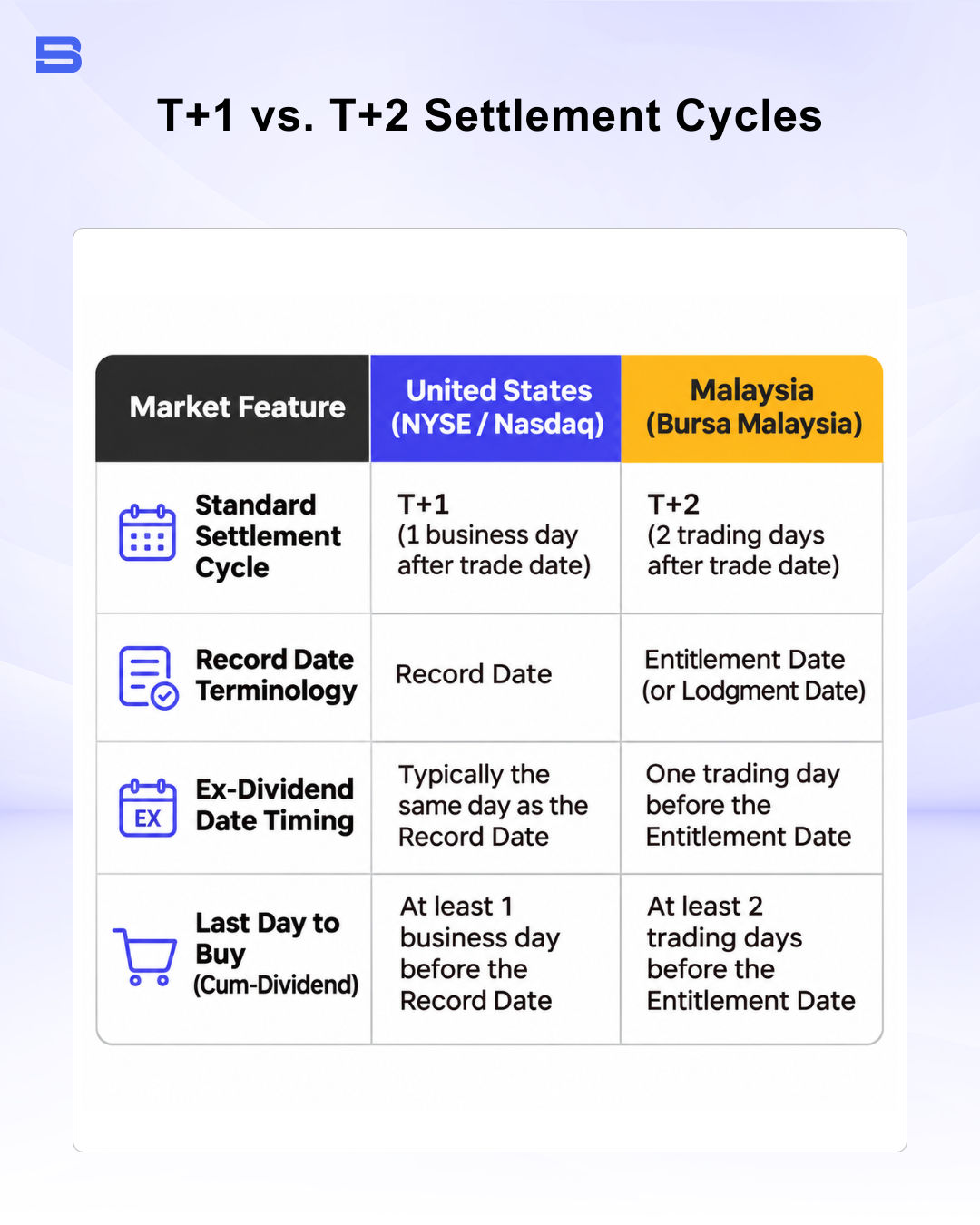
Following the US Securities and Exchange Commission (SEC) transition to T+1 settlement on May 28, 2024, US stocks generally go ex-dividend on the same business day as their record date. On Bursa Malaysia, which generally operates on a T+2 settlement cycle, the record date is often called the Entitlement Date or Lodgment Date, and the ex-date typically falls one trading day earlier. Public holidays and weekends do not count as trading days, so always check your exchange’s holiday calendar before placing a trade near a cutoff.
How the Ex-Dividend Date Affects Stock Prices
Beyond settlement timing, the stock price drop on the ex-dividend date typically equals roughly the amount of the declared dividend. This adjustment happens because the company is transferring cash off its balance sheet to shareholders, reducing its net asset value per share.
Unlike a stock split, which increases your share count while lowering the share price proportionally, a cash dividend leaves your share count unchanged and converts part of the share’s market value into cash.
Consider a practical example where an investor owns 1,000 shares of a Bursa-listed company trading at RM10.00 at the close of the cum-dividend day, giving that investor a position worth RM10,000. If the company declares a RM0.30 per share dividend, the exchange adjusts the opening reference price on the ex-date downward by RM0.30 to RM9.70.
The shares are now worth RM9,700 at the open, while the investor is owed RM300 in upcoming dividends, keeping the combined pre-tax value unchanged at RM10,000 before regular market trading begins.
How Special Dividends Affect Ex-Dividend Dates and Price Drops
When a company issues an unusually large one-off payout known as a special dividend, the ex-dividend price drop is proportionally larger. In the US, a special distribution equal to 25% or more of the stock’s value may cause the ex-dividend date to be deferred until the first business day after the payment date, and trades in that window may carry “due bills” that transfer the dividend entitlement from seller to buyer until settlement completes.
Risks of Trading Around the Ex-Dividend Date
Some short-term traders attempt a "dividend capture" strategy by buying dividend stocks right before the ex-date and selling immediately afterward. In practice, this approach does not produce effortless income because the opening share price already adjusts downward to reflect the payout. Depending on market conditions, broader market sell-offs or weak earnings sentiment can push the stock price down further than the dividend amount, leaving you with a net capital loss.
Transaction costs also erode narrow dividend margins, including brokerage commissions, clearing fees, stamp duties, and foreign dividend withholding taxes. If you trade equities through Contracts for Difference (CFDs) rather than owning physical shares, brokers typically apply a cash dividend adjustment to open positions on the ex-date rather than paying a shareholder dividend.
Because CFDs are leveraged derivatives, they amplify both gains and losses, and long CFD holders also incur overnight financing costs that can outweigh any positive dividend adjustment.
Know the Cutoff, Then Judge the Company
Checking the cutoff date and your market’s settlement cycle before placing an order ensures you know whether a payout belongs to you or the seller. Evaluating a company’s cash flow, payout sustainability, and total return potential may matter more than chasing a single cutoff date.
- What Is Trading and How Does Trading Work?
- Trading Fundamentals: A Guide for Beginners
- Trading vs. Investing: What Are the Key Differences?
- Trading Terms and Terminologies Every Beginner Should Know
- Common Trading Mistakes Beginners Make and How to Avoid
- Understanding Risk and Reward in Trading: A Complete Guide
- Guide to the Different Types of Financial Markets
- Investment Basics: Definition, Strategies, and How to Invest
- Benefits of Investing: Financial Growth and Security
- What Is Swing Trading? A Practical Guide For Beginners
- What Is Spot Trading? A Guide for Beginners
- What Are Futures in Trading? A Guide for Beginners
- Understanding Bull Markets: Growth & Strategy
- How to Read a Candlestick Chart: A Guide for Beginners
- Is Trading Gambling? The Truth About Risk
- Pip in Forex: How It Works & How to Calculate It
- What Is the Bid-Ask Spread in Trading? A Guide for Beginners
- What Is a Margin Call? A Guide for Beginners
- Market Volatility Explained: What It Is and How to Trade It
- Drawdown in Trading: Meaning, Math, and Risk
- Understanding Slippage in Trading: Causes and Control
- Forex Lot Size Explained: Standard, Mini & Micro
- Trailing Stop vs Stop Loss: Essential Risk Strategy
- How Asset Allocation Works: Strategies Explained
- Understanding Market Trading Hours & Sessions
- Market Makers Explained: A Trader's Guide
- Portfolio Diversification: A Strategy Guide
- Capital Gains Explained: How Investment Taxes Work
- Stock Market Circuit Breakers: How Trading Halts Work
- What Is an IPO? How Initial Public Offerings Work
- What Is a Secondary Market? A Complete Guide
- What Is a Stock Exchange? Functions and Overview Explained
- Understanding Ticker Symbols: A Market Guide
- How Clearing Houses Work in Financial Markets
- Stock Market After Labor Day: Trends and What To Expect
Disclaimer: The content on this page is intended for educational and informational purposes only. It does not constitute financial, investment, tax, or legal advice, and should not be interpreted as a recommendation to buy, sell, or hold any financial instrument or asset. Trading and investing involve significant risk, including the possible loss of your entire capital. Products such as forex, CFDs, and cryptocurrencies carry additional risks due to leverage, high volatility, and limited regulatory protection in some jurisdictions. Past performance of any financial instrument does not guarantee future results. Any market views, forecasts, or opinions expressed are those of the author at the time of writing and may not reflect current market conditions. Platform features, fees, and regulatory status are subject to change — always verify information directly with the relevant provider or regulator before making any financial decision. BrokerSpecs may receive compensation from third parties featured on this site. Always conduct your own due diligence and consider seeking advice from a licensed financial professional before investing. Portions of this article were prepared with the assistance of AI tools and reviewed by our editorial team before publication.