



Related Tags
You log into your brokerage account on dividend payout day expecting a fresh cash deposit, only to find shares of an unfamiliar company sitting in your portfolio. Instead of wiring money to your bank, the company you invested in has paid out a dividend in specie. Understanding how this non-cash payout works helps you decide whether to hold or sell those newly credited shares.
What Is a Dividend in Specie and How Does It Work?
A dividend in specie is a corporate payout where a company distributes non-cash assets, such as subsidiary shares or property units, to shareholders. Rather than selling an asset and handing you the cash proceeds, the company transfers ownership of the asset directly into your account. Think of it like owning a stake in a fruit orchard that rewards you with crates of harvested apples instead of ringgit from fruit sales.
Eligibility depends on the class of shares you hold on the company's register. Ordinary shareholders typically receive these distributions proportionally, whereas holders of preference shares usually receive fixed cash payouts unless their terms state otherwise. Under Bursa Malaysia listing rules, the company announces the exact distribution ratio in advance so you know how many asset units each existing share entitles you to receive.
Key Dates and Step-by-Step Settlement Process
This payout follows four sequential corporate action dates that determine your eligibility and settlement timeline:
- The board announces the proposal and seeks shareholder approval at a general meeting if required by exchange rules.
- The stock trades past its ex-dividend date, meaning anyone who buys the parent stock on or after this date will not receive the asset distribution.
- The company records all eligible shareholders on the entitlement date, usually one business day after the ex-dividend date.
- The distributed shares are credited directly into your Central Depository System (CDS) or brokerage custody account on the payment date without requiring any action from you.
Dividend in Specie Meaning: Why Companies Distribute Assets Instead of Cash
In practical terms, the meaning of a dividend in specie comes down to corporate restructuring and cash preservation. When a listed conglomerate owns a fast-growing subsidiary, the stock market may undervalue that unit inside the parent company's overall share price. Distributing the subsidiary's shares directly to investors spins off the business so the market can value both companies independently.
Companies also use this method when they want to reward shareholders without draining operating cash needed for debt repayment or expansion. Instead of declaring a one-off cash special dividend, management can distribute excess treasury shares or real estate investment trust units already sitting on its balance sheet. In Malaysia, listed issuers typically publish a detailed circular explaining the valuation and rationale behind the asset transfer, and Bursa Malaysia reviews that circular under its listing requirements.
Dividend in Specie vs. Distribution in Specie
Investors often see both phrases in exchange filings, and while they overlap, company law treats them slightly differently. A dividend in specie specifically refers to a non-cash payout funded out of a company's accumulated distributable profits or reserves. A distribution in specie is a broader legal term that covers any non-cash asset transfer to shareholders, including capital reductions or asset payouts during a company liquidation.
How a Dividend in Specie Affects Share Price and Your Portfolio
Receiving new shares in your account does not create instant free wealth because exchange rules adjust the parent stock's price downward on the ex-dividend date. According to CFA Institute corporate finance principles, a company's market value drops by the fair value of the assets leaving its balance sheet. Your total portfolio value immediately before and after the adjustment remains unchanged, though market supply and demand can move both stocks once trading begins.
Consider a worked example to see how the math plays out in your account. Suppose you hold 1,000 shares of Parent Co trading at RM2.00 per share, giving you a total position worth RM2,000. Parent Co declares a non-cash payout of 1 Subsidiary Co share, valued at RM0.50, for every 5 Parent Co shares you own.
On the entitlement date, you receive 200 Subsidiary Co shares worth RM100 (1,000 divided by 5, multiplied by RM0.50). On the ex-dividend date, Parent Co's reference share price adjusts downward by RM0.10 per share (RM0.50 divided by 5) to RM1.90. Your 1,000 Parent Co shares are now worth RM1,900, and combined with RM100 in Subsidiary Co shares, your total value stays at RM2,000.
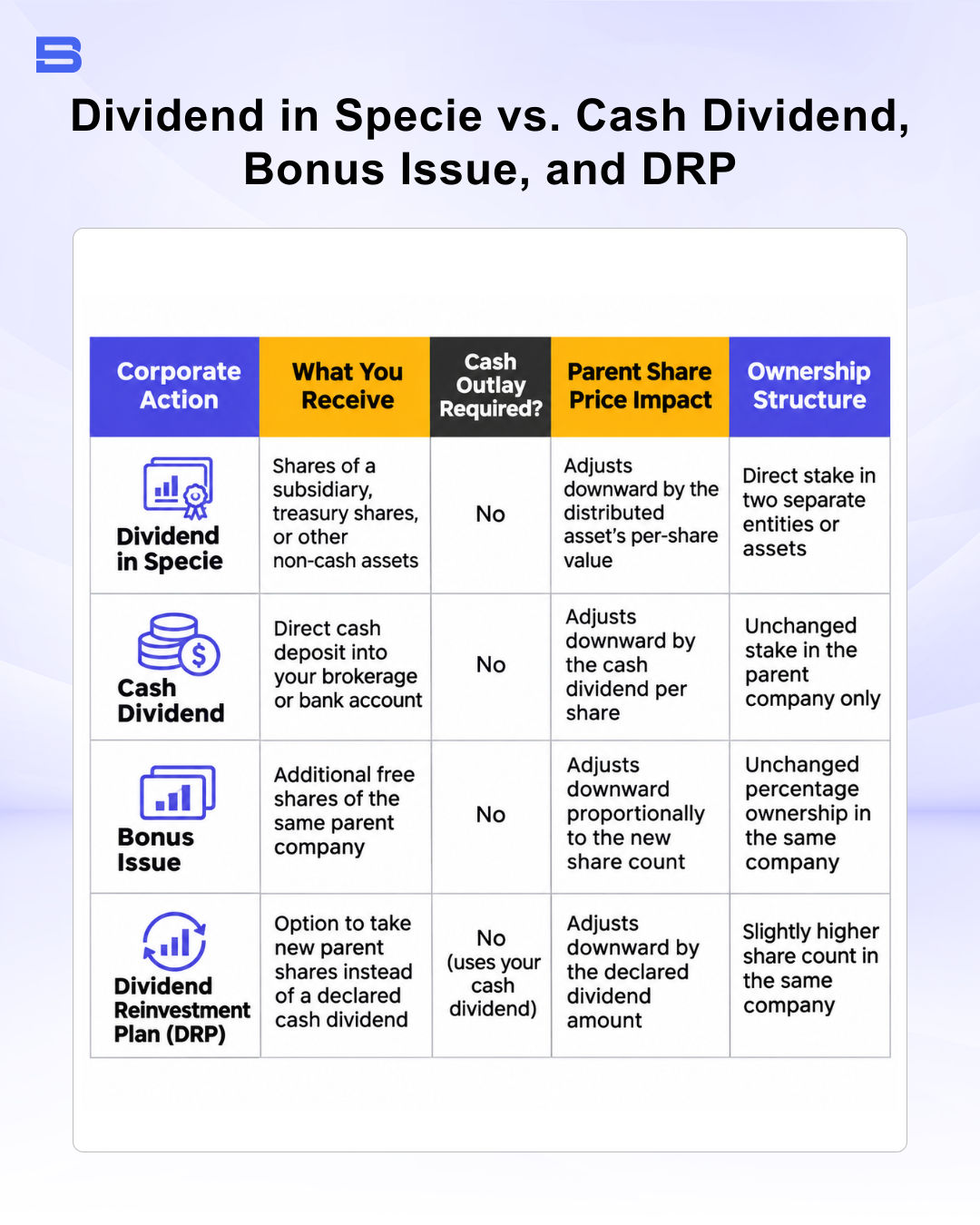
Dividend in Specie vs. Cash Dividend, Bonus Issue, and DRP
Corporate payouts take several forms, and each changes your cash balance, share count, and liquidity profile differently. Unlike a standard cash dividend that deposits money into your bank account, this non-cash payout transfers a separate security or asset.
It also differs from a bonus issue or stock split, which divides existing ownership into more shares without spinning off external assets, and from a dividend reinvestment plan (DRP) or rights issue, where you elect to take or buy new shares.
| Feature | Dividend in Specie | Cash Dividend | Bonus Issue | DRP |
|---|---|---|---|---|
| What you receive | Shares or other non-cash assets | Cash in your account | Extra shares of the same company | New shares of the same company in place of cash |
| Your share count in the company you hold | Unchanged | Unchanged | Increases | Increases when you elect shares |
| Parent share price on the ex-dividend date | Adjusts down by the value of the assets distributed | Typically adjusts down by about the dividend amount | Adjusts down in proportion to the new shares | Follows the underlying cash dividend |
Benefits and Risks of a Dividend in Specie for Shareholders
On the upside, this distribution gives you direct ownership in a spun-off business without paying brokerage commissions, clearing fees, or stamp duty to acquire those shares on the open market. If the newly independent subsidiary attracts dedicated analyst coverage or sharper management focus, its standalone market valuation may grow independently of the parent company. Because the parent company keeps its cash on hand rather than paying out liquid reserves, it also retains financial flexibility to reduce debt or fund core operations.
On the downside, receiving shares instead of cash introduces real liquidity and valuation risks you need to weigh carefully. Depending on the distribution ratio, you may receive odd lots below Bursa Malaysia's standard 100-share board lot, which trade on odd-lot boards with wider bid-ask spreads and fewer buyers.
Both stocks can also experience heavy selling pressure after the ex-dividend date when index funds offload spun-off shares, and if a company distributes unlisted subsidiary shares, you could hold an illiquid asset with no public exchange to exit or face dilution from a future private placement.
Shares Instead of Cash, Same Starting Value
This distribution replaces a traditional cash payout with direct ownership in another asset, leaving your combined portfolio value unchanged on the ex-dividend date. Before deciding whether to hold or sell your new shares, evaluate the spun-off company's fundamentals alongside any odd-lot liquidity constraints in your brokerage account.
- What Is Trading and How Does Trading Work?
- Trading Fundamentals: A Guide for Beginners
- Trading vs. Investing: What Are the Key Differences?
- Trading Terms and Terminologies Every Beginner Should Know
- Common Trading Mistakes Beginners Make and How to Avoid
- Understanding Risk and Reward in Trading: A Complete Guide
- Guide to the Different Types of Financial Markets
- Investment Basics: Definition, Strategies, and How to Invest
- Benefits of Investing: Financial Growth and Security
- What Is Swing Trading? A Practical Guide For Beginners
- What Is Spot Trading? A Guide for Beginners
- What Are Futures in Trading? A Guide for Beginners
- Understanding Bull Markets: Growth & Strategy
- How to Read a Candlestick Chart: A Guide for Beginners
- Is Trading Gambling? The Truth About Risk
- Pip in Forex: How It Works & How to Calculate It
- What Is the Bid-Ask Spread in Trading? A Guide for Beginners
- What Is a Margin Call? A Guide for Beginners
- Market Volatility Explained: What It Is and How to Trade It
- Drawdown in Trading: Meaning, Math, and Risk
- Understanding Slippage in Trading: Causes and Control
- Forex Lot Size Explained: Standard, Mini & Micro
- Trailing Stop vs Stop Loss: Essential Risk Strategy
- How Asset Allocation Works: Strategies Explained
- Understanding Market Trading Hours & Sessions
- Market Makers Explained: A Trader's Guide
- Portfolio Diversification: A Strategy Guide
- Capital Gains Explained: How Investment Taxes Work
- Stock Market Circuit Breakers: How Trading Halts Work
- What Is an IPO? How Initial Public Offerings Work
- What Is a Secondary Market? A Complete Guide
- What Is a Stock Exchange? Functions and Overview Explained
- Understanding Ticker Symbols: A Market Guide
- How Clearing Houses Work in Financial Markets
- Stock Market After Labor Day: Trends and What To Expect
Disclaimer: The content on this page is intended for educational and informational purposes only. It does not constitute financial, investment, tax, or legal advice, and should not be interpreted as a recommendation to buy, sell, or hold any financial instrument or asset. Trading and investing involve significant risk, including the possible loss of your entire capital. Products such as forex, CFDs, and cryptocurrencies carry additional risks due to leverage, high volatility, and limited regulatory protection in some jurisdictions. Past performance of any financial instrument does not guarantee future results. Any market views, forecasts, or opinions expressed are those of the author at the time of writing and may not reflect current market conditions. Platform features, fees, and regulatory status are subject to change — always verify information directly with the relevant provider or regulator before making any financial decision. BrokerSpecs may receive compensation from third parties featured on this site. Always conduct your own due diligence and consider seeking advice from a licensed financial professional before investing. Portions of this article were prepared with the assistance of AI tools and reviewed by our editorial team before publication.