



Related Tags
Picture a former colleague sliding a laptop across a cafe table to show you an early prototype for a logistics app and asking if you would fund the first RM100,000. Unlike buying shares of a public company on a stock exchange, writing that check makes you an angel investor backing an unproven private business from the ground up. Before you commit personal savings to a founder's vision, it helps to understand how early-stage startup deals work, who legally qualifies to participate, and why angel investments carry a real risk of total loss.
What Is an Angel Investor and How Does Early-Stage Funding Work?
An angel investor is a high-net-worth individual who invests personal money into an early-stage startup in exchange for equity or convertible debt. Because these young companies rarely have enough revenue or collateral to qualify for bank loans, angel capital bridges the funding gap between a founder's personal savings and institutional financing.
Within the broader world of alternative investments, angel funding typically enters at the pre-seed or seed stage. Founders use this capital to build a minimum viable product, run initial customer trials, and hire their first key engineers. In return, you receive an ownership stake that can grow substantially if the business scales, though you also absorb the full risk of losing your principal if the product fails to find a market.
Angel Investor Meaning Beyond Capital: Mentorship and Smart Money
In startup circles, the true meaning of an angel investor extends beyond simply wiring cash into a founder's bank account. Many angels are former entrepreneurs or senior executives who offer "smart money," pairing their capital with hands-on industry mentorship, hiring advice, and introductions to early enterprise clients.
While strategic guidance can help a young team avoid common operational mistakes, mentorship cannot eliminate market or execution risk. Even startups backed by experienced operators frequently stall when customer acquisition costs climb or larger competitors enter the space.
How Angel Investing Works: From Deal Screening to Exit
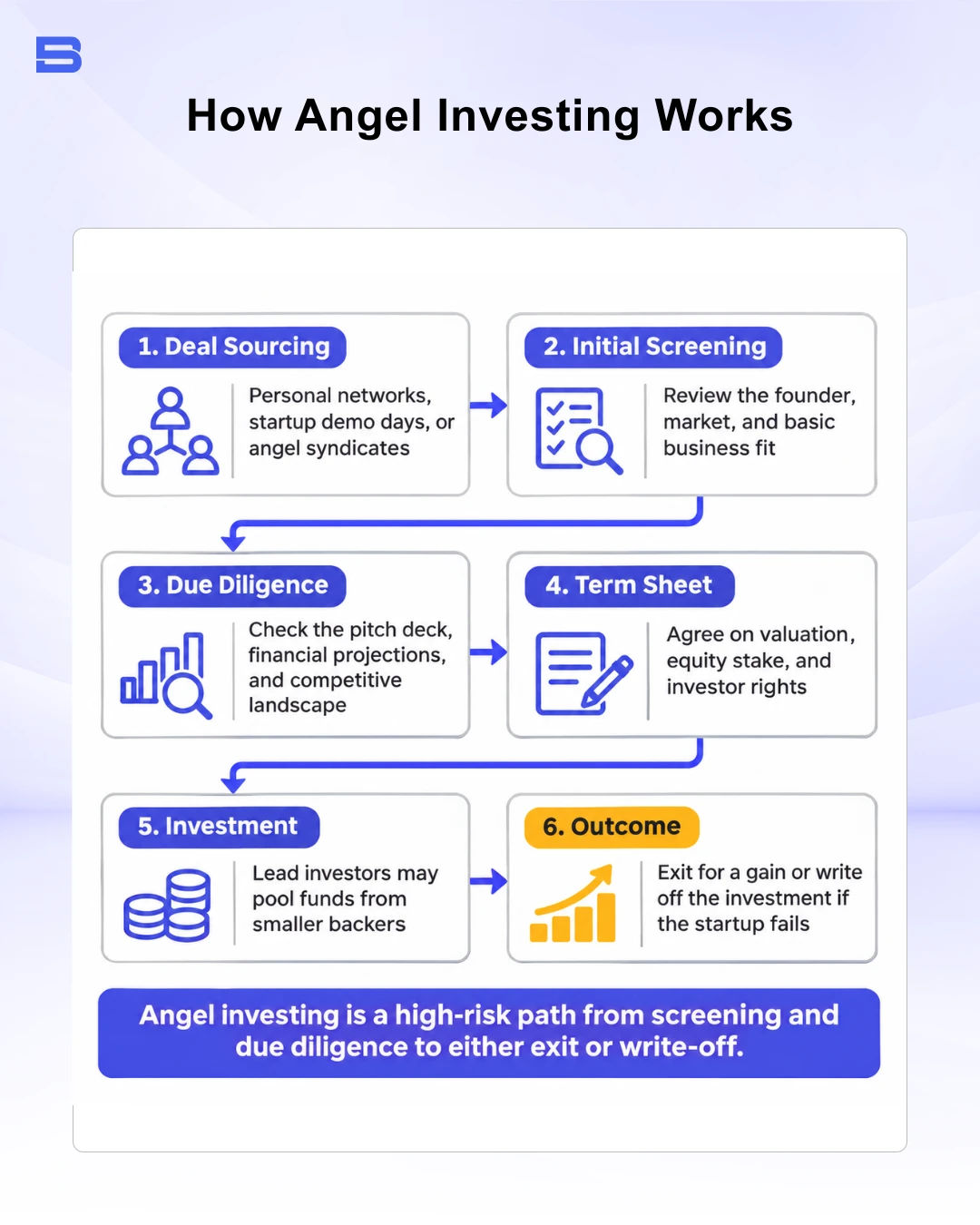
Most angel deals begin through personal networks, startup demo days, or organized angel syndicates where experienced lead investors pool funds from smaller backers. You review the founder's pitch deck, financial projections, and competitive landscape during due diligence to decide whether the business model is credible.
Once you agree on terms and wire funds, your capital remains locked inside the private company for years because there is no public stock market where you can sell your shares. Your return on investment depends entirely on a future liquidity event, most commonly an acquisition by a larger company or an initial public offering (IPO). If neither event happens and the company runs out of cash, your shares become worthless.
Common Deal Structures: Equity, SAFEs, and Convertible Notes
Early-stage investors usually fund startups through one of three legal instruments: priced equity, convertible notes, or a Simple Agreement for Future Equity (SAFE). Priced equity gives you immediate shares at an agreed company valuation, whereas convertible notes and SAFEs delay setting a share price until a future institutional funding round.
Convertible instruments typically include a valuation cap or discount rate that rewards you for taking earlier risk by converting your money into shares at a lower price than later investors pay. However, these contracts often carry complex dilution and liquidation preference clauses (rules that let certain investors be repaid before others) that can reduce your payout even when a startup sells.
Angel Investor vs. Venture Capitalist and Equity Crowdfunding: Key Differences
Although angel investors, venture capitalists (VCs), and equity crowdfunding platforms all fund private companies, they differ sharply in where the money comes from and who can participate. Understanding these distinctions helps you see where individual angel investing sits alongside institutional private equity and regulated retail startup platforms.
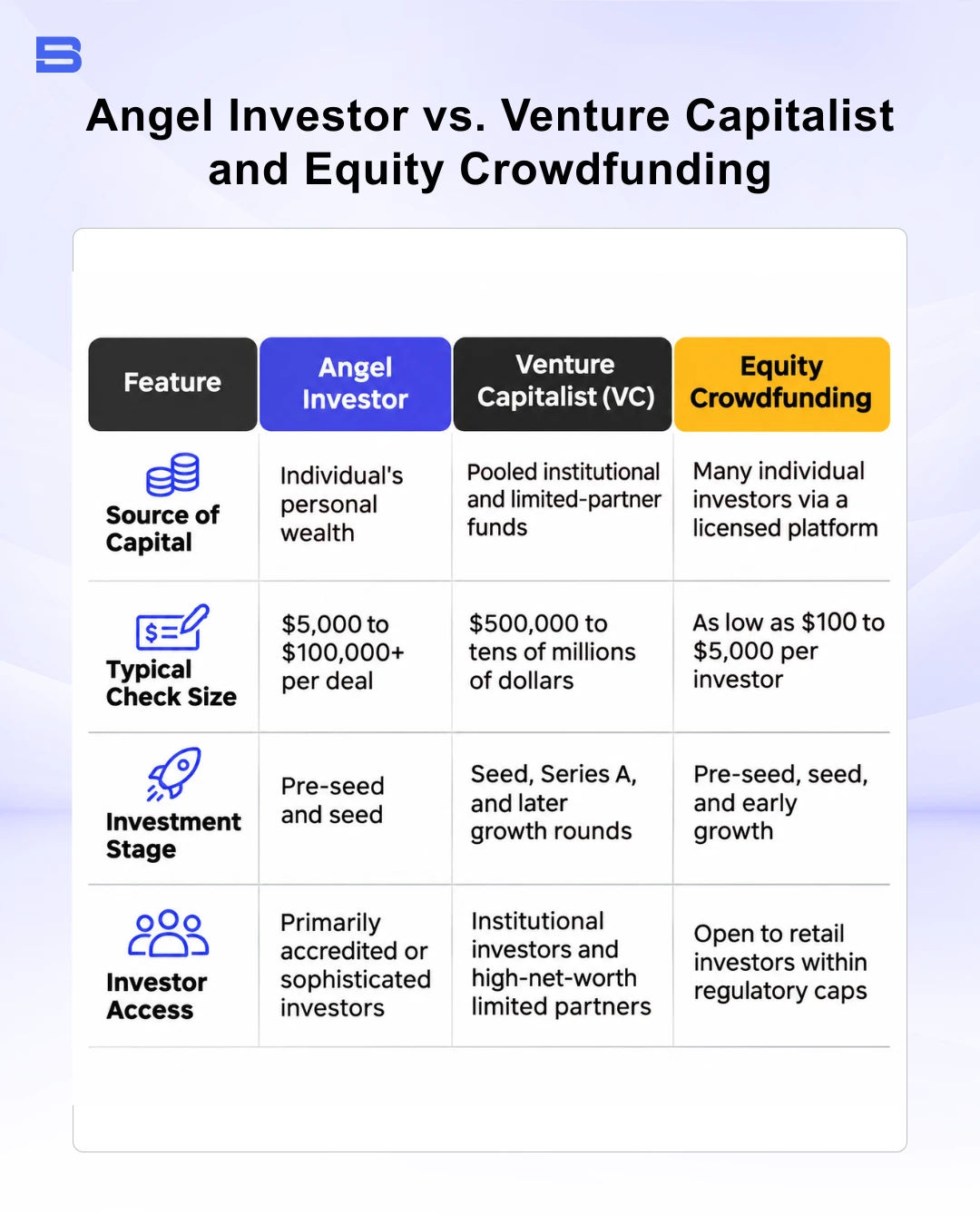
Venture capital firms operate similarly to a hedge fund in that professional managers invest other people's money and charge management fees plus a share of profits, whereas angels invest their own cash directly. For everyday investors who want startup exposure with smaller ticket sizes, regulated equity crowdfunding in Malaysia and similar platforms globally offer a more accessible entry point, though the underlying startup risks remain just as high.
Angel Investing in Malaysia: Eligibility Rules, SC Guidelines, and Local Networks
If you are exploring opportunities as an angel investor in Malaysia, the country has an organized ecosystem anchored by the Malaysian Business Angel Network (MBAN), the official trade association and accreditation body for local angel investors. Joining an accredited angel club or syndicate allows you to co-invest alongside seasoned founders and share due diligence workloads rather than evaluating pitches alone.
Private fundraising and angel syndicates in Malaysia fall under the oversight of the Securities Commission Malaysia (SC), which restricts direct private placements (share offers made privately to selected investors rather than to the public) to qualified sophisticated investors. Retail investors who do not meet those wealth thresholds can still back local startups through SC-registered equity crowdfunding operators, subject to statutory annual investment limits.
Accredited Investor Requirements: SEC vs. SC Malaysia Sophisticated Investor Rules
Regulators restrict direct private startup offerings because early-stage financial disclosures are limited and investors must be able to absorb a complete loss of capital. In the United States, the U.S. Securities and Exchange Commission (SEC) generally requires an individual accredited investor to hold a net worth above $1 million excluding a primary residence, earn over $200,000 annually ($300,000 jointly) for the past two years, or hold qualifying securities licenses.
Under the SC’s Guidelines on Categories of Sophisticated Investors, an individual qualifies as a High-Net Worth Individual by holding total net personal assets above RM3 million (with primary residence equity capped at RM1 million), earning over RM300,000 in gross annual income, maintaining a RM1 million net investment portfolio, or holding accreditation as an MBAN angel investor. Always verify your eligibility status with a licensed intermediary or legal advisor before signing private subscription agreements.
Key Risks of Angel Investing: Illiquidity, Dilution, and Startup Failure Rates
Angel investing sits at the highest end of the risk spectrum, because many early-stage ventures fail or take multiple years to reach profitability. Your capital may remain tied up for five to 10 years with zero dividend income and no secondary buyer willing to take your shares off your hands.
Consider a practical example where you invest $25,000 into a seed-stage software startup at a $500,000 post-money valuation (the company’s value right after your money is added), giving you an initial 5% equity stake. Over the next seven years, the startup raises two larger institutional rounds that dilute your ownership from 5% down to 3.2%, and the company eventually sells for $1.5 million, returning $48,000 before taxes and legal fees.
While that outcome nearly doubles your initial outlay, the same $25,000 stake drops to $0 if the startup runs out of cash before finding product-market fit (evidence that enough customers want the product), which is a frequent outcome in early-stage ventures. Because locking money into illiquid private shares carries a substantial opportunity cost compared with holding a diversified index fund, experienced angels generally limit startup allocations to a small fraction of their overall net worth that they can afford to lose entirely.
Only Commit What You Can Afford to Lose
Becoming an angel investor lets you support innovative founders at the ground floor and potentially capture substantial upside if a young business scales into a market leader. At the same time, high startup failure rates, multi-year capital lock-ups, and later-round equity dilution mean you should only commit capital you can comfortably afford to lose without disrupting your broader financial plan.
- What Is Trading and How Does Trading Work?
- Trading Fundamentals: A Guide for Beginners
- Trading vs. Investing: What Are the Key Differences?
- Trading Terms and Terminologies Every Beginner Should Know
- Common Trading Mistakes Beginners Make and How to Avoid
- Understanding Risk and Reward in Trading: A Complete Guide
- Guide to the Different Types of Financial Markets
- Investment Basics: Definition, Strategies, and How to Invest
- Benefits of Investing: Financial Growth and Security
- What Is Swing Trading? A Practical Guide For Beginners
- What Is Spot Trading? A Guide for Beginners
- What Are Futures in Trading? A Guide for Beginners
- Understanding Bull Markets: Growth & Strategy
- How to Read a Candlestick Chart: A Guide for Beginners
- Is Trading Gambling? The Truth About Risk
- Pip in Forex: How It Works & How to Calculate It
- What Is the Bid-Ask Spread in Trading? A Guide for Beginners
- What Is a Margin Call? A Guide for Beginners
- Market Volatility Explained: What It Is and How to Trade It
- Drawdown in Trading: Meaning, Math, and Risk
- Understanding Slippage in Trading: Causes and Control
- Forex Lot Size Explained: Standard, Mini & Micro
- Trailing Stop vs Stop Loss: Essential Risk Strategy
- How Asset Allocation Works: Strategies Explained
- Understanding Market Trading Hours & Sessions
- Market Makers Explained: A Trader's Guide
- Portfolio Diversification: A Strategy Guide
- Capital Gains Explained: How Investment Taxes Work
- Stock Market Circuit Breakers: How Trading Halts Work
- What Is an IPO? How Initial Public Offerings Work
- What Is a Secondary Market? A Complete Guide
- What Is a Stock Exchange? Functions and Overview Explained
- Understanding Ticker Symbols: A Market Guide
- How Clearing Houses Work in Financial Markets
- Stock Market After Labor Day: Trends and What To Expect
Disclaimer: The content on this page is intended for educational and informational purposes only. It does not constitute financial, investment, tax, or legal advice, and should not be interpreted as a recommendation to buy, sell, or hold any financial instrument or asset. Trading and investing involve significant risk, including the possible loss of your entire capital. Products such as forex, CFDs, and cryptocurrencies carry additional risks due to leverage, high volatility, and limited regulatory protection in some jurisdictions. Past performance of any financial instrument does not guarantee future results. Any market views, forecasts, or opinions expressed are those of the author at the time of writing and may not reflect current market conditions. Platform features, fees, and regulatory status are subject to change — always verify information directly with the relevant provider or regulator before making any financial decision. BrokerSpecs may receive compensation from third parties featured on this site. Always conduct your own due diligence and consider seeking advice from a licensed financial professional before investing. Portions of this article were prepared with the assistance of AI tools and reviewed by our editorial team before publication.