



Related Tags
Receiving a cash payout in your brokerage account feels rewarding, but a small amount of cash often sits idle. A dividend reinvestment plan takes that idle money and puts it back to work automatically. It continuously buys new shares so your portfolio can grow faster over time.
What Is a Dividend Reinvestment Plan?
This plan is an automated program that uses your cash payouts to purchase additional shares of the underlying stock. Instead of receiving money in your brokerage account, the company or your broker uses those funds to increase your ownership stake.
This creates a powerful cycle of growth. The new shares you acquire may generate their own payouts in the future, as long as the company keeps paying them. As you continue to reinvest those distributions, your position size expands steadily without requiring you to deposit fresh capital. This is a practical way to harness the power of compound interest.
Many long-term investors use these programs to build wealth through dividends, although companies can reduce or suspend them at any time. While it requires patience, the mechanism turns small, incremental payouts into a larger share count that can accelerate your portfolio’s value over the years.
How a Dividend Reinvestment Plan Works Step by Step
The reinvestment cycle follows a strict timeline set by the company or exchange. To participate, you must own the stock before the ex-dividend date. This is the cutoff point that determines who receives the upcoming payout.
Once the company declares the payout, eligible shareholders receive a notice of election. You must submit your election form before the specified deadline if you want to receive shares instead of cash. The company then determines the issue price for the new shares. On regional exchanges, this price often involves a discount based on a five-day volume-weighted average market price.
Finally, the new shares are credited to your account on the payment date. Any leftover cash that cannot form a full share is usually paid directly into your brokerage account.
Company-Sponsored DRPs vs. Broker-Operated DRIPs
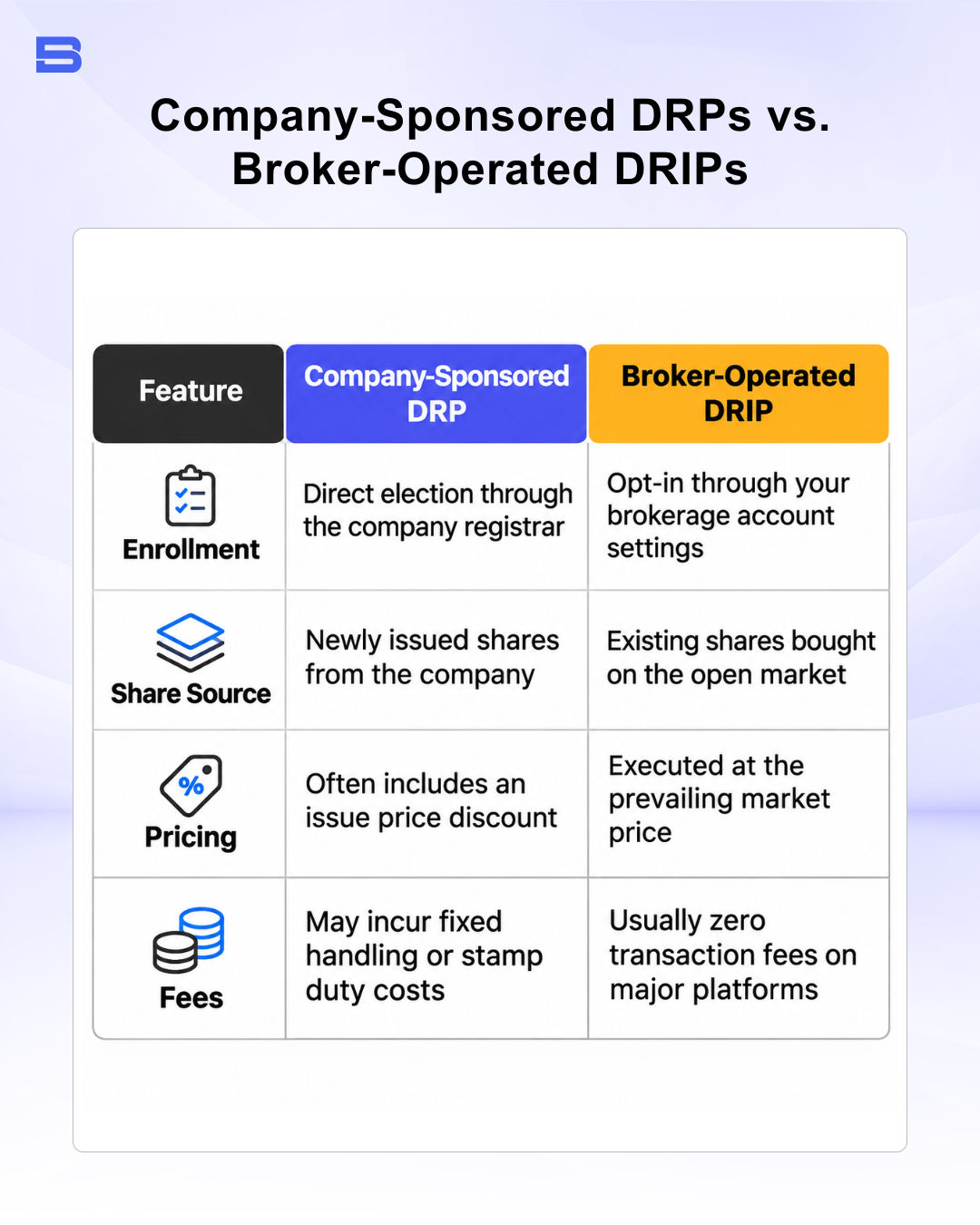
Reinvestment programs operate differently depending on who runs them, so the company-sponsored vs broker DRIP distinction matters.
| Feature | Company-Sponsored DRP | Broker-Operated DRIP |
|---|---|---|
| Enrollment | Election form submitted before the deadline | — |
| Pricing | Issue price may include a discount to the market price | — |
| Share rounding | Whole shares only, with leftover cash paid out | Fractional shares credited |
Fractional Shares vs. Whole-Share Rounding
Global brokers often credit your account with fractional shares in a DRIP. This means every cent of your payout is invested immediately.
Many regional exchanges use a whole-share rounding system instead. If your payout is enough to buy 15.6 shares, you will receive exactly 15 new shares. The remaining cash equivalent of the 0.6 share is paid directly into your trading account.
Worked Example: Compounding Growth and Fee Break-Even Math
It is crucial to calculate whether participating makes financial sense for your specific holding size. Consider a realistic scenario involving a regional plan.
Imagine you own 2,000 shares of a company trading at RM5.00 per share. The company declares a 5% payout, giving you RM500 in cash. They also offer a reinvestment option with a 5% issue price discount, making the new shares available at RM4.75 each.
With RM500, you can acquire exactly 105 new shares. The value of those discounted shares is RM525 at the current market price, giving you an immediate RM25 benefit. However, you must pay a fixed RM10 stamp duty and handling fee to process the election.
Your net benefit is RM15. If you only held 500 shares, your total payout would be RM125. The discount benefit on 500 shares would be only about RM5, which is less than the RM10 fee, so taking the cash would be more practical.
Dividend Reinvestment Plan Pros and Cons
Reinvesting payouts is a popular strategy, but it carries distinct structural risks that require your attention. You must balance the long-term benefits against the potential downsides.
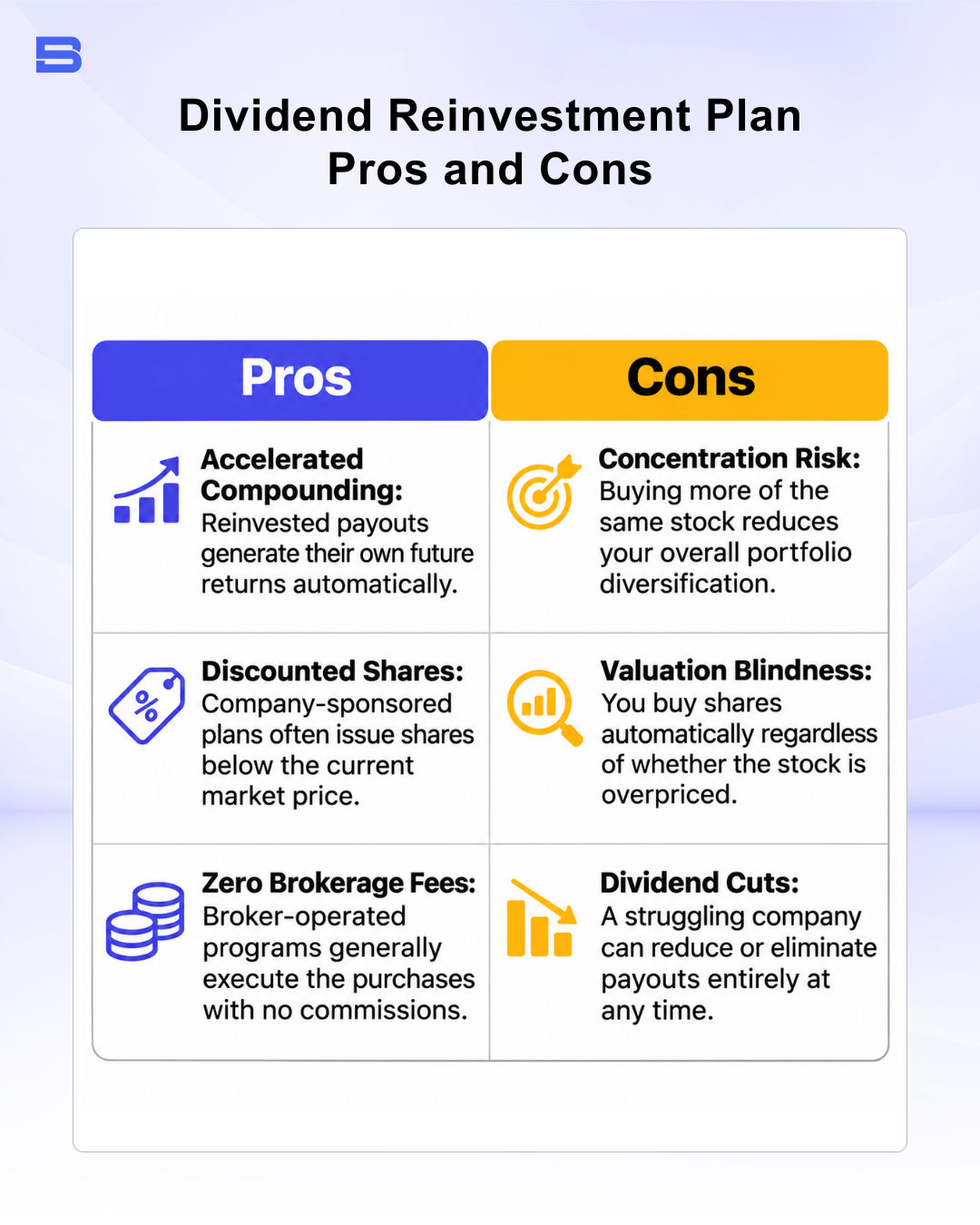
Putting your portfolio on autopilot makes it easy to overlook concentration risk with dividend stocks. You might end up heavily exposed to a single company if that stock continues to grow and reinvest over decades. You also owe taxes on the reinvested amount in jurisdictions that tax investment income, even though you never received the physical cash.
DRP vs. Other Corporate Actions
A voluntary reinvestment plan is distinctly different from other corporate actions. Unlike a dividend in specie, where you receive direct shares of a subsidiary automatically, a reinvestment plan requires your active election.
It also differs from a bonus issue or a stock split, which adjust your total share count without requiring you to spend your cash payouts. A reinvestment program issues new shares similar to a private placement or rights issue, but it is strictly funded by your earned payouts rather than demanding fresh capital.
Reinvest Only When the Math Works
This plan may help compound your wealth automatically over long periods, provided the company keeps paying dividends. You must weigh the convenience of discounted shares against the hidden costs of handling fees and the risk of portfolio over-concentration. Choosing to reinvest is a strategic decision that shapes your long-term success.
- What Is Trading and How Does Trading Work?
- Trading Fundamentals: A Guide for Beginners
- Trading vs. Investing: What Are the Key Differences?
- Trading Terms and Terminologies Every Beginner Should Know
- Common Trading Mistakes Beginners Make and How to Avoid
- Understanding Risk and Reward in Trading: A Complete Guide
- Guide to the Different Types of Financial Markets
- Investment Basics: Definition, Strategies, and How to Invest
- Benefits of Investing: Financial Growth and Security
- What Is Swing Trading? A Practical Guide For Beginners
- What Is Spot Trading? A Guide for Beginners
- What Are Futures in Trading? A Guide for Beginners
- Understanding Bull Markets: Growth & Strategy
- How to Read a Candlestick Chart: A Guide for Beginners
- Is Trading Gambling? The Truth About Risk
- Pip in Forex: How It Works & How to Calculate It
- What Is the Bid-Ask Spread in Trading? A Guide for Beginners
- What Is a Margin Call? A Guide for Beginners
- Market Volatility Explained: What It Is and How to Trade It
- Drawdown in Trading: Meaning, Math, and Risk
- Understanding Slippage in Trading: Causes and Control
- Forex Lot Size Explained: Standard, Mini & Micro
- Trailing Stop vs Stop Loss: Essential Risk Strategy
- How Asset Allocation Works: Strategies Explained
- Understanding Market Trading Hours & Sessions
- Market Makers Explained: A Trader's Guide
- Portfolio Diversification: A Strategy Guide
- Capital Gains Explained: How Investment Taxes Work
- Stock Market Circuit Breakers: How Trading Halts Work
- What Is an IPO? How Initial Public Offerings Work
- What Is a Secondary Market? A Complete Guide
- What Is a Stock Exchange? Functions and Overview Explained
- Understanding Ticker Symbols: A Market Guide
- How Clearing Houses Work in Financial Markets
- Stock Market After Labor Day: Trends and What To Expect
Disclaimer: The content on this page is intended for educational and informational purposes only. It does not constitute financial, investment, tax, or legal advice, and should not be interpreted as a recommendation to buy, sell, or hold any financial instrument or asset. Trading and investing involve significant risk, including the possible loss of your entire capital. Products such as forex, CFDs, and cryptocurrencies carry additional risks due to leverage, high volatility, and limited regulatory protection in some jurisdictions. Past performance of any financial instrument does not guarantee future results. Any market views, forecasts, or opinions expressed are those of the author at the time of writing and may not reflect current market conditions. Platform features, fees, and regulatory status are subject to change — always verify information directly with the relevant provider or regulator before making any financial decision. BrokerSpecs may receive compensation from third parties featured on this site. Always conduct your own due diligence and consider seeking advice from a licensed financial professional before investing. Portions of this article were prepared with the assistance of AI tools and reviewed by our editorial team before publication.