



Related Tags
Opening your brokerage app in early February often brings an unexpected surprise. Alongside your portfolio balance sits a multi-page document detailing every single execution, sell order, and fraction of a share you closed over the prior 12 months.
If you are new to active investing or trying to understand how trading works, seeing dozens of transaction rows can feel overwhelming. That document is your 1099-B form, and understanding how it functions is essential for reporting your trading activity accurately and avoiding unnecessary penalties.
What Is a 1099-B Form and Who Receives It?
What is Form 1099-B? A 1099-B form is an official tax document issued by brokerages that reports your annual gross proceeds (the total amount you received from sales) and capital transactions to the Internal Revenue Service (IRS). Brokerages generally must send you your copy by February 15, or the next business day if that date falls on a weekend or holiday. They file the IRS copy separately, by February 28 on paper or March 31 if filed electronically.
You will receive a 1099-B form if you sold stocks, bonds, options, commodities, or mutual fund shares during the calendar year. Simply buying and holding securities does not trigger the document. A taxable transaction occurs only when you close a position by selling or exchanging it.
International investors should note that tax documentation depends heavily on tax residency. Non-US residents who buy US stocks generally submit a W-8BEN form (a certificate of foreign status) instead, meaning they receive Form 1042-S for US-source dividend withholdings rather than a standard 1099-B form for capital disposals.
How to Read Form 1099-B: Key Boxes Explained
When you review your 1099-B form, the raw data is organized into standardized lettered and numbered boxes. Each box provides a specific piece of information required to determine whether you made a profit or took a loss.
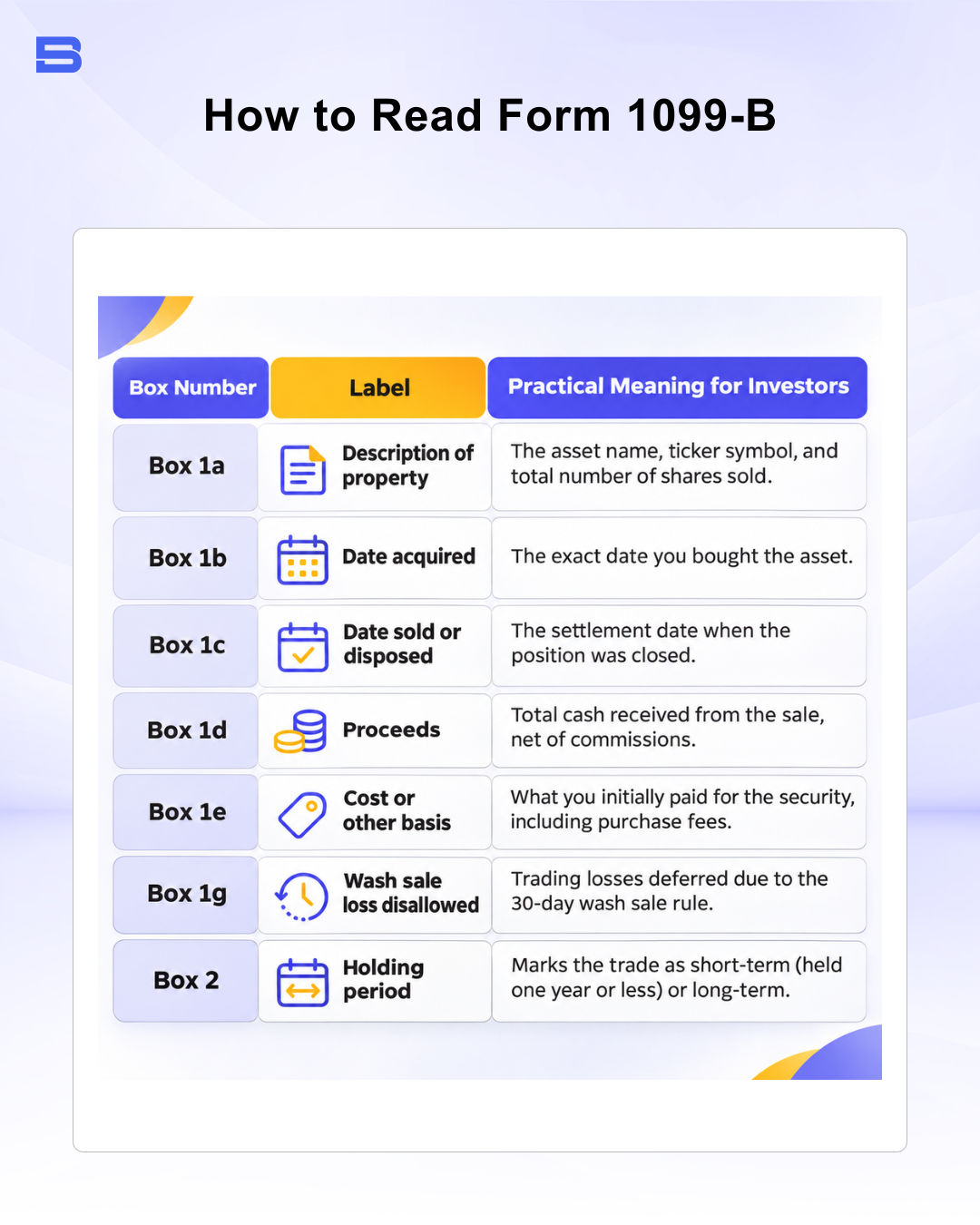
The relationship between Box 1d and Box 1e determines your baseline tax liability. Subtracting Box 1e from Box 1d yields your net realized gain or loss before tax adjustments.
Covered vs. Noncovered Securities: Why Cost Basis Matters
Box 5 is checked when the shares you sold are noncovered, and Box 12 is checked when your broker reported your cost basis (the price you paid for the shares) to the IRS. Under cost basis reporting rules issued by the IRS, brokerages are legally required to track and report cost basis for covered securities.
For covered shares, your broker calculates Box 1e automatically and transmits that exact figure directly to the tax authority. This minimizes your recordkeeping burden because the IRS already has the matched numbers on file.
Noncovered securities usually represent older holdings acquired before phased cost-basis legislation took effect, or assets transferred between platforms without transfer records. When a security is noncovered, your broker may leave Box 1e completely blank. In that scenario, you are personally responsible for locating original trade confirmations to establish your true purchase price.
Wash Sales on Form 1099-B: How Box 1g Affects Your Losses
Active market participants and those exploring day trading frequently trigger the wash sale rule, and any Form 1099-B wash sale adjustment appears in Box 1g. The rule prevents you from claiming a tax deduction on a losing trade if you purchase the same or a substantially identical security within 30 days before or after the sale.
When a wash sale occurs, the broker notes the disallowed loss in Box 1g rather than applying it to reduce your current-year tax burden. That disallowed amount does not vanish forever. Instead, it is added to the cost basis of your replacement shares.
To see how this works, imagine you purchase 100 shares of Tech Stock A at $50 per share for a total cost of $5,000. You sell all 100 shares on March 1 at $40, realizing a loss of $1,000. On March 11, 10 days later, you rebuy 100 shares of Tech Stock A at $42.
Because you repurchased within the 30-day window, your $1,000 loss is disallowed and reported in Box 1g. Your new cost basis rises from $42 to $52 per share ($5,200 total), deferring the tax deduction until you eventually exit the new position permanently. Failing to anticipate wash sale adjustments can create substantial unexpected tax bills if you trade in and out of volatile names frequently.
Consolidated 1099 Statements: Understanding the Full Broker Tax Package
Most modern online brokerages do not send a 1099-B form as an isolated one-page slip. Instead, they issue a comprehensive package called a Consolidated 1099 Tax Statement.
This bundled PDF compiles several distinct reporting documents into one packet. Alongside the 1099-B form, you will typically find Form 1099-DIV, which details every taxable dividend distribution paid to your portfolio. It also contains Form 1099-INT, capturing cash interest earned on uninvested account balances.
Reviewing a consolidated statement as a single composite unit prevents common filing omissions. It ensures that both transaction proceeds and ongoing passive income streams are accounted for simultaneously.
How to Report Form 1099-B on Your Tax Return (Form 8949 and Schedule D)
To understand how to report 1099-B on your tax return, start by transferring the data onto IRS Form 8949 and Schedule D to compute your taxable capital gains. The reporting flow depends directly on how the transactions are categorized on your broker statement.
First, sort transactions by holding duration (one year or less is short-term, and more than one year is long-term) and basis reporting status. Short-term sales with basis reported to the IRS are recorded under Part I (Box A) on Form 8949. Long-term sales with basis reported are entered under Part II (Box D). If Box 1g shows a wash sale loss, enter code W in column (f) of Form 8949 and the disallowed amount in column (g).
| Holding period | Basis reported to the IRS? | Form 8949 section |
|---|---|---|
| Short-term | Yes | Part I, Box A |
| Short-term | No | Part I, Box B |
| Long-term | Yes | Part II, Box D |
| Long-term | No | Part II, Box E |
Transactions with missing or unrecorded cost basis use Box B or Box E, where you enter your reconstructed basis figure manually. The IRS requires short-term and long-term transactions to be reported separately on Form 8949 because they are taxed at different rates.
Finally, the net totals calculated on Form 8949 flow directly onto Schedule D of Form 1040. Schedule D aggregates your net capital gains or losses across all asset classes, applying statutory capital loss deduction caps against regular income.
Treating Your 1099-B as an Audit Trail
Your 1099-B form is an objective audit trail of your annual market activity rather than an administrative roadblock. Taking time to cross-reference Box 1d proceeds, verify Box 1e cost basis, and track wash sale adjustments in Box 1g keeps your trading records transparent and protects your capital from unnecessary tax disputes.
- What Is Trading and How Does Trading Work?
- Trading Fundamentals: A Guide for Beginners
- Trading vs. Investing: What Are the Key Differences?
- Trading Terms and Terminologies Every Beginner Should Know
- Common Trading Mistakes Beginners Make and How to Avoid
- Understanding Risk and Reward in Trading: A Complete Guide
- Guide to the Different Types of Financial Markets
- Investment Basics: Definition, Strategies, and How to Invest
- Benefits of Investing: Financial Growth and Security
- What Is Swing Trading? A Practical Guide For Beginners
- What Is Spot Trading? A Guide for Beginners
- What Are Futures in Trading? A Guide for Beginners
- Understanding Bull Markets: Growth & Strategy
- How to Read a Candlestick Chart: A Guide for Beginners
- Is Trading Gambling? The Truth About Risk
- Pip in Forex: How It Works & How to Calculate It
- What Is the Bid-Ask Spread in Trading? A Guide for Beginners
- What Is a Margin Call? A Guide for Beginners
- Market Volatility Explained: What It Is and How to Trade It
- Drawdown in Trading: Meaning, Math, and Risk
- Understanding Slippage in Trading: Causes and Control
- Forex Lot Size Explained: Standard, Mini & Micro
- Trailing Stop vs Stop Loss: Essential Risk Strategy
- How Asset Allocation Works: Strategies Explained
- Understanding Market Trading Hours & Sessions
- Market Makers Explained: A Trader's Guide
- Portfolio Diversification: A Strategy Guide
- Capital Gains Explained: How Investment Taxes Work
- Stock Market Circuit Breakers: How Trading Halts Work
- What Is an IPO? How Initial Public Offerings Work
- What Is a Secondary Market? A Complete Guide
- What Is a Stock Exchange? Functions and Overview Explained
- Understanding Ticker Symbols: A Market Guide
- How Clearing Houses Work in Financial Markets
- Stock Market After Labor Day: Trends and What To Expect
Disclaimer: The content on this page is intended for educational and informational purposes only. It does not constitute financial, investment, tax, or legal advice, and should not be interpreted as a recommendation to buy, sell, or hold any financial instrument or asset. Trading and investing involve significant risk, including the possible loss of your entire capital. Products such as forex, CFDs, and cryptocurrencies carry additional risks due to leverage, high volatility, and limited regulatory protection in some jurisdictions. Past performance of any financial instrument does not guarantee future results. Any market views, forecasts, or opinions expressed are those of the author at the time of writing and may not reflect current market conditions. Platform features, fees, and regulatory status are subject to change — always verify information directly with the relevant provider or regulator before making any financial decision. BrokerSpecs may receive compensation from third parties featured on this site. Always conduct your own due diligence and consider seeking advice from a licensed financial professional before investing. Portions of this article were prepared with the assistance of AI tools and reviewed by our editorial team before publication.