


- What Is Trading and How Does Trading Work?
- Trading Fundamentals: A Guide for Beginners
- Trading vs. Investing: What Are the Key Differences?
- Trading Terms and Terminologies Every Beginner Should Know
- Common Trading Mistakes Beginners Make and How to Avoid
- Understanding Risk and Reward in Trading: A Complete Guide
- Guide to the Different Types of Financial Markets
- Investment Basics: Definition, Strategies, and How to Invest
- Benefits of Investing: Financial Growth and Security
- What Is Swing Trading? A Practical Guide For Beginners
- What Is Spot Trading? A Guide for Beginners
- What Are Futures in Trading? A Guide for Beginners
- Understanding Bull Markets: Growth & Strategy
- How to Read a Candlestick Chart: A Guide for Beginners
- Is Trading Gambling? The Truth About Risk
- Pip in Forex: How It Works & How to Calculate It
- What Is the Bid-Ask Spread in Trading? A Guide for Beginners
- What Is a Margin Call? A Guide for Beginners
- Market Volatility Explained: What It Is and How to Trade It
- Drawdown in Trading: Meaning, Math, and Risk
- Understanding Slippage in Trading: Causes and Control
- Forex Lot Size Explained: Standard, Mini & Micro
- Trailing Stop vs Stop Loss: Essential Risk Strategy
- How Asset Allocation Works: Strategies Explained
- Understanding Market Trading Hours & Sessions
- Market Makers Explained: A Trader's Guide
- Portfolio Diversification: A Strategy Guide
- Capital Gains Explained: How Investment Taxes Work
- Stock Market Circuit Breakers: How Trading Halts Work
- What Is an IPO? How Initial Public Offerings Work
- What Is a Secondary Market? A Complete Guide
- What Is a Stock Exchange? Functions and Overview Explained
- Understanding Ticker Symbols: A Market Guide
- How Clearing Houses Work in Financial Markets
- Stock Market After Labor Day: Trends and What To Expect
The order board is flashing red. Tickers scroll past faster than the human eye can track, and bid-ask spreads widen into a void. You watch your portfolio value drop by percentage points in seconds as algorithms trigger automated sell orders in a cascading feedback loop.
Then, suddenly, the numbers freeze. The ticker stops moving. The screen locks down.
Silence falls across the exchange floor.
You haven't lost your internet connection, and your broker's app hasn't crashed. You have just experienced a market-wide circuit breaker—the financial system's emergency brake designed to halt trading before collective panic tears the market apart.
What Is a Circuit Breaker in the Stock Market?
A circuit breaker is an automated regulatory mechanism that temporarily pauses all trading on an exchange when prices drop sharply within a single trading day. Just as an electrical circuit breaker trips to cut off power before overloaded wiring causes a house fire, a financial circuit breaker trips to halt trading before panic selling destabilizes the entire financial system.
Market regulators like the US Securities and Exchange Commission (SEC) introduced these system-wide safeguards following the catastrophic "Black Monday" crash of October 19, 1987, when the Dow Jones Industrial Average dropped 22.6% in a single day.
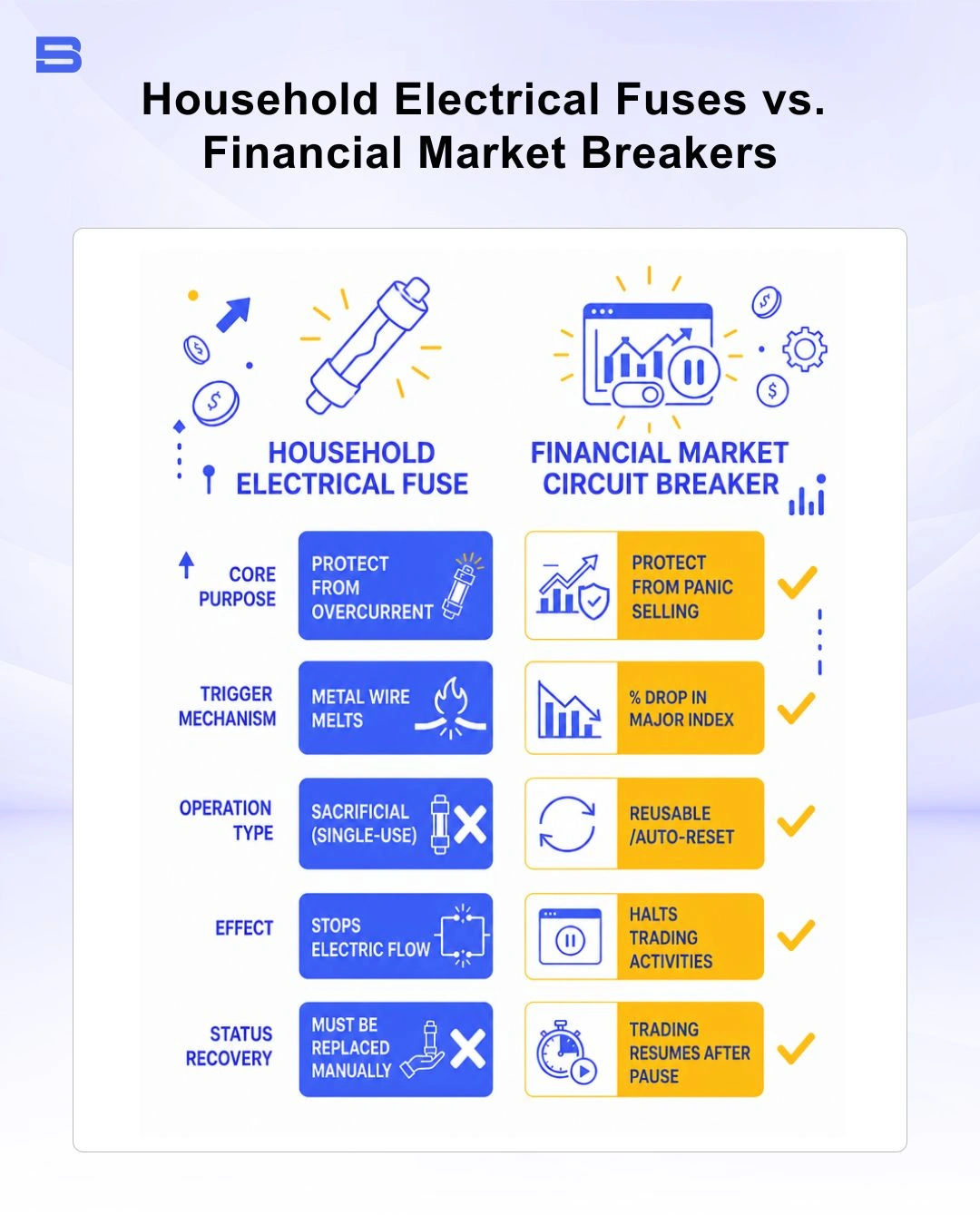
The primary job of a circuit breaker isn't to prevent prices from falling permanently; markets must be free to adjust to economic realities. Instead, circuit breakers exist to enforce a cooling-off period.
This brief pause gives human traders time to process breaking news, allows market makers to recalculate their risk parameters, and prevents high-frequency trading (HFT) algorithms from driving prices into an artificial death spiral. For retail investors, this pause provides a vital buffer against making emotional, panic-driven execution mistakes.
How Market-Wide Circuit Breakers Work: The 3 Levels
In the United States equity markets, Market-Wide Circuit Breakers (MWCBs) are tied directly to intraday drops in the Standard & Poor's 500 (S&P 500) Index. The rules dictate three distinct threshold levels, calculated daily based on the previous session's closing value.
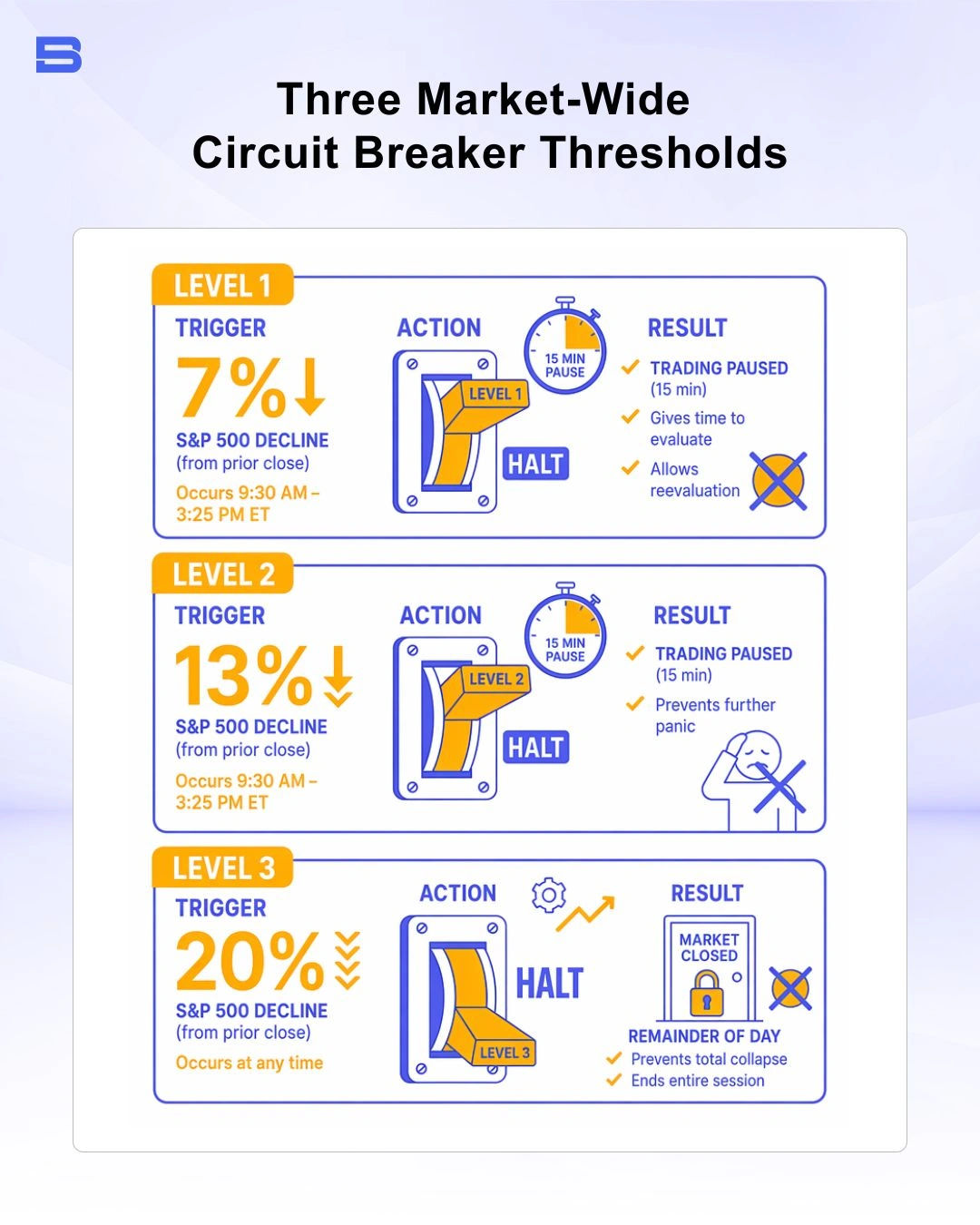
Level 1 (7% Drop)
- Trigger: A 7% drop in the S&P 500 below the previous day's close.
- Action: Trading freezes across all US stock exchanges for 15 minutes.
- Timing: Like Level 1, a Level 2 halt can only be triggered before 3:25 PM Eastern Time.
Level 2 (13% Drop)
- Trigger: A 13% drop in the S&P 500 below the previous day's close.
- Action: Trading freezes across all exchanges for another 15 minutes.
- Timing: Like Level one, a Level two halt can only be triggered before 3:25 PM Eastern Time.
Level 3 (20% Drop)
- Trigger: A 20% drop in the S&P 500 below the previous day's close.
- Action: Trading is halted for the remainder of the trading day.
- Timing: A Level three breaker can trigger at any time during market hours, immediately closing the market until the next business day.
Rule reference: Market-wide circuit breakers are now governed by New York Stock Exchange (NYSE) Rule 7.12 (formerly Rule 80B). Rule 80B is no longer the current governing rule.
Worked Example: Calculating Circuit Breaker Triggers
Circuit breakers pause trading during sharp market declines, making it easier to understand what is a stock exchange and how it maintains market stability.
To understand how this functions in real-time, consider a practical scenario using rounded market numbers.
Assume the S&P 500 closed yesterday at 5,000 points. Here is how the exchange calculates the exact triggers for today's trading session:
- Level 1 Trigger (7% drop):
5,000 x 0.07 = 350 points
Trading halts for 15 minutes if the index falls to 4,650 points. - Level 2 Trigger (13% drop):
5,000 x 0.13 = 650 points
Trading halts for an additional 15 minutes if the index falls to 4,350 points. - Level 3 Trigger (20% drop):
5,000 x 0.20 = 1,000 points
Trading shuts down for the rest of the day if the index reaches 4,000 points.
If the index opens in a severe gap down and drops 350 points within minutes of the market bell, all trading stops instantly across every US exchange. Orders freeze, market quotes disappear, and investors gain a 15-minute breather to evaluate whether the decline is driven by fundamentals or algorithmic panic.
What Triggers a Circuit Breaker? (Real-World History)
Market-wide circuit breakers are intentionally rare. They do not trigger during normal daily price swings, but rather during extraordinary macroeconomic shocks or systemic crises.
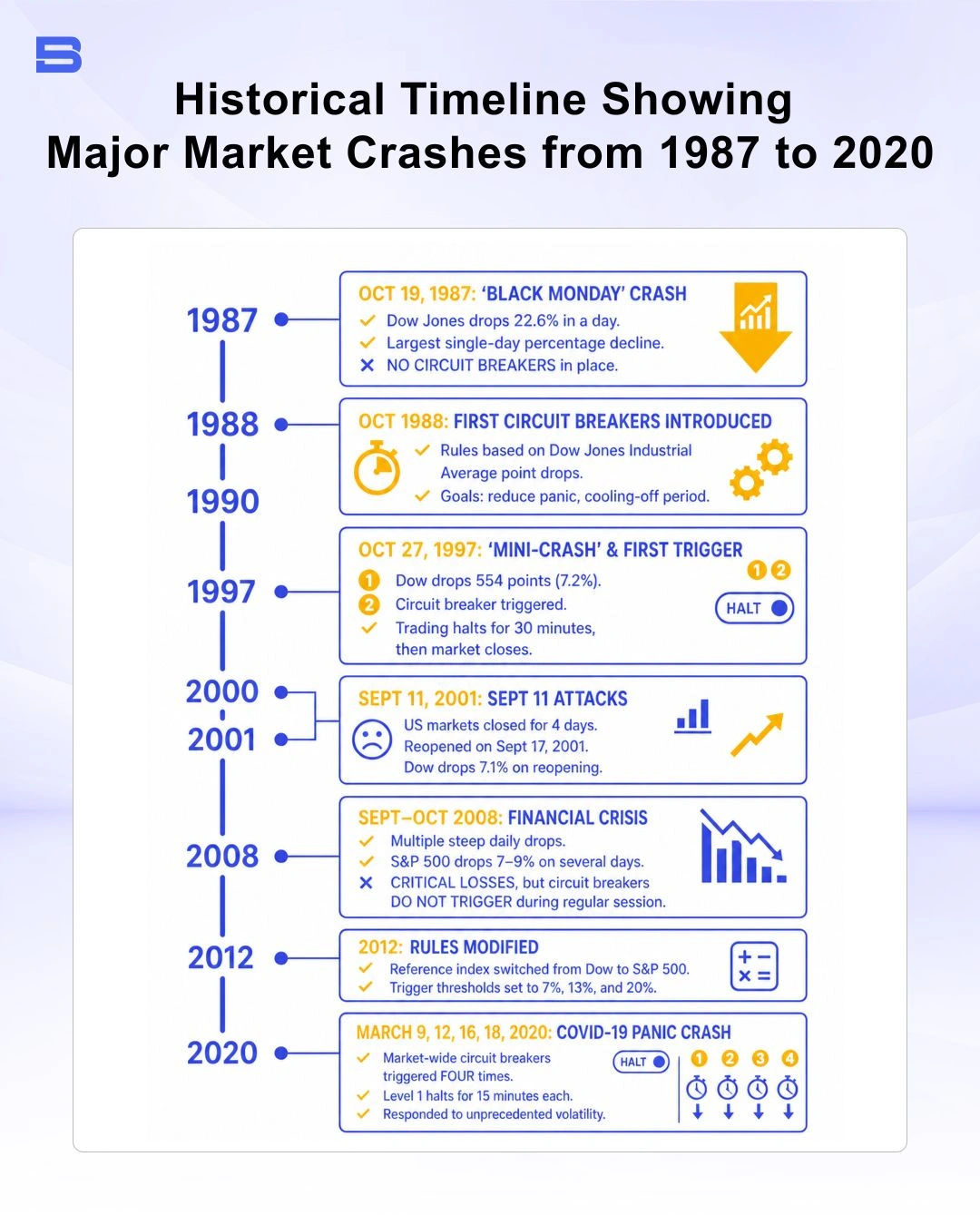
- October 1987 (The Catalyst): On "Black Monday," the Dow plunged over 22% in a single session. Automated computer trading strategies amplified panic selling without any mechanism to pause the flood of sell orders. Regulators implemented circuit breaker rules shortly after to prevent a repeat performance.
- May 2010 (The Flash Crash): On May 6, 2010, the Flash Crash briefly erased nearly $1 trillion in U.S. equity market value before prices rapidly recovered. Subsequent SEC and CFTC (Commodity Futures Trading Commission) investigations, detailed in their joint report on the event, found that it was triggered by a large sell order interacting with market structure and high-frequency trading, rather than HFT alone. Although market-wide circuit breakers were not triggered, the event led regulators to implement the Limit Up-Limit Down (LULD) mechanism to prevent extreme price swings in individual securities.
- March 2020 (The COVID-19 Crash): As the global pandemic unfolded and economic activity halted, extreme uncertainty flooded global markets. The S&P 500 triggered Level 1 circuit breakers four separate times in two weeks (March 9, 12, 16, and 18). Each 15-minute halt allowed investors to process historic economic headlines and restored orderly execution upon reopening.
What Should You Do When a Market Halt Happens?
When a circuit breaker trips while you are active in the market, your immediate response determines whether you preserve your capital or suffer unnecessary execution losses.
1. Avoid Placing Unpriced Market Orders
The most common mistake retail traders make during a market pause is smashing the "Market Sell" button out of fear. When the 15-minute halt ends, market order execution occurs in a single burst of unmatched order flow. Bid-ask spreads can be wildly wider than normal, leading to severe slippage—meaning your sell order might execute at a price significantly lower than where the market was halted.
2. Switch to Limit Orders
If you decide your positions need adjusting, many traders choose to use limit orders instead, since a limit order only executes at your designated price or better — though the right choice always depends on your own risk tolerance and circumstances.
3. Check Order Book Liquidity
When trading resumes after a halt, market makers take several seconds to post liquidity. Wait a moment for liquidity to return before making active trading decisions.
4. Step Away and Re-Evaluate
Remember why the circuit breaker exists: to give market participants time to think rationally. Use those 15 minutes to review news headlines, check your position sizes, and verify whether the market decline changes your overall investment strategy.
Key Takeaways: Understanding Circuit Breakers
Stock market circuit breakers are often perceived as dramatic indicators of financial chaos, but they are actually vital safety systems engineered to protect market integrity. By imposing structured timeouts during severe price declines, circuit breakers curb algorithmic runaways, reduce emotional panic, and give participants room to evaluate fundamental realities.
Understanding how these rules work ensures that when extreme market volatility strikes, you can maintain discipline, manage your risk with precise limit orders, and navigate chaotic conditions with clarity.
Disclaimer: The content on this page is intended for educational and informational purposes only. It does not constitute financial, investment, tax, or legal advice, and should not be interpreted as a recommendation to buy, sell, or hold any financial instrument or asset. Trading and investing involve significant risk, including the possible loss of your entire capital. Products such as forex, CFDs, and cryptocurrencies carry additional risks due to leverage, high volatility, and limited regulatory protection in some jurisdictions. Past performance of any financial instrument does not guarantee future results. Any market views, forecasts, or opinions expressed are those of the author at the time of writing and may not reflect current market conditions. Platform features, fees, and regulatory status are subject to change — always verify information directly with the relevant provider or regulator before making any financial decision. BrokerSpecs may receive compensation from third parties featured on this site. Always conduct your own due diligence and consider seeking advice from a licensed financial professional before investing.