


- What Is Trading and How Does Trading Work?
- Trading Fundamentals: A Guide for Beginners
- Trading vs. Investing: What Are the Key Differences?
- Trading Terms and Terminologies Every Beginner Should Know
- Common Trading Mistakes Beginners Make and How to Avoid
- Understanding Risk and Reward in Trading: A Complete Guide
- Guide to the Different Types of Financial Markets
- Investment Basics: Definition, Strategies, and How to Invest
- Benefits of Investing: Financial Growth and Security
- What Is Swing Trading? A Practical Guide For Beginners
- What Is Spot Trading? A Guide for Beginners
- What Are Futures in Trading? A Guide for Beginners
- Understanding Bull Markets: Growth & Strategy
- How to Read a Candlestick Chart: A Guide for Beginners
- Is Trading Gambling? The Truth About Risk
- Pip in Forex: How It Works & How to Calculate It
- What Is the Bid-Ask Spread in Trading? A Guide for Beginners
- What Is a Margin Call? A Guide for Beginners
- Market Volatility Explained: What It Is and How to Trade It

You are sitting in front of your trading terminal, watching price bars flicker across the screen. An asset suddenly spikes upward, but looking at a standard line or candlestick chart, you cannot see why it happened. You are only looking at past transactions—the history of where prices have already been.
To understand where price might head next, you need to peek behind the curtain. Every digital exchange relies on a real-time, dynamic ledger of supply and demand known as the order book. By showing you every buyer and seller waiting in line before a trade happens, the order book transforms price charts from abstract shapes into transparent markets.
What Is an Order Book and How Does It Work?
An order book is a real-time, continuously updated electronic list of buy and sell orders for a specific financial asset, such as a stock, forex pair, or cryptocurrency. It serves as the primary engine for price discovery on modern exchanges, organized strictly by price level and time of entry.
The order book consists of two main sides:
Buyers (Bids): Displayed on one side (often green or blue), listing the maximum prices traders are willing to pay and the exact quantity they want to purchase.
Sellers (Asks or Offers): Displayed on the opposite side (often red), listing the minimum prices sellers are willing to accept and the volume they want to offload.
When you view an order book, you are looking at resting limit orders. These are traders standing in line, waiting for the market to reach their specific price. The moment a buyer's price matches a seller's price, the exchange's matching engine executes the trade automatically, removes those orders from the book, and records the trade on the chart.
Mastering how these orders sit in the queue requires understanding the mechanics of different order types. Understanding this real-time ledger allows you to evaluate actual market interest rather than relying solely on lagging indicators.
Decoding the Core Components: Bids, Asks, and Spreads
To read an order book effectively, you must master three fundamental concepts: the bid, the ask, and the gap between them.
The highest bid represents the top price any buyer in the world is currently willing to pay. Conversely, the lowest ask represents the cheapest price any seller is willing to accept. Because buyers want to buy low and sellers want to sell high, the highest bid is always lower than the lowest ask.
The distance between these two figures is known as the bid-ask spread. The size of this spread provides immediate insight into the asset's liquidity and trading costs:
Tight Spread: Indicates high liquidity and heavy competition among traders, meaning you can enter and exit positions with minimal cost friction.
Wide Spread: Signals lower liquidity or higher market uncertainty, meaning trading the asset carries higher execution costs.
Worked Scenario: Calculating Spread and Execution Cost
Setup: Imagine you are looking at the order book for Stock ABC. The highest bid on the book is $100.00 and the lowest ask is $100.05. This means the bid-ask spread is $0.05 per share.
If you buy 100 shares immediately using a market order, you will pay the ask price of $100.05. If you sell those same shares instantly, you will receive the bid price of $100.00. That $0.05 difference ($5.00 total on 100 shares) represents your immediate transaction friction before any broker commissions.
Reading Market Depth and Order Book Structure
Looking only at the top bid and ask price gives you a narrow view of the market. To gauge true market strength, traders evaluate market depth—often referred to as Level 2 data.
Market depth reveals all the orders stacked further down the ladder away from the current price. It shows not just the immediate prices, but how much volume is waiting at $100.00, $99.90, $99.80, and so forth.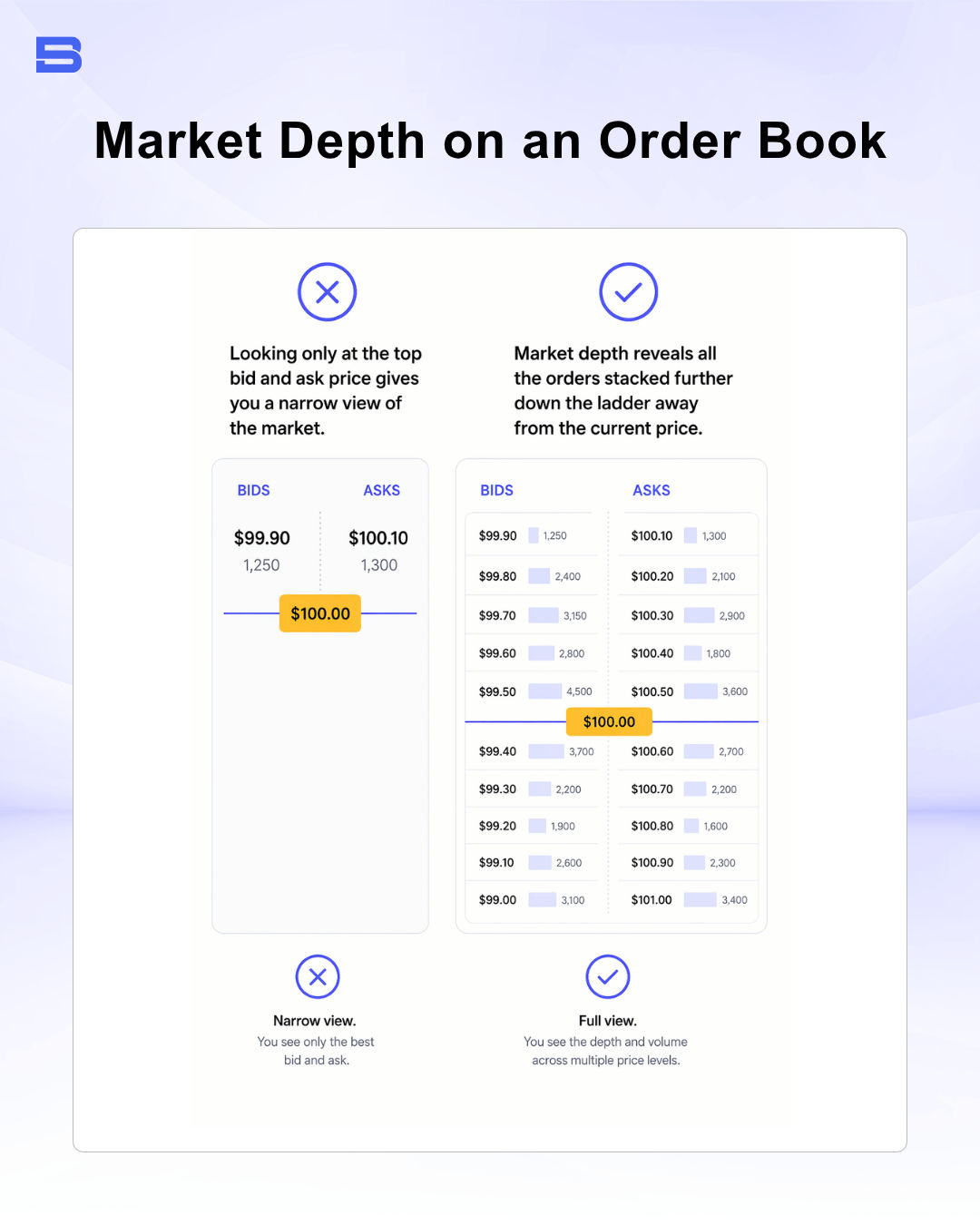
Understanding market depth helps you evaluate two major concepts:
- Liquidity Walls: Large clusters of buy or sell orders at a single price level. A massive wall of buy orders can act as temporary support, since price generally cannot fall through until those orders are filled—though it's worth noting that resting orders can be modified or cancelled at any moment, so a large wall is not a guaranteed floor and can disappear without warning.
- Slippage: If you place a market order to buy 1,000 shares, but the lowest ask only offers 300 shares at $100.05, the exchange will fill the remaining 700 shares at higher ask levels (e.g., 400 shares at $100.08 and 300 shares at $100.10). This difference between your expected price and actual execution price is called slippage.
By analyzing market depth, you can size your positions appropriately to avoid eating through order levels and paying unexpected slippage costs.
Market Orders vs. Limit Orders in the Book
Every participant in an order book falls into one of two categories based on how they interact with liquidity: liquidity makers or liquidity takers.
Limit Orders (Makers): When you place a limit order, you tell the market, "I want to buy at $99.00 or better." If the current market price is $100.00, your order sits in the order book, adding depth and providing liquidity. You are acting as a liquidity maker in this context.
Market Orders (Takers): When you place a market order, you tell the market, "Execute my order right now at whatever price is available." A market order instantly consumes the top resting limit orders on the opposing side of the book. You are removing liquidity from the market.
Knowing this dynamic is crucial when developing a trading strategy. If speed of execution is your top priority during volatile events, you use market orders and take liquidity. If price precision and minimizing costs are your goals, you use limit orders and make liquidity. For a deeper technical breakdown of order types, see the Securities and Exchange Commission’s (SEC) breakdown of the different order types available.
Integrating Order Book Analysis
The order book is the living, breathing foundation of modern financial markets. Rather than relying purely on technical patterns drawn from historic prices, analyzing the order book provides direct visibility into current supply, demand, and liquidity depth.
Whether you are placing small retail trades or managing larger positions, understanding how bids, asks, and order types interact inside the book empowers you to make smarter execution decisions and minimize trading costs.
Disclaimer: The content on this page is intended for educational and informational purposes only. It does not constitute financial, investment, tax, or legal advice, and should not be interpreted as a recommendation to buy, sell, or hold any financial instrument or asset. Trading and investing involve significant risk, including the possible loss of your entire capital. Products such as forex, CFDs, and cryptocurrencies carry additional risks due to leverage, high volatility, and limited regulatory protection in some jurisdictions. Past performance of any financial instrument does not guarantee future results. Any market views, forecasts, or opinions expressed are those of the author at the time of writing and may not reflect current market conditions. Platform features, fees, and regulatory status are subject to change — always verify information directly with the relevant provider or regulator before making any financial decision. BrokerSpecs may receive compensation from third parties featured on this site. Always conduct your own due diligence and consider seeking advice from a licensed financial professional before investing.