



Related Tags
Imagine buying thousands of shares in a company for just a few hundred dollars, watching a minor price move double your account overnight.
It is the headline-grabbing promise that draws countless newcomers into the world of cheap stocks. But behind those sudden spikes lies an ecosystem filled with low liquidity, extreme volatility, and hidden risks that can wipe out a portfolio just as quickly.
Understanding how these low-priced equities operate is essential before placing your first order. Whether you are drawn by the potential for high percentage returns or simply curious about how these markets function, learning the mechanics, risks, and trading strategies will help you navigate this space safely.
What Is a Penny Stock?
In financial markets, a penny stock traditionally refers to shares of small public companies that trade at low prices per share. While the name implies a stock trading for literally pennies, official regulatory definitions are broader.
The Securities and Exchange Commission (SEC) generally defines a penny stock as any equity security issued by a small company that trades below $5.00 per share and is not listed on a major national exchange.
However, in casual market parlance, traders often group any stock trading under $5.00 into this category, regardless of where it lists.
Where They Trade
Where a company lists its shares makes a profound difference in risk and transparency:
- Major Exchanges (NASDAQ / NYSE): Companies trading under $5.00 on major exchanges must still follow strict financial reporting guidelines, maintain minimum capital requirements, and submit regular SEC filings.
- Over-the-Counter (OTC) Markets: Many low-priced equities trade via OTC marketplaces, such as OTCQX (the OTC Markets Group's highest tier, with stricter disclosure standards), OTCQB (the venture-stage tier for early-growth companies), or Pink Sheets (the lowest tier, with minimal or no disclosure requirements). These platforms have far fewer listing requirements than major exchanges, meaning some issuers publish minimal financial data.
Because these companies typically have small market capitalizations—often categorized as micro-cap or nano-cap—they experience thin trading volume and low institutional interest. This structural dynamic sets the stage for extreme price fluctuations.
How Penny Stocks Work in Practice
Trading low-priced equities is fundamentally different from trading blue-chip stocks like Apple or Microsoft. The core mechanics revolve around market liquidity and the bid-ask spread.
In high-volume stocks, the difference between the price buyers are willing to pay (the bid) and the price sellers are willing to accept (the ask) is usually a fraction of a cent. In cheap stocks, that spread can represent a massive percentage of the total stock price.
A Worked Trading Scenario
To understand how bid-ask spreads and low prices affect your capital, consider a simple real-world example.
Suppose you decide to purchase 10,000 shares of a micro-cap stock trading at $0.10 per share.
- Initial Investment: 10,000 shares x $0.10 = $1,000 position.
- The Spread Factor: When you enter the trade, the market quote displays a Bid of $0.08 and an Ask of $0.10.
- Immediate Liquidation Loss: If you buy at the Ask ($0.10) and instantly decide to sell back at the current Bid ($0.08), your 10,000 shares are sold for $800.
In this scenario, you incur an immediate 20% loss without the stock price moving at all, simply due to the wide bid-ask spread.
Furthermore, if the stock price drops just $0.01 (from $0.10 to $0.09), your position value falls by 10%. This mathematical reality demonstrates why low-priced shares carry elevated execution risk.
Are Penny Stocks Safe? Risks and Red Flags
For beginner traders, penny stocks are generally considered high-risk instruments. While the potential percentage gains attract attention, the structural disadvantages make capital preservation challenging.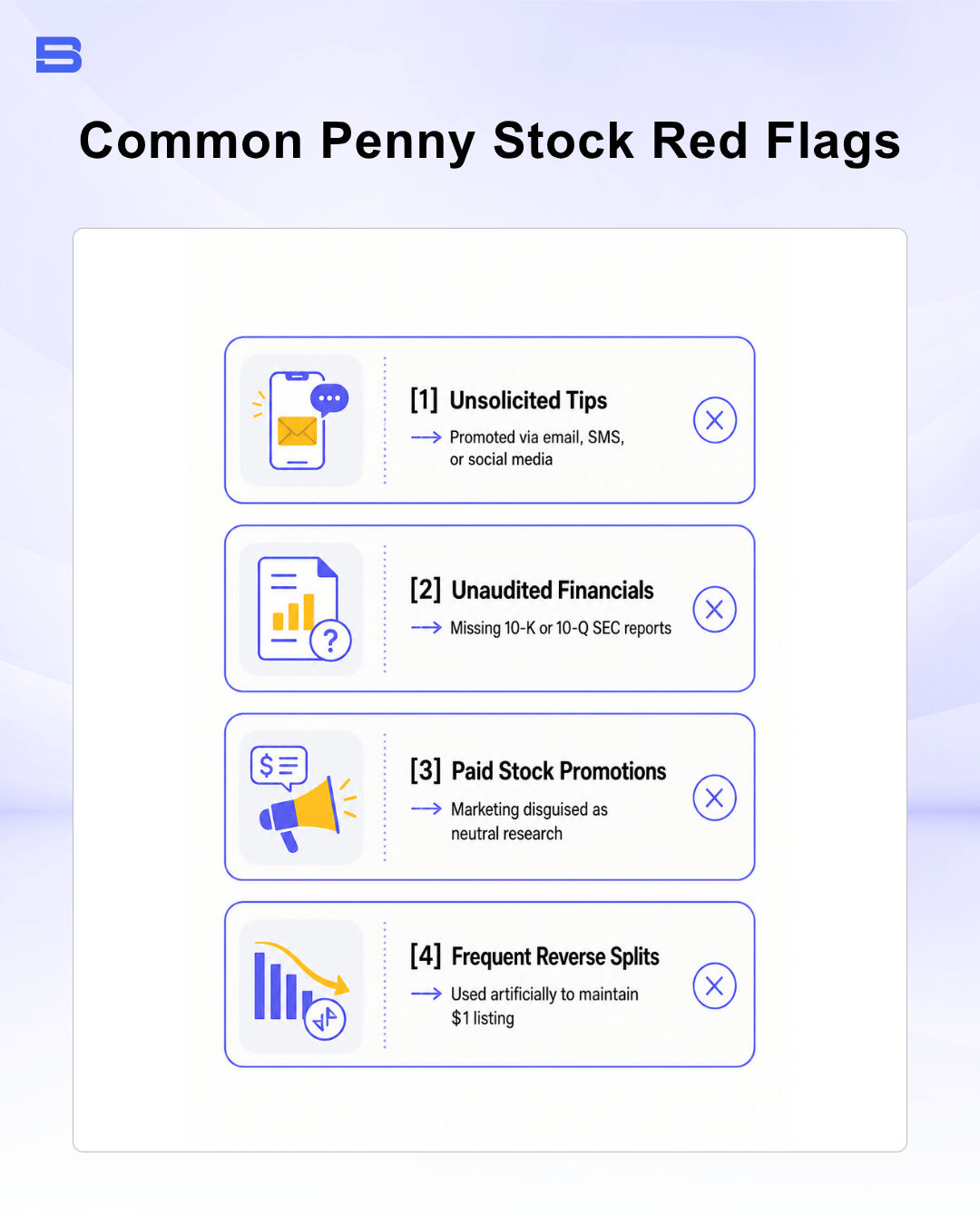
Primary Market Risks
- Illiquidity Traps: In thinly traded OTC markets, you may buy shares but find no willing buyers when you want to sell, forcing you to dump shares at a steep discount.
- Information Scarcity: Many small OTC companies do not publish audited balance sheets, making fundamental analysis nearly impossible.
- Insolvency Risk: Micro-cap firms often run on thin cash reserves and rely heavily on stock dilution or debt financing to stay operational.
Red Flags to Avoid
Pump-and-dump schemes remain a persistent issue in unlisted micro-cap stocks. Bad actors accumulate large positions in a cheap stock, artificially inflate the price through misleading promotions or paid social media hype, and then sell off their holdings to unsuspecting buyers.
Always be wary of unsolicited stock picks, promises of guaranteed returns, or companies that repeatedly execute reverse stock splits to keep their share price above exchange minimums.
How to Trade Penny Stocks Safely: Essential Rules
If you decide to allocate a portion of your portfolio to penny stock trading, adopting a disciplined, risk-first approach is critical.
- Stick to Major Exchanges: Focus primarily on stocks trading on the NASDAQ or NYSE. Companies on major exchanges must meet reporting requirements, providing audited disclosures that make evaluating financial health much clearer.
- Implement Strict Position Sizing: Never risk a large portion of your total trading capital on a single speculative stock. Keep micro-cap allocations to a small, manageable percentage of your portfolio (for instance, under 2% to 5%).
- Check SEC Filings Directly: Do not rely solely on press releases or forum posts. Use the SEC EDGAR database to check official quarterly reports (Form 10-Q) and annual reports (Form 10-K). Verify whether the company generates revenue or relies entirely on share dilution.
- Use Limit Orders Instead of Market Orders: Given the wide spreads common in low-priced stocks, always use limit orders. A limit order ensures you specify the exact price you are willing to pay or accept, preventing unexpected price execution slippage.
Trading Penny Stocks Safely
Penny stocks offer an accessible entry point and high percentage volatility, but they demand a high degree of risk management. The combination of wide spreads, low liquidity, and limited corporate transparency means that capital preservation must always take priority over chasing quick returns.
By sticking to exchange-listed companies, checking official disclosures, and managing position sizing carefully, you can explore low-priced equities without taking unnecessary risks with your capital.
- What Is Trading and How Does Trading Work?
- Trading Fundamentals: A Guide for Beginners
- Trading vs. Investing: What Are the Key Differences?
- Trading Terms and Terminologies Every Beginner Should Know
- Common Trading Mistakes Beginners Make and How to Avoid
- Understanding Risk and Reward in Trading: A Complete Guide
- Guide to the Different Types of Financial Markets
- Investment Basics: Definition, Strategies, and How to Invest
- Benefits of Investing: Financial Growth and Security
- What Is Swing Trading? A Practical Guide For Beginners
- What Is Spot Trading? A Guide for Beginners
- What Are Futures in Trading? A Guide for Beginners
- Understanding Bull Markets: Growth & Strategy
- How to Read a Candlestick Chart: A Guide for Beginners
- Is Trading Gambling? The Truth About Risk
- Pip in Forex: How It Works & How to Calculate It
- What Is the Bid-Ask Spread in Trading? A Guide for Beginners
- What Is a Margin Call? A Guide for Beginners
- Market Volatility Explained: What It Is and How to Trade It
- Drawdown in Trading: Meaning, Math, and Risk
- Understanding Slippage in Trading: Causes and Control
- Forex Lot Size Explained: Standard, Mini & Micro
- Trailing Stop vs Stop Loss: Essential Risk Strategy
- How Asset Allocation Works: Strategies Explained
- Understanding Market Trading Hours & Sessions
- Market Makers Explained: A Trader's Guide
- Portfolio Diversification: A Strategy Guide
- Capital Gains Explained: How Investment Taxes Work
- Stock Market Circuit Breakers: How Trading Halts Work
- What Is an IPO? How Initial Public Offerings Work
- What Is a Secondary Market? A Complete Guide
- What Is a Stock Exchange? Functions and Overview Explained
- Understanding Ticker Symbols: A Market Guide
- How Clearing Houses Work in Financial Markets
- Stock Market After Labor Day: Trends and What To Expect
Disclaimer: The content on this page is intended for educational and informational purposes only. It does not constitute financial, investment, tax, or legal advice, and should not be interpreted as a recommendation to buy, sell, or hold any financial instrument or asset. Trading and investing involve significant risk, including the possible loss of your entire capital. Products such as forex, CFDs, and cryptocurrencies carry additional risks due to leverage, high volatility, and limited regulatory protection in some jurisdictions. Past performance of any financial instrument does not guarantee future results. Any market views, forecasts, or opinions expressed are those of the author at the time of writing and may not reflect current market conditions. Platform features, fees, and regulatory status are subject to change — always verify information directly with the relevant provider or regulator before making any financial decision. BrokerSpecs may receive compensation from third parties featured on this site. Always conduct your own due diligence and consider seeking advice from a licensed financial professional before investing. Portions of this article were prepared with the assistance of AI tools and reviewed by our editorial team before publication.