



Related Tags
You sit down at your trading desk right as the London bell rings, watch price violently break out past the Asian session high, and jump into a long position to catch the momentum. Within ten minutes, the move abruptly stalls, reverses with aggressive speed, and tags your stop-loss before sprinting straight down into your original target direction. Retail traders frequently call this "bad luck" or "market manipulation," but institutional order flow traders recognize it as an engineered session-open trap.
What Is a Judas Swing and Why Does It Form?
In the ICT (Inner Circle Trader) trading methodology, a Judas Swing refers to what proponents describe as an intentional early-session false breakout, designed to sweep accumulated retail liquidity before the true daily trend begins.
Large financial institutions handle transaction volumes so massive that they cannot simply execute market orders without causing severe slippage against their own positions. To accumulate buy positions at wholesale prices or distribute short inventory at premium levels, these entities require counterparties willing to absorb the other side of the trade.
Regulatory bodies like the US Securities and Exchange Commission (SEC) continually emphasize that market depth and liquidity distribution dictate price execution quality across major electronic markets.
When retail traders cluster stop-loss orders just above session highs or below session lows, they create pools of resting stop orders. The Judas Swing drives price directly into these clusters. Once those stops are triggered, providing the necessary volume, institutional algorithms quickly reverse price in the genuine direction of their higher-timeframe intent.
Judas Swing Trading Mechanics: How the False Breakout Operates
The foundational principle of Judas swing trading centers on smart money mechanics. During low-volatility periods, such as the Asian trading session, price typically consolidates within a well-defined horizontal channel. Retail breakout systems naturally place buy stops above the range ceiling and sell stops below the floor.
Institutional traders view these boundaries as prime areas of inducement in trading. Rather than defending the range, algorithms engineer an artificial price expansion outside the boundary. As retail participants interpret this breakout as genuine trend acceleration, breakout buyers enter the market, while existing short sellers are forced to cover their positions via market buy orders.
This simultaneous influx of retail buying provides the exact liquidity required for institutional accounts to execute substantial short positions. Once this liquidity exchange is finalized, the false expansion ceases immediately, and price collapses back into the range with high displacement.
Timing the Move: London and New York Session Killzones
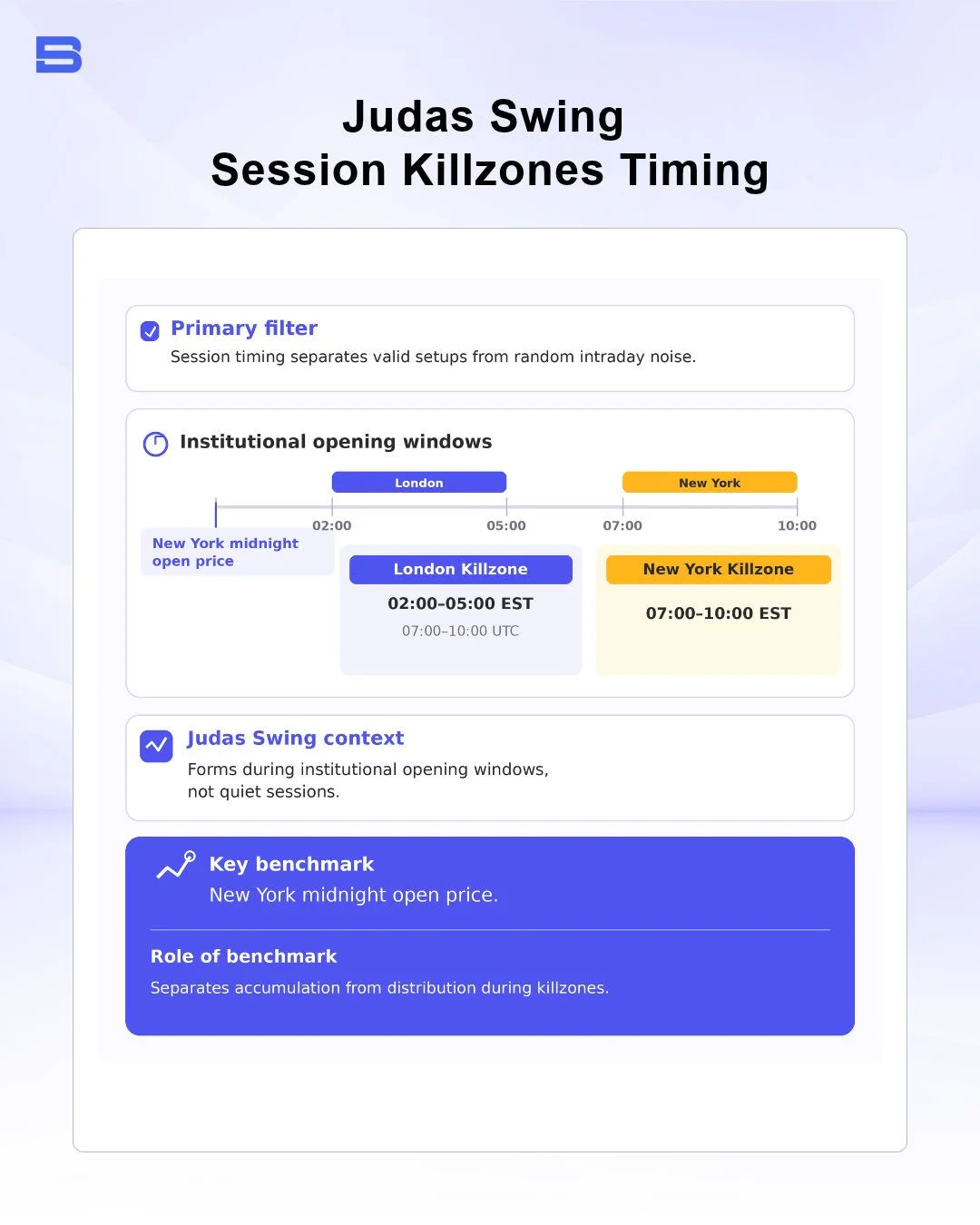
Session timing serves as the primary filter separating valid setup conditions from random intraday noise. A true Judas Swing does not develop in the middle of a quiet session; it occurs during institutional opening windows known as session killzones.
The London Killzone, running between 02:00 and 05:00 EST (07:00 to 10:00 UTC), represents the most frequent window for this pattern. The New York Killzone, active between 07:00 and 10:00 EST, offers similar conditions, often clearing liquidity established during the London morning. The critical benchmark separating accumulation from distribution during these windows is the New York midnight open price.
If higher-timeframe analysis points toward a bullish daily expansion, the Judas Swing typically drives price downward below the midnight open price, creating an intraday discount. Conversely, if daily bias is bearish, the algorithm engineers a move upward above the midnight open into a premium zone before the true selloff unfolds.
Step-by-Step Execution: How to Trade the Judas Swing Setup
Trading this pattern requires strict mechanical confirmation rather than anticipating the top or bottom of an aggressive candle. Jumping blindly in front of an expanding breakout candle frequently results in severe drawdown if the market is experiencing a genuine trend day.
Requiring a Market Structure Shift Before Entry
Execution begins by waiting for the liquidity sweep to fully conclude across the session extreme. Once price raids the liquidity pool, you must drop down to a lower timeframe, such as the 1-minute or 5-minute chart, and wait for a clear market structure shift confirmation.
A valid market structure shift occurs when price aggressively breaks back through the most recent swing low (for a bearish reversal) or swing high (for a bullish reversal) with a full candle body close. This displacement confirms that institutional order flow has taken control and that the early expansion has officially failed.
Entry Triggers Using Fair Value Gaps and Liquidity Sweeps
Following the structural shift, price typically leaves behind an institutional imbalance known as a fair value gap or mitigates an intraday order block trading footprint. This zone provides the optimal technical platform for an entry.
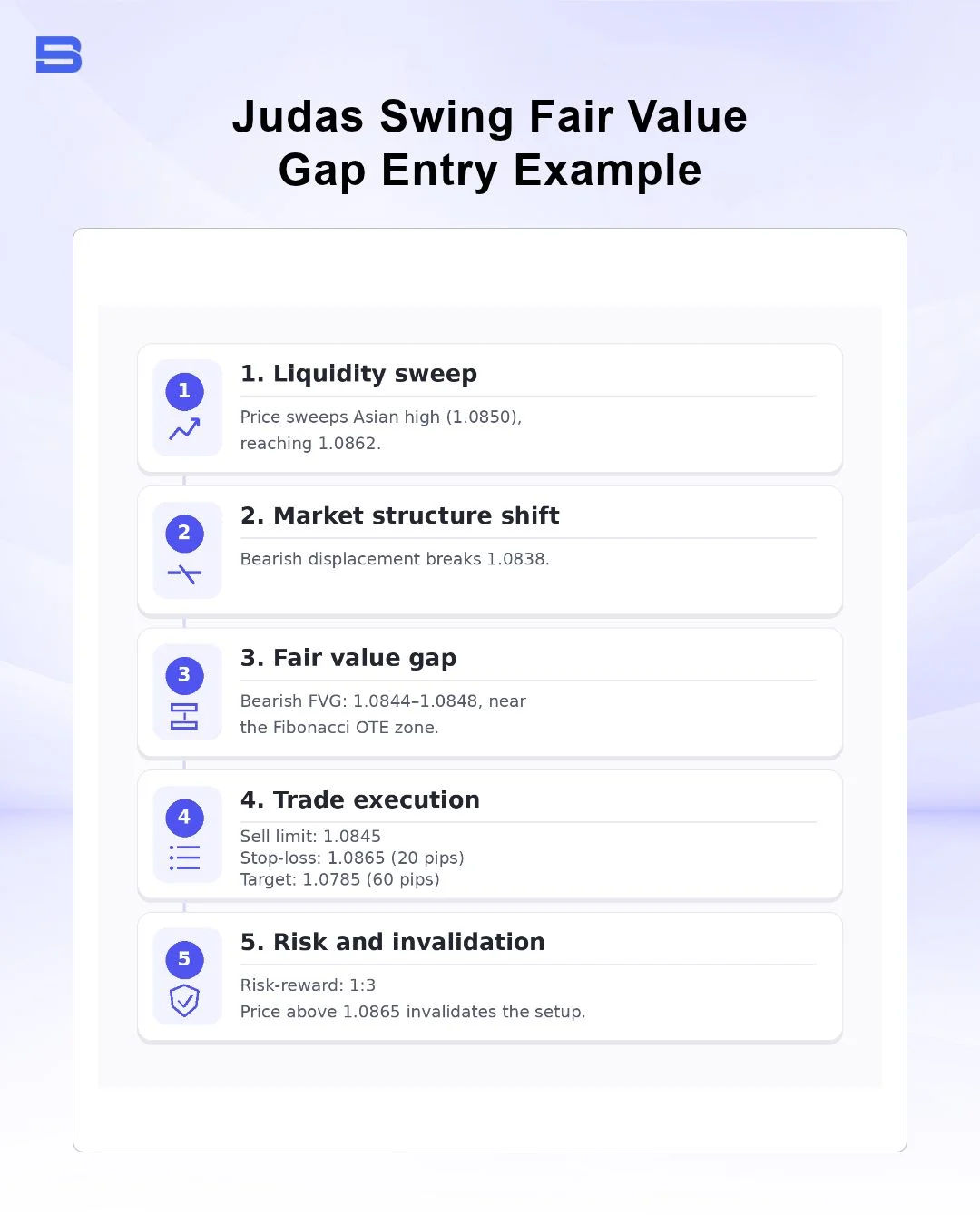
Consider a worked scenario on EUR/USD during the London open. Price sweeps the Asian session high at 1.0850, reaching 1.0862 before printing a sharp 5-minute market structure shift downward that breaks 1.0838. This displacement creates a 5-minute bearish fair value gap between 1.0844 and 1.0848, aligning closely with what ICT traders call the Optimal Trade Entry (OTE) zone, a specific Fibonacci retracement area used to time entries.
You place a limit sell order at 1.0845, with a protective stop-loss set 3 pips above the swing extreme at 1.0865 (a 20-pip risk). Target liquidity sits at the Asian low of 1.0785. If filled, the setup targets a hypothetical 60-pip move for an illustrative 1:3 risk-reward ratio — in live trading, spreads, slippage, and volatility can change this outcome, and the position may be stopped out instead. If price drives through 1.0865 instead of reversing, the trade is mechanically invalidated immediately.
Judas Swing vs Turtle Soup: Key Differences in Modern Market Structure
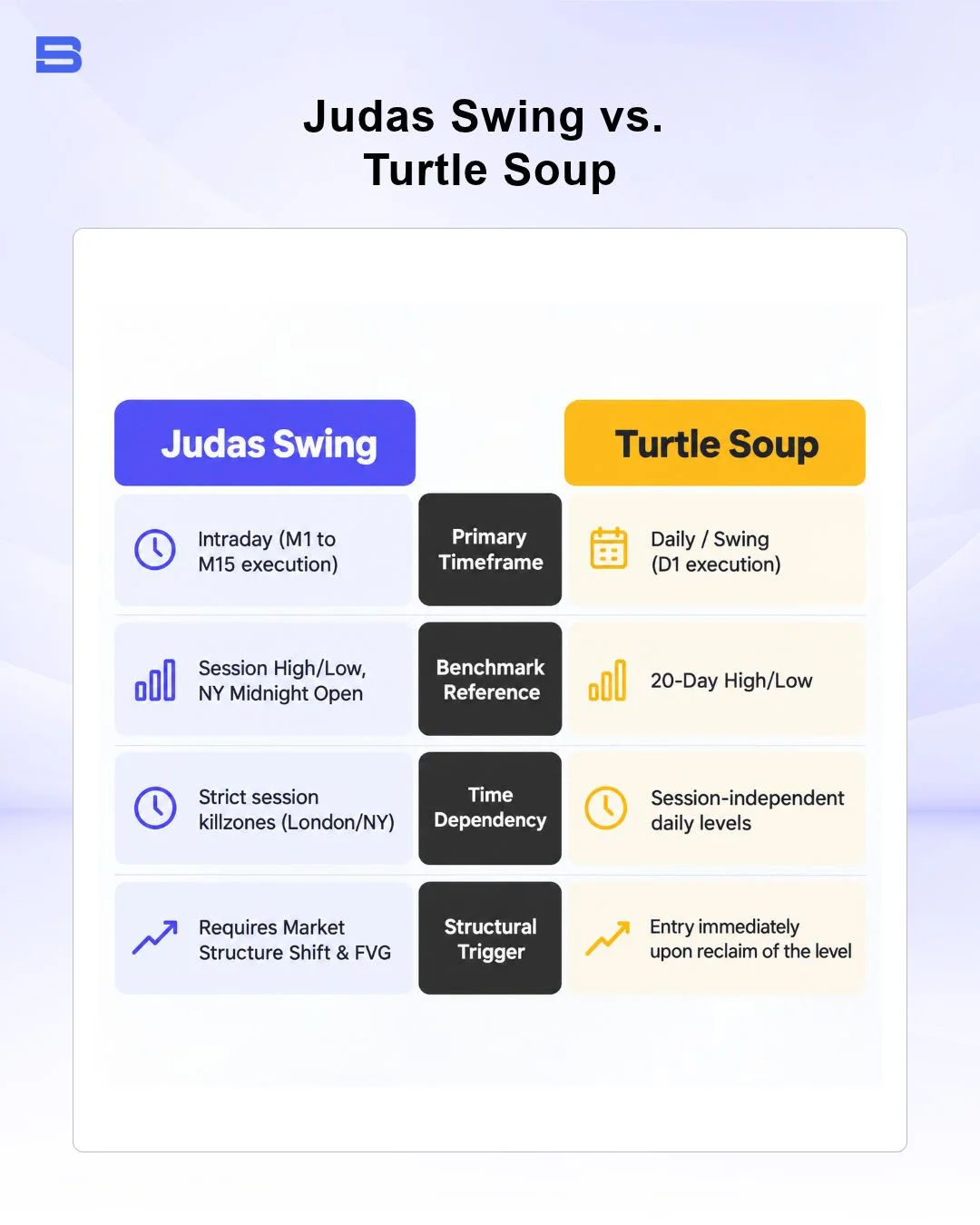
Traders often conflate the Judas Swing with the classic Turtle Soup pattern popularized by Linda Raschke. While both strategies capitalize on failed breakouts and liquidity runs, their structural application differs significantly across timeframes and execution benchmarks.
Risk Management and Common Pitfalls When Trading Session Sweeps
Fading early morning momentum carries substantial capital risk if executed without mechanical discipline. A common pitfall is mistaking a genuine macroeconomic trend breakout for a Judas Swing.
High-impact macroeconomic news releases, such as interest rate decisions or non-farm payroll reports, inject genuine institutional volume that easily overpowers standard session reversal patterns. Authoritative financial regulators, such as the Financial Conduct Authority (FCA), frequently warn retail participants about the severe risks associated with excessive leverage and unpredictable volatility during major session opens.
If a breakout candle closes strongly outside a session range on elevated volume without leaving an immediate lower-timeframe shift, attempting to fade the move will quickly wipe out a trading account.
Never enter a reversal trade without a verified hard stop-loss positioned outside the extreme swing point. Leverage amplifies your returns when you catch a clean reversal, but it accelerates capital destruction just as quickly when the market moves into a sustained one-directional expansion; a 2.5% adverse move on a 30:1 leveraged position will erase 75% of your allocated margin.
The Bottom Line
Mastering the Judas Swing shifts your perspective from chasing early session momentum to patiently waiting for institutional traps to resolve. Protect your capital by demanding structural confirmation, respecting the New York midnight benchmark, and applying consistent position sizing on every setup.
- How to Build an Investment Plan That Actually Works for You?
- What Is the MACD Indicator and How to Use It
- What Is a Wedge Pattern in Trading?
- What Is Ichimoku Cloud Strategy? A Complete Trading System
- Mastering Elliott Wave Theory: Rules and Trading Strategies
- News Trading: Strategies, Execution Risks, and Risk Control
- What Is an Iron Condor Options Strategy?
- Backtesting Explained: What It Is and Why It Really Matters
- Grid Trading: Mechanics, Parameters, and Risk Strategies
- What Is Breakout Trading and How Does It Work?
- Mean Reversion: Technical Strategies and Risk Frameworks
- Momentum Trading: Indicators, Strategies, and Risk Control
- Hammer Candlestick: Structure, Meaning, and Strategy
- Doji Candlestick: Types, Signals, and Trading Strategies
- What Is the Sharpe Ratio and How to Calculate It
- What Is VWAP and How Do Traders Use It?
- Trade the Ascending Triangle: A Step-by-Step Practical Guide
- What Is the Stochastic Oscillator and How to Use It
- How to Trade the Descending Triangle Pattern
- High Frequency Trading: Speed, Algorithms, and Market Impact
- What Is Volume Profile and How to Use It in Trading
- What Is a Morning Star Pattern Candlestick?
- Trade with Parabolic SAR: A Practical Analysis Guide
- Evening Star Pattern: Structure, Rules, and Risk Controls
- Kelly Criterion: Formula, Position Sizing, and Risk
- What Is the NYSE Minimum Trading Price? Rules Explained
Disclaimer: The content on this page is intended for educational and informational purposes only. It does not constitute financial, investment, tax, or legal advice, and should not be interpreted as a recommendation to buy, sell, or hold any financial instrument or asset. Trading and investing involve significant risk, including the possible loss of your entire capital. Products such as forex, CFDs, and cryptocurrencies carry additional risks due to leverage, high volatility, and limited regulatory protection in some jurisdictions. Past performance of any financial instrument does not guarantee future results. Any market views, forecasts, or opinions expressed are those of the author at the time of writing and may not reflect current market conditions. Platform features, fees, and regulatory status are subject to change — always verify information directly with the relevant provider or regulator before making any financial decision. BrokerSpecs may receive compensation from third parties featured on this site. Always conduct your own due diligence and consider seeking advice from a licensed financial professional before investing. Portions of this article were prepared with the assistance of AI tools and reviewed by our editorial team before publication.