



Related Tags
The countdown timer on your economic calendar hits zero, and within a split second, the price chart on your screen erupts into violent upward and downward spikes. For macro traders, major economic announcements trigger some of the sharpest liquidity movements of the trading week — spreads that normally sit under 1 pip can widen to 15–25 pips within milliseconds. News trading attempts to harness this exact volatility, turning high-impact macroeconomic releases into structured trading opportunities.
However, trading around high-impact events requires far more than guessing economic data points. Capitalizing on sudden price shifts demands a firm grasp of market microstructure, order execution behavior, and institutional risk protocols.
What Is News Trading and How Does It Work?
News trading is an execution-focused strategy where market participants take positions in financial instruments directly before, during, or after major economic announcements to capture sharp, volatility-driven price movements. Rather than holding assets for long-term fundamentals, you react to the sudden repricing of assets caused by unexpected macroeconomic updates.
When central banks or government statistical agencies release fresh economic reports, institutional algorithms process the data within milliseconds. If the published figure diverges significantly from what institutional markets priced in, liquidity providers reprice their order books instantaneously.
Retail traders often expect the market to move in the logical direction of the news—for example, rallying on strong job numbers. However, price direction during major releases depends entirely on the surprise factor: the gap between actual published numbers and prevailing consensus forecasts. To build a resilient analytical foundation for these setups, To build a resilient analytical foundation for these setups, explore our guide to market volatility.
The Mechanics of News Trading: Market Sentiment and Volatility
To execute news trades effectively, you must understand how institutional sentiment builds before a scheduled event. Weeks before a major release, market participants form a consensus expectation based on economic forecasts. Prices adjust gradually to reflect this collective outlook, a process known as "pricing in" the event.
When data aligns perfectly with consensus expectations, price movement is often surprisingly muted. The real catalyst for explosive asset volatility — the kind that turns a normally sub-1-pip spread into 15–25 pips — occurs when actual data deviates sharply from expectations.
This deviation causes liquidity providers to instantly pull their resting limit orders from order books to avoid taking toxic flow. As thin market depth meets a surge of market orders, prices jump across price ladders. News trading strategies capitalize on this structural repricing across forex, global indices, commodities, and fixed-income assets.
Before diving into setups: a pip is the smallest standard price move in a currency pair, and a standard lot represents 100,000 units of the base currency — the size most spread and slippage figures below are quoted against.
Key High-Impact Economic Events to Track
Not all economic reports generate sufficient liquidity expansion to justify execution. As a news trader, your focus is primarily on tier-1 releases such as Non-Farm Payrolls (NFP), Consumer Price Index (CPI) inflation data, FOMC rate decisions, and GDP prints — these consistently generate the deepest liquidity swings.
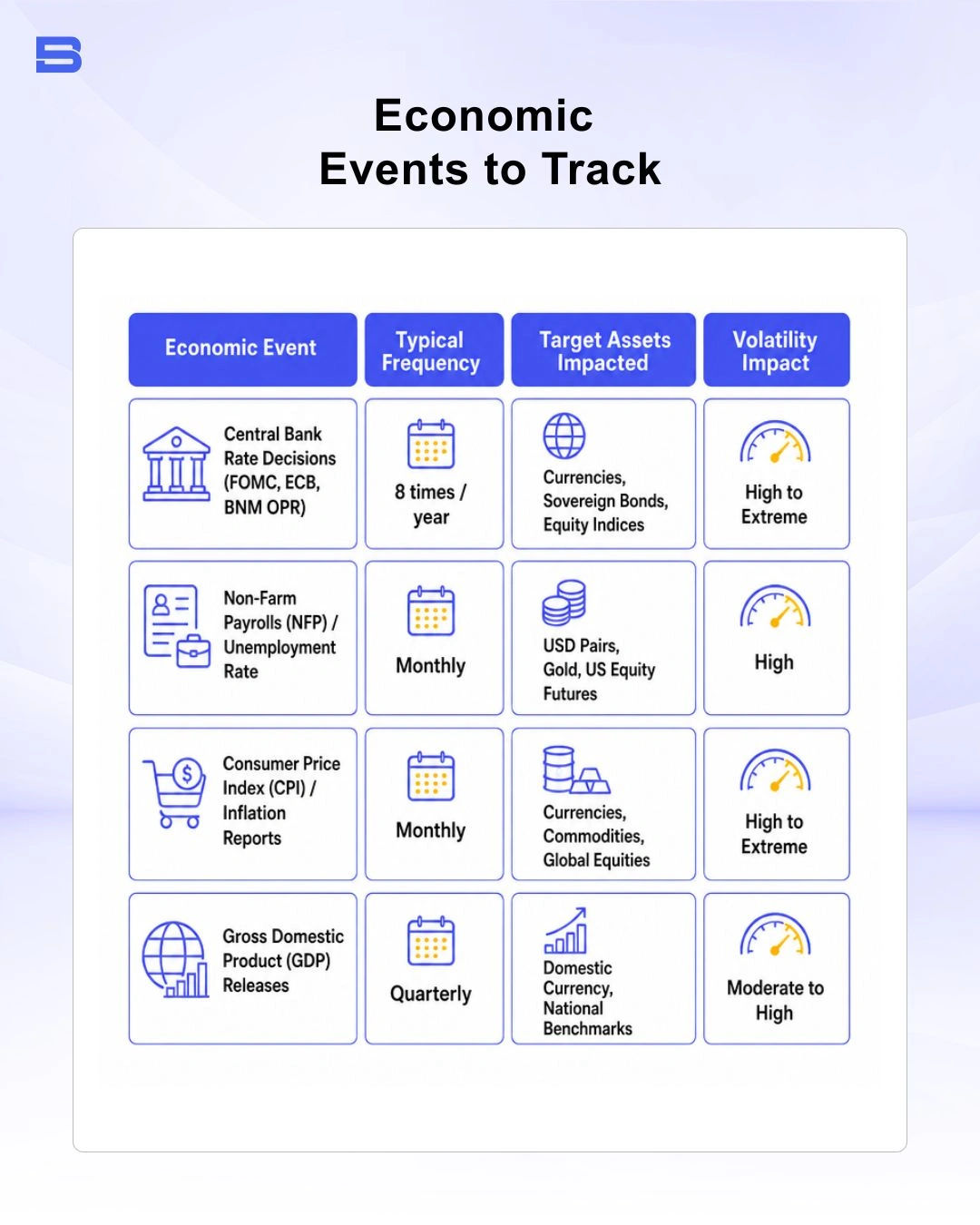
Regulatory bodies, such as the US Securities and Exchange Commission (SEC), enforce strict public reporting timelines for public companies and financial entities, ensuring equal market access during economic disclosures.
Core News Trading Strategies: Pre-Event vs Post-Event
Execution methodology generally falls into pre-event directional positioning, pre-event non-directional straddles, or post-event momentum confirmation.
Mapping Technical Key Levels Before News Releases
Before any tier-1 event, outline structural technical boundaries on lower timeframe charts. You need to map out key support and resistance levels, recent session highs, and consolidations. These structural zones define where institutional stop losses cluster and where breakout confirmation or rejection will likely occur.
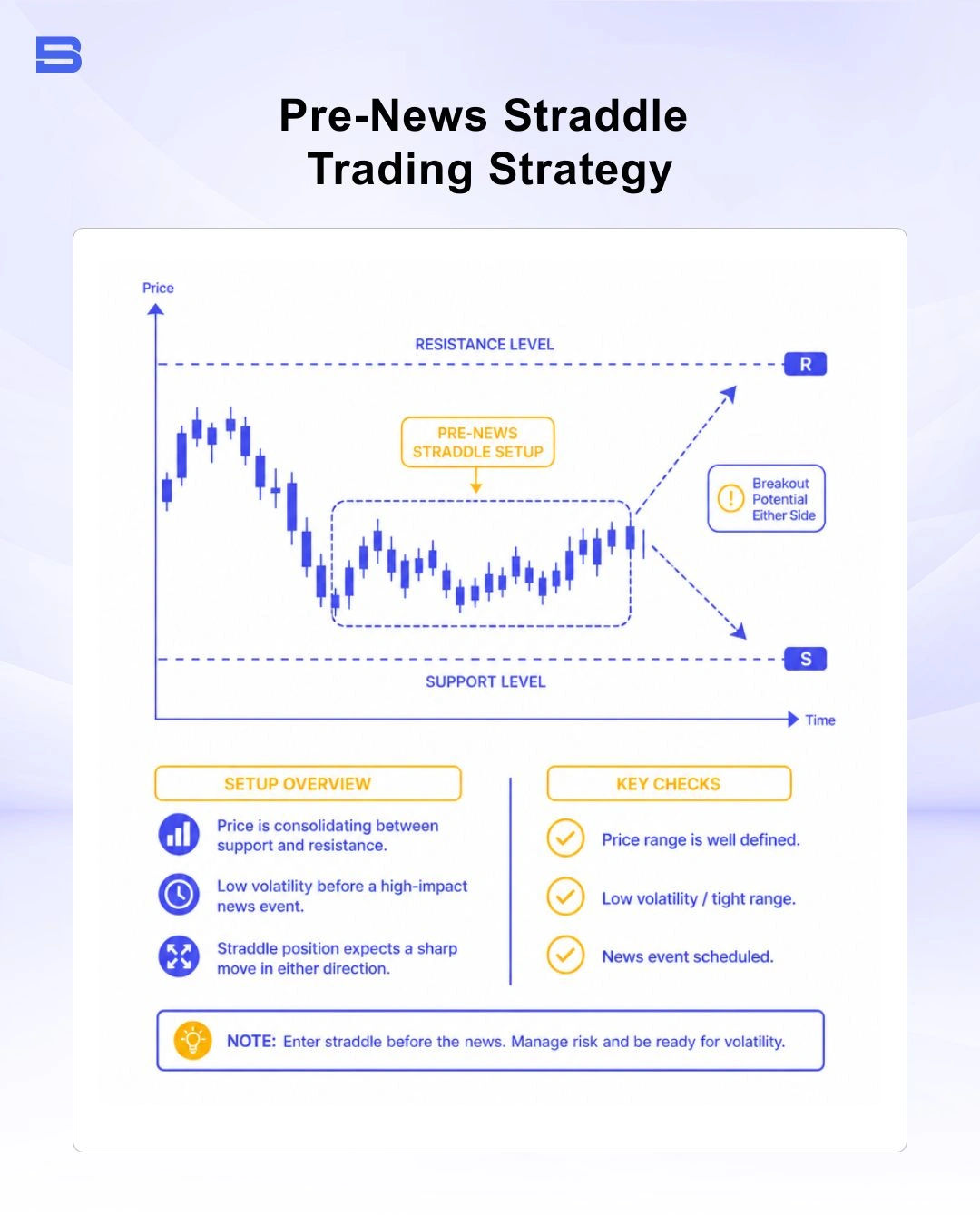
Pre-News Straddle Setup
A non-directional straddle strategy attempts to capture explosive momentum — moves that can exceed a full daily average trading range within minutes — regardless of which direction the market breaks.
- Identify a tight consolidation range 15 to 30 minutes before the economic release.
- Place a pending Buy Stop order a few pips above local resistance and a Sell Stop order a few pips below local support.
- Set tight stop-loss orders for both sides within the established range.
- When the news hits, fast price action triggers one pending order while you cancel the unfulfilled opposite order immediately.
Post-News Momentum Confirmation Entry
Instead of anticipating the initial spike, post-news traders wait for the immediate market reaction to clear.
- Allow the initial 1-to-5-minute post-release candle to close to absorb initial order-book spikes.
- Verify that order-book spreads have normalized back to baseline levels.
- Enter in the direction of the confirmed impulse once price breaks the initial 1-minute release candle's high or low.
Post-Spike Mean Reversion Setups
Market overreaction is common during news events. A post-spike Mean Reversion entry involves identifying liquidity exhaustion after an initial emotional drive hits key long-term daily or weekly structural levels, entering counter-trend positions as pricing normalizes back toward fair value.
Execution Risks: Slippage, Spreads, and Broker Liquidity
While rapid price expansion offers profit opportunities, the structural mechanics of news execution introduce operational risks severe enough to turn a $100 planned loss into $200 or more, as the example below shows.
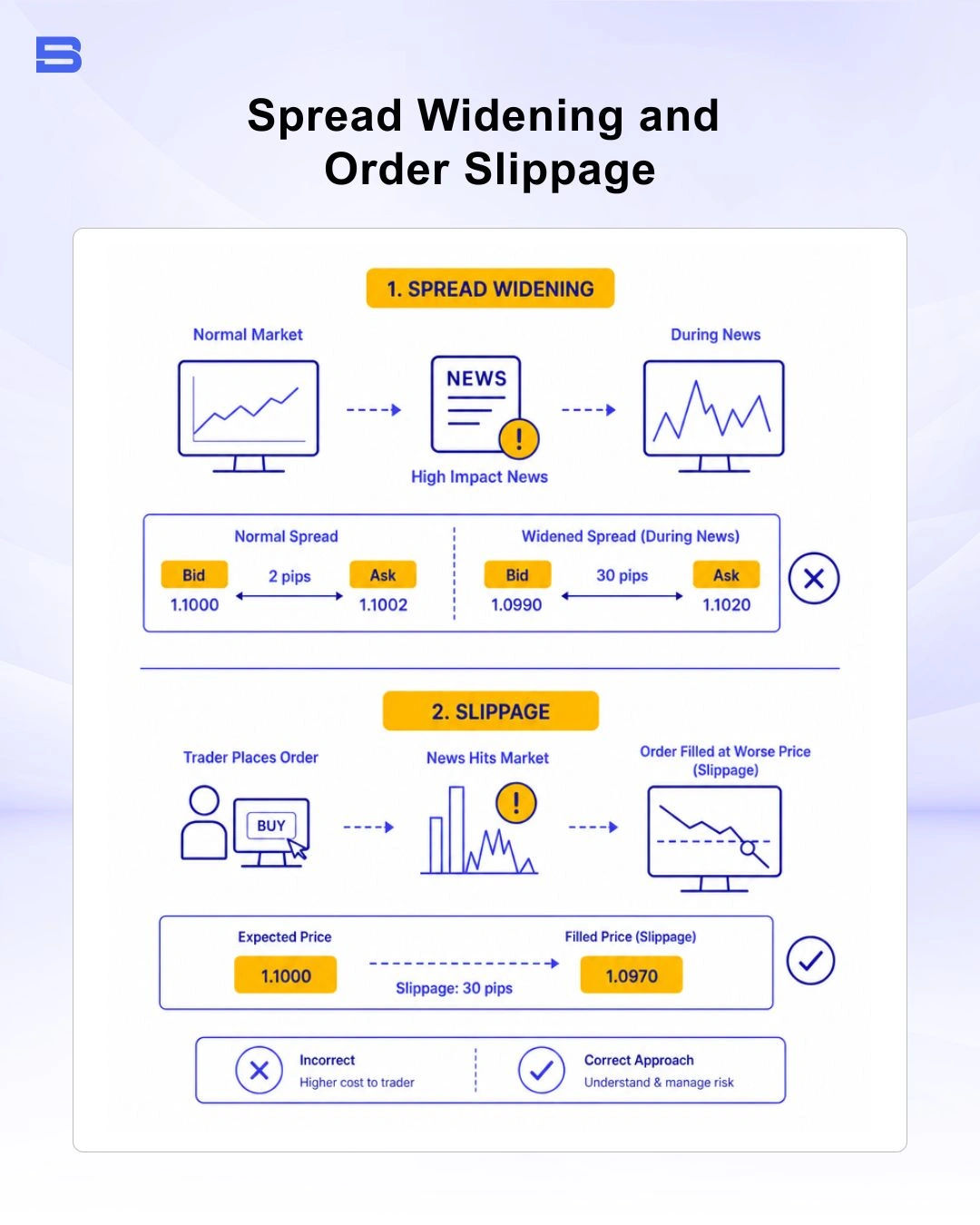
During major releases, top-tier liquidity providers temporarily withdraw limit orders to insulate themselves from rapid repricing. This institutional liquidity withdrawal triggers three primary execution hazards:
- Spread Expansion: Typical Euro and US Dollar (EUR/USD) spreads of 0.8 pips can expand to 15 or 25 pips within milliseconds as depth disappears.
- Order Slippage: Market orders and stop-loss orders execute at the next best available price ladder level, which may sit significantly far from your requested price.
- Execution Delays and Re-quotes: Broker routing queues become congested during latency surges, causing execution delays or order rejections.
Consider a concrete execution scenario:
You place a 1-lot order on EUR/USD with a 10-pip stop loss ($100 risk) right before a Consumer Price Index (CPI) release. The spread suddenly expands by 12 pips, and market slippage executes your stop 10 pips beyond your preset parameter. Instead of the intended $100 loss, execution degradation expands your realized loss to $200.
News Trading vs Position Trading
Understanding where news execution sits relative to long-term macro strategies helps clarify your operational focus.
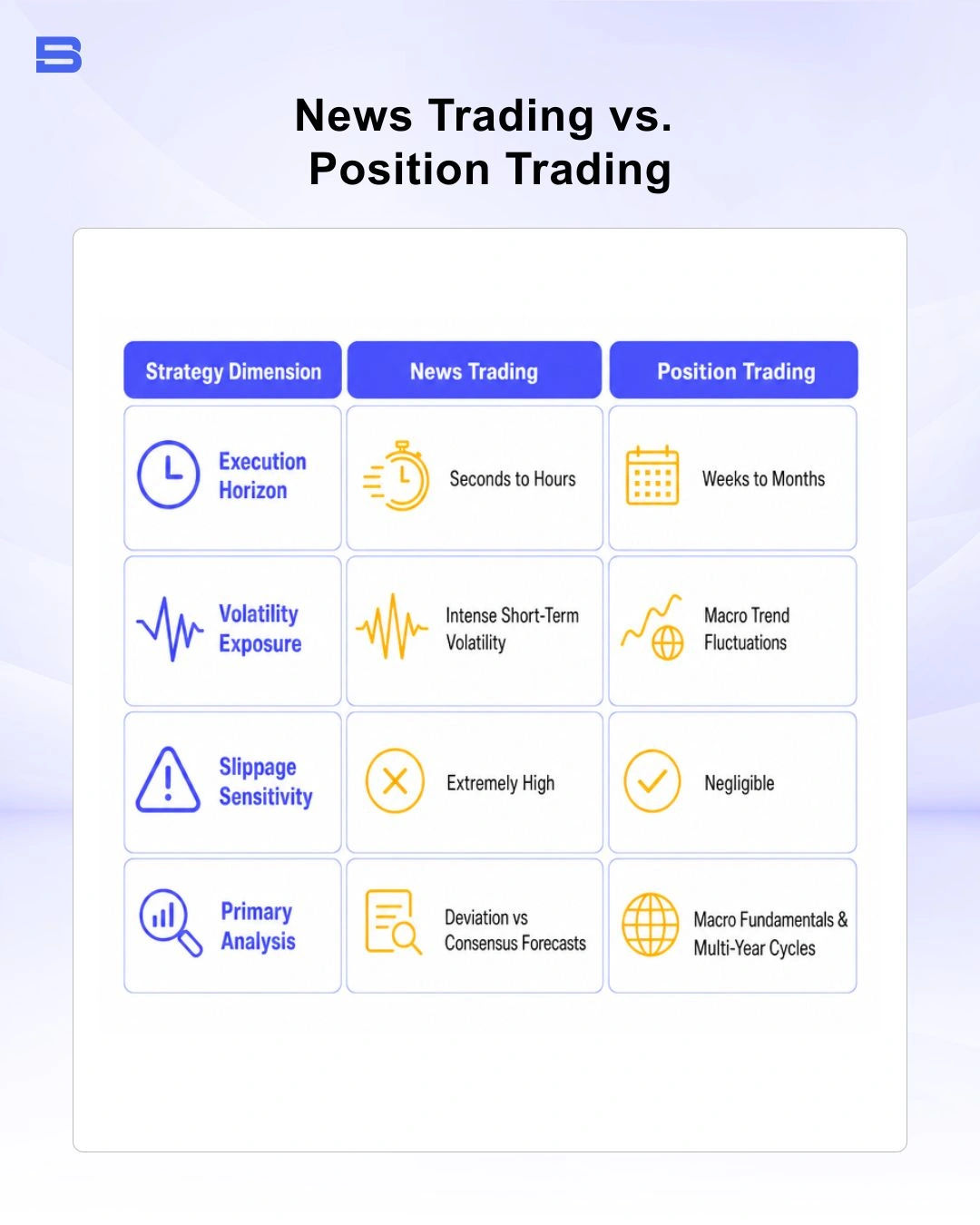
If you're seeking lower-stress macro exposure, you'll likely favor position trading — holding trades across major economic cycles rather than fighting millisecond-level execution spikes.
Is News Trading Profitable for Retail Traders?
News trading can be profitable for disciplined traders, but retail success hinges on managing execution costs rather than correctly predicting macroeconomic data.
Because spread widening and slippage inherently skew risk-to-reward ratios against short-term market orders, sustainable profitability relies on strict risk protocols. Successful news traders cut position sizes in half during volatile releases, use wide stop parameters to account for spread expansion, or restrict entries purely to post-release stabilization phases.
- How to Build an Investment Plan That Actually Works for You?
- What Is the MACD Indicator and How to Use It
- What Is a Wedge Pattern in Trading?
- What Is Ichimoku Cloud Strategy? A Complete Trading System
- Mastering Elliott Wave Theory: Rules and Trading Strategies
- News Trading: Strategies, Execution Risks, and Risk Control
- What Is an Iron Condor Options Strategy?
- Backtesting Explained: What It Is and Why It Really Matters
- Grid Trading: Mechanics, Parameters, and Risk Strategies
- What Is Breakout Trading and How Does It Work?
- Mean Reversion: Technical Strategies and Risk Frameworks
- Momentum Trading: Indicators, Strategies, and Risk Control
- Hammer Candlestick: Structure, Meaning, and Strategy
- Doji Candlestick: Types, Signals, and Trading Strategies
- What Is the Sharpe Ratio and How to Calculate It
- What Is VWAP and How Do Traders Use It?
- Trade the Ascending Triangle: A Step-by-Step Practical Guide
- What Is the Stochastic Oscillator and How to Use It
- How to Trade the Descending Triangle Pattern
- High Frequency Trading: Speed, Algorithms, and Market Impact
- What Is Volume Profile and How to Use It in Trading
- What Is a Morning Star Pattern Candlestick?
- Trade with Parabolic SAR: A Practical Analysis Guide
- Evening Star Pattern: Structure, Rules, and Risk Controls
- Kelly Criterion: Formula, Position Sizing, and Risk
- What Is the NYSE Minimum Trading Price? Rules Explained
Disclaimer: The content on this page is intended for educational and informational purposes only. It does not constitute financial, investment, tax, or legal advice, and should not be interpreted as a recommendation to buy, sell, or hold any financial instrument or asset. Trading and investing involve significant risk, including the possible loss of your entire capital. Products such as forex, CFDs, and cryptocurrencies carry additional risks due to leverage, high volatility, and limited regulatory protection in some jurisdictions. Past performance of any financial instrument does not guarantee future results. Any market views, forecasts, or opinions expressed are those of the author at the time of writing and may not reflect current market conditions. Platform features, fees, and regulatory status are subject to change — always verify information directly with the relevant provider or regulator before making any financial decision. BrokerSpecs may receive compensation from third parties featured on this site. Always conduct your own due diligence and consider seeking advice from a licensed financial professional before investing. Portions of this article were prepared with the assistance of AI tools and reviewed by our editorial team before publication.