



Related Tags
An asset trades within a narrow price channel for weeks while implied volatility steadily declines. For directional traders, this price action offers few opportunities. For delta-neutral option traders, however, range-bound market conditions create an ideal environment to profit from time decay and volatility contraction.
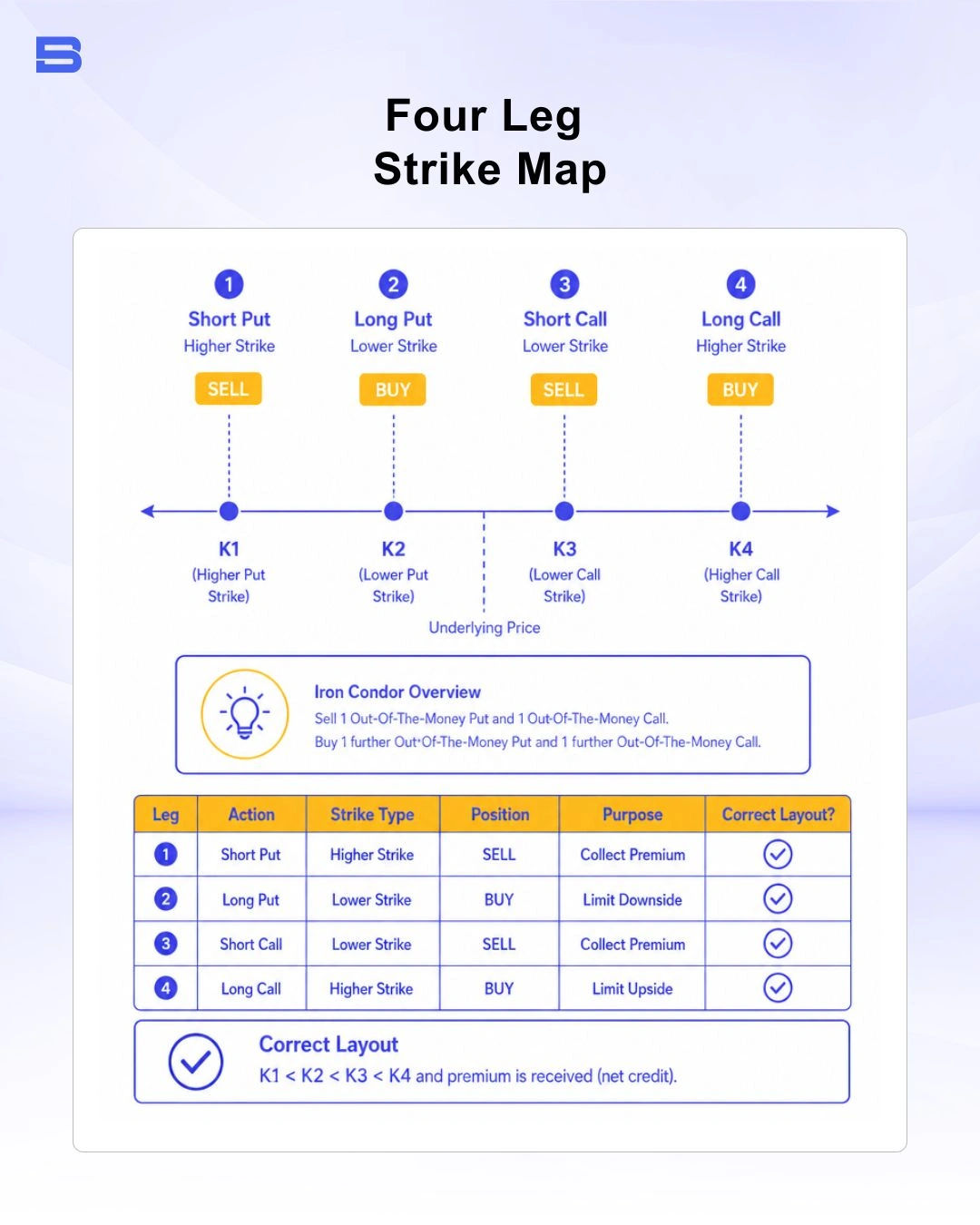
An iron condor options strategy is a defined-risk, four-leg options position created by simultaneously selling an out-of-the-money put spread and an out-of-the-money call spread on the same underlying asset with the same expiration date.
The core thesis of an iron condor relies on range-bound stability. By collecting a net credit upon entry, you earn a maximum profit if the underlying stock remains strictly between the short strikes through expiration, benefiting directly from theta decay (the erosion of an option's value as expiration approaches) and vega contraction (the drop in value as implied volatility falls).
Dissecting the Four Legs: Bull Put Spread vs. Bear Call Spread
Before diving into the four legs, a quick refresher: a strike price is the price at which an option can be exercised, and premium is the price you pay or collect to open a position. When you 'sell to open' a spread, you collect that premium upfront as a credit.
Understanding an iron condor requires breaking down its structure. It combines two multi-leg credit positions: a short put spread on the lower side and a short call spread on the upper side. Each side consists of a short option sold closer to the market price (to collect premium) and a long option bought further out-of-the-money (to limit downside risk).
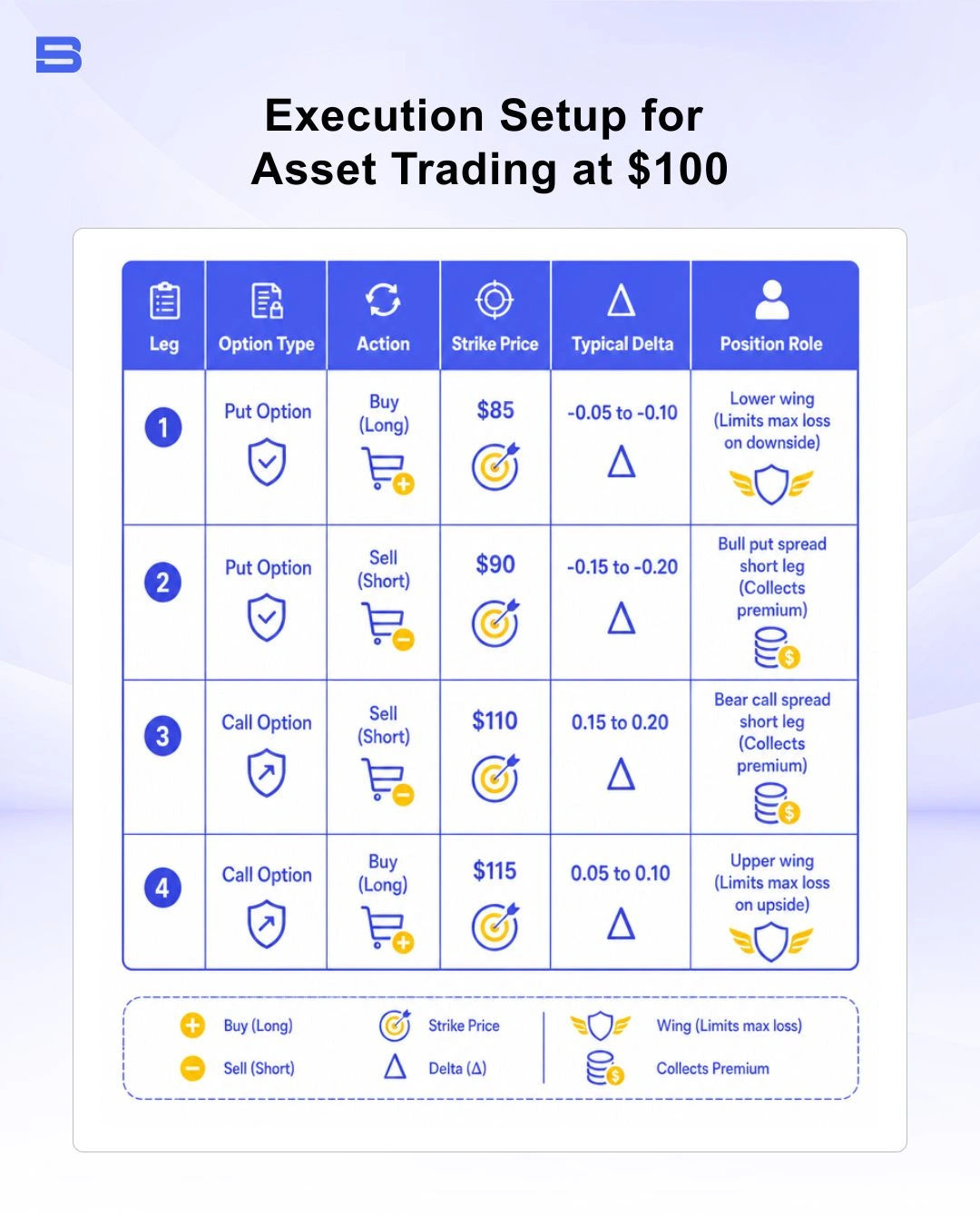
The image below outlines the execution setup for an iron condor centered around an underlying asset trading at $100:
The Put Side Structure
The lower side of the iron condor is a bull put spread — a credit spread built from two puts. You sell an out-of-the-money put option at a higher strike price to collect premium, while simultaneously purchasing a lower-strike put option to cap your maximum potential loss if the market drops sharply.
The Call Side Structure
The upper side mirrors the put side using call contracts to form a bear call spread — a credit spread built from two calls. You sell an out-of-the-money call option closer to the current stock price and buy a further out-of-the-money call option above it. This upper wing limits risk if the market rallies unexpectedly.
Maximum Profit, Maximum Loss, and Breakeven Mechanics
Because an iron condor is a net-credit, defined-risk strategy, both your maximum gain and maximum loss are fixed at trade inception. Capital requirements are bounded by margin requirements defined under guidelines set by authorities like the US Securities and Exchange Commission (SEC).
Mathematically, the risk parameters are derived as follows:
- Net Credit Received: Total Premium Collected - Total Premium Paid
- Maximum Profit: Net Credit Received
- Maximum Loss: (Width of Widest Wing - Net Credit Received) × Contract Multiplier
- Upper Breakeven Point: Short Call Strike + Net Credit Received
- Lower Breakeven Point: Short Put Strike - Net Credit Received
Worked Example: $100 Stock Setup
Consider XYZ stock trading at $100. You enter an iron condor expiring in 45 days with $5-wide wings on both sides:
- Sell 1x $90 Put @ $1.50 credit | Buy 1x $85 Put @ $0.50 debit (Put Spread Credit = $1.00)
- Sell 1x $110 Call @ $1.50 credit | Buy 1x $115 Call @ $0.50 debit (Call Spread Credit = $1.00)
Your total net credit collected is $2.00 per share ($200 per contract).
Calculating the exact outcomes:
- Max Profit: $200 (if XYZ stays between $90 and $110 at expiration).
- Max Loss: ($5.00 wing width - $2.00 credit) × 100 shares = $300 (if XYZ trades at or below $85 or at or above $115).
- Upper Breakeven: $110 + $2.00 = $112.00
- Lower Breakeven: $90 - $2.00 = $88.00
While options trading carries defined mechanics, exposure to market volatility can still result in the total loss of the allocated risk capital ($300 in this scenario) if a wing is breached.
Strategic Trade Selection: Delta Neutral Wings and Volatility Filtering
Successful execution relies on precise strike selection and volatility timing. Entering an iron condor during periods of low implied volatility exposes the position to severe losses if volatility in trading surges unexpectedly, expanding contract values against your short legs.
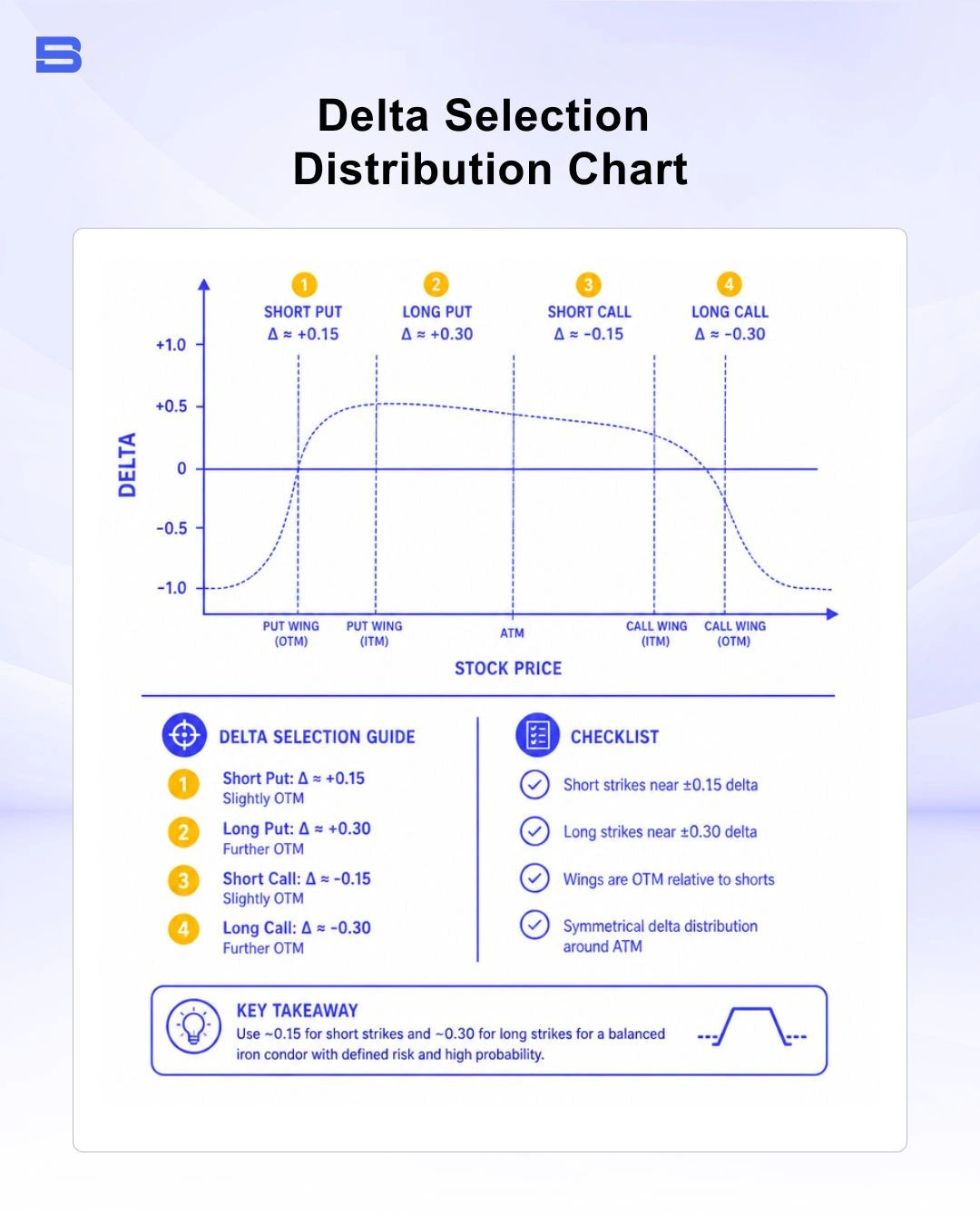
To optimize probability of profit (POP) while maintaining a balanced risk-reward profile, experienced traders target delta-neutral options trading parameters defined by contract specifications from exchanges like the Chicago Board Options Exchange (Cboe):
- Short Strike Deltas: Target a 0.15–0.20 Delta for short strikes. Cboe Options Institute educational materials note that Delta can be used as an approximate measure of the probability an option will expire in-the-money; a 0.15 Delta is therefore commonly read as roughly an 85% probability of expiring out-of-the-money, though Delta is not a precise probability measure.
- Expiration Window: Select contracts with 30–45 days to expiration (DTE). According to the OIC, theta decay accelerates as expiration approaches, with the decay curve beginning to steepen meaningfully around 30 days. This range can therefore provide a balance between capturing increasing theta decay and avoiding the substantially higher gamma exposure (the rate at which an option's Delta changes as the stock price moves) associated with near-expiration options.
- Implied Volatility Rank (IVR): Consider entering premium-selling trades when IV Rank (IVR) or IV Percentile is above 30%–50%. Elevated IV generally produces higher option premiums, which can increase the credit received and move the breakeven farther from the short strike. However, higher IV also reflects greater expected price movement, so elevated IV should be considered alongside other risk factors. The OIC confirms that higher implied volatility generally results in higher option prices.
Trade Management: Adjustments, Rollovers, and Early Exit Rules
Holding an iron condor all the way to expiration is rarely optimal. Late-stage gamma risk increases price sensitivity drastically during the final week before expiration, making small underlying price swings produce severe profit and loss (P&L) shifts.
Profit Targets and Exit Rules
- Close at 50% Max Gain: If you collect $2.00 in credit, place a limit order to buy back the condor at $1.00. Closing early frees up margin-trading capital and reduces exposure duration.
- Stop-Loss Threshold: Close the entire position if the total loss reaches 100% to 200% of the credit collected (e.g., exiting when the trade loses $2.00 to $4.00), preventing the trade from reaching the absolute maximum loss.
Defensive Adjustments When Tested
When the underlying asset moves aggressively toward one side, threatening a short strike, iron condor adjustment strategies help reduce exposure:
- Roll the Untested Wing: If the stock rallies toward the $110 call, buy back (close) the $90/$85 put spread for a profit and re-establish a new short put spread closer to the current market price (e.g., $100/$95). The additional credit collected widens your overall breakeven buffer on the tested side.
- Roll for Time: If a wing is breached near expiration, roll the entire four-leg structure out to the next monthly expiration cycle for a net credit, extending time for the underlying asset to revert to the mean.
Comparative Mechanics: Iron Condor vs. Other Income Strategies
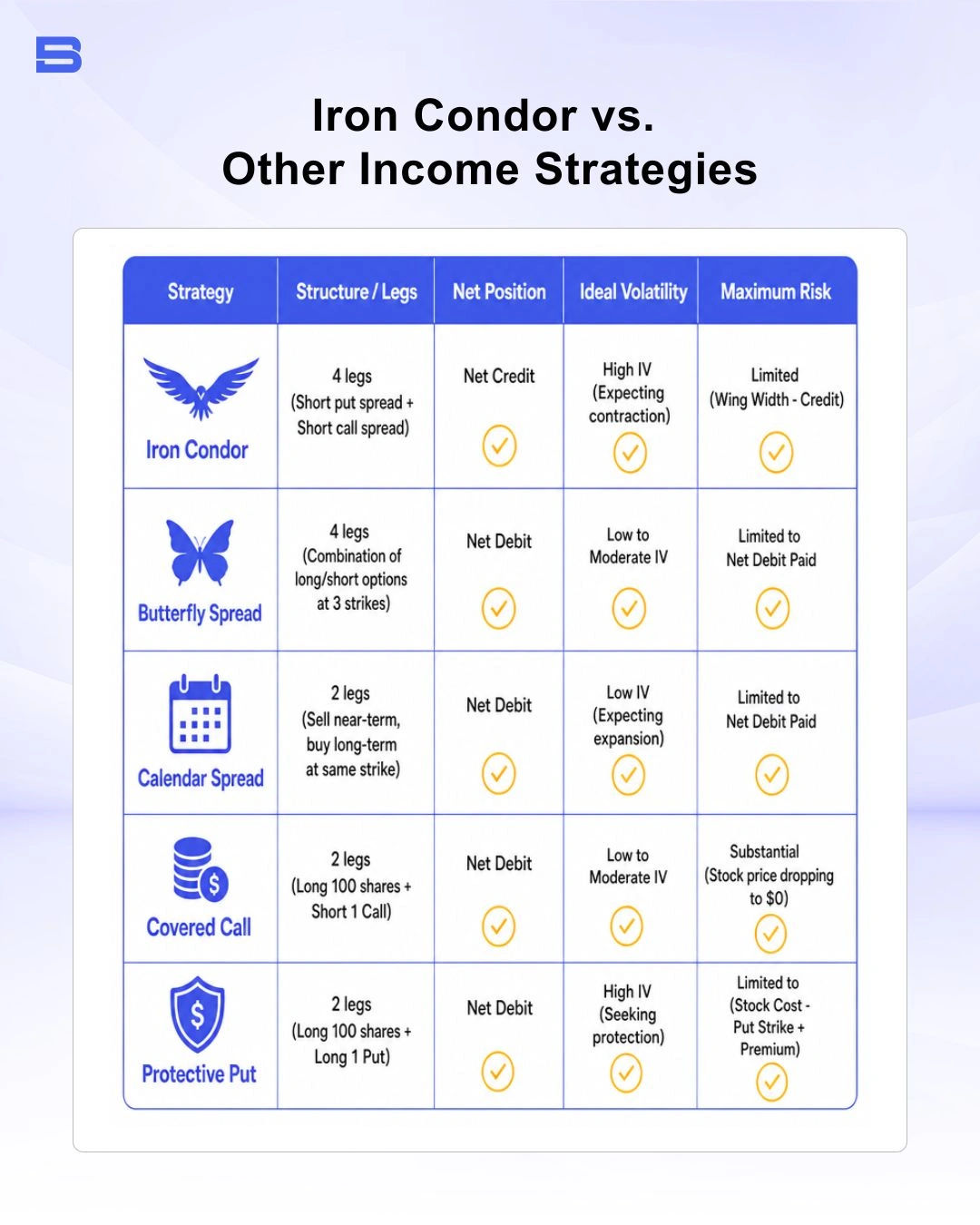
Iron Condor vs. Covered Call Strategies
Unlike a covered call, which requires buying 100 shares of underlying stock and leaves you exposed to downside market risk, an iron condor requires no equity ownership. Capital requirements are capped strictly by option wing widths rather than full share value, offering a delta-neutral profile rather than bullish underlying exposure.
The Bottom Line
The iron condor offers option traders a precise, defined-risk vehicle to generate consistent income in sideways or range-bound markets. By balancing a bull put spread against a bear call spread, the strategy capitalizes on time decay and implied volatility contraction without taking a directional stance.
However, success requires disciplined entry criteria—selecting high implied volatility environments, managing delta neutrality, and systematically taking profits at 50% maximum gain before late-stage gamma risk undermines performance.
- How to Build an Investment Plan That Actually Works for You?
- What Is the MACD Indicator and How to Use It
- What Is a Wedge Pattern in Trading?
- What Is Ichimoku Cloud Strategy? A Complete Trading System
- Mastering Elliott Wave Theory: Rules and Trading Strategies
- News Trading: Strategies, Execution Risks, and Risk Control
- What Is an Iron Condor Options Strategy?
- Backtesting Explained: What It Is and Why It Really Matters
- Grid Trading: Mechanics, Parameters, and Risk Strategies
- What Is Breakout Trading and How Does It Work?
- Mean Reversion: Technical Strategies and Risk Frameworks
- Momentum Trading: Indicators, Strategies, and Risk Control
- Hammer Candlestick: Structure, Meaning, and Strategy
- Doji Candlestick: Types, Signals, and Trading Strategies
- What Is the Sharpe Ratio and How to Calculate It
- What Is VWAP and How Do Traders Use It?
- Trade the Ascending Triangle: A Step-by-Step Practical Guide
- What Is the Stochastic Oscillator and How to Use It
- How to Trade the Descending Triangle Pattern
- High Frequency Trading: Speed, Algorithms, and Market Impact
- What Is Volume Profile and How to Use It in Trading
- What Is a Morning Star Pattern Candlestick?
- Trade with Parabolic SAR: A Practical Analysis Guide
- Evening Star Pattern: Structure, Rules, and Risk Controls
- Kelly Criterion: Formula, Position Sizing, and Risk
- What Is the NYSE Minimum Trading Price? Rules Explained
Disclaimer: The content on this page is intended for educational and informational purposes only. It does not constitute financial, investment, tax, or legal advice, and should not be interpreted as a recommendation to buy, sell, or hold any financial instrument or asset. Trading and investing involve significant risk, including the possible loss of your entire capital. Products such as forex, CFDs, and cryptocurrencies carry additional risks due to leverage, high volatility, and limited regulatory protection in some jurisdictions. Past performance of any financial instrument does not guarantee future results. Any market views, forecasts, or opinions expressed are those of the author at the time of writing and may not reflect current market conditions. Platform features, fees, and regulatory status are subject to change — always verify information directly with the relevant provider or regulator before making any financial decision. BrokerSpecs may receive compensation from third parties featured on this site. Always conduct your own due diligence and consider seeking advice from a licensed financial professional before investing. Portions of this article were prepared with the assistance of AI tools and reviewed by our editorial team before publication.