


Related Tags
Picture an active trader watching a technology stock break out past a multi-month resistance level on high earnings volume. As the price surges 6% in minutes, the trader faces a split-second dilemma: jump into the upward velocity to ride the wave, or hesitate out of fear of buying at the absolute top?
This high-velocity environment is where this strategy thrives. If you focus on asset velocity rather than fair value, you can aim to capture profits from established price acceleration before the trend exhausts itself.
The Core Mechanics of Momentum Trading
Momentum trading is an active strategy that buys assets showing upward price velocity and sells short those with downward acceleration. Rather than searching for undervalued assets, momentum traders operate on the market anomaly that existing price trends tend to persist over short-to-medium horizons due to institutional order flow and retail behavioral biases.
According to market efficiency studies by the CFA Institute, the momentum effect remains one of the most persistent financial anomalies, driven largely by investor underreaction to new information followed by herd behavior.
To evaluate price velocity, traders examine the rate of change in price alongside trading volume. High price movement without accompanying volume often signals a fragile trend, whereas volume expansion confirms institutional capital commitment.
Worked Scenario: Confirming Price Velocity
Consider a stock trading at $100 with an average daily volume of 1,000,000 shares.
- Day 1: Price rises to $104 on a volume of 3,500,000 shares (3.5x average volume). The price velocity is +4%, supported by high volume expansion.
- Day 2: Price moves to $105 on a volume of 800,000 shares. Although the price rose, the volume dropped below average, indicating fading velocity and potential trend exhaustion.
Without continuous order flow, momentum rapidly decays, exposing late entrants to sharp pullbacks. Understanding what is volatility in trading is essential, as volatile markets can accelerate profits or trigger sudden trend reversals.
Essential Momentum Trading Indicators
To confirm price acceleration and filter out fakeouts, traders rely on specific technical indicators that measure rate of change, momentum strength, and trend direction.
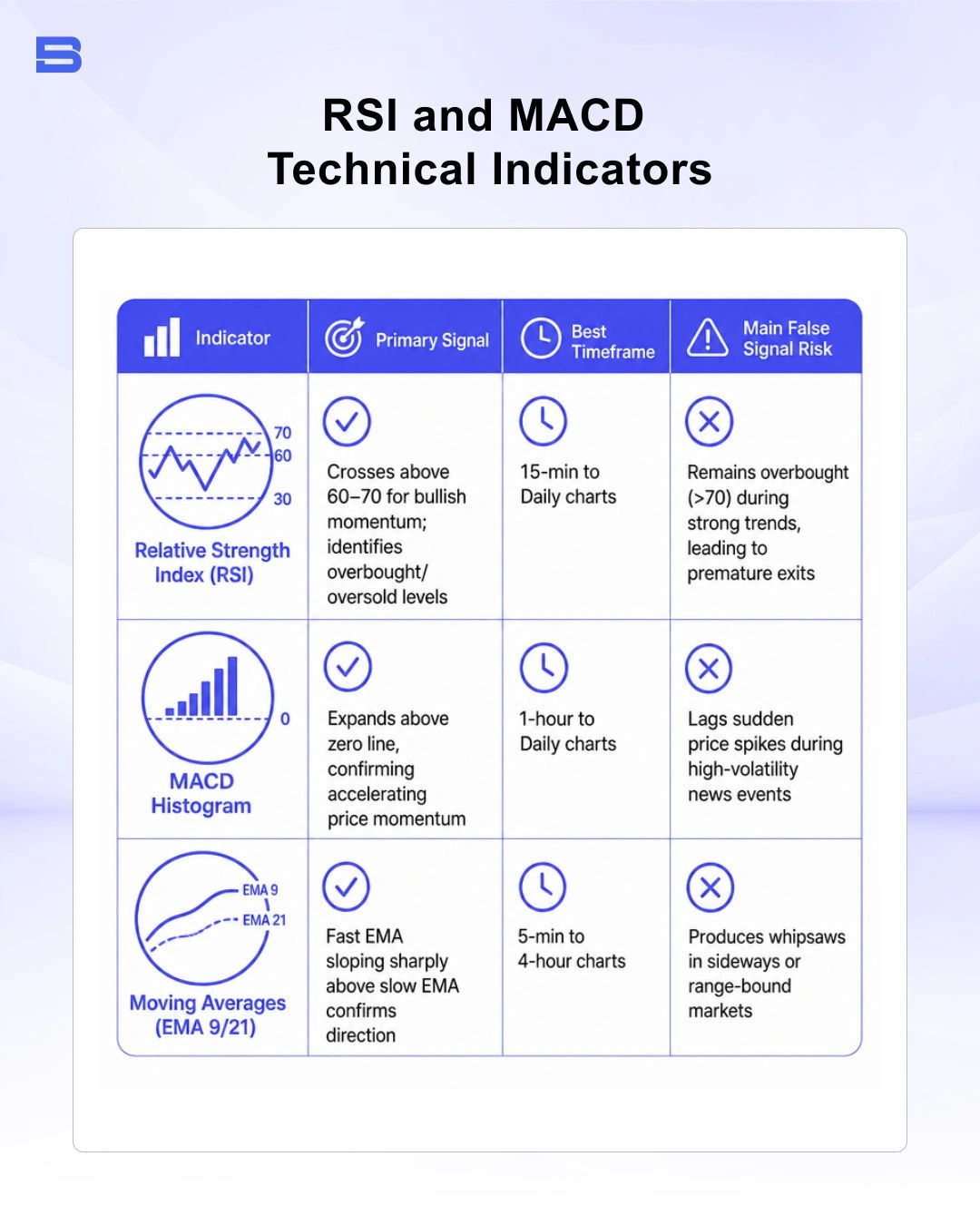
Combining these tools reduces your reliance on a single metric. For instance, a breakout verified by an expanding Moving Average Convergence Divergence (MACD) indicator histogram and a bullish moving average cross carries a higher probability than a signal from the Relative Strength Index (RSI) indicator alone.
Step-by-Step Execution: How to Trade Momentum
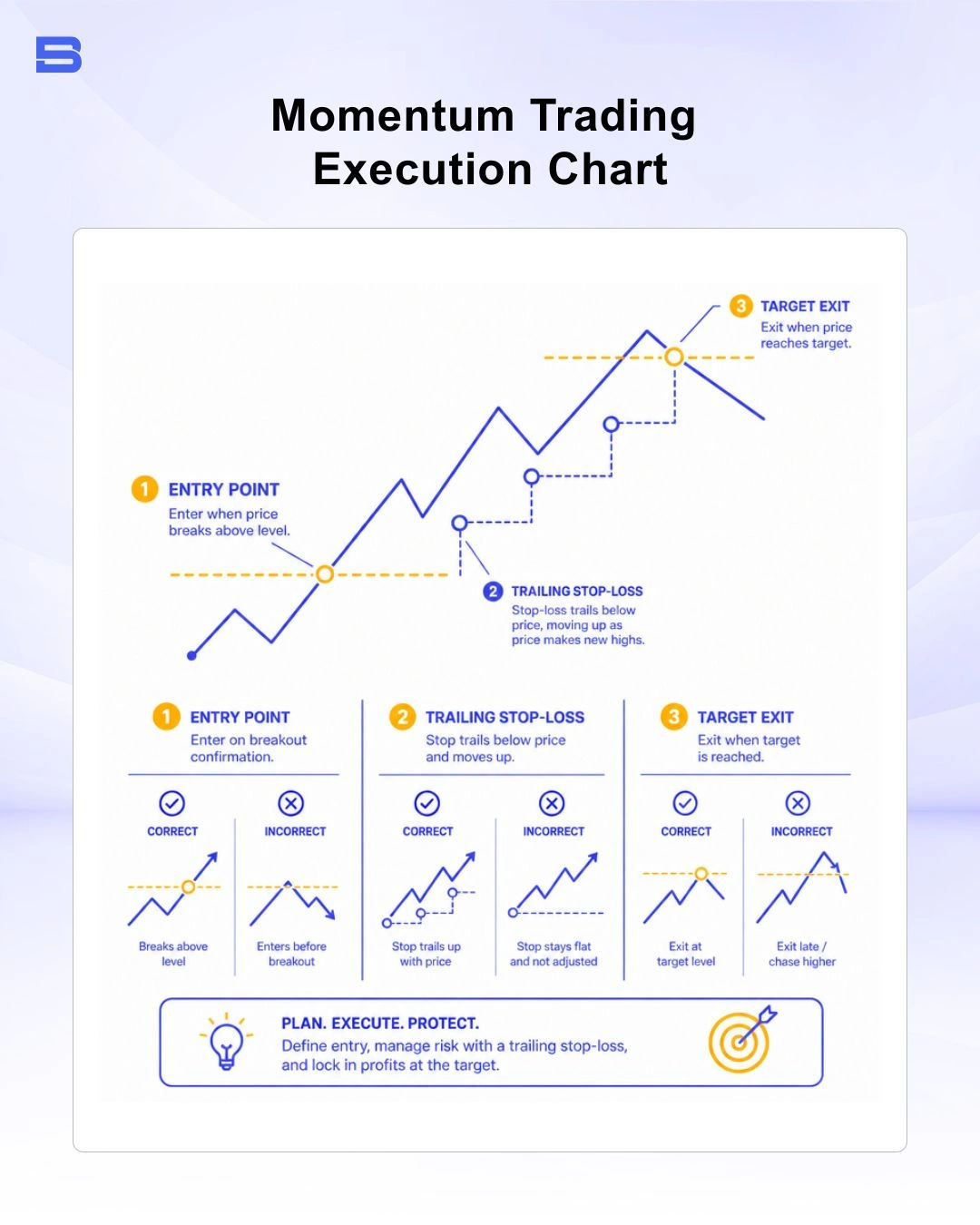
Executing a momentum strategy requires you to set systematic entry triggers, clear risk boundaries, and dynamic exit strategies.
Step 1: Asset Selection and Screening
Scan for assets demonstrating strong relative strength compared to the broader index. Look for stocks, forex pairs, or commodities experiencing fresh news catalysts, earnings surprises, or technical breakouts past key support and resistance levels.
Step 2: Entry Confirmation
Do not enter on price acceleration alone. Wait for a multi-factor confirmation:
- Price breaks above resistance or recent swing high.
- Volume increases by at least 150%–200% above the 20-period average volume.
- RSI crosses above 60 without showing bearish divergence.
Step 3: Setting Risk Controls
Place an initial stop-loss just below the breakout structure or recent swing low. For active momentum trades, keep your risk per trade capped between 1% and 2% of total account capital.
Step 4: Exit and Trailing Profits
Because momentum can reverse abruptly, lock in profits as the move progresses. Implement a dynamic trailing stop tied to a fast moving average, such as the 9-period Exponential Moving Average (EMA), or an Average True Range (ATR) multiple. This helps you capture the majority of the move while protecting accrued gains.
Momentum Trading vs. Breakout Trading vs. Trend Following
Active market strategies are often confused, yet they differ significantly in holding duration, primary triggers, and underlying risk profiles.
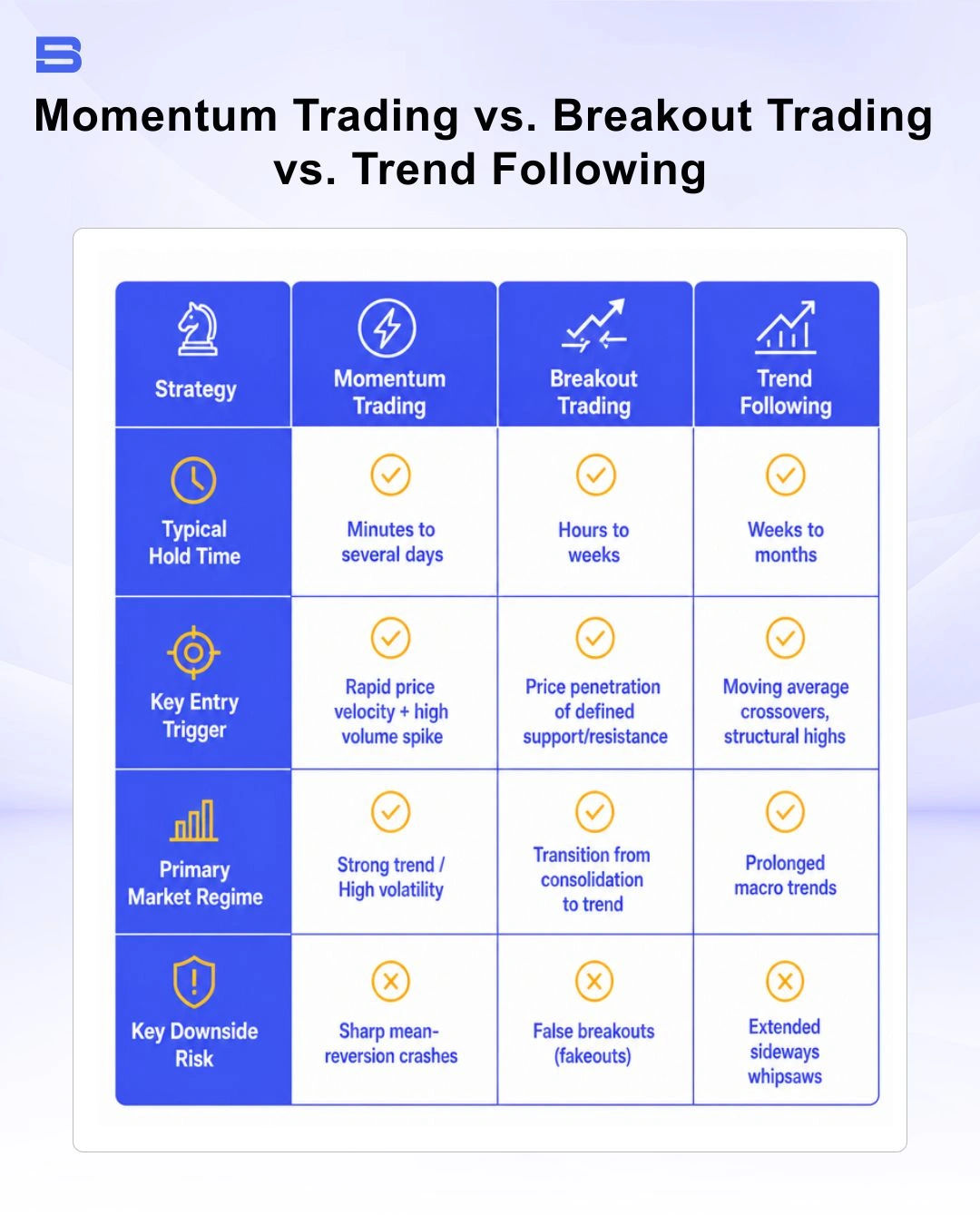
While breakout trading focuses specifically on the moment price breaches a boundary, this approach enters during sustained price acceleration. In contrast, trend following and position trading hold assets across larger macroeconomic cycles, tolerating temporary pullbacks that a short-term momentum trader would exit immediately.
Core Risks and Volatility Traps in Momentum Trading
Momentum trading carries substantial downside exposure. The same velocity that drives fast profits can cause rapid capital erosion when market dynamics shift unexpectedly.
Key Downside Hazards:
- Sharp Mean Reversion: Assets exhibiting extreme momentum often crash just as fast once institutional buying dries up.
- Execution Slippage: High-velocity moves often create wide bid-ask spreads and liquidity gaps, leading to poor order execution.
- Market Regime Shifts: Systemic risk events or unexpected economic data can instantly end momentum across entire asset classes.
In its 2022 review of retail CFD trading, the Financial Conduct Authority (FCA) reported that approximately 80% of customers lose money when investing in contracts for differences (CFDs). The FCA highlights leverage as a significant risk because adverse price movements can amplify losses.
Trading momentum with excessive leverage amplifies capital losses during adverse price moves, making rigid risk controls vital. Active traders who struggle with execution discipline sometimes explore alternative approaches like copy trading, though automated social platforms also carry underlying market risk.
Key Takeaways for Trading Momentum Successfully
Momentum trading offers active market participants a structured framework to capitalize on price acceleration and institutional volume flows. Succeeding with this strategy requires balancing high-velocity entries with disciplined risk management, clear indicator confirmations, and active profit-taking mechanisms.
By treating momentum as a systematic execution plan rather than a chase after rising prices, traders can participate in rapid market movements while protecting their account capital against sudden reversals.
- How to Build an Investment Plan That Actually Works for You?
- What Is the MACD Indicator and How to Use It
- What Is a Wedge Pattern in Trading?
- What Is Ichimoku Cloud Strategy? A Complete Trading System
- Mastering Elliott Wave Theory: Rules and Trading Strategies
- News Trading: Strategies, Execution Risks, and Risk Control
- What Is an Iron Condor Options Strategy?
- Backtesting Explained: What It Is and Why It Really Matters
- Grid Trading: Mechanics, Parameters, and Risk Strategies
- What Is Breakout Trading and How Does It Work?
- Mean Reversion: Technical Strategies and Risk Frameworks
- Momentum Trading: Indicators, Strategies, and Risk Control
- Hammer Candlestick: Structure, Meaning, and Strategy
- Doji Candlestick: Types, Signals, and Trading Strategies
- What Is the Sharpe Ratio and How to Calculate It
- What Is VWAP and How Do Traders Use It?
- Trade the Ascending Triangle: A Step-by-Step Practical Guide
- What Is the Stochastic Oscillator and How to Use It
- How to Trade the Descending Triangle Pattern
- High Frequency Trading: Speed, Algorithms, and Market Impact
- What Is Volume Profile and How to Use It in Trading
- What Is a Morning Star Pattern Candlestick?
- Trade with Parabolic SAR: A Practical Analysis Guide
- Evening Star Pattern: Structure, Rules, and Risk Controls
- Kelly Criterion: Formula, Position Sizing, and Risk
- What Is the NYSE Minimum Trading Price? Rules Explained
Disclaimer: The content on this page is intended for educational and informational purposes only. It does not constitute financial, investment, tax, or legal advice, and should not be interpreted as a recommendation to buy, sell, or hold any financial instrument or asset. Trading and investing involve significant risk, including the possible loss of your entire capital. Products such as forex, CFDs, and cryptocurrencies carry additional risks due to leverage, high volatility, and limited regulatory protection in some jurisdictions. Past performance of any financial instrument does not guarantee future results. Any market views, forecasts, or opinions expressed are those of the author at the time of writing and may not reflect current market conditions. Platform features, fees, and regulatory status are subject to change — always verify information directly with the relevant provider or regulator before making any financial decision. BrokerSpecs may receive compensation from third parties featured on this site. Always conduct your own due diligence and consider seeking advice from a licensed financial professional before investing. Portions of this article were prepared with the assistance of AI tools and reviewed by our editorial team before publication.