



Related Tags
Entering a position in a stock that keeps dropping can test any investor’s patience, but watching a share price drift toward $1.00 introduces a different kind of anxiety: exchange compliance warnings and potential delisting. When a company listed on the New York Stock Exchange (NYSE) trades below minimum regulatory floors, exchange authorities trigger strict oversight protocols to maintain market integrity.
Understanding these price thresholds helps you assess whether a struggling stock faces a temporary operational setback or an imminent threat of exchange removal.
What Is the NYSE Minimum Trading Price?
The baseline NYSE minimum trading price for continued listing is $1.00 per share. Under the rules enforced by the New York Stock Exchange, a company is considered non-compliant if its average closing price falls below $1.00 over a period of 30 consecutive trading days.
Stock exchanges set minimum price standards to prevent high-volatility, low-priced assets from undermining market stability. When securities trade at micro-cap or penny-stock levels, they become significantly more susceptible to liquidity crunches and price manipulation.
Establishing a minimum trading price floor ensures that public companies maintain a baseline standard of investor participation and institutional credibility.
Initial Listing vs. Continued Listing Standards
Companies seeking an initial listing on the exchange face stricter quantitative requirements than those applied to ongoing compliance. The NYSE minimum trading price for an initial public offering (IPO) or market transfer is $4.00 per share.
For example, a $2,500 position in a company trading at $4.00 per share represents 625 shares. If severe business challenges cause the share price to fall to $0.80 over several weeks, the stock may face NYSE non-compliance concerns under the NYSE $0.25 rule (established in 2014, current as of 2025).
If severe business challenges cause the share price to fall to $0.80 over several weeks, the stock may approach non-compliance with the NYSE's $1.00 continued-listing standard, triggering the 6-month cure period. However, if the price drops below $0.25, the company faces immediate delisting without a cure opportunity.
Although your share count remains unchanged, the company may need to take corporate actions to raise its share price above the $1.00 minimum.
Reverse Stock Splits as the Primary Solution
Understanding the NYSE's minimum trading price rules and continued-listing compliance standards (current rules as of 2025) can help investors assess potential compliance and delisting risks.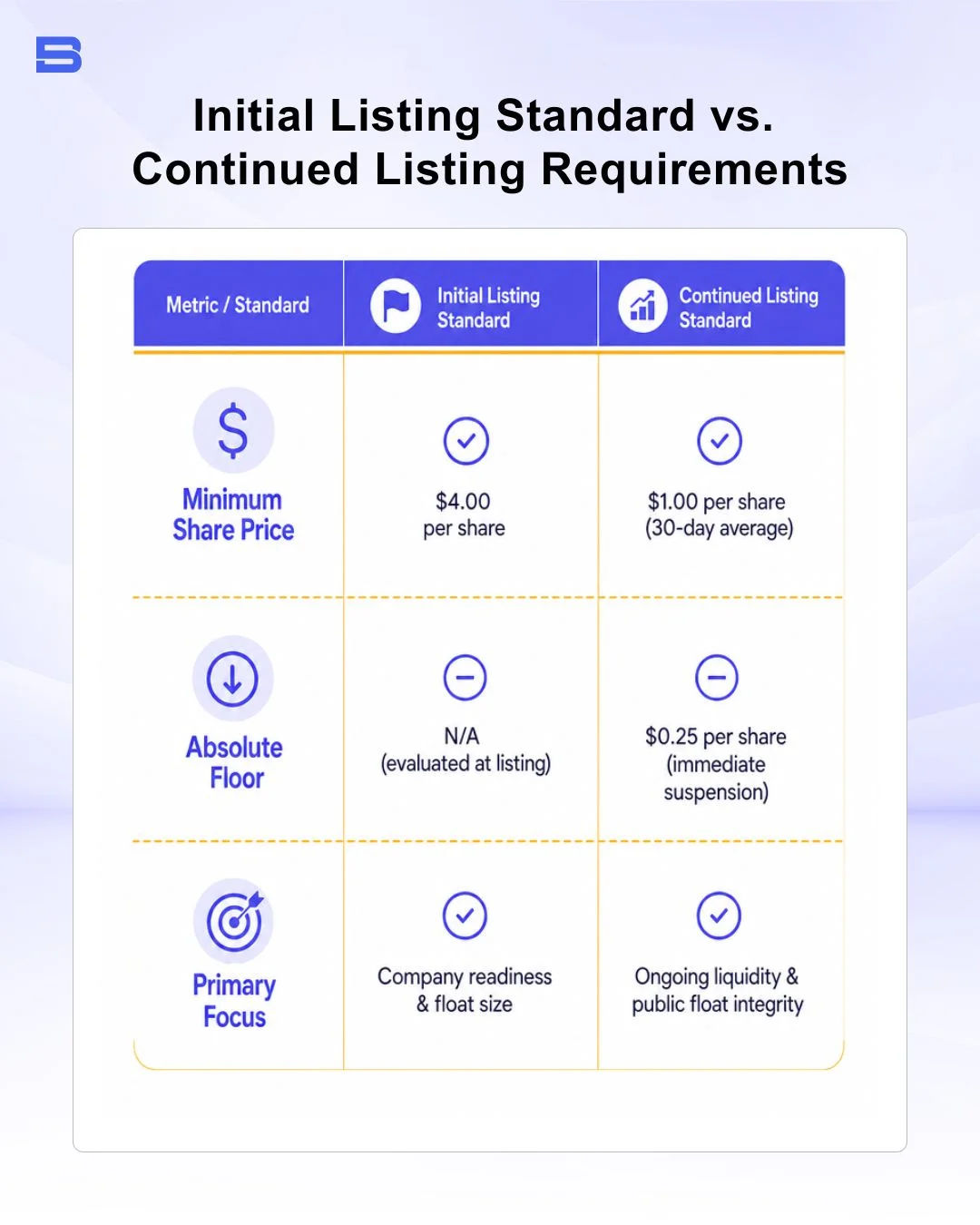
The $1.00 Continued Listing Standard
When a stock's closing price averages below $1.00 over 30 consecutive trading days, the NYSE issues an official notification of non-compliance. The company must publicly disclose this notice by issuing a press release and filing Form 8-K with the US Securities and Exchange Commission (SEC) within four business days.
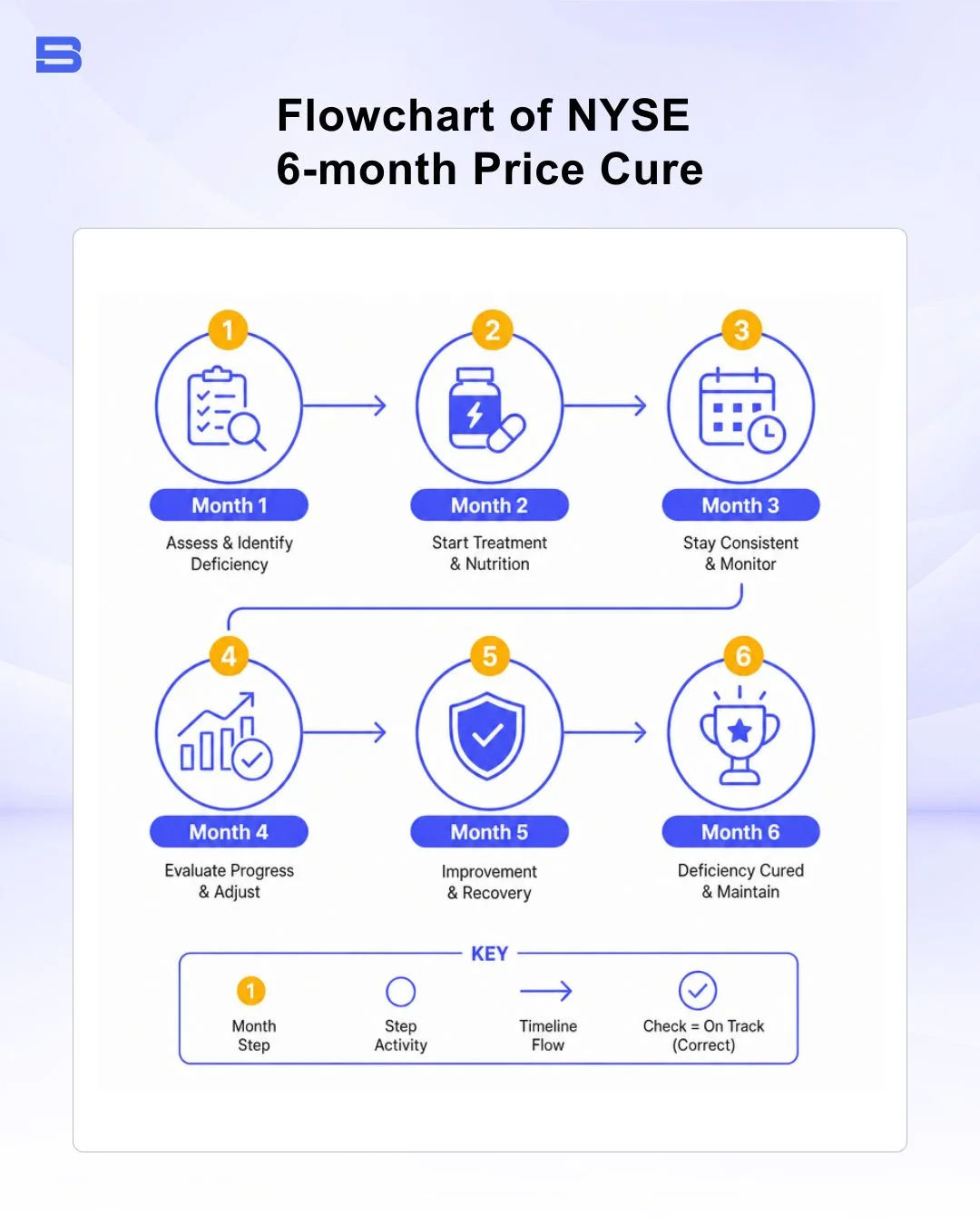
Once notified, the company enters a standard 6-month cure period to regain compliance. To resolve the deficiency, the stock price must close at or above $1.00 on the final trading day of any calendar month during the cure period and maintain an average closing price of at least $1.00 over the 30-trading-day period ending on that same date.
The $0.25 Immediate Suspension Hard Floor
While the standard 6-month window applies to shares hovering between $0.25 and $0.99, the exchange maintains an absolute emergency threshold. If a security's trading price falls below $0.25 on a single-day basis, or trades at an abnormally low value, the NYSE initiates immediate delisting proceedings without granting a cure period.
Trading in the stock is suspended immediately, and the securities are transitioned to over-the-counter (OTC) markets, drastically reducing trading volume and execution speed.
How Companies Cure a Share Price Deficiency
One common remedy is a reverse stock split — a corporate action where a company consolidates its existing shares into fewer shares at a higher price per share. When organic operational growth is insufficient to pull a stock back above $1.00, corporate management typically relies on a reverse stock split.
In a reverse stock split, the company consolidates its outstanding shares at a predetermined ratio (such as 1-for-10 or 1-for-20). If you hold 1,000 shares of a stock trading at $0.50 (total position value: $500), a 1-for-10 reverse split converts your holding into 100 shares valued at $5.00 each.
While your overall capital exposure remains identical, the higher nominal share price lifts the company back above the NYSE $1.00 threshold.
Summary
Monitoring exchange compliance notices can help investors manage risk and identify potential warning signals. When a stock falls below the NYSE minimum trading price, companies may face a price deficiency process that can prompt management to consider measures such as financial restructuring or a share consolidation.
Tracking whether a company plans to cure its deficiency through fundamental revenue growth or emergency reverse splits helps you protect your portfolio against severe liquidity losses and OTC demotions.
- How to Build an Investment Plan That Actually Works for You?
- What Is the MACD Indicator and How to Use It
- What Is a Wedge Pattern in Trading?
- What Is Ichimoku Cloud Strategy? A Complete Trading System
- Mastering Elliott Wave Theory: Rules and Trading Strategies
- News Trading: Strategies, Execution Risks, and Risk Control
- What Is an Iron Condor Options Strategy?
- Backtesting Explained: What It Is and Why It Really Matters
- Grid Trading: Mechanics, Parameters, and Risk Strategies
- What Is Breakout Trading and How Does It Work?
- Mean Reversion: Technical Strategies and Risk Frameworks
- Momentum Trading: Indicators, Strategies, and Risk Control
- Hammer Candlestick: Structure, Meaning, and Strategy
- Doji Candlestick: Types, Signals, and Trading Strategies
- What Is the Sharpe Ratio and How to Calculate It
- What Is VWAP and How Do Traders Use It?
- Trade the Ascending Triangle: A Step-by-Step Practical Guide
- What Is the Stochastic Oscillator and How to Use It
- How to Trade the Descending Triangle Pattern
- High Frequency Trading: Speed, Algorithms, and Market Impact
- What Is Volume Profile and How to Use It in Trading
- What Is a Morning Star Pattern Candlestick?
- Trade with Parabolic SAR: A Practical Analysis Guide
- Evening Star Pattern: Structure, Rules, and Risk Controls
- Kelly Criterion: Formula, Position Sizing, and Risk
- What Is the NYSE Minimum Trading Price? Rules Explained
Disclaimer: The content on this page is intended for educational and informational purposes only. It does not constitute financial, investment, tax, or legal advice, and should not be interpreted as a recommendation to buy, sell, or hold any financial instrument or asset. Trading and investing involve significant risk, including the possible loss of your entire capital. Products such as forex, CFDs, and cryptocurrencies carry additional risks due to leverage, high volatility, and limited regulatory protection in some jurisdictions. Past performance of any financial instrument does not guarantee future results. Any market views, forecasts, or opinions expressed are those of the author at the time of writing and may not reflect current market conditions. Platform features, fees, and regulatory status are subject to change — always verify information directly with the relevant provider or regulator before making any financial decision. BrokerSpecs may receive compensation from third parties featured on this site. Always conduct your own due diligence and consider seeking advice from a licensed financial professional before investing. Portions of this article were prepared with the assistance of AI tools and reviewed by our editorial team before publication.