



Related Tags
Imagine sitting in front of your terminal, spotting a flawless market setup, and knowing exactly how to exploit it with your understanding of how trading works. You check your balance, but your modest $2,000 account means a successful execution will only yield enough for a decent dinner.
Now, imagine executing that exact same trade, but instead of risking your personal savings, you are utilizing a $100,000 account provided by a firm that takes on the financial liability while letting you keep the majority of the profits.
This scenario describes the core appeal of proprietary trading—commonly known as prop trading. It bridges the gap between talented individuals who possess strategy but lack capital, and entities that possess capital but need human talent to generate returns.
What Is Proprietary Trading?
Proprietary trading occurs when a financial firm, commercial bank, or specialized institution invests its own internal capital directly in the financial markets rather than earning commissions by executing trades for clients.
When you trade via a traditional retail broker, you are risking your own capital to generate personal returns. In contrast, a proprietary trader utilizes the firm's balance sheet to buy and sell equities, bonds, commodities, currencies, or derivatives.
For decades, prop trading was primarily the domain of elite Wall Street investment banks and private trading boutiques governed by strict institutional banking standards under regulatory bodies like the Securities and Exchange Commission (SEC).
These institutions hired quantitative analysts (specialists who use mathematical models to guide trading decisions) and floor traders to exploit market inefficiencies. However, the modern financial landscape has witnessed the rise of online prop firms, often referred to as evaluation or funded account challenges.
These modern prop trading firms open their doors to retail traders globally, offering remote access to institutional-sized accounts provided the traders can prove their skills under strict risk parameters.
How Does Modern Prop Trading Work?
The mechanics of modern online prop trading revolve around a merit-based allocation system. Because these firms are handing over significant financial resources to external parties, they do not distribute capital blindly.
Instead, they require applicants to complete a structured evaluation process. To understand the operational flow, it is helpful to look at the standard lifecycle of an online prop trader: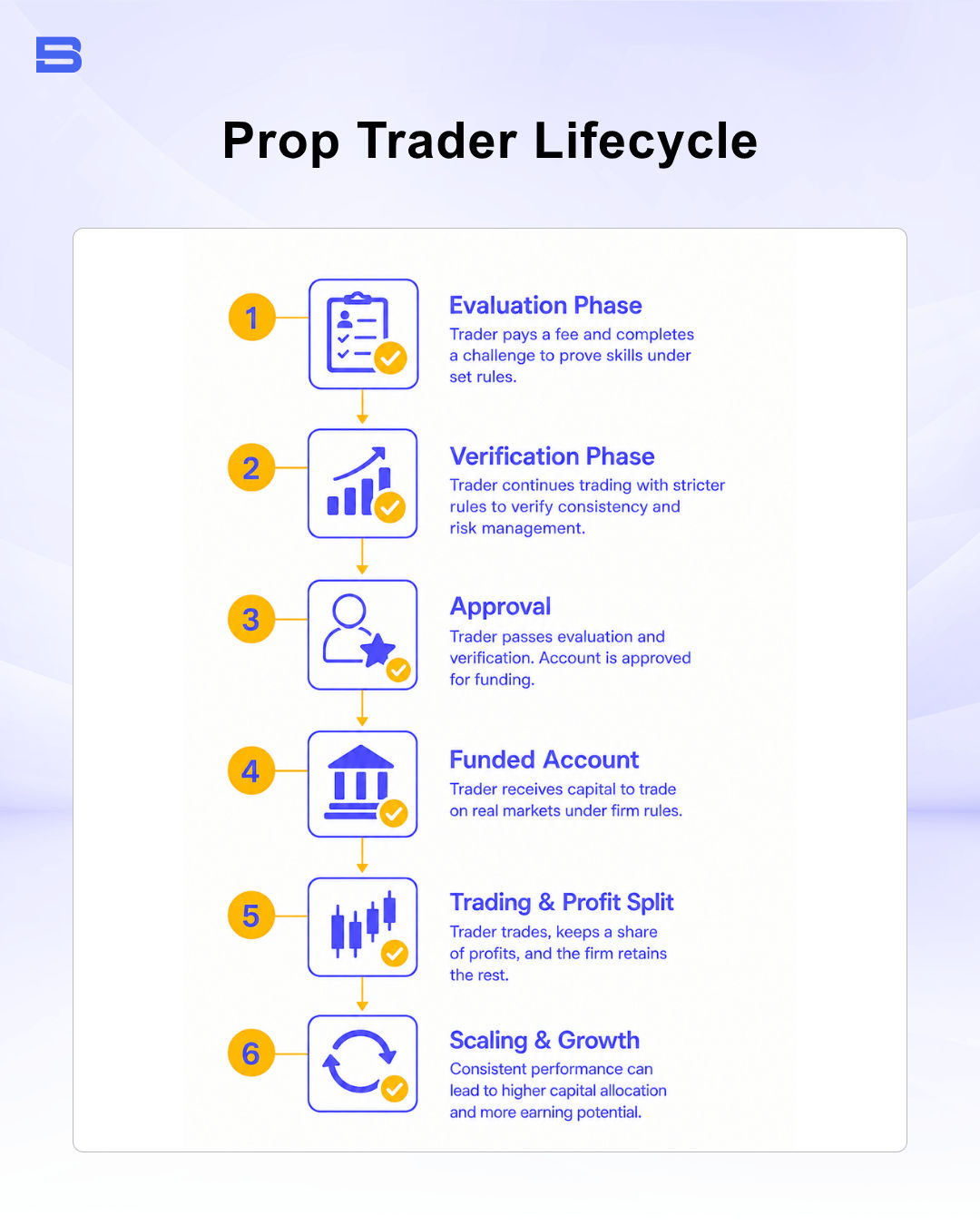
- The Evaluation Phase: You pay an upfront audition fee to participate in a simulated challenge. The firm provides you with a demo account loaded with virtual capital—for example, $50,000—and sets a target profit goal that, based on common industry practice among evaluation-based prop firms, typically falls between 8% and 10%, which you must achieve within specific guidelines (exact targets vary by provider and should be confirmed against that firm's official rules).
- The Funded Phase: Once you successfully hit the profit targets without violating any structural rules, you transition into a funded trader status. The firm grants you access to a live account or a simulated live environment where real capital allocations are tied to your performance.
- The Profit Split: As you generate real returns on the funded account, the profits are split between you and the firm. Based on publicly advertised terms from several well-known evaluation-based firms, profit splits frequently range from 75% to 90% in the trader's favor, while the firm retains the remainder as their corporate yield—though exact terms vary by provider and should always be confirmed directly.
By structuring the ecosystem this way, prop trading firms aim to filter out reckless traders and build a roster of disciplined market operators who can compound corporate capital over time.
The Core Prop Trading Rules You Must Follow
The allure of managing six-figure accounts often blinds beginners to the operational constraints imposed by these firms.
Prop firms are fundamentally risk management entities; therefore, they enforce rigid structural guidelines designed to protect their capital from catastrophic drawdowns. Violating a single rule typically results in immediate account liquidation or challenge forfeiture.
1. The Daily Loss Limit
Firms enforce a strict cap on how much equity your account can lose within a single trading day. This is usually calculated based on the previous day's closing balance and, per commonly advertised industry terms, typically hovers around 4% to 5%, though the exact figure differs by provider and should be verified in that firm's rulebook.
2. The Maximum Overall Drawdown
Distinct from the daily limit, the maximum overall drawdown represents the total cumulative amount your account is permitted to drop from its peak initial balance. Based on commonly published terms across evaluation-based prop firms, this ceiling is typically set somewhere between 8% and 12%, though the precise figure is provider-specific.
3. Consistency and Time Controls
Many traditional evaluation models require you to trade for a minimum number of days to prove your performance is not the result of a single lucky market anomaly.
Additionally, some firms restrict holding positions over the weekend or trading during high-impact macroeconomic news releases due to extreme volatility and slippage risks.
Understanding these constraints highlights the reality of the industry: succeeding as a prop trader requires an exceptional mastery of defensive risk management far more than an aggressive pursuit of high returns.
A Real-World Scenario: The Math of a Funded Account
To see how these rules and profit structures translate to your bottom line, let us break down a practical example utilizing realistic industry metrics.
Suppose you apply for, and successfully pass, a $100,000 funded account challenge with an online prop firm. The firm operates with an 80/20 profit split in favor of the trader, maintains a 5% daily loss limit ($5,000), and a 10% maximum drawdown limit ($10,000).
Over the course of your first calendar month, you execute a disciplined swing trading strategy. Your performance yields the following steps:
- The Setup: Your initial starting balance is $100,000. Your absolute risk floor is $90,000.
- The Execution: You close out the month with a net profit of 6%. Your account balance now stands at $106,000.
- The Calculation: The total net profit generated is $6,000. The firm initiates the payout process based on your agreed contract.
- The Result: Your 80% share equates to $4,800, while the prop firm retains $1,200 as their corporate cut.
For the trader, this structure can offer a meaningful advantage: in this hypothetical scenario, you secured a $4,800 payout by risking only the initial challenge registration fee—which typically costs a fraction of the total account value—rather than exposing $10,000 of your personal capital to market drawdowns.
It's worth noting that many prop trading applicants never reach the funded stage: had losses breached the $5,000 daily limit or the $10,000 maximum drawdown at any point during the evaluation, the challenge would have been terminated immediately and the registration fee forfeited, with no payout at all.
Pros and Cons of Proprietary Trading
Prop trading is a highly specialized environment that alters the psychological and financial dynamics of trading. Weighing the structural advantages against the inherent limitations is essential before purchasing an evaluation slot.
The Benefits: Scaling Capital Without Personal Liability
The most profound advantage of prop trading is the immediate mitigation of personal financial ruin. Because you are trading the firm’s capital, your personal liability is strictly capped at the registration fee you paid to sit for the evaluation.
Furthermore, prop firms give retail traders access to institutional-grade software, deeper liquidity pools (larger pools of buyers and sellers, which make it easier to enter and exit trades at a fair price), and capital scaling plans that increase your account size automatically if you maintain consistent quarterly profitability.
The Drawbacks: Strict Oversight and Psychological Strain
Conversely, trading under a microscope introduces intense psychological pressure. Knowing that a single pip movement could violate a daily drawdown limit and terminate your account creates a high-stress environment that can break a trader's emotional discipline.
Additionally, you do not own the account; you are operating as an independent contractor bound by the firm's specific operational parameters, meaning you sacrifice the total strategic freedom enjoyed when trading a personal retail broker account.
Surviving the Prop Trading Landscape
Proprietary trading transforms the financial landscape by shifting the primary barrier to entry from capital availability to pure tactical skill. It provides an institutional launchpad for disciplined strategists to manage significant funds without risking personal insolvency.
However, the corporate capital comes with ironclad boundaries. To survive and thrive in the prop space, you must prioritize risk mitigation over raw profit targets, treating the firm’s rules not as obstacles to overcome, but as the foundational framework of your trading business.
- What Is Trading and How Does Trading Work?
- Trading Fundamentals: A Guide for Beginners
- Trading vs. Investing: What Are the Key Differences?
- Trading Terms and Terminologies Every Beginner Should Know
- Common Trading Mistakes Beginners Make and How to Avoid
- Understanding Risk and Reward in Trading: A Complete Guide
- Guide to the Different Types of Financial Markets
- Investment Basics: Definition, Strategies, and How to Invest
- Benefits of Investing: Financial Growth and Security
- What Is Swing Trading? A Practical Guide For Beginners
- What Is Spot Trading? A Guide for Beginners
- What Are Futures in Trading? A Guide for Beginners
- Understanding Bull Markets: Growth & Strategy
- How to Read a Candlestick Chart: A Guide for Beginners
- Is Trading Gambling? The Truth About Risk
- Pip in Forex: How It Works & How to Calculate It
- What Is the Bid-Ask Spread in Trading? A Guide for Beginners
- What Is a Margin Call? A Guide for Beginners
- Market Volatility Explained: What It Is and How to Trade It
- Drawdown in Trading: Meaning, Math, and Risk
- Understanding Slippage in Trading: Causes and Control
- Forex Lot Size Explained: Standard, Mini & Micro
- Trailing Stop vs Stop Loss: Essential Risk Strategy
- How Asset Allocation Works: Strategies Explained
- Understanding Market Trading Hours & Sessions
- Market Makers Explained: A Trader's Guide
- Portfolio Diversification: A Strategy Guide
- Capital Gains Explained: How Investment Taxes Work
- Stock Market Circuit Breakers: How Trading Halts Work
- What Is an IPO? How Initial Public Offerings Work
- What Is a Secondary Market? A Complete Guide
- What Is a Stock Exchange? Functions and Overview Explained
- Understanding Ticker Symbols: A Market Guide
- How Clearing Houses Work in Financial Markets
- Stock Market After Labor Day: Trends and What To Expect
Disclaimer: The content on this page is intended for educational and informational purposes only. It does not constitute financial, investment, tax, or legal advice, and should not be interpreted as a recommendation to buy, sell, or hold any financial instrument or asset. Trading and investing involve significant risk, including the possible loss of your entire capital. Products such as forex, CFDs, and cryptocurrencies carry additional risks due to leverage, high volatility, and limited regulatory protection in some jurisdictions. Past performance of any financial instrument does not guarantee future results. Any market views, forecasts, or opinions expressed are those of the author at the time of writing and may not reflect current market conditions. Platform features, fees, and regulatory status are subject to change — always verify information directly with the relevant provider or regulator before making any financial decision. BrokerSpecs may receive compensation from third parties featured on this site. Always conduct your own due diligence and consider seeking advice from a licensed financial professional before investing. Portions of this article were prepared with the assistance of AI tools and reviewed by our editorial team before publication.