


Related Tags
You click "Buy" on EUR/USD at 1.0850, expecting an instant fill. A second later, your trade confirmation pops up showing an entry price of 1.0853. That 3-pip gap is not necessarily an error, but rather execution slippage in action. Understanding why fills deviate from quoted prices is fundamental to mastering trade costs and evaluating broker execution quality.
What Is Slippage in Forex and How Does It Work?
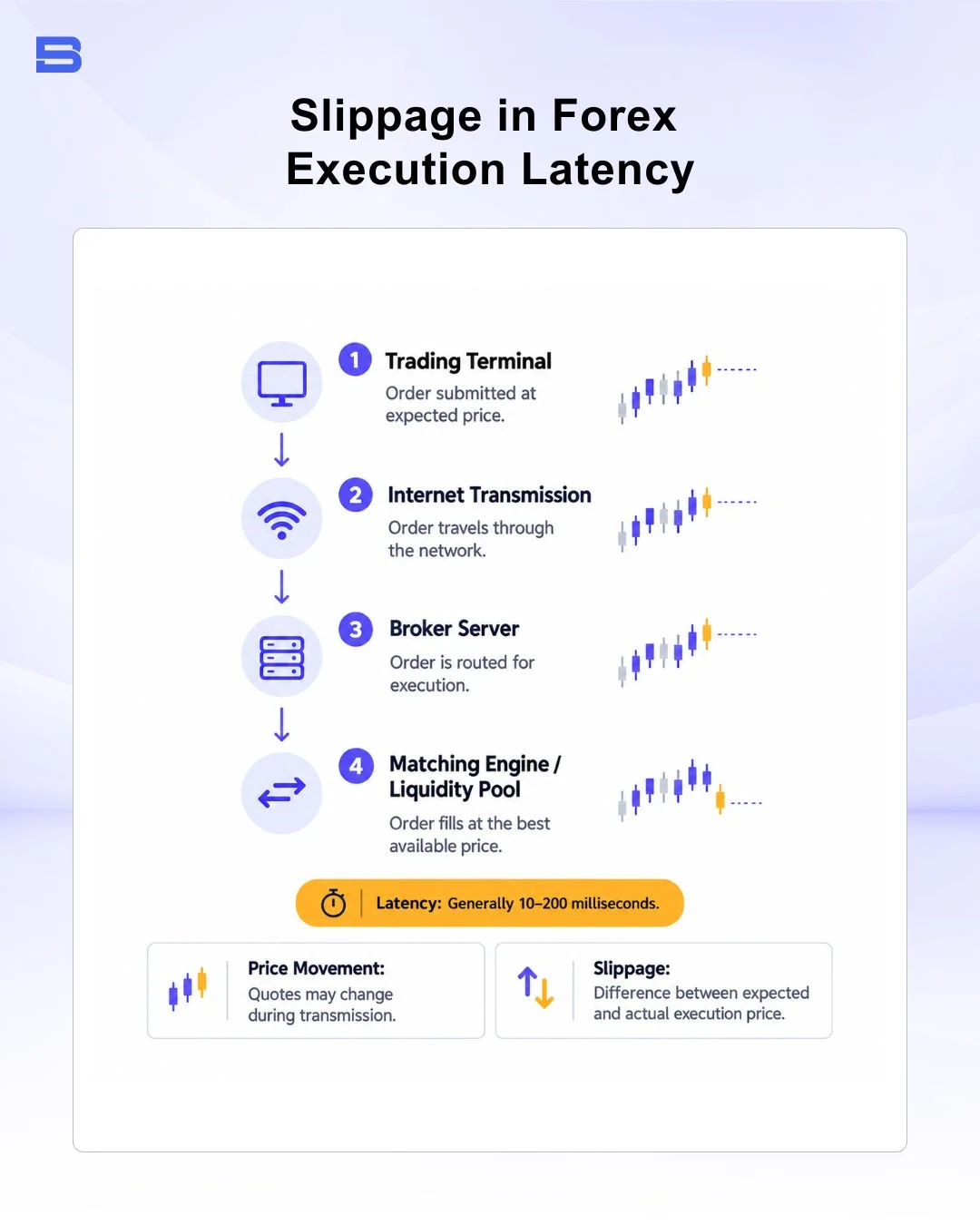
Slippage in forex is the difference between the expected execution price of an order and the actual price at which the trade fills.
Every market transaction requires time to travel from your terminal across the internet to your broker's trading servers, and finally into a matching engine or liquidity pool. Even with high-speed fiber networks, this journey still takes a measurable amount of time.
If prices change during that fractional window, the available quotes shift before your order settles. Your trade simply matches against the best available price currently in the order book.
Positive vs Negative Slippage: Worked Calculation
Slippage is not always an added cost. Price movement cuts both ways, depending on whether the market shifts in your favor or against you.
Suppose you submit a market order to buy 1 standard lot (100,000 units) of EUR/USD when the ask quote reads 1.0850. Each pip movement on EUR/USD equals exactly $10.00.
- Negative Slippage: Fast-moving momentum pushes the price upward during order routing. Your order fills at 1.0853. Because you paid 3 pips more than anticipated, you experience an immediate negative execution drag of $30.00 ($10 × 3 pips).
- Positive Slippage: A sudden surge of selling liquidity dips the ask price while your order is in transit. Your order fills at 1.0848. You receive a 2-pip price improvement, saving $20.00 ($10 × 2 pips) right at market entry.
Dealing with execution differences requires recognizing that while positive fills reduce trading overhead, sustained negative fills can erode your edge (the small advantage a strategy relies on to stay profitable).
Slippage vs Spread: Understanding Your True Trading Costs
Traders frequently confuse the bid-ask spread with slippage, but they represent entirely different components of transaction friction.
The spread is the difference between the buying price and selling price quoted directly on your platform. It serves as the primary compensation model for liquidity provision or broker processing. Slippage, by contrast, is an execution deviation that happens after you transmit the order.
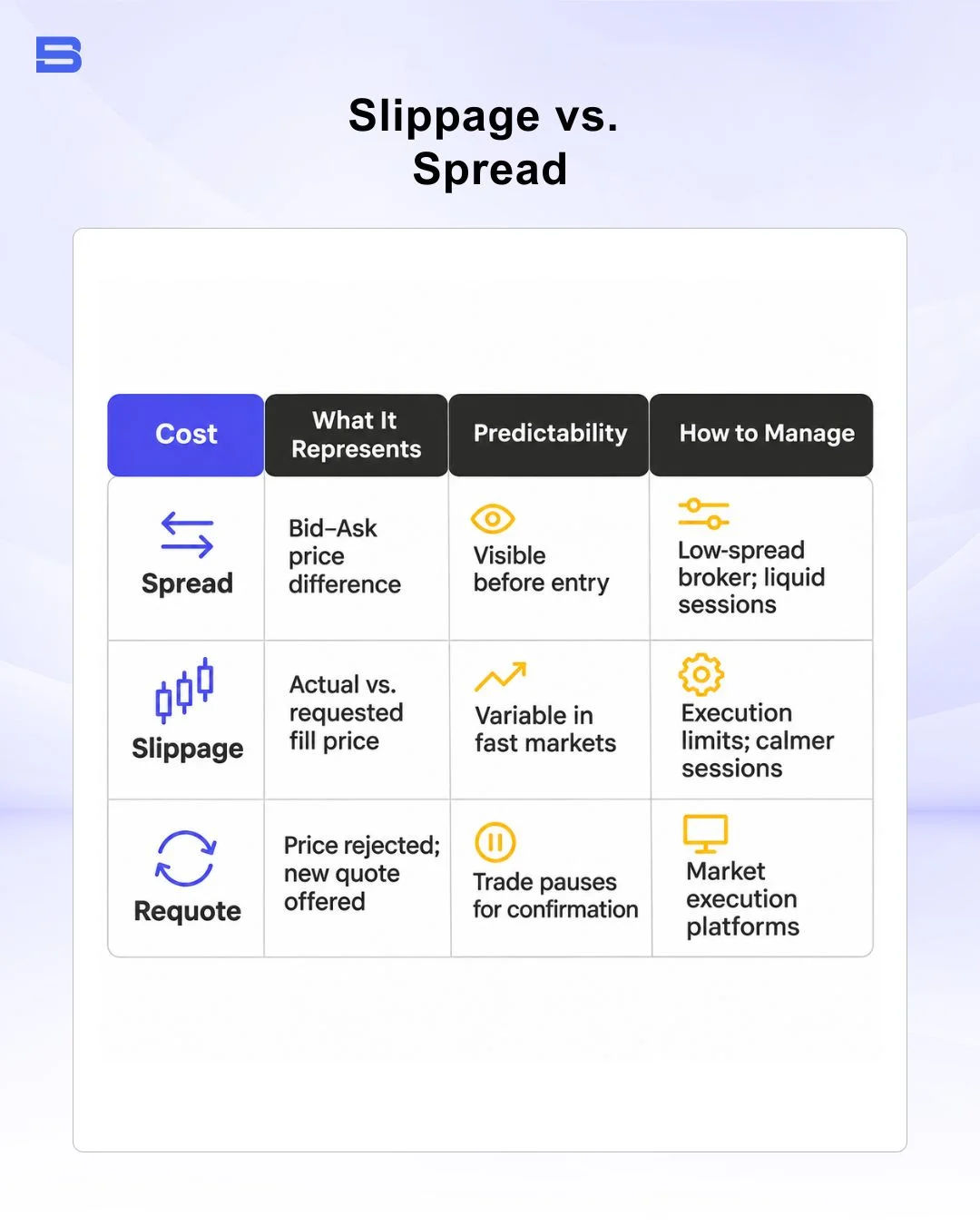
Slippage is also different from a requote, which happens when the broker declines your order at the requested price and offers a new price instead. Requotes generally occur under “Instant Execution” dealing desk setups.
What Causes Slippage in Forex Trading?
Execution variances stem primarily from two interconnected market mechanics: sudden volatility spikes and thin liquidity depth.
According to survey data from the Bank for International Settlements (BIS), the global foreign exchange market turned over about $9.6 trillion per day in April 2025, making it the most liquid financial venue in existence. However, this deep liquidity is not distributed evenly across every minute of the day.
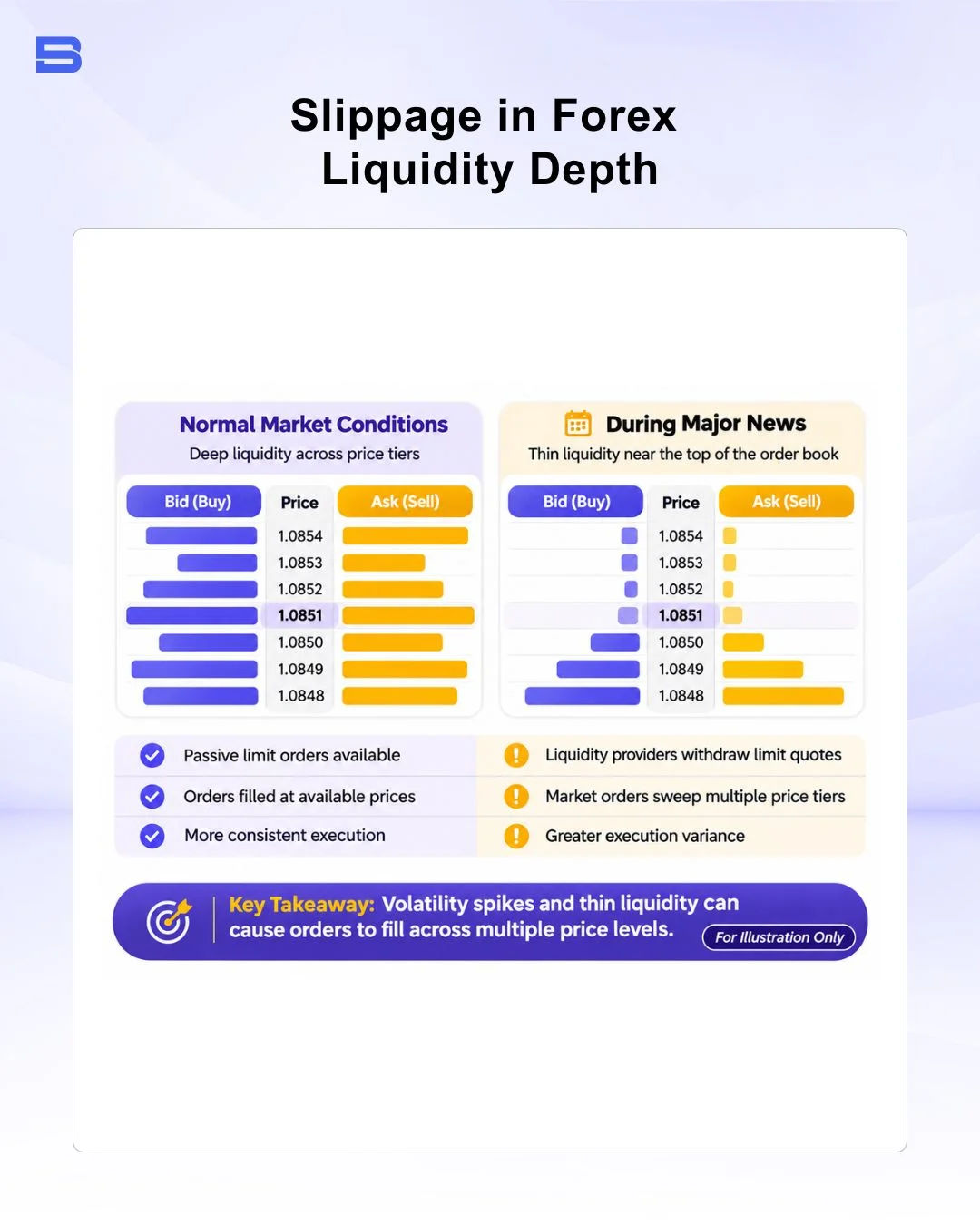
When high-tier macroeconomic data breaks—such as US Non-Farm Payrolls or central bank rate decisions—liquidity providers often quickly pull passive limit quotes (resting orders waiting in the order book) to protect against sharp inventory imbalances. The top of the order book can thin dramatically. As retail market orders flood the matching engine simultaneously, orders must sweep through multiple price tiers to get filled.
Low-volume periods create identical execution hurdles. Trading during the late New York to early Asian session transition or holding positions over weekend market closes often exposes positions to wide price gaps and severe slippage.
How Order Types and Execution Models Affect Slippage
The type of order you place determines whether you absorb execution drag or risk missing a market entry entirely.
A standard market order instructs the network to fill immediately at the best prevailing price, accepting whatever liquidity sits on the other side. A standard stop loss operates identically: once triggered, it converts directly into an unrestricted market order. During violent volatility, a stop loss cannot prevent a fill gap, meaning your realized exit may settle pips beyond your planned risk boundary.
Limit orders, however, eliminate negative slippage. A buy limit guarantees you receive your requested price or better. If liquidity is absent at that tier, the trade simply remains unfilled.
Execution architecture also shapes slippage patterns. Regulators like the Financial Conduct Authority (FCA) mandate clear "best execution" rules, requiring regulated brokers to pass positive price improvements to retail clients rather than keeping the difference.
An ECN broker routes orders straight into interbank matching venues, which may produce both positive and negative slippage on a broadly symmetrical basis. Conversely, dealing desk setups acting as market makers internalize order flow, occasionally holding orders or rejecting fills via requotes.
The Role of Liquidity Providers and Order Books
Retail brokers rarely take market risk on every client position. Instead, they aggregate price quotes from Tier 1 institutions and non-bank market makers.
To see how slippage in forex works in practice, consider how limited liquidity at different price levels affects order execution. If a liquidity provider offers only 2 lots at the top ask price and you submit a 5-lot order, the matching engine fills 2 lots at that quote and executes the remaining 3 lots at the next higher price level. This weighted average execution price reflects natural order book behavior rather than necessarily indicating broker interference.
Practical Ways to Control and Manage Slippage
While you cannot eliminate market friction, disciplined execution habits significantly curb negative slippage.
- Set Maximum Deviation / Slippage Tolerance: Most modern platforms let you establish a slippage tolerance threshold. If the market shifts beyond your selected pip limit during transit, the platform cancels the order rather than executing an unfavorable fill.
- Avoid Trading High-Impact Economic Releases: Sidestep news releases unless your strategy specifically targets event volatility. Spreads historically widen, and liquidity can thin sharply during the opening seconds of central bank rate statements.
- Deploy a Trading VPS: Physical distance creates routing delays. Setting up a Virtual Private Server (VPS) for trading hosted inside major financial data centers (such as London LD4 or New York NY4) shortens the distance your orders travel.
- Trade Peak Liquidity Sessions: Confine market orders to overlapping sessions, particularly the London and New York crossover, when institutional order books are deepest.
Knowing what slippage in forex is matters because leverage amplifies your market exposure, while negative slippage can accelerate losses by executing your entry or exit at less favorable prices than expected, potentially pushing your risk beyond the original trading plan.
Conclusion
Understanding what slippage in forex is helps traders recognize that execution differences are an inevitable part of trading live, decentralized financial markets rather than necessarily a platform defect. By understanding order book mechanics, using limit orders where practical, and enforcing strict slippage tolerance rules, traders can better manage entry prices and maintain control over transaction costs.
- How to Build an Investment Plan That Actually Works for You?
- What Is the MACD Indicator and How to Use It
- What Is a Wedge Pattern in Trading?
- What Is Ichimoku Cloud Strategy? A Complete Trading System
- Mastering Elliott Wave Theory: Rules and Trading Strategies
- News Trading: Strategies, Execution Risks, and Risk Control
- What Is an Iron Condor Options Strategy?
- Backtesting Explained: What It Is and Why It Really Matters
- Grid Trading: Mechanics, Parameters, and Risk Strategies
- What Is Breakout Trading and How Does It Work?
- Mean Reversion: Technical Strategies and Risk Frameworks
- Momentum Trading: Indicators, Strategies, and Risk Control
- Hammer Candlestick: Structure, Meaning, and Strategy
- Doji Candlestick: Types, Signals, and Trading Strategies
- What Is the Sharpe Ratio and How to Calculate It
- What Is VWAP and How Do Traders Use It?
- Trade the Ascending Triangle: A Step-by-Step Practical Guide
- What Is the Stochastic Oscillator and How to Use It
- How to Trade the Descending Triangle Pattern
- High Frequency Trading: Speed, Algorithms, and Market Impact
- What Is Volume Profile and How to Use It in Trading
- What Is a Morning Star Pattern Candlestick?
- Trade with Parabolic SAR: A Practical Analysis Guide
- Evening Star Pattern: Structure, Rules, and Risk Controls
- Kelly Criterion: Formula, Position Sizing, and Risk
- What Is the NYSE Minimum Trading Price? Rules Explained
Disclaimer: The content on this page is intended for educational and informational purposes only. It does not constitute financial, investment, tax, or legal advice, and should not be interpreted as a recommendation to buy, sell, or hold any financial instrument or asset. Trading and investing involve significant risk, including the possible loss of your entire capital. Products such as forex, CFDs, and cryptocurrencies carry additional risks due to leverage, high volatility, and limited regulatory protection in some jurisdictions. Past performance of any financial instrument does not guarantee future results. Any market views, forecasts, or opinions expressed are those of the author at the time of writing and may not reflect current market conditions. Platform features, fees, and regulatory status are subject to change — always verify information directly with the relevant provider or regulator before making any financial decision. BrokerSpecs may receive compensation from third parties featured on this site. Always conduct your own due diligence and consider seeking advice from a licensed financial professional before investing. Portions of this article were prepared with the assistance of AI tools and reviewed by our editorial team before publication.