



Related Tags
Tracking 30 individual blue-chip stocks on Bursa Malaysia to capture overall equity market movement can be capital-intensive and operationally complex. Instead of managing thirty separate shareholdings, retail traders and institutional fund managers often turn to a single, standardized derivative contract: FTSE Bursa Malaysia KLCI Futures, universally known as FKLI.
What Is FKLI and How Does Stock Index Futures Trading Work in Malaysia?
FKLI is a Ringgit Malaysia (MYR)-denominated stock index futures contract traded on Bursa Malaysia Derivatives (BMD) and cleared through Bursa Malaysia Derivatives Clearing (BMDC). It tracks the benchmark FTSE Bursa Malaysia KLCI (FBM KLCI), which represents the 30 largest companies by market capitalization listed on the Main Market of Bursa Malaysia.
When you trade FKLI, you are entering a legally binding agreement to buy or sell the value of the FBM KLCI index at a predetermined price on a specified future date. Because it is a financial derivative, you do not take delivery of physical corporate shares. Instead, all profits and losses are settled in cash based on index level fluctuations.
Contract Size, Tick Size, and Multiplier
Understanding the financial mechanics of an FKLI contract requires knowing its exact structural parameters:
- Contract Multiplier: Index Level × MYR 50.00. If the FBM KLCI is trading at 1,600 points, one full FKLI contract represents a total nominal value of MYR 80,000 (1,600 x RM50).
- Minimum Price Fluctuation (Tick Size): 0.5 index points.
- Tick Value: MYR 25.00 per contract (0.5 x RM50). Every half-point movement in the index gains or loses MYR 25.00 per contract held.
Expiration Months and Cash Settlement Mechanics
FKLI trades on specific contract expiration cycles: spot month, next month, and the next two calendar quarterly months (March, June, September, and December).
Unlike physical commodity contracts like FCPO contracts, FKLI is strictly cash-settled. On the final trading day—the last Business Day of the contract month—the contract expires.
The Final Settlement Value is calculated based on the average FBM KLCI index level taken every 15 seconds during the afternoon session, excluding the highest and lowest values. Your open position is automatically closed against this settlement price, crediting or debiting your trading account in MYR.
What Is the KLCI Index and How Does It Differ from FKLI Futures?
The FBM KLCI is Malaysia's flagship stock market index, calculated in real time using a free-float market-capitalization weighted methodology. It serves as the primary health gauge for the Malaysian equity market.
While the underlying index measures stock performance, FKLI derivative contracts represent forward market expectations and facilitate directional exposure or portfolio protection.
Spot FBM KLCI vs. FKLI Contract Specs
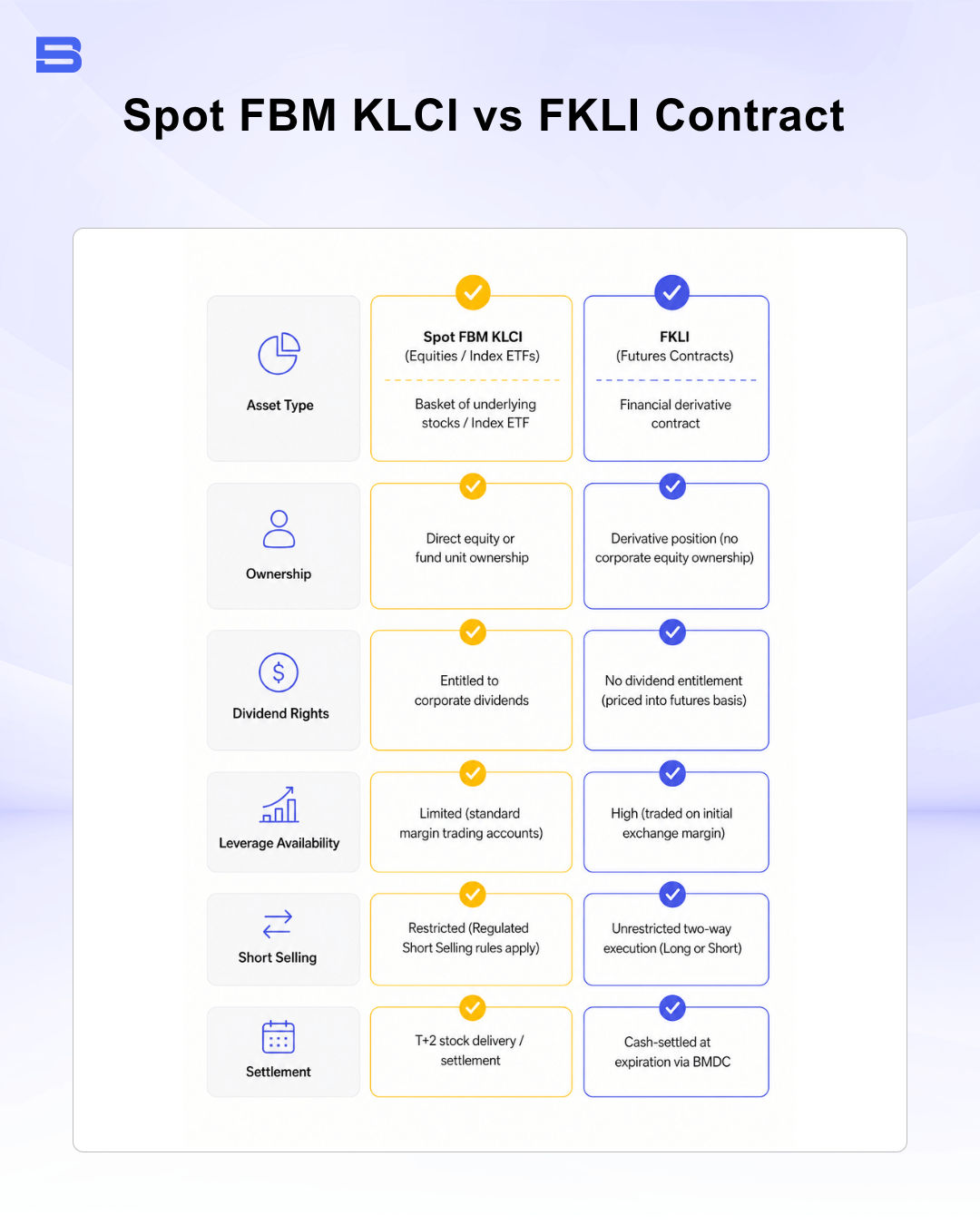
Margin Requirements, Tick Value, and Leverage Risk
Trading FKLI requires opening a dedicated futures trading account with a broker licensed by the Securities Commission Malaysia (SC). Futures operate on initial and maintenance margin requirements established by Bursa Malaysia Derivatives Clearing.
Leverage amplifies your returns when market moves align with your trade, but it accelerates capital destruction just as quickly when the price moves against your position.
To illustrate how leverage and tick values function in practice:
Assume the initial margin requirement set by the exchange is MYR 4,200 per contract, and the FBM KLCI is trading at 1,600.0 points (contract value = MYR 80,000). You go Long 1 contract.
- Bullish Scenario (+10 points move): The index rises to 1,610.0 points (+20 ticks).
Calculation: 20 ticks x RM25 = RM500 gross profit
Return on initial margin: RM500 / RM4,200 = +11.90% - Bearish Scenario (-10 points move): The index drops to 1,590.0 points (-20 ticks).
Calculation: 20 ticks x RM25.00 = RM500 gross loss
Loss on initial margin: -RM500 / RM4,200 = -11.90%
If market volatility pushes your account balance below the maintenance margin threshold, your broker issues a margin call. If you fail to deposit additional funds immediately, the broker is legally required to liquidate your position to prevent further capital deficits.
Strategic Applications: Portfolio Hedging vs. Directional Trading
Market participants utilize FKLI primarily for two main strategic purposes:
- Institutional Portfolio Hedging: A fund manager holding an MYR 10 million Malaysian equity portfolio may anticipate short-term macroeconomic headwinds. Selling physical holdings incurs substantial brokerage fees, market impact costs, and potential tax implications. Instead, the manager short-sells FKLI contracts. If the market declines, gains on the short FKLI contracts offset paper losses in the stock portfolio.
- Directional Speculation: Retail and institutional traders execute short-term long or short strategies based on technical breakouts, interest rate trends, or corporate earnings cycles. Because FKLI offers high liquidity, positions can be opened and closed rapidly during trading sessions.
How to Start Trading FKLI Futures in Malaysia
To access FKLI futures legally and securely in Malaysia, follow a structured setup path:
- Select an SC-Licensed Derivatives Broker: Ensure your broker is a Trading Participant of Bursa Malaysia Derivatives and licensed by the Securities Commission Malaysia.
- Open a Futures Trading Account: A standard Central Depository System (CDS) account used for buying stocks cannot trade futures. You must open a separate Futures Trading Account and complete a risk suitability assessment.
- Deposit Margin Capital: Transfer initial margin funds into the segregated client account maintained by the brokerage.
- Deploy Risk Controls: Before placing order tickets, establish clear strict risk management rules using pre-set stop loss and take-profit levels.
Trading Hours and Platform Execution
FKLI executes electronically via Chicago Mercantile Exchange (CME) Globex® across regular daytime trading and after-hours T+1 sessions:
- Morning Session: 08:45 AM – 12:45 PM (MYT)
- Afternoon Session: 02:30 PM – 05:15 PM (MYT)
- After-Hours (T+1) Night Session (Monday–Thursday): 09:00 PM – 02:30 AM (MYT)
The night session allows Malaysian traders to hedge or execute positions in response to overnight moves in European and US equity markets.
FKLI vs. Index ETFs for Equity Market Exposure
Investors seeking long-term exposure to the Malaysian equity benchmark can choose between futures contracts and funds:
- Index ETFs: Holding an FBM KLCI index ETF allows passive investors to accumulate market exposure over extended horizons without handling contract roll dates or maintenance margin requirements.
- FKLI Futures: Designed primarily for short-to-medium term traders, institutional hedgers, and tactical positioning due to contractual expiration dates and leverage maintenance.
How to Incorporate FKLI into Your Broader Malaysian Portfolio
FKLI works best as a tactical instrument alongside core long-term holdings. While passive long-term capital sits in diversified allocations like unit trusts, REITs, or direct blue-chip equities, an active allocation to FKLI provides targeted protection during broader market downturns.
By maintaining strict position sizing and respecting maintenance margin limits, traders can use FKLI to navigate both bull and bear market cycles effectively.
The Utility of FKLI
FTSE Bursa Malaysia KLCI Futures (FKLI) offer capital efficiency, liquid execution, and strategic flexibility for hedging equity portfolios or trading market direction. However, trading leveraged derivative contracts requires disciplined risk management, continuous margin monitoring, and clear exit rules to protect trading capital.
- What Can You Trade? A Guide to Forex, Stocks, and More
- CFD Trading for Beginners
- What is CFD Trading and How Does It Work?
- Forex vs. Stocks: Which Market Suits You Best?
- How to Diversify a Portfolio Across Asset Classes
- How Dividend Stocks Work: Yields, Risks, and Strategies
- Silver Trading Explained: A Guide for Retail Investors
- Precious Metals Trading: A Complete Guide for Beginners
- Natural Gas Trading: A Guide to the Market
- Structured Warrants Malaysia: How They Work and Risks
- What Is the KLCI Index and How to Trade It
- Gold Investment in Malaysia: A Complete Guide for Beginners
- What Is Kijang Emas and How to Invest in It
- Value Investing Explained: How to Find Undervalued Stocks
- How to Trade Bitcoin Safely: A Complete Market Guide
- Growth Investing Explained: Strategies, Metrics, and Risks
- What Is Digital Gold Malaysia and How to Invest
- Crypto Trading Strategies for Beginners
- Gold vs Bitcoin: Key Differences, Risks, and Strategies
- Sukuk: A Guide for Beginners to Islamic Bonds
- What Is FCPO (Crude Palm Oil Futures) and How to Trade It
- How to Identify and Invest in Shariah-Compliant Stocks
- Timber Investment: Is It Worth It?
- Gold ETF Malaysia: A Guide for Beginners
- What Are Malaysian Government Securities (MGS)?
- Corporate Bonds Malaysia: A Guide for Beginners
- China A-Shares Trading Guide for Malaysian Investors
- What Is a Silver ETF and How to Invest in It?
- How to Trade XRP: A Practical Guide for Retail Investors
- How to Trade Solana (SOL): A Guide for Beginners
- What Are Gold Futures and How Do They Work?
- Money Market Fund in Malaysia: A Guide for Beginners
- Property Investment Malaysia: Direct Real Estate or M-REITs?
- What Is Binance Coin and How Does It Work?
- Green Sukuk: A Guide for Beginners to Islamic ESG Investing
- What Is Shiba Inu (SHIB) and How to Trade It
- What Is USDT? A Complete Guide to Tether for Beginners
- What Is Dogecoin and How to Trade It Safely for Beginners
- Cardano: A Guide for Beginners to Trade This Cryptocurrency
- Polkadot: A Guide to Trading This Cryptocurrency
- Tron: A Guide for Beginners to Trading This Cryptocurrency
- What Is Litecoin (LTC)? A Guide to Trading Digital Silver
- What Is Chainlink (LINK) and How to Trade It
- How to Trade Pepe Coin: Spot, Leverage, and Risk Management
- Near Protocol: A Guide to Trading This Cryptocurrency
- Trading Polygon Crypto: A Practical Guide for Beginners
- Trade Toncoin: Understanding the TON Ecosystem and Risks
- Cosmos Crypto: Ecosystem Architecture, Tokenomics, and Risks
- Stellar Crypto: A Guide to Trading This Cryptocurrency
- Avalanche Crypto Explained: A Practical Guide for Traders
- What Is Worldcoin? How to Trade WLD and Manage Risk
- Aptos: A Guide for Beginners to Trading This Cryptocurrency
- Sui Crypto Explained: Tokenomics and Trading Guide
- Celestia: A Guide to Trading This Cryptocurrency
- Decentraland: A Guide to Trading This Cryptocurrency
- What Is Arbitrum? How to Trade the Leading Layer 2 Network
- Sei Crypto: A Guide to Trading This Cryptocurrency
- What Is Injective Protocol and How to Trade INJ Safely
Disclaimer: The content on this page is intended for educational and informational purposes only. It does not constitute financial, investment, tax, or legal advice, and should not be interpreted as a recommendation to buy, sell, or hold any financial instrument or asset. Trading and investing involve significant risk, including the possible loss of your entire capital. Products such as forex, CFDs, and cryptocurrencies carry additional risks due to leverage, high volatility, and limited regulatory protection in some jurisdictions. Past performance of any financial instrument does not guarantee future results. Any market views, forecasts, or opinions expressed are those of the author at the time of writing and may not reflect current market conditions. Platform features, fees, and regulatory status are subject to change — always verify information directly with the relevant provider or regulator before making any financial decision. BrokerSpecs may receive compensation from third parties featured on this site. Always conduct your own due diligence and consider seeking advice from a licensed financial professional before investing. Portions of this article were prepared with the assistance of AI tools and reviewed by our editorial team before publication.