



Related Tags
Imagine wanting to collect steady rental income from prime commercial properties—like landmark shopping malls, bustling logistics hubs, or private hospitals—without saving up a six-figure down payment, applying for a massive bank loan, or dealing with tenant complaints.
Real Estate Investment Trusts, commonly referred to as M-REITs, offer retail investors a fractional property ownership mechanism directly through Bursa Malaysia. By pooling capital from investors, M-REITs allow you to build income-focused portfolios backed by physical real estate assets while maintaining the flexibility of stock market trading.
What Is a REIT and How Does It Work in Malaysia?
A Real Estate Investment Trust (REIT) in Malaysia is a listed collective investment scheme that pools capital from investors to purchase, manage, and hold a diversified portfolio of income-producing real estate assets.
Instead of purchasing physical property directly, you buy units of a listed REIT on Bursa Malaysia, effectively becoming a fractional owner of the underlying real estate portfolio. Professional asset managers operate the properties, secure commercial tenants, collect monthly rents, and handle ongoing property maintenance.
Under Section 61A of the Malaysian Income Tax Act 1967, an M-REIT is exempt from corporate income tax on the portion of earnings it distributes, provided it pays out at least 90% of its total taxable income to unitholders as dividends within a given financial year.
This tax incentive creates a direct pipeline, passing the bulk of gross rental yields straight to investors rather than retaining profits internally.
How M-REIT Dividend Distributions and Withholding Tax Work
Most M-REITs distribute earnings to unitholders on a quarterly or semi-annual basis. However, retail investors must understand the applicable dividend taxation rules before projecting net cash flows.
Standard Malaysian public listed companies issue single-tier dividends, which are completely tax-free at the retail level. M-REIT distributions work differently: they're subject to a final withholding tax at source.
- Malaysian Retail Individuals: As of the 2026 assessment year, no tax is withheld at source. Instead, you must declare your REIT distributions in your annual tax return and pay tax at your own individual scale rate.
- Foreign Individual Investors: As of the 2026 assessment year, distributions are taxed at 30% of chargeable income. Non-resident corporate investors continue to face a separate 24% final withholding tax.
- Non-Corporate Foreign Institutional Investors: As of the 2026 assessment year, taxed at 30% of chargeable income, in line with the treatment for foreign individual investors.
- Malaysian Resident Companies: Income distributions are received gross without withholding tax, but the earnings are subsequently taxed at the standard corporate tax rate of 24%.
For example, if an M-REIT announces a gross dividend distribution of 5.0 sen per unit and you hold 10,000 units, your total gross dividend is RM500. Under the current rules, no tax is withheld at source—the full RM500 is deposited into your bank account, and you'll report it in your annual tax return at your own individual scale rate.
Direct Real Estate vs. REIT Investment: Core Differences
Many investors weigh M-REITs against buying direct residential or commercial property in Malaysia. While direct real estate grants total ownership control and allows you to utilize bank leverage, M-REITs eliminate management burdens and offer significantly higher liquidity.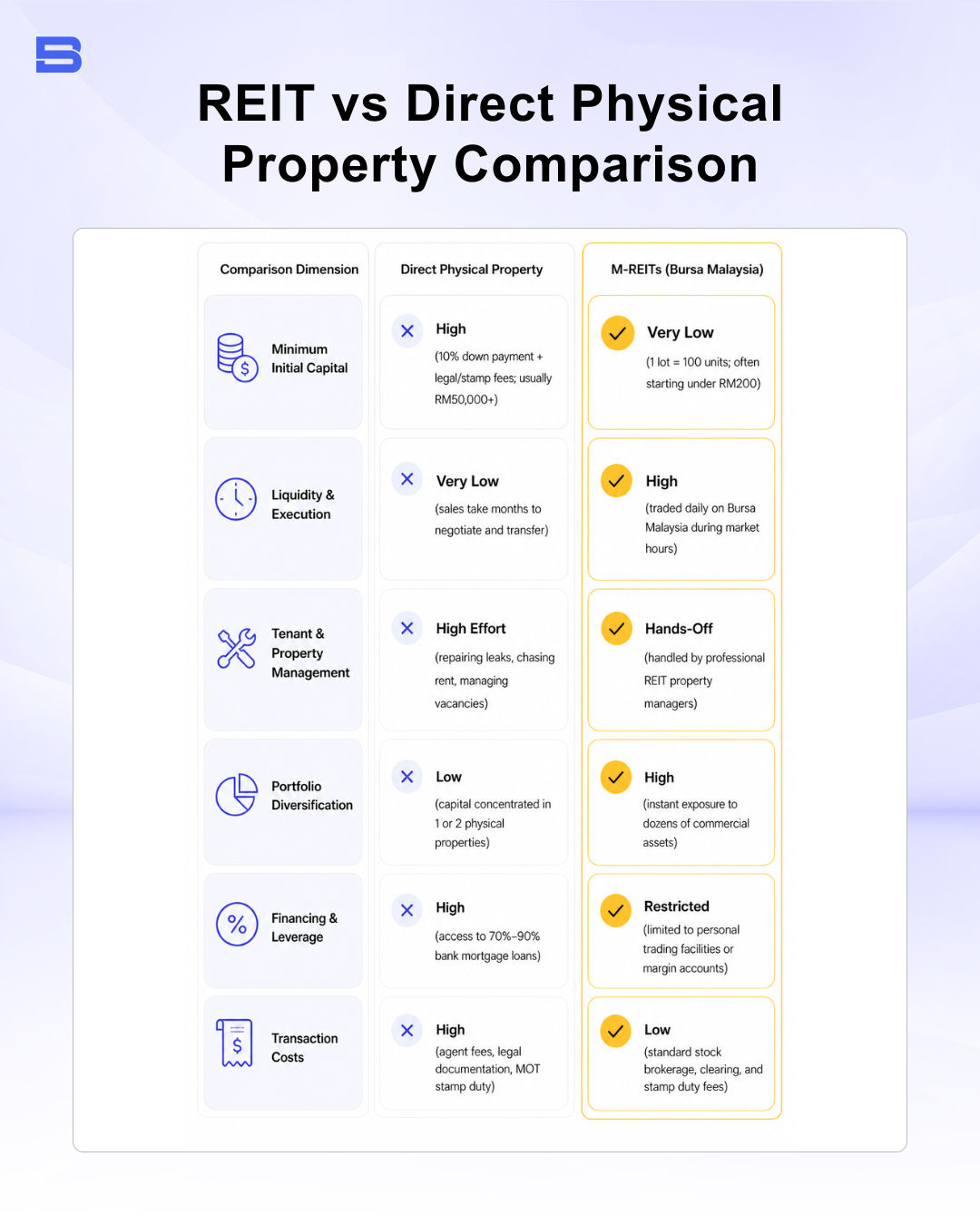
If you purchase a physical apartment for RM500,000, your entire capital commitment is tied to a single tenant and location. If that tenant leaves, your rental yield drops instantly to zero while mortgage payments, maintenance fees, and quit rent obligations continue.
By contrast, putting a fraction of that capital into an M-REIT gives you fractional ownership across multiple assets—such as prime retail centers, industrial parks, and office towers—spreading lease default risks across hundreds of commercial tenants.
Key M-REIT Sectors: Retail, Industrial, Healthcare, and Office
Not all M-REITs behave identically. The cash flow stability of a trust depends largely on the economic sector of its underlying properties:
- Retail REITs: Own and operate major shopping malls and retail centers. Their revenue is driven by foot traffic, retail sales volumes, and tenant turnover. Leading retail REITs often utilize structured lease arrangements combining a fixed base rent with a percentage of tenant turnover rent.
- Industrial & Logistics REITs: Hold warehouses, distribution centers, manufacturing facilities, and data centers. Driven by regional e-commerce growth and supply chain expansions, these assets often benefit from long-term master leases (often 5 to 15 years), providing highly predictable rental cash flows.
- Healthcare REITs: Own private hospital buildings, wellness centers, and specialist clinics. Healthcare properties feature long-term leases with built-in inflation escalations and display defensive characteristics, as healthcare demand remains resilient during economic downturns.
- Office REITs: Own commercial office buildings and corporate towers. Yields depend on business corporate health, employment trends, and regional office space supply. Investors in office REITs must closely track vacancy rates and structural shifts toward hybrid work arrangements.
Crucial Metrics: Gearing Ratios and Occupancy
Evaluating M-REIT performance requires going beyond high distribution yields. Key metrics monitored by analysts include:
- Net Asset Value (NAV) Per Unit: Represents the net worth of the REIT’s property assets minus its overall liabilities, divided by total outstanding units. Comparing the NAV per unit to the current market price reveals whether the REIT is trading at a premium or a discount.
- Gearing Ratio: Measures the total debt of the trust relative to its total asset value. To protect unitholders from excessive debt exposure, the Securities Commission Malaysia (SC) enforces a strict 50% gearing cap limit on M-REITs (which can temporarily be raised to 60% with unitholder approval for property acquisitions). A lower gearing ratio gives a trust balance sheet headroom to acquire new properties via debt during market downturns.
- Occupancy Rate & WALE: The occupancy rate indicates the percentage of total net lettable area currently generating rental income. Coupled with the Weighted Average Lease Expiry (WALE), these metrics show how soon current tenant leases expire and how susceptible the trust is to tenancy renewals.
How REITs Compare to ETFs and Unit Trusts
Investors building an income portfolio often evaluate M-REITs alongside standard Exchange-Traded Funds (ETFs) and retail unit trust funds. While all three pool investor capital, their asset focus and regulatory structures differ significantly.
An ETF tracks a specific market index or asset basket (such as equity indices, commodities, or fixed-income bonds). When you buy an ETF, your capital is spread across multiple corporate shares or debt paper to achieve broad market performance.
Unit trusts are unlisted, actively managed collective investment schemes priced once daily based on NAV. While a unit trust may hold stocks, bonds, or liquid money market instruments, unitholders pay ongoing management fees to a fund manager tasked with beating a benchmark index.
M-REITs differ in that they are asset-backed operating trusts holding real physical properties. Instead of holding a basket of paper securities, an M-REIT functions as an active property landlord.
Its primary objective is consistent dividend distribution driven by long-term rental contracts, making it a specialized asset class positioned between equity growth instruments and fixed-income bonds.
Practical Step-by-Step Execution for Beginners
Because M-REITs trade publicly, buying units follows the exact same process as buying standard stocks listed on Bursa Malaysia.
Step-by-Step: How to Buy REITs on Bursa Malaysia
- Open a Central Depository System (CDS) Account: You need an active direct or nominee CDS account linked to a licensed stockbroker platform in Malaysia.
- Fund Your Brokerage Account: Deposit your intended investment capital into your trading account via online Financial Process Exchange (FPX) transfer.
- Search the M-REIT Stock Code: Look up your target M-REIT using its official 4-digit stock code or stock name on your trading platform interface or through Bursa Malaysia.
- Place Your Order using Standard Lot Sizing: Units on Bursa Malaysia trade in standard lots of 100 units. Enter your target purchase price and quantity in lots.
Once executed, the M-REIT units will settle into your CDS account within two trading days (T+2).
Core Risks and Vulnerabilities to Consider
While M-REITs provide accessible cash flows, they carry specific vulnerabilities that every investor must monitor carefully:
- Interest Rate Sensitivity: M-REITs borrow money from commercial banks to fund acquisitions. When central banks adjust benchmark interest rates, higher borrowing rates increase refinancing costs for debt-heavy REITs, directly squeezing distributable income. Furthermore, rising yields on risk-free assets like fixed deposits can reduce the relative attractiveness of REIT dividend yields.
- Tenancy Default & Vacancy Risk: Financial instability among major anchor tenants can quickly translate into uncollected rent or sudden property vacancies. An anchor tenant exiting a retail mall or industrial warehouse can reduce overall occupancy and dividend distributions until a replacement lease is signed.
- Inflation & Maintenance Expenses: Operating properties requires continuous capital expenditure for upkeep, refurbishments, and asset enhancement initiatives. Elevated building maintenance costs and utility charges can erode net property income if lease agreements do not allow landlords to pass inflation costs onto tenants.
Building a Resilient Portfolio with REITs
Investing in M-REITs offers retail investors a liquid, low-barrier pathway to earning regular rental income from prime commercial real estate without the heavy capital requirements of direct property ownership.
By distributing at least 90% of their taxable income, M-REITs deliver regular yields, but profitability remains tied to occupancy rates, management quality, and interest rate environments.
By analyzing NAVs, monitoring debt levels, and diversifying across property sectors, you can build a resilient, income-focused portfolio tailored to your long-term financial goals.
- What Can You Trade? A Guide to Forex, Stocks, and More
- CFD Trading for Beginners
- What is CFD Trading and How Does It Work?
- Forex vs. Stocks: Which Market Suits You Best?
- How to Diversify a Portfolio Across Asset Classes
- How Dividend Stocks Work: Yields, Risks, and Strategies
- Silver Trading Explained: A Guide for Retail Investors
- Precious Metals Trading: A Complete Guide for Beginners
- Natural Gas Trading: A Guide to the Market
- Structured Warrants Malaysia: How They Work and Risks
- What Is the KLCI Index and How to Trade It
- Gold Investment in Malaysia: A Complete Guide for Beginners
- What Is Kijang Emas and How to Invest in It
- Value Investing Explained: How to Find Undervalued Stocks
- How to Trade Bitcoin Safely: A Complete Market Guide
- Growth Investing Explained: Strategies, Metrics, and Risks
- What Is Digital Gold Malaysia and How to Invest
- Crypto Trading Strategies for Beginners
- Gold vs Bitcoin: Key Differences, Risks, and Strategies
- Sukuk: A Guide for Beginners to Islamic Bonds
- What Is FCPO (Crude Palm Oil Futures) and How to Trade It
- How to Identify and Invest in Shariah-Compliant Stocks
- Timber Investment: Is It Worth It?
- Gold ETF Malaysia: A Guide for Beginners
- What Are Malaysian Government Securities (MGS)?
- Corporate Bonds Malaysia: A Guide for Beginners
- China A-Shares Trading Guide for Malaysian Investors
- What Is a Silver ETF and How to Invest in It?
- How to Trade XRP: A Practical Guide for Retail Investors
- How to Trade Solana (SOL): A Guide for Beginners
- What Are Gold Futures and How Do They Work?
- Money Market Fund in Malaysia: A Guide for Beginners
- Property Investment Malaysia: Direct Real Estate or M-REITs?
- What Is Binance Coin and How Does It Work?
- Green Sukuk: A Guide for Beginners to Islamic ESG Investing
- What Is Shiba Inu (SHIB) and How to Trade It
- What Is USDT? A Complete Guide to Tether for Beginners
- What Is Dogecoin and How to Trade It Safely for Beginners
- Cardano: A Guide for Beginners to Trade This Cryptocurrency
- Polkadot: A Guide to Trading This Cryptocurrency
- Tron: A Guide for Beginners to Trading This Cryptocurrency
- What Is Litecoin (LTC)? A Guide to Trading Digital Silver
- What Is Chainlink (LINK) and How to Trade It
- How to Trade Pepe Coin: Spot, Leverage, and Risk Management
- Near Protocol: A Guide to Trading This Cryptocurrency
- Trading Polygon Crypto: A Practical Guide for Beginners
- Trade Toncoin: Understanding the TON Ecosystem and Risks
- Cosmos Crypto: Ecosystem Architecture, Tokenomics, and Risks
- Stellar Crypto: A Guide to Trading This Cryptocurrency
- Avalanche Crypto Explained: A Practical Guide for Traders
- What Is Worldcoin? How to Trade WLD and Manage Risk
- Aptos: A Guide for Beginners to Trading This Cryptocurrency
- Sui Crypto Explained: Tokenomics and Trading Guide
- Celestia: A Guide to Trading This Cryptocurrency
- Decentraland: A Guide to Trading This Cryptocurrency
- What Is Arbitrum? How to Trade the Leading Layer 2 Network
- Sei Crypto: A Guide to Trading This Cryptocurrency
- What Is Injective Protocol and How to Trade INJ Safely
Disclaimer: The content on this page is intended for educational and informational purposes only. It does not constitute financial, investment, tax, or legal advice, and should not be interpreted as a recommendation to buy, sell, or hold any financial instrument or asset. Trading and investing involve significant risk, including the possible loss of your entire capital. Products such as forex, CFDs, and cryptocurrencies carry additional risks due to leverage, high volatility, and limited regulatory protection in some jurisdictions. Past performance of any financial instrument does not guarantee future results. Any market views, forecasts, or opinions expressed are those of the author at the time of writing and may not reflect current market conditions. Platform features, fees, and regulatory status are subject to change — always verify information directly with the relevant provider or regulator before making any financial decision. BrokerSpecs may receive compensation from third parties featured on this site. Always conduct your own due diligence and consider seeking advice from a licensed financial professional before investing. Portions of this article were prepared with the assistance of AI tools and reviewed by our editorial team before publication.