



Related Tags
Imagine placing a single drop of water into an empty bucket. The next day, you add two drops. The day after that, four drops. For the first week, the bottom of the bucket is barely covered, and it feels like a waste of time.
But if that pattern continues uninterrupted, the bucket won't just fill up—it will overflow in a remarkably short window.
This simple dynamic is the core engine behind long-term wealth creation. In personal finance and investing, compounding operates on the exact same logic.
It is the process where the return you earn on an initial investment begins to earn returns of its own, turning modest regular contributions into substantial wealth over time.
What Is Compound Interest and How Does It Work?
At its most fundamental level, compound interest is interest calculated on both the initial principal amount and the accumulated interest from previous periods. You can think of it as "interest on interest." To demonstrate, it helps to contrast it with simple interest: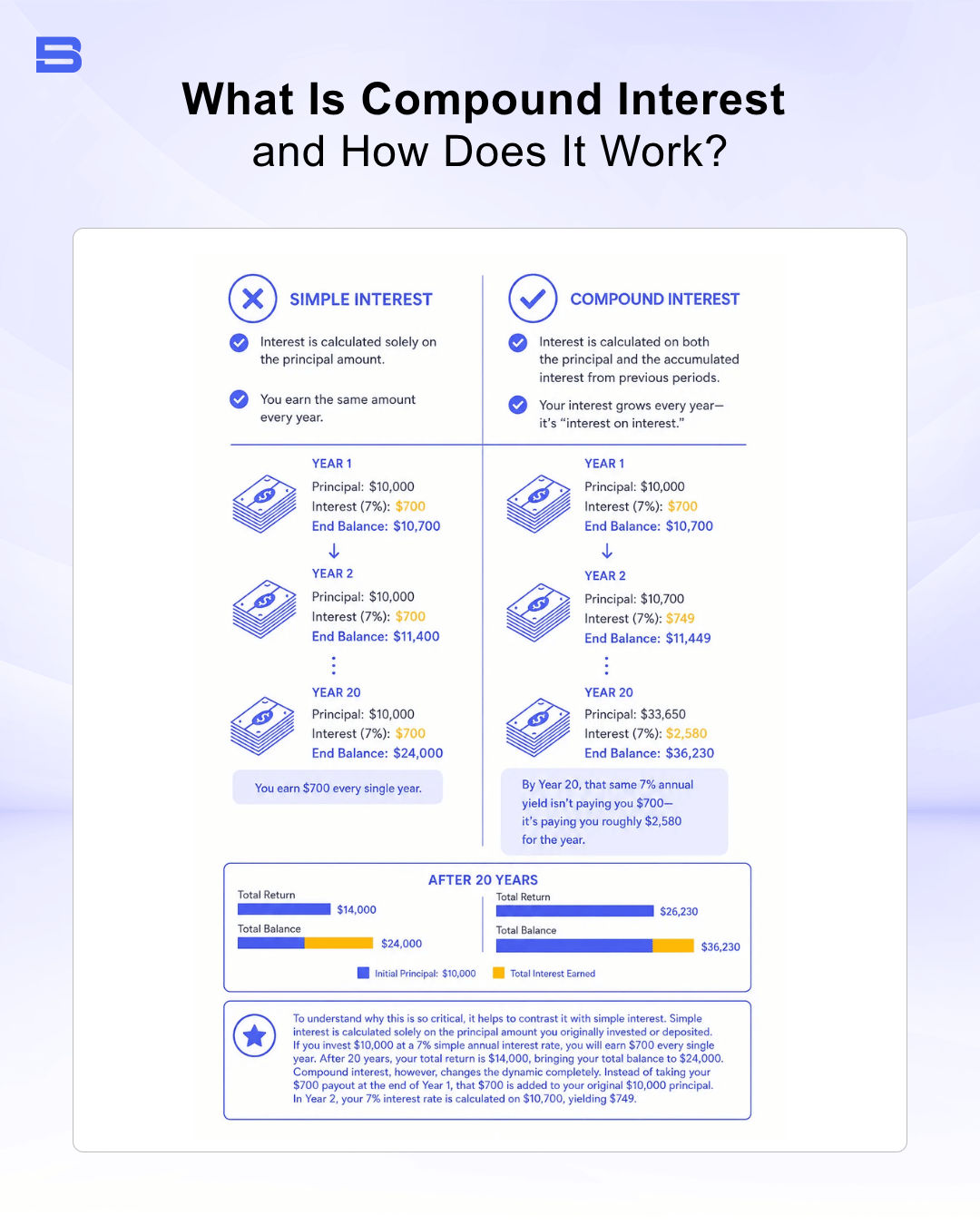
The frequency of compounding also plays a major role in your final outcome. Interest can be compounded on various schedules:
- Annually: Calculated once per year.
- Monthly: Calculated 12 times a year (common for savings accounts and mortgages).
- Daily: Calculated 365 times a year (often used by credit card companies and high-yield accounts).
The more frequently interest is calculated and added back to your balance, the faster your principal baseline expands, yielding a higher overall effective return.
Why Compound Interest Is So Powerful (The Time Factor)
The single most influential factor in compounding is not the amount of money you start with, nor is it achieving exceptionally high annual returns—it is time.
Because compound growth follows an exponential curve rather than a straight line, the vast majority of your gains occur in the final years of your investment horizon. Starting five or ten years earlier can mean a huge difference by retirement.
The Rule of 72
To quickly estimate how long it will take for your money to double due to compounding without breaking out a complex spreadsheet, you can use the Rule of 72.
Simply divide 72 by your expected annual rate of return. If you expect an 8% average return on your investment portfolio, dividing 72 by 8 gives you 9. Your initial capital will approximately double every nine years.
The Dark Side: Compounding Debt
It is vital to recognize that compounding is a neutral mechanism—it works with equal intensity in whichever direction it is pointed. While it builds wealth when applied to investments, it destroys wealth when applied to high-interest debt.
Credit card issuers compound interest on unpaid balances daily. If you maintain a $5,000 balance on a card carrying a 22% APR (Annual Percentage Rate) and only pay the minimum balance, compounding works against you, ensuring that the total interest paid far exceeds the original amount borrowed.
How to Maximize the Power of Compounding in Your Portfolio
Understanding the mechanics of compound interest is only useful if you apply the principles to your personal financial strategy. Here are three core habits to optimize compound growth in your portfolio:
1. Maintain Consistent Contributions
While a one-time lump sum grows steadily, combining compounding with continuous contributions—such as a regular Dollar-Cost Averaging (DCA) strategy—dramatically accelerates the snowball. Adding even $200 a month to an existing portfolio increases your baseline principal every 30 days, giving compound interest a larger target to multiply.
2. Reinvest Your Earnings Automatically
Compounding requires momentum, which means you cannot withdraw your returns if you want the curve to steepen. In equity investing, this means enrolling in a Dividend Reinvestment Plan (DRIP).
Instead of receiving cash dividends in your account balance, DRIP automatically purchases additional shares or fractional shares, expanding your asset base instantly.
3. Minimize Performance Drag (Fees and Taxes)
High management fees and unexpected tax hits act as friction on compounding. A 2% annual expense ratio on a mutual fund might sound minor on paper, but over a 30-year investing horizon, that fee reduces the principal balance available to compound every single year—for a portfolio in the six-figure range, this can cost tens of thousands in lost future growth.
Compounding doesn't just build your balance through interest—it also shapes how your capital gains are taxed.
In a taxable brokerage account, holding an investment for over a year before selling typically qualifies any profit as a long-term capital gain, which is usually taxed at a lower rate than short-term gains—one more reason letting compounding work undisturbed, rather than trading frequently, tends to preserve more of your wealth.
Opting for low-cost index funds and utilizing tax-advantaged accounts, like IRAs or 401ks if you’re in the United States, is one way many investors reduce fee drag so more of their capital stays available to compound, though the right mix of funds and accounts depends on each investor's individual goals and circumstances.
The Bottom Line
Compound interest is the ultimate force multiplier for personal finance. It rewards patience, consistency, and discipline far more than market timing or speculative stock picking.
It's worth remembering that compounding math assumes a steady rate of return, but real markets don't move in a straight line. Downturns and periods of negative performance can temporarily interrupt the curve, which is why time in the market and a diversified approach matter alongside the math itself.
By starting as early as possible, reinvesting your returns automatically, and keeping investment costs low, you turn time into your greatest asset on the path to financial independence.
- What Is Trading and How Does Trading Work?
- Trading Fundamentals: A Guide for Beginners
- Trading vs. Investing: What Are the Key Differences?
- Trading Terms and Terminologies Every Beginner Should Know
- Common Trading Mistakes Beginners Make and How to Avoid
- Understanding Risk and Reward in Trading: A Complete Guide
- Guide to the Different Types of Financial Markets
- Investment Basics: Definition, Strategies, and How to Invest
- Benefits of Investing: Financial Growth and Security
- What Is Swing Trading? A Practical Guide For Beginners
- What Is Spot Trading? A Guide for Beginners
- What Are Futures in Trading? A Guide for Beginners
- Understanding Bull Markets: Growth & Strategy
- How to Read a Candlestick Chart: A Guide for Beginners
- Is Trading Gambling? The Truth About Risk
- Pip in Forex: How It Works & How to Calculate It
- What Is the Bid-Ask Spread in Trading? A Guide for Beginners
- What Is a Margin Call? A Guide for Beginners
- Market Volatility Explained: What It Is and How to Trade It
- Drawdown in Trading: Meaning, Math, and Risk
- Understanding Slippage in Trading: Causes and Control
- Forex Lot Size Explained: Standard, Mini & Micro
- Trailing Stop vs Stop Loss: Essential Risk Strategy
- How Asset Allocation Works: Strategies Explained
- Understanding Market Trading Hours & Sessions
- Market Makers Explained: A Trader's Guide
- Portfolio Diversification: A Strategy Guide
- Capital Gains Explained: How Investment Taxes Work
- Stock Market Circuit Breakers: How Trading Halts Work
- What Is an IPO? How Initial Public Offerings Work
- What Is a Secondary Market? A Complete Guide
- What Is a Stock Exchange? Functions and Overview Explained
- Understanding Ticker Symbols: A Market Guide
- How Clearing Houses Work in Financial Markets
- Stock Market After Labor Day: Trends and What To Expect
Disclaimer: The content on this page is intended for educational and informational purposes only. It does not constitute financial, investment, tax, or legal advice, and should not be interpreted as a recommendation to buy, sell, or hold any financial instrument or asset. Trading and investing involve significant risk, including the possible loss of your entire capital. Products such as forex, CFDs, and cryptocurrencies carry additional risks due to leverage, high volatility, and limited regulatory protection in some jurisdictions. Past performance of any financial instrument does not guarantee future results. Any market views, forecasts, or opinions expressed are those of the author at the time of writing and may not reflect current market conditions. Platform features, fees, and regulatory status are subject to change — always verify information directly with the relevant provider or regulator before making any financial decision. BrokerSpecs may receive compensation from third parties featured on this site. Always conduct your own due diligence and consider seeking advice from a licensed financial professional before investing. Portions of this article were prepared with the assistance of AI tools and reviewed by our editorial team before publication.