



Related Tags
You wake up on a Tuesday morning, log into your trading account, and notice your cash balance increased by $45 without you executing a single trade. You didn't sell any shares or time a market spike. Instead, a company you own a small slice of simply sent you a cut of its profits.
That automated payout is a dividend—one of the primary ways long-term investors turn stock market ownership into passive cash flow. While price growth allows you to profit on paper, dividends place real capital directly into your account, providing returns regardless of whether market prices swing up or down on any given day.
How Dividends Work: The Lifecycle of a Payout
When a company matures past the fast-paced growth phase, it often generates more cash than it can productively reinvest back into expanding the business. The board of directors evaluates the corporate bank balance and votes to return excess profits to shareholders through a dividend payment.
To make sure payouts occur smoothly across millions of global investors, every dividend distribution follows a four-part schedule:
- Declaration Date: The board announces the dividend amount, key cutoff dates, and the future payment date.
- Ex-Dividend Date: The critical deadline for buyers. You must own the stock before this date to receive the upcoming payout. If you buy on or after the ex-dividend date, the seller gets the cash.
- Record Date: Usually one business day after the ex-dividend date, when the company officially updates its record book of registered shareholders.
- Payment Date: The day the dividend cash hits your brokerage account.
To see how this works in practice, imagine you own 150 shares of a consumer goods stock. The company declares an annual cash dividend of $2.40 per share, distributed in four equal quarterly payments of $0.60 per share.
On the payment date, your brokerage account receives: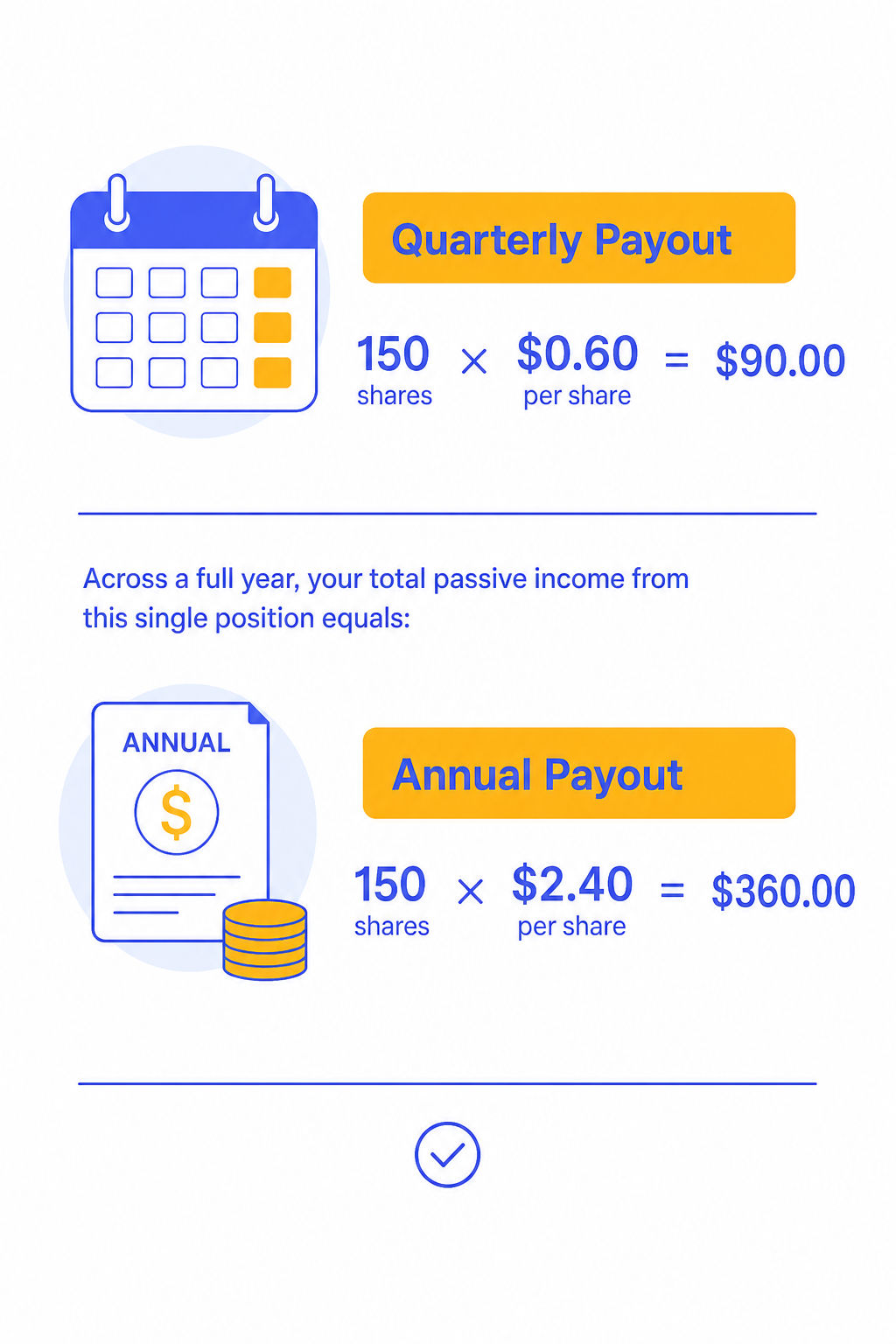
You can withdraw that cash directly to your bank account, let it sit as uninvested cash reserves, or put it back to work in the market.
Dividend Yield vs. Dividend Growth: Avoid the High-Yield Trap
When searching for dividend investing opportunities, beginners naturally look for the highest payout percentage. This metric is known as the dividend yield, calculated by dividing the annual dividend payout by the current share price.
If a stock trades at $50 per share and pays $2.00 in annual dividends, its yield is 4.0%. If the stock price rises to $100 while the payout remains $2.00, the yield drops to 2.0%. This inverse relationship creates a notorious trap for new investors known as a yield trap.
Consider a company whose stock price crashes from $40 down to $10 due to severe business struggles. If their previous annual dividend was $1.00, the stock now mathematically reflects a massive 10% dividend yield ($1.00 / $10).
To an untrained eye, 10% looks like an irresistible bargain. In reality, a company with collapsing stock value usually lacks the financial strength to sustain its cash distributions. Shortly after, the board often slashes or cancels the dividend entirely, causing the stock price to drop even further.
When analyzing stock dividends, look beyond raw yield. Sustainable wealth is built by focusing on dividend growth—companies that consistently increase their payouts year after year supported by steady earnings growth.
Established blue chip stocks are often favored by dividend investors because their steady earnings support reliable, gradually increasing payouts.
Monthly vs. Quarterly Payouts: How Frequently Are Dividends Paid?
How often you receive dividend income depends largely on the asset class and regional market structure:
- Quarterly (4x per year): The standard schedule for most established US and UK public corporations.
- Monthly (12x per year): Common among Real Estate Investment Trusts (REITs), business development companies, and specific income-focused Exchange-Traded Funds (ETFs) that hold underlying debt or dividend assets.
- Semi-Annually or Annually (1x or 2x per year): Standard practice across many European, Asian, and Australian stock exchanges.
Rather than taking dividend cash as spending money, long-term investors frequently utilize a Dividend Reinvestment Plan (DRIP). A DRIP automatically takes your dividend cash the moment it arrives and purchases additional shares—or fractional shares—of that same company without charging manual order execution fees.
By reinvesting payouts, you increase your total share count. During the next payment cycle, those newly added shares earn dividends of their own. Over decades, this compounding cycle can drastically accelerate your portfolio's total return profile.
Key Risks and Strategic Considerations
While earning cash flow sounds straightforward, passive income strategies carry unique market risks that require active management:
- Dividends Are Not Guaranteed: Unlike bond coupon payments—which companies are legally obligated to pay—board members can cut, pause, or eliminate stock dividends at any point if corporate revenues drop or financial distress emerges.
- Tax Considerations: In many jurisdictions, dividends are treated as taxable income. Qualified dividends (those held for a minimum period, typically at least 60 days) often benefit from lower capital gains tax rates, whereas non-qualified or ordinary dividends are taxed at your regular income tax rate. It’s important to understand how dividend income is taxed in your country.
- Inflation Risk: If a company pays a fixed dividend that never increases, persistent inflation gradually reduces the real purchasing power of that income stream over time.
Before buying any company purely for its yield, review its payout ratio—the percentage of total net income spent on funding these payouts. A healthy payout ratio generally stays under 60% to 70%, ensuring the business retains enough cash to handle downturns and fund future growth.
Benefit From Compounding Income with Dividends
Dividends bridge the gap between speculative stock price trading and real-world cash generation. By focusing on financially stable companies with growing payouts rather than chasing high-yield traps, you position your portfolio to benefit from both compounding income and long-term capital growth.
Start by analyzing payout ratios, paying close attention to ex-dividend dates, and considering automated reinvestment to get the most out of every payout.
- What Is Trading and How Does Trading Work?
- Trading Fundamentals: A Guide for Beginners
- Trading vs. Investing: What Are the Key Differences?
- Trading Terms and Terminologies Every Beginner Should Know
- Common Trading Mistakes Beginners Make and How to Avoid
- Understanding Risk and Reward in Trading: A Complete Guide
- Guide to the Different Types of Financial Markets
- Investment Basics: Definition, Strategies, and How to Invest
- Benefits of Investing: Financial Growth and Security
- What Is Swing Trading? A Practical Guide For Beginners
- What Is Spot Trading? A Guide for Beginners
- What Are Futures in Trading? A Guide for Beginners
- Understanding Bull Markets: Growth & Strategy
- How to Read a Candlestick Chart: A Guide for Beginners
- Is Trading Gambling? The Truth About Risk
- Pip in Forex: How It Works & How to Calculate It
- What Is the Bid-Ask Spread in Trading? A Guide for Beginners
- What Is a Margin Call? A Guide for Beginners
- Market Volatility Explained: What It Is and How to Trade It
- Drawdown in Trading: Meaning, Math, and Risk
- Understanding Slippage in Trading: Causes and Control
- Forex Lot Size Explained: Standard, Mini & Micro
- Trailing Stop vs Stop Loss: Essential Risk Strategy
- How Asset Allocation Works: Strategies Explained
- Understanding Market Trading Hours & Sessions
- Market Makers Explained: A Trader's Guide
- Portfolio Diversification: A Strategy Guide
- Capital Gains Explained: How Investment Taxes Work
- Stock Market Circuit Breakers: How Trading Halts Work
- What Is an IPO? How Initial Public Offerings Work
- What Is a Secondary Market? A Complete Guide
- What Is a Stock Exchange? Functions and Overview Explained
- Understanding Ticker Symbols: A Market Guide
- How Clearing Houses Work in Financial Markets
- Stock Market After Labor Day: Trends and What To Expect
Disclaimer: The content on this page is intended for educational and informational purposes only. It does not constitute financial, investment, tax, or legal advice, and should not be interpreted as a recommendation to buy, sell, or hold any financial instrument or asset. Trading and investing involve significant risk, including the possible loss of your entire capital. Products such as forex, CFDs, and cryptocurrencies carry additional risks due to leverage, high volatility, and limited regulatory protection in some jurisdictions. Past performance of any financial instrument does not guarantee future results. Any market views, forecasts, or opinions expressed are those of the author at the time of writing and may not reflect current market conditions. Platform features, fees, and regulatory status are subject to change — always verify information directly with the relevant provider or regulator before making any financial decision. BrokerSpecs may receive compensation from third parties featured on this site. Always conduct your own due diligence and consider seeking advice from a licensed financial professional before investing. Portions of this article were prepared with the assistance of AI tools and reviewed by our editorial team before publication.