


Related Tags
Picture yourself sitting at your desk in Kuala Lumpur on a late-November Thursday night, waiting for the New York stock market bell to ring at 10:30 PM. You refresh your trading screen, only to find US tech stocks completely frozen and gold prices barely ticking. Checking seasonal trading hours before placing orders saves you from getting stuck in a silent, illiquid market.
Are US Stock and Bond Markets Open on Thanksgiving?
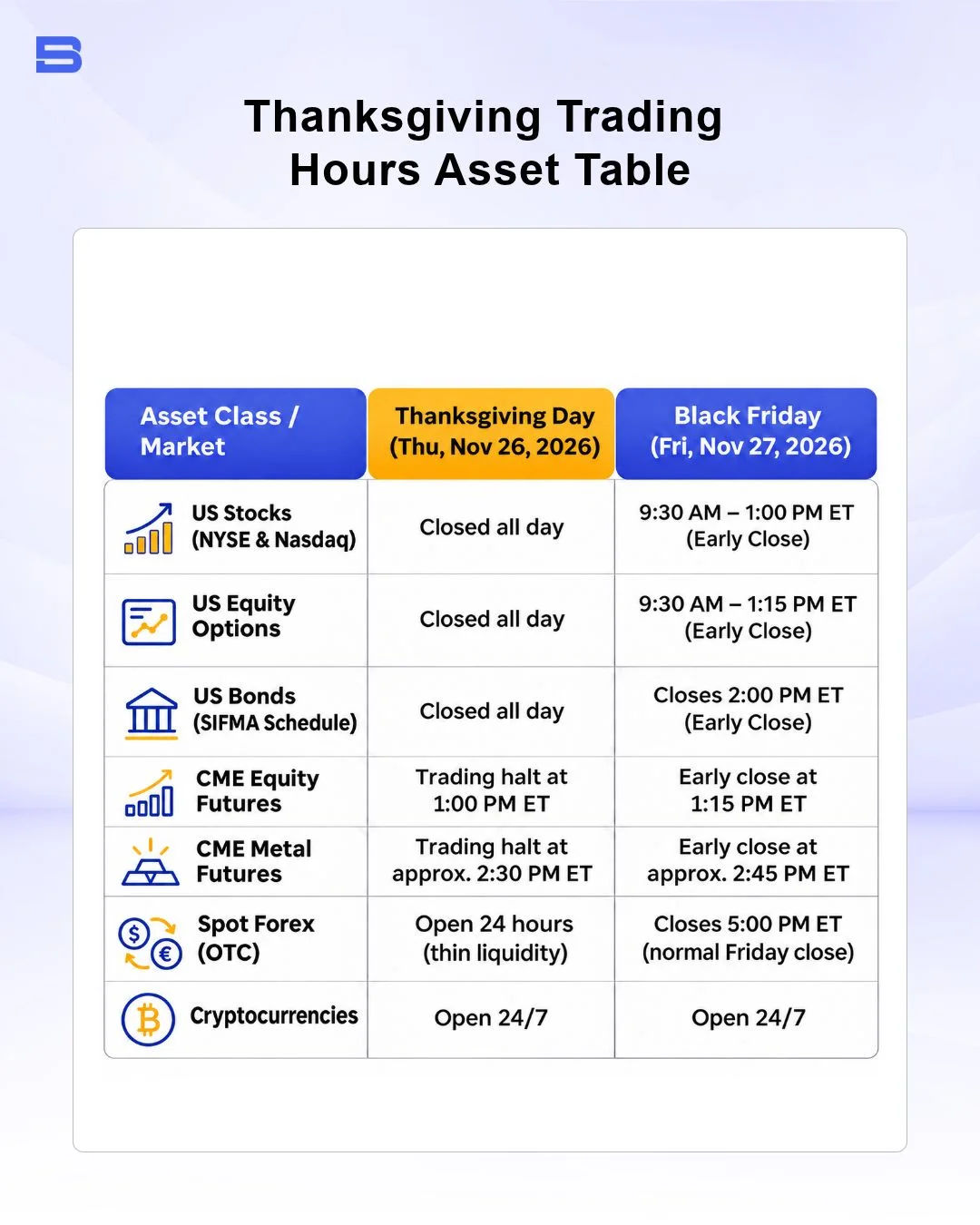
US equity and fixed-income markets observe a full-day closure on Thanksgiving Day, Thursday, November 26, 2026. Both the New York Stock Exchange (NYSE) and Nasdaq suspend regular trading for the holiday, with normal equity trading hours typically running from 9:30 AM to 4:00 PM Eastern Time (ET) on regular trading days. The Securities Industry and Financial Markets Association (SIFMA) also recommends a full-day closure for US dollar-denominated fixed-income markets, including government and corporate bonds.
Neither exchange runs pre-market or late-trading sessions on Thanksgiving Thursday. If you submit a stock order through your broker on that day, it sits in a queue until Friday morning’s opening auction.
The US bond market follows the same holiday pause. Under SIFMA recommendations, US dollar-denominated government securities, including Treasury bonds, and over-the-counter corporate bond markets observe a full-day trading closure on Thursday, November 26, 2026.
However, these recommendations are voluntary, allowing individual firms to determine whether their fixed-income trading desks remain operational. Understanding standard trading hours versus federal holiday closures ensures you do not misinterpret a closed order book as a platform outage.
Black Friday Trading Hours and Early Close Schedule
US equity markets reopen on Friday, November 27, 2026, after the Thanksgiving closure, but operate on a shortened schedule commonly known as an early close. Both the New York Stock Exchange (NYSE) and Nasdaq resume trading at their usual 9:30 AM Eastern Time (ET) opening bell and close at 1:00 PM ET, three hours earlier than their standard 4:00 PM closing time.
Eligible US equity options continue trading briefly after the regular stock market closes, with certain options sessions ending at 1:15 PM ET instead of 1:00 PM ET. Meanwhile, the Securities Industry and Financial Markets Association (SIFMA) recommends that US dollar-denominated fixed-income markets close early at 2:00 PM ET on Friday, November 27, 2026.
Extended trading hours are also shortened on certain exchanges, with late trading sessions on NYSE American, NYSE Arca, NYSE National, and NYSE Texas ending at 5:00 PM ET rather than their usual 8:00 PM ET closing time.
Reviewing this schedule before Friday helps you avoid holding intraday stock positions past the 1:00 PM ET cutoff.
Forex, Futures, and Crypto Schedules During Thanksgiving and Black Friday
Not every global financial market shuts down for a US national holiday. The over-the-counter (OTC) spot forex market generally continues operating through international financial centers such as Sydney, Tokyo, and London, although individual brokers may adjust their trading hours.
However, North American forex liquidity typically declines during Thanksgiving as US market participants reduce their activity, particularly after the London trading session ends at around 11:00 AM Eastern Time (ET), or 4:00 PM London time. Daily rollover interest adjustments may still be processed at 5:00 PM ET, depending on the broker’s policies, with FOREX.com confirming this as its standard daily rollover time.
Futures exchanges regulated by the Commodity Futures Trading Commission (CFTC) maintain limited trading activity during the Thanksgiving holiday. CME Group’s equity index futures, including S&P 500 and Nasdaq-100 contracts, continue trading overnight into Thursday morning before halting at 1:00 PM Eastern Time (ET).
On the CME Group calendar, gold and crude oil futures follow separate schedules, with their Thanksgiving sessions extending until approximately 2:30 PM ET. Trading resumes later that evening, while Black Friday brings shortened sessions, with equity index futures closing at 1:15 PM ET and gold and crude oil futures at approximately 2:45 PM ET.
Cryptocurrency exchanges run 24 hours a day, seven days a week, without holiday interruptions. However, lower US institutional participation during the long weekend can still affect dollar-paired crypto order books.
Thanksgiving Trading Hours in Malaysia Time (MYT / GMT+8)
Because US Daylight Saving Time ends in early November, US Eastern Time sits 13 hours behind Malaysia Time (GMT+8) during the Thanksgiving holiday. For traders monitoring global markets alongside local sessions overseen by Bank Negara Malaysia (BNM), aligning your clock prevents missed cutoffs.
On Thursday, November 26, 2026, US stock exchanges remain closed throughout the day, extending the market pause into Thursday night and Friday morning in Malaysia. CME equity index futures halt at 2:00 AM Malaysia Time (MYT) on Friday, November 27, while gold futures continue trading until 3:30 AM MYT. Both markets reopen at 7:00 AM MYT on Friday following the Thanksgiving holiday break.
On Black Friday, November 27, 2026, US stock markets operate from 10:30 PM Malaysia Time (MYT) on Friday until their shortened closing time of 2:00 AM MYT on Saturday, November 28. This early close occurs three hours ahead of the usual 5:00 AM MYT closing time, allowing Malaysian traders to adjust their trading schedules and set alerts for the earlier Saturday morning market close.
Risks of Trading During Thanksgiving and Black Friday
Trading when major Wall Street desks are offline carries distinct execution hazards. While quiet sessions may tempt you to range-trade small price swings, thin order books can turn minor order flow into costly fills.
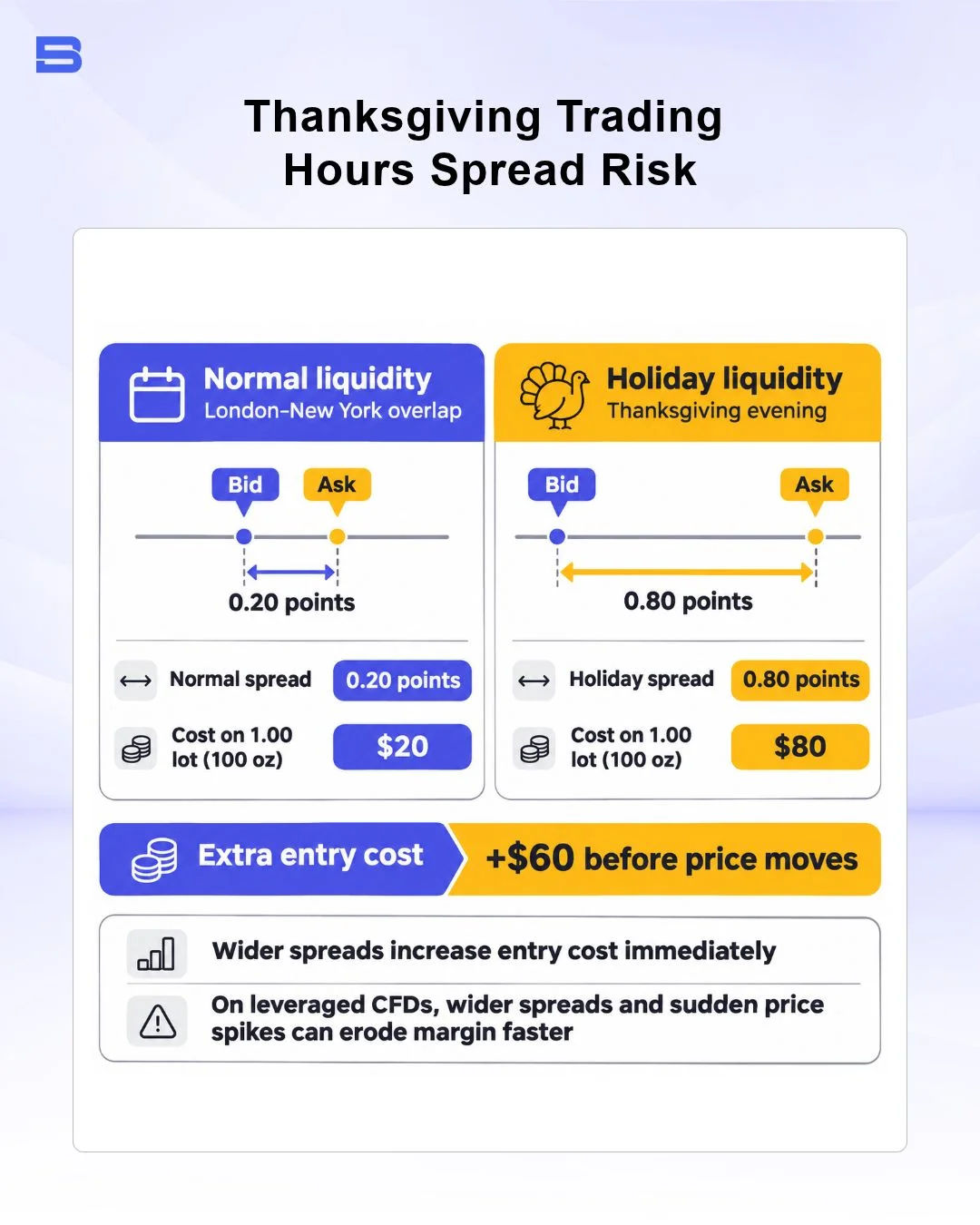
When institutional liquidity providers step away, brokers often widen the bid-ask spread to manage their own inventory risk. Market orders placed during these hours may also face higher slippage, meaning your trade can execute at a worse price than displayed on your screen.
Consider a practical example on spot gold (XAU/USD) during a normal London-New York overlap versus Thanksgiving evening. Under normal conditions, a broker might quote a 0.20-point spread, costing $20 in spread on a 1.00-lot position (100 ounces).
During Thanksgiving night, that same spread can widen to 0.80 points, raising your immediate entry cost to $80 before the market moves a single tick. If you use leverage on CFDs, it magnifies both potential gains and losses, while wider spreads and sudden air-pocket price spikes (sharp jumps through thin order books) can erode your margin faster than expected.
Understanding how trading works in low-volume environments helps you decide whether to reduce your position size, use limit orders instead of market orders, or simply step away until Monday.
Planning Your Trades Around Thanksgiving Trading Hours
Thanksgiving trading hours bring a full Thursday closure for US stocks and bonds, followed by a shortened Black Friday session ending at 1:00 PM ET (2:00 AM MYT Saturday). Always verify your broker’s specific holiday notice beforehand, and consider trimming position sizes or sitting out low-liquidity sessions to protect your capital from widened spreads.
- How to Build an Investment Plan That Actually Works for You?
- What Is the MACD Indicator and How to Use It
- What Is a Wedge Pattern in Trading?
- What Is Ichimoku Cloud Strategy? A Complete Trading System
- Mastering Elliott Wave Theory: Rules and Trading Strategies
- News Trading: Strategies, Execution Risks, and Risk Control
- What Is an Iron Condor Options Strategy?
- Backtesting Explained: What It Is and Why It Really Matters
- Grid Trading: Mechanics, Parameters, and Risk Strategies
- What Is Breakout Trading and How Does It Work?
- Mean Reversion: Technical Strategies and Risk Frameworks
- Momentum Trading: Indicators, Strategies, and Risk Control
- Hammer Candlestick: Structure, Meaning, and Strategy
- Doji Candlestick: Types, Signals, and Trading Strategies
- What Is the Sharpe Ratio and How to Calculate It
- What Is VWAP and How Do Traders Use It?
- Trade the Ascending Triangle: A Step-by-Step Practical Guide
- What Is the Stochastic Oscillator and How to Use It
- How to Trade the Descending Triangle Pattern
- High Frequency Trading: Speed, Algorithms, and Market Impact
- What Is Volume Profile and How to Use It in Trading
- What Is a Morning Star Pattern Candlestick?
- Trade with Parabolic SAR: A Practical Analysis Guide
- Evening Star Pattern: Structure, Rules, and Risk Controls
- Kelly Criterion: Formula, Position Sizing, and Risk
- What Is the NYSE Minimum Trading Price? Rules Explained
Disclaimer: The content on this page is intended for educational and informational purposes only. It does not constitute financial, investment, tax, or legal advice, and should not be interpreted as a recommendation to buy, sell, or hold any financial instrument or asset. Trading and investing involve significant risk, including the possible loss of your entire capital. Products such as forex, CFDs, and cryptocurrencies carry additional risks due to leverage, high volatility, and limited regulatory protection in some jurisdictions. Past performance of any financial instrument does not guarantee future results. Any market views, forecasts, or opinions expressed are those of the author at the time of writing and may not reflect current market conditions. Platform features, fees, and regulatory status are subject to change — always verify information directly with the relevant provider or regulator before making any financial decision. BrokerSpecs may receive compensation from third parties featured on this site. Always conduct your own due diligence and consider seeking advice from a licensed financial professional before investing. Portions of this article were prepared with the assistance of AI tools and reviewed by our editorial team before publication.