



Related Tags
You watch a sudden displacement candle rip through a resistance level, leaving your pending limit orders far behind. The urge to buy market-at-price takes over, but entering at the top usually means buying right into an institutional distribution pool before an immediate 40-pip drawdown. Waiting for price to retrace into deep discount territory is how professional participants manage their entry pricing without chasing market momentum.
What Is Optimal Trade Entry (OTE) in ICT Trading?
An optimal trade entry is a technical execution framework using specific Fibonacci retracement levels to enter positions at wholesale discount or premium prices. It seeks to align retail trade placement directly with institutional order flow after a clear directional displacement occurs.
This concept comes from Inner Circle Trader (ICT) methodology, a framework built around how institutional order flow moves price.
In institutional order flow, algorithmic pricing models do not chase runaway trends indefinitely. Instead, large market participants require deep liquidity pools to fill substantial orders without moving the price unfavorably against their own average cost basis. By operating within smart money concepts, traders evaluate price delivery through the lens of premium and discount valuations.
When price expands rapidly in one direction, it creates an inefficiency in the market. Optimal trade entry models the expected counter-move where price rebalances that inefficiency back toward institutional fair valuation before resuming higher-timeframe expansion.
Key Fibonacci Retracement Levels in an OTE Setup
The optimal trade entry framework relies on three precise mathematical ratios configured within a standard Fibonacci retracement tool: the 62%, 70.5%, and 79% levels. The 70.5% retracement serves as the central sweet spot, representing the mathematical midpoint between the traditional 61.8% golden ratio and the 79% institutional threshold.
Entering at the 70.5% level provides an objective pricing zone where your stop-loss distance remains tightly defined against the swing origin. If price retraces past 79%, the structural integrity of the displacement leg begins to deteriorate significantly.
OTE vs. Standard Fibonacci Retracement: What Is the Difference?
Standard retail technical analysis typically pulls a Fibonacci tool across arbitrary highs and lows, searching for reactions at the 38.2% or 50% equilibrium marks. These shallow pullbacks often lure retail breakout traders into entering early during aggressive continuation runs.
The main difference is the required market context, not the lines drawn on your screen. While standard Fibonacci strategies treat lines as standalone support or resistance, OTE demands structural evidence that market control has changed hands before measuring a swing.
Retail pullbacks drawn on random chart swings fail because algorithmic order execution actively seeks out the resting liquidity situated just below shallow retracement levels. Without institutional context, a generic Fibonacci level is merely a mathematical coordinate with no underlying order accumulation.
How to Identify and Trade a High-Probability OTE Setup
A valid optimal trade entry begins with identifying a decisive liquidity sweep followed by an aggressive structural reversal. Price must sweep a prominent swing high or low to clear resting stop orders before violently shifting direction.
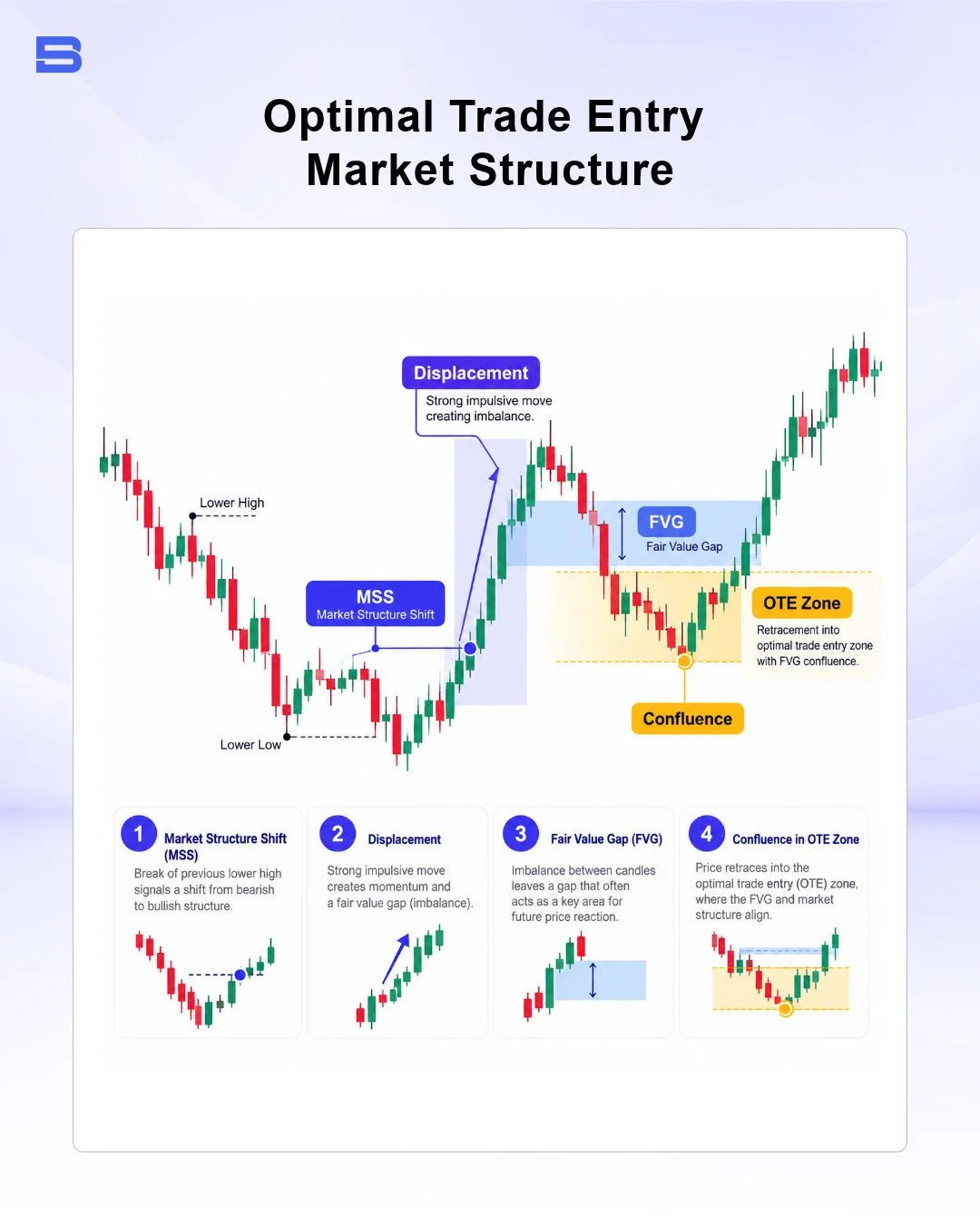
Once liquidity is cleared, watch for a displacement leg that causes a clear break of structure on your execution timeframe. This shift signals that institutional capital has stepped in to defend a specific price zone.
Session timing is critical when framing this setup. Look for structural displacement during major liquidity windows, particularly following a Judas swing during the London open or the initial New York session cash open.
High-probability setups require confluence inside the OTE zone. Look for the 62% to 79% zone to overlap directly with an institutional order block or an unfilled fair value gap.
Worked Trade Example: EUR/USD Bearish Displacement
Consider a scenario where EUR/USD sweeps previous Asian session highs at 1.0880 and drops sharply by 40 pips to create a swing low at 1.0840. This move creates a visible displacement leg and breaks the previous 15-minute structural low.
- Swing Origin (High): 1.0880
- Displacement Low: 1.0840
- Total Swing Range: 40 pips
- OTE Entry (70.5% Retracement): 1.0868
- Structural Invalidation (Stop-Loss): 1.0883 (15 pips risk, placed 3 pips above the swing origin)
- Target (Swing Low Expansion): 1.0838 (30 pips reward)
On a $10,000 trading account, adhering to a 1% risk rule limits your maximum allowable dollar loss on this trade to $100.
Position Size = Account Risk / Stop Distance in Pips x Pip Value = $100 / 15 x $10 = 0.66 Lots
Executing 0.66 standard lots at 1.0868 with an exit at 1.0883 risks exactly $99 to capture a potential $198 gain, a hypothetical 1:2 risk-to-reward outcome — real market conditions such as slippage, spread widening, or an invalidated setup can prevent this result.
Invalidation and Stop-Loss Placement for OTE
A valid optimal trade entry setup is strictly invalidated if price trades beyond the 100% origin of the displacement swing leg. If price closes beyond this boundary, the presumed institutional defense of that price level has failed.
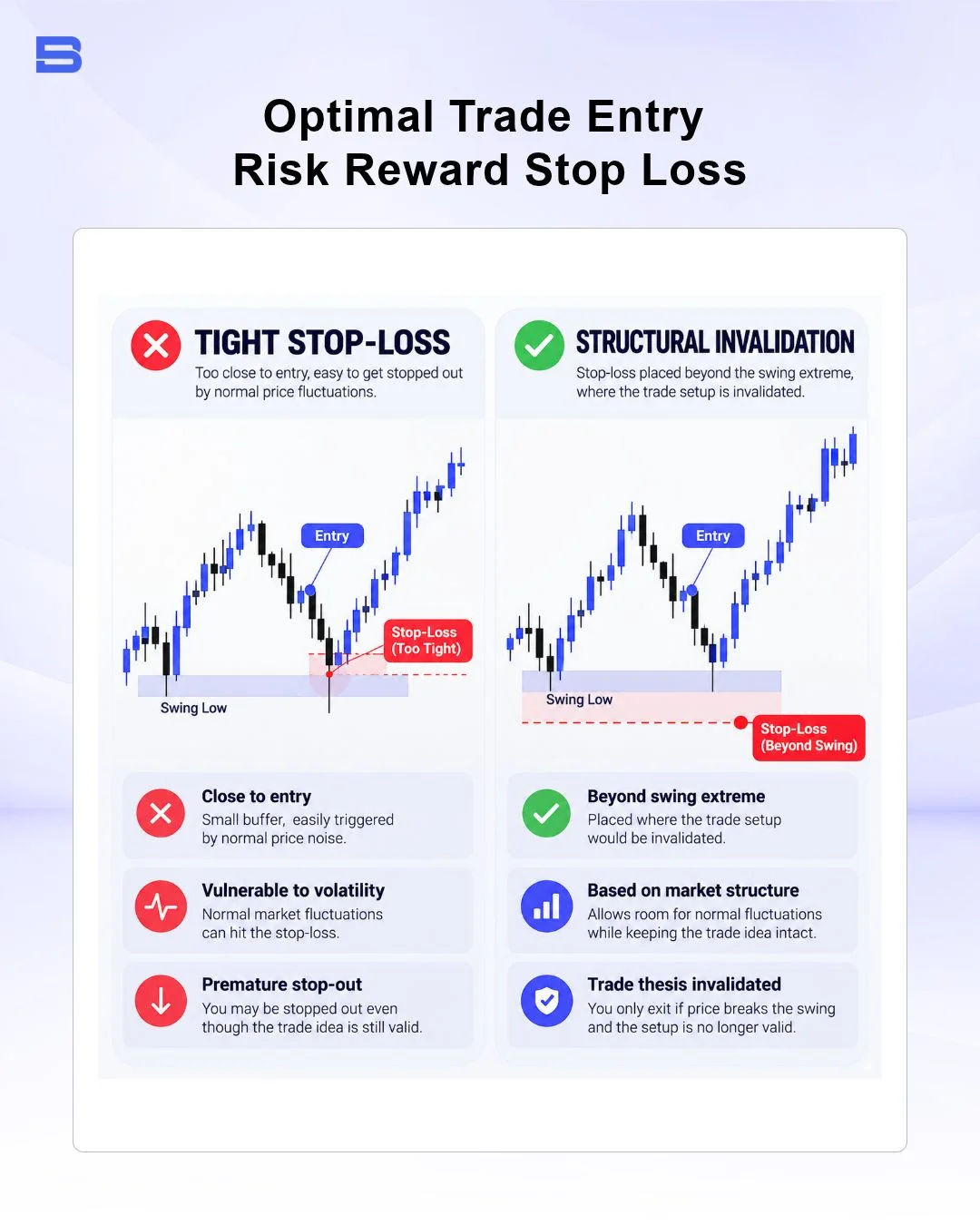
Placing stop-loss orders arbitrarily tight inside the 79% zone frequently exposes your position to minor liquidity wick sweeps before the real expansion unfolds. It is advisable to anchor your protective stop a few pips beyond the actual swing origin to absorb normal session spread widening.
Research from the Bank for International Settlements (BIS) indicates that foreign exchange liquidity varies throughout the trading day, typically peaking at the London market open and during the London–New York session overlap. During volatile economic news releases or illiquid market rollovers, spreads can widen beyond standard parameters, potentially triggering stops prematurely or causing execution slippage.
Regulatory technical standards from the Financial Conduct Authority (FCA) consistently emphasize that retail CFD trading involves substantial volatility and execution risk, meaning consecutive loss clusters can occur even when your technical framework appears pristine.
The Bottom Line
Optimal trade entry provides an objective, rules-based mechanism to enter markets at wholesale discount or premium levels rather than chasing aggressive momentum candles. Pairing deep Fibonacci retracements with market structure shifts and imbalance confluences helps you build consistent execution criteria.
However, mathematical ratios do not control the market, and institutional setups fail regularly in strong macroeconomic trends. Protecting your capital requires strict position sizing, structural invalidation stops, and disciplined acceptance of market volatility.
- How to Build an Investment Plan That Actually Works for You?
- What Is the MACD Indicator and How to Use It
- What Is a Wedge Pattern in Trading?
- What Is Ichimoku Cloud Strategy? A Complete Trading System
- Mastering Elliott Wave Theory: Rules and Trading Strategies
- News Trading: Strategies, Execution Risks, and Risk Control
- What Is an Iron Condor Options Strategy?
- Backtesting Explained: What It Is and Why It Really Matters
- Grid Trading: Mechanics, Parameters, and Risk Strategies
- What Is Breakout Trading and How Does It Work?
- Mean Reversion: Technical Strategies and Risk Frameworks
- Momentum Trading: Indicators, Strategies, and Risk Control
- Hammer Candlestick: Structure, Meaning, and Strategy
- Doji Candlestick: Types, Signals, and Trading Strategies
- What Is the Sharpe Ratio and How to Calculate It
- What Is VWAP and How Do Traders Use It?
- Trade the Ascending Triangle: A Step-by-Step Practical Guide
- What Is the Stochastic Oscillator and How to Use It
- How to Trade the Descending Triangle Pattern
- High Frequency Trading: Speed, Algorithms, and Market Impact
- What Is Volume Profile and How to Use It in Trading
- What Is a Morning Star Pattern Candlestick?
- Trade with Parabolic SAR: A Practical Analysis Guide
- Evening Star Pattern: Structure, Rules, and Risk Controls
- Kelly Criterion: Formula, Position Sizing, and Risk
- What Is the NYSE Minimum Trading Price? Rules Explained
Disclaimer: The content on this page is intended for educational and informational purposes only. It does not constitute financial, investment, tax, or legal advice, and should not be interpreted as a recommendation to buy, sell, or hold any financial instrument or asset. Trading and investing involve significant risk, including the possible loss of your entire capital. Products such as forex, CFDs, and cryptocurrencies carry additional risks due to leverage, high volatility, and limited regulatory protection in some jurisdictions. Past performance of any financial instrument does not guarantee future results. Any market views, forecasts, or opinions expressed are those of the author at the time of writing and may not reflect current market conditions. Platform features, fees, and regulatory status are subject to change — always verify information directly with the relevant provider or regulator before making any financial decision. BrokerSpecs may receive compensation from third parties featured on this site. Always conduct your own due diligence and consider seeking advice from a licensed financial professional before investing. Portions of this article were prepared with the assistance of AI tools and reviewed by our editorial team before publication.