



Related Tags
The minutes tick toward 2:00 PM Eastern Time, and your trading terminal screens go strangely quiet. Order books on major currency pairs thin out, bid-ask spreads flicker wider, and Treasury yields freeze in place. Whether you trade spot foreign exchange in Kuala Lumpur or hold index derivatives in London, the October FOMC meeting 2026 commands your complete attention.
Navigating this central bank event requires understanding its unique non-projection structure, analyzing dual policy paths, and executing strict position sizing to preserve capital.
October FOMC Meeting 2026 Dates and Policy Context
The Federal Open Market Committee (FOMC) held its second-to-last scheduled policy meeting of 2026 on October 27–28, according to the Federal Reserve’s official calendar. Official policy deliberations conclude on the afternoon of Wednesday, October 28, followed immediately by the release of the policy statement at 2:00 PM Eastern Time (ET).
Fed Chair Jerome Powell then takes the podium for the post-meeting press conference at 2:30 PM ET, fielding questions that frequently cause sharper intraday swings than the policy document itself.
Every policy decision reflects months of incoming macroeconomic data rather than isolated committee debates. The Fed's dual mandate requires balancing price stability against sustainable employment levels. Leading into late October, rate-setters evaluate late-cycle inflationary prints from US CPI alongside labor dynamics tracked in Nonfarm Payrolls reports.
If headline consumer prices show stubborn persistence while payroll creation remains resilient, policymakers face mounting pressure to keep borrowing costs elevated. Conversely, evidence of rapid labor deterioration can force an immediate dovish pivot.
October FOMC Meeting 2026 Schedule and Mechanics
The October FOMC meeting 2026 follows a two-day schedule in which Federal Reserve governors and regional bank presidents discuss domestic economic growth, global financial stability, and monetary policy behind closed doors, helping traders anticipate potential market volatility.
Next FOMC Meeting Timing and Announcement Window
For international traders, the announcement window requires adjusting to significant time zone offsets. When the policy statement drops at 2:00 PM ET in Washington, local clocks show 2:00 AM Thursday in Malaysia and Singapore.
Between 2:00 PM and 2:30 PM ET, algorithmic liquidity feeds process text adjustments in the statement, often creating sudden whipsaws. Liquidity conditions shift again once the press conference opens at 2:30 PM ET, as verbal forward guidance directly recalibrates global yield expectations before the Asian cash session opens.
Reading the Statement vs. Waiting for FOMC Meeting Minutes
The October meeting features a critical structural distinction: it does not include an updated Summary of Economic Projections (SEP) or dot plot. Because revised rate projections only appear in March, June, September, and December, the October statement and press conference carry heavier interpretive weight.
Traders dissect subtle wording adjustments in the balance-of-risks paragraph to gauge future policy trajectories. Official FOMC meeting minutes arrive three weeks later, providing detailed committee perspectives, but market pricing reacts instantaneously to the initial statement release.
Evaluating Potential Scenarios: The Federal Reserve Interest Rate Decision
Financial markets rarely move based on policy decisions in isolation; they react to how those outcomes compare against prior expectations. You can track shifting market probabilities leading up to the announcement using the CME FedWatch Tool, which calculates pricing implied by 30-day Fed Funds futures contracts.
A balanced assessment requires preparing for both hawkish and dovish monetary outcomes, as each carries distinct operational consequences across major asset classes.
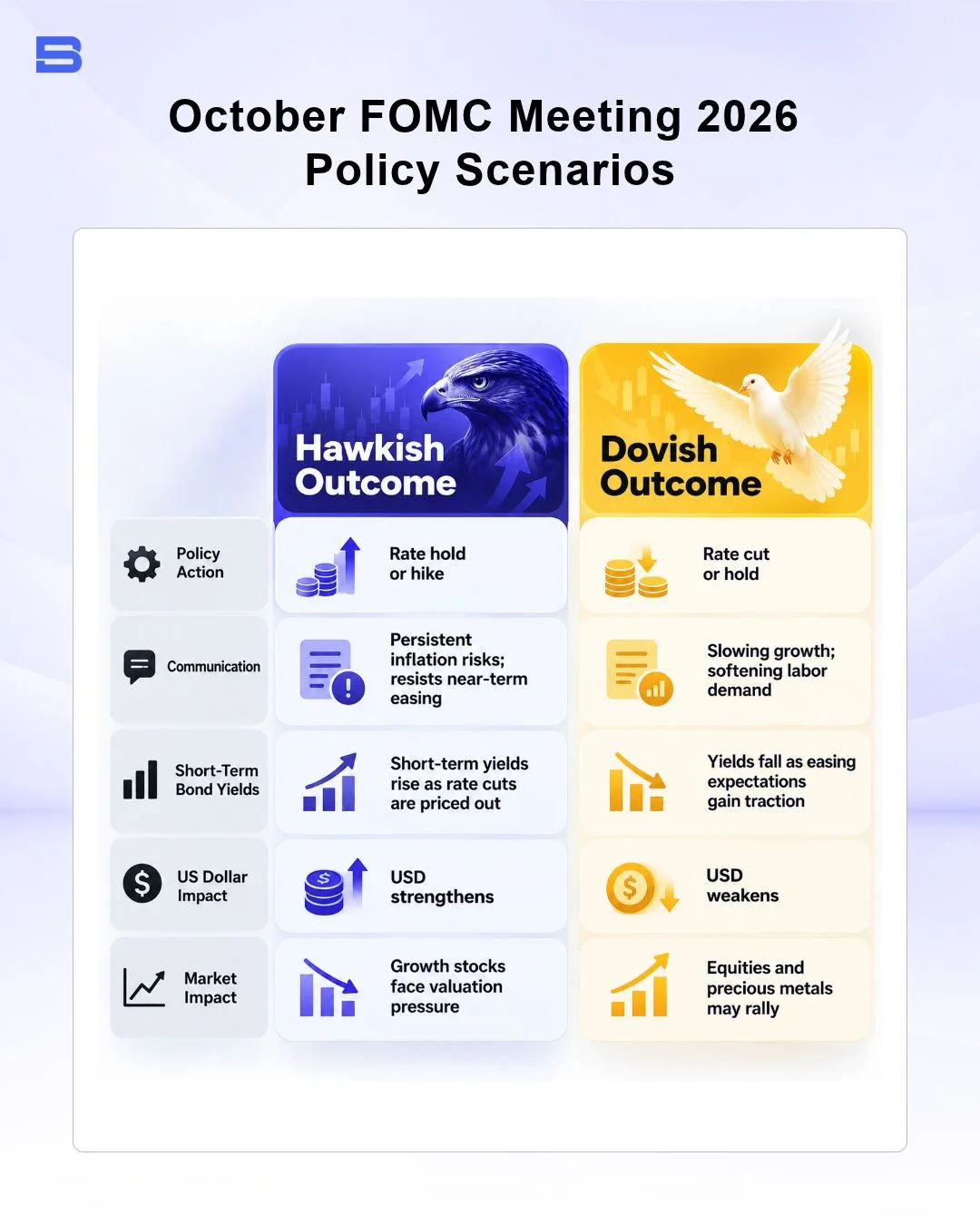
Neither outcome represents a certainty. Relying solely on historical precedents can lead to severe drawdowns if the central bank surprises consensus forecasts.
How a Federal Reserve Interest Rate Cut or Hold Ripples Across Markets
Adjustments to the target range for the federal funds rate ripple through global financial plumbing. When borrowing costs drop via a Federal Reserve interest rate cut, sovereign yield premiums decline, exerting downward pressure on the DXY dollar index. A softer dollar historically provides breathing room for non-dollar assets, boosting physical commodities like gold and crude oil while lifting emerging market liquidity.
Regional impacts are especially noticeable across Southeast Asia. Central banks such as Bank Negara Malaysia (BNM) balance domestic inflation against capital outflow risks when setting the OPR Malaysia. When the Fed holds rates higher for longer while local rates remain steady, widening interest rate differentials can trigger capital flight into dollar-denominated assets, putting downward pressure on the Malaysian ringgit.
To understand how sudden currency volatility impacts leveraged trading, consider a practical CFD scenario:
Suppose you trade a 100,000-unit USD/MYR CFD position using a $10,000 margin account at 20:1 leverage.
- Opening position: USD/MYR at 4.4000 (total position value: 440,000 MYR, margin required: $5,000).
- Hawkish outcome: The Fed signals prolonged higher rates, driving USD/MYR up 100 pips to 4.4100. Your gain equals 1,000 MYR (approximately $227), generating a 4.5% return on your $5,000 used margin.
- Dovish outcome: The Fed hints at accelerated cuts, pushing USD/MYR down 100 pips to 4.3900. Your loss equals 1,000 MYR (approximately $227), eroding 4.5% of your used margin.
Leverage amplifies your returns when you are on the right side of the trend, but it accelerates capital destruction at the same velocity when prices move against you.
Tactical Execution: Navigating Volatility and Broker Liquidity
Trading around major macroeconomic data releases carries distinct structural risks that standard technical indicators cannot anticipate.
Managing Market Volatility and Spread Widening
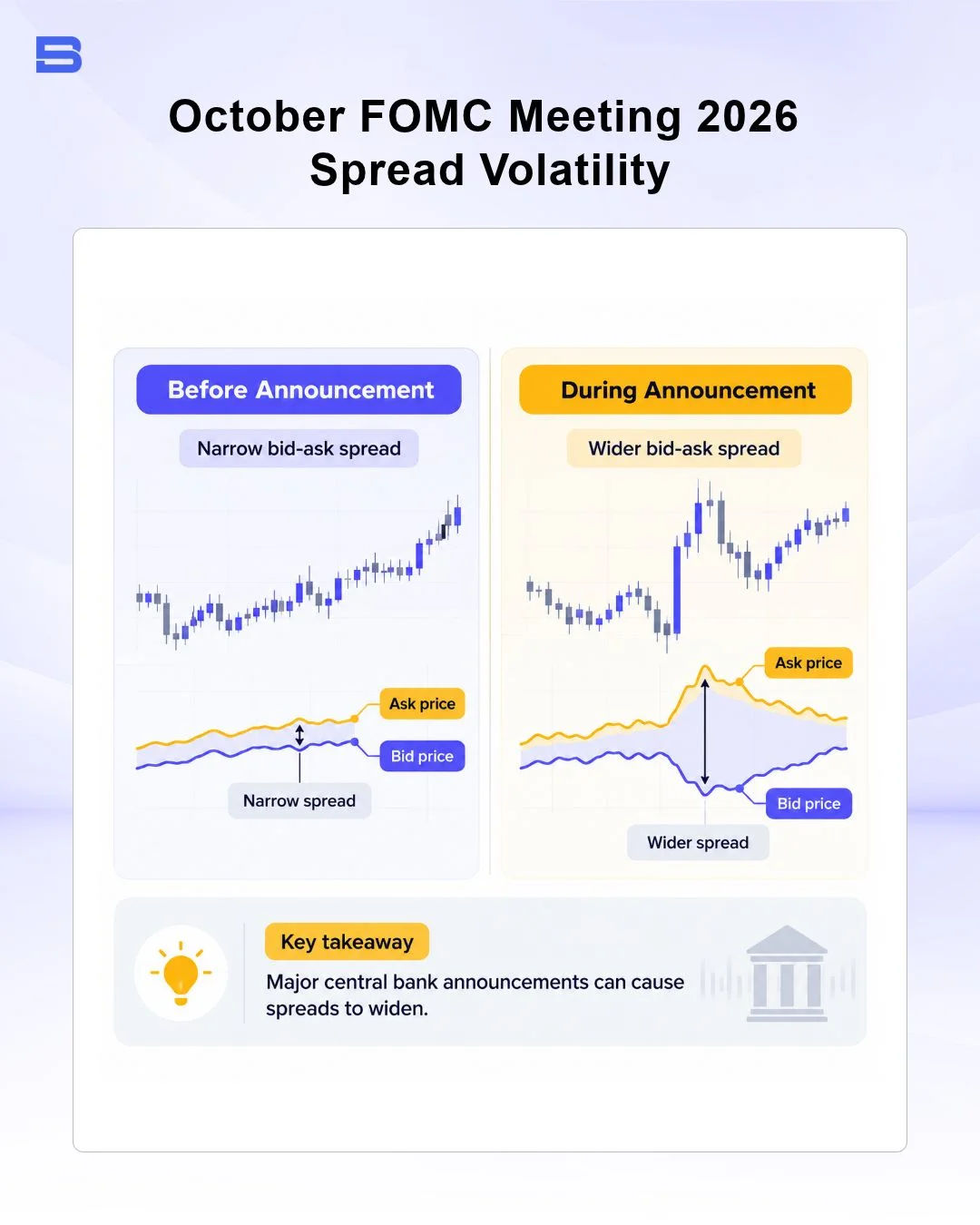
Institutional liquidity providers frequently pull limit orders from public books moments before the 2:00 PM ET announcement. This withdrawal leads to sharp market volatility and sudden spread widening, as documented in market microstructure studies by the Bank for International Settlements (BIS). A currency pair with a normal 0.8-pip spread can briefly widen to 6.0 pips or more during the release.
To protect your capital around central bank events, evaluate these tactical rules:
- Reduce leverage and lot size: Scaling back position size before the release lowers portfolio sensitivity to whipsaws.
- Avoid execution via market orders: Executing market orders into a hollow order book creates high slippage, filling trades far from intended prices.
- Widen safety buffers: If you use a stop loss, place it beyond normal market noise to avoid premature liquidation from temporary spikes.
Conclusion
The October FOMC meeting 2026 highlights the Federal Reserve’s ongoing challenge of balancing persistent inflation with economic growth and employment. According to the Federal Reserve's October 28 policy statement, the FOMC kept the federal funds rate unchanged at 3.75%–4.00% on a 10–2 vote, with two policymakers preferring a rate hike, while noting that inflation remains elevated and further decisions will depend on incoming economic data.
For traders and investors, the market impact will depend on how inflation data, employment reports, and future Fed guidance shape interest-rate expectations. Monitoring Treasury yields, the US dollar, gold, equities, and other risk-sensitive assets can help market participants assess changing conditions. Rather than relying on a single policy scenario, traders should prepare for multiple outcomes, apply disciplined risk management, and adjust their strategies as new information emerges.
- How to Build an Investment Plan That Actually Works for You?
- What Is the MACD Indicator and How to Use It
- What Is a Wedge Pattern in Trading?
- What Is Ichimoku Cloud Strategy? A Complete Trading System
- Mastering Elliott Wave Theory: Rules and Trading Strategies
- News Trading: Strategies, Execution Risks, and Risk Control
- What Is an Iron Condor Options Strategy?
- Backtesting Explained: What It Is and Why It Really Matters
- Grid Trading: Mechanics, Parameters, and Risk Strategies
- What Is Breakout Trading and How Does It Work?
- Mean Reversion: Technical Strategies and Risk Frameworks
- Momentum Trading: Indicators, Strategies, and Risk Control
- Hammer Candlestick: Structure, Meaning, and Strategy
- Doji Candlestick: Types, Signals, and Trading Strategies
- What Is the Sharpe Ratio and How to Calculate It
- What Is VWAP and How Do Traders Use It?
- Trade the Ascending Triangle: A Step-by-Step Practical Guide
- What Is the Stochastic Oscillator and How to Use It
- How to Trade the Descending Triangle Pattern
- High Frequency Trading: Speed, Algorithms, and Market Impact
- What Is Volume Profile and How to Use It in Trading
- What Is a Morning Star Pattern Candlestick?
- Trade with Parabolic SAR: A Practical Analysis Guide
- Evening Star Pattern: Structure, Rules, and Risk Controls
- Kelly Criterion: Formula, Position Sizing, and Risk
- What Is the NYSE Minimum Trading Price? Rules Explained
Disclaimer: The content on this page is intended for educational and informational purposes only. It does not constitute financial, investment, tax, or legal advice, and should not be interpreted as a recommendation to buy, sell, or hold any financial instrument or asset. Trading and investing involve significant risk, including the possible loss of your entire capital. Products such as forex, CFDs, and cryptocurrencies carry additional risks due to leverage, high volatility, and limited regulatory protection in some jurisdictions. Past performance of any financial instrument does not guarantee future results. Any market views, forecasts, or opinions expressed are those of the author at the time of writing and may not reflect current market conditions. Platform features, fees, and regulatory status are subject to change — always verify information directly with the relevant provider or regulator before making any financial decision. BrokerSpecs may receive compensation from third parties featured on this site. Always conduct your own due diligence and consider seeking advice from a licensed financial professional before investing. Portions of this article were prepared with the assistance of AI tools and reviewed by our editorial team before publication.