



Related Tags
Entering a trade or adjusting a personal financial plan right after a central bank announcement can feel like navigating a moving target. When Bank Negara Malaysia (BNM) updates or maintains its policy interest rate, the benchmark ripple effect spreads almost immediately across borrowing costs, fixed-income yields, equity valuations, and local currency strength.
Understanding these shifts empowers you to align your multi-asset portfolio with the prevailing macroeconomic regime rather than being caught off guard.
What Is OPR and How Does It Function in Malaysia?
The Overnight Policy Rate (OPR) is the target interest rate set by Bank Negara Malaysia (BNM) for interbank lending, determining the cost at which commercial financial institutions lend overnight balances to one another. As the foundational benchmark for monetary policy in Malaysia, shifts in the OPR set the price of short-term liquidity across the entire domestic banking sector.
Impact of OPR Changes on Housing Loans and Variable Rates
When BNM adjusts the policy rate, commercial banks adjust their Standardised Base Rate (SBR), Base Rate (BR), and Base Lending Rate (BLR) in lockstep. Variable-rate retail instruments—most notably housing loans—react directly.
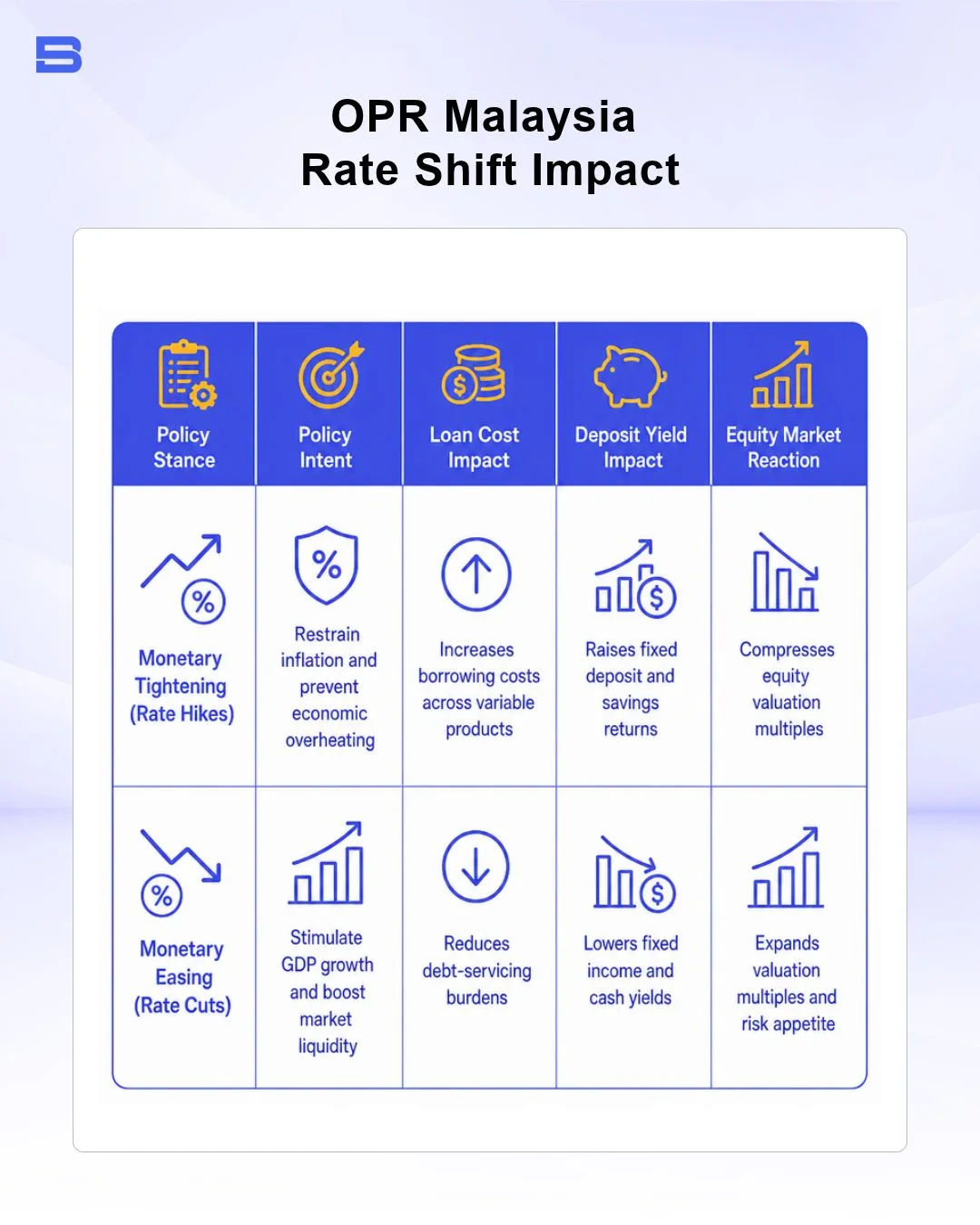
Changes in OPR Malaysia can affect borrowers’ repayment costs, with rate hikes potentially increasing monthly installments for variable-rate loans, while rate cuts may reduce repayment burdens, depending on the loan terms.
Effects on Savings, Fixed Deposits, and Borrowing Costs
When OPR Malaysia rises, banks may increase interest rates on fixed deposits and certain savings products to reflect changing monetary conditions. This can encourage savers to accumulate capital rather than spend, although actual returns depend on each bank’s rates and product terms.
Conversely, lower rate environments compress fixed deposit yields, driving yield-seeking capital toward risk-asset markets. Personal loans, cash credit facilities, and corporate lines of credit similarly experience borrowing cost shifts matching policy adjustments.
Current OPR Rate in Malaysia: Where Policy Stands in 2026
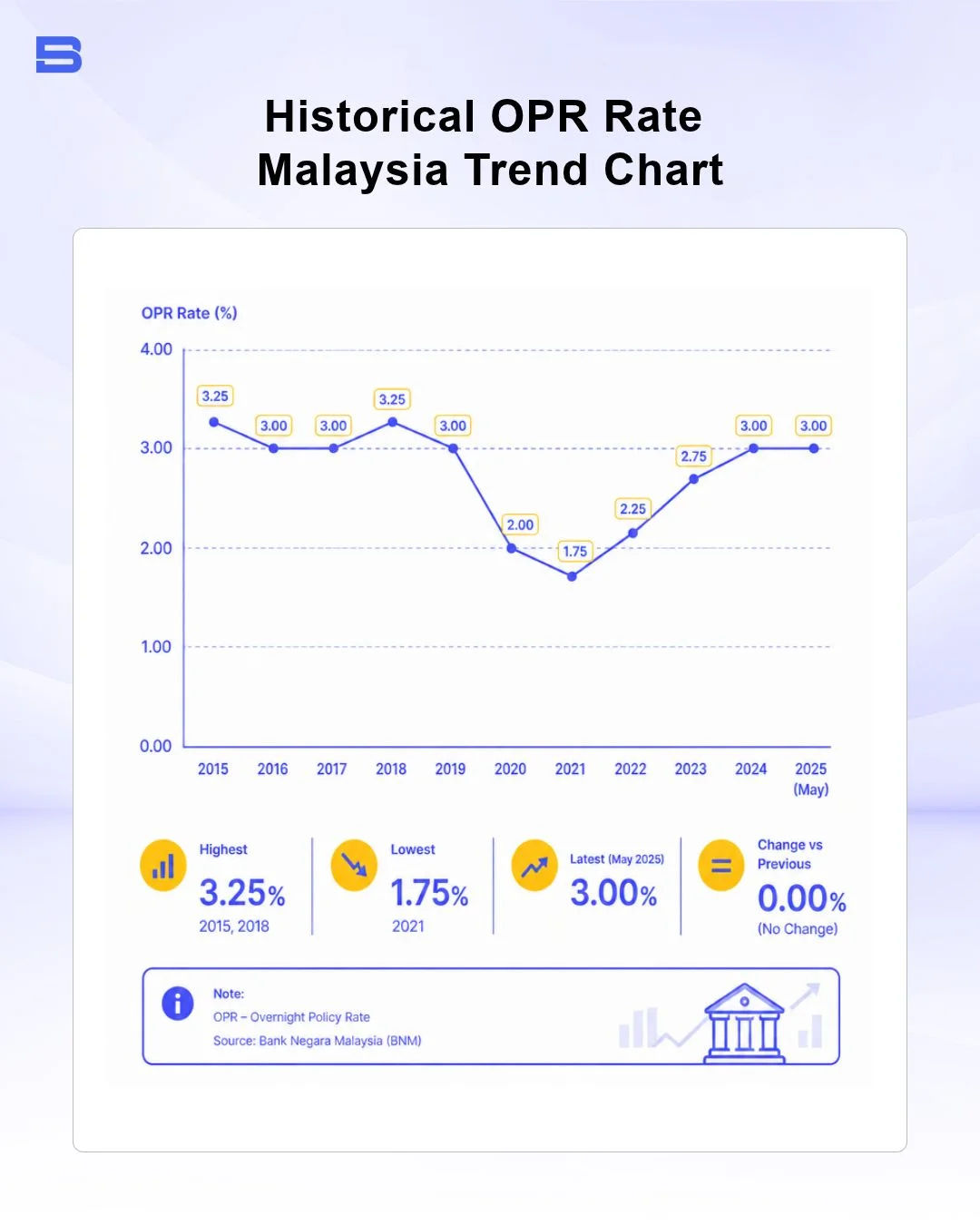
As of September 2026, the OPR Malaysia rate stands at 2.75%, following Bank Negara Malaysia's Monetary Policy Committee (MPC) decision to ease from the 3.00% level held through most of 2025. This decision reflects the central bank’s assessment that the current monetary policy stance supports sustainable domestic economic growth while maintaining price stability and monitoring inflationary risks.
To understand how a rate shift translates to real-world costs, consider a variable housing loan of RM500,000 with a 30-year tenure at an effective interest rate of 3.85%. A 25 basis point (0.25%) increase in the OPR rate Malaysia lifts the loan's effective rate to 4.10%. This shift raises the monthly installment from approximately RM2,343 to RM2,416—adding RM73 per month in debt service, or RM876 annually.
Economic Growth vs Inflation: BNM's Balancing Act
OPR Malaysia decisions involve assessing economic growth alongside inflationary pressures. Higher interest rates can curb borrowing and overall demand to help control inflation, while lower rates may encourage lending, spending, and capital investment when economic growth slows.
Tracking trade data, inflation metrics, and broader economic indicators helps clarify how macro shifts dictate policy direction.
How OPR Shifts Impact Multi-Asset Portfolios
Monetary policy adjustments transmit differently across asset classes. Aligning position sizing with the interest rate cycle requires evaluating asset-specific transmission channels.
- Equities: Higher policy rates raise corporate interest expenses and increase discount rates applied to future cash flows, putting pressure on growth-stock valuations. Financial sector equities often benefit initially from expanded Net Interest Margins (NIM), whereas rate cuts tend to drive broad-based equity valuation expansion as liquidity expands.
- Fixed Income: Bond prices share an inverse relationship with interest rates. An OPR increase drives yields on newly issued paper higher, causing existing fixed-rate bond prices to decline. Falling policy rates generate capital gains on existing fixed-income holdings as yields compress.
- Real Estate Investment Trusts (REITs): Real estate vehicles typically rely on debt leverage for property acquisition portfolios. Higher rate regimes elevate debt financing costs, compressing distributable income yields. Rate cuts lower refinancing obligations, enhancing distribution prospects. Read our dedicated analysis on REIT Malaysia for sector-specific strategies.
- Currency Markets (MYR): The Ringgit's exchange value reacts to yield differentials between domestic and foreign benchmark rates. Holding local policy rates stable while foreign central banks cut interest rates widens yield spreads in favor of the Ringgit, encouraging capital inflows. Explore currency dynamics further in our overview of the Global Forex Market in 2026.
Global Monetary Policy Spillover: Federal Reserve vs BNM
OPR Malaysia decisions are influenced by global monetary policy, particularly changes made by the US Federal Reserve. Adjustments to US interest rates can affect global capital flows, the strength of the US dollar, and cross-border yield differentials, shaping the economic factors that Bank Negara Malaysia considers when setting its policy rate.
When the Federal Reserve adjusts its target range during scheduled meetings, domestic central banks evaluate the resulting foreign exchange pressure. A widening interest rate differential between the US Federal Funds Rate and the OPR can induce capital realignments and currency volatility, forcing domestic policymakers to carefully balance local growth requirements against currency stability.
The Bottom Line
In conclusion, understanding the OPR Malaysia framework helps investors make more informed decisions as interest rates change. Bank Negara Malaysia’s Overnight Policy Rate (OPR) influences borrowing costs, loan repayments, savings returns, bond prices, and market sentiment, which can affect different asset classes in different ways.
When the OPR rises, borrowing generally becomes more expensive, while a rate cut may support spending and investment. However, the impact depends on broader economic conditions and market expectations. By monitoring OPR announcements, reviewing their portfolio allocation, and maintaining a diversified investment strategy, investors can better manage interest rate risks and identify opportunities in Malaysia’s changing financial environment.
Disclaimer: The content on this page is intended for educational and informational purposes only. It does not constitute financial, investment, tax, or legal advice, and should not be interpreted as a recommendation to buy, sell, or hold any financial instrument or asset. Trading and investing involve significant risk, including the possible loss of your entire capital. Products such as forex, CFDs, and cryptocurrencies carry additional risks due to leverage, high volatility, and limited regulatory protection in some jurisdictions. Past performance of any financial instrument does not guarantee future results. Any market views, forecasts, or opinions expressed are those of the author at the time of writing and may not reflect current market conditions. Platform features, fees, and regulatory status are subject to change — always verify information directly with the relevant provider or regulator before making any financial decision. BrokerSpecs may receive compensation from third parties featured on this site. Always conduct your own due diligence and consider seeking advice from a licensed financial professional before investing. Portions of this article were prepared with the assistance of AI tools and reviewed by our editorial team before publication.