


- How to Start Trading: A Step-by-Step Guide for Beginners
- Demo Trading Accounts: Safe Practice for Beginners
- Understanding How Much Capital You Need to Start Trading
- How to Set Realistic Trading Goals as a New Trader
- How to Open a Trading Account in Malaysia (Step-by-Step)
- How to Start Trading in Malaysia: A Guide for Beginners
- How to Create a Trading Plan Before You Start Trading
- What Is a Trading Account? Everything You Need to Know
- How to Learn Trading: Step-by-Step Beginner Roadmap
- What Is Stop Loss in Trading and How Does It Work?
- Why Every Trader Needs a Trading Journal
- Islamic Forex Account Explained: How Swap-Free Trading Works
- Funded Trading Account: Rules, Splits & Risks
- Master Money Management: Practical Capital Protection Rules
- Overtrading Explained: Common Causes, Signs, and How to Stop
- How Risk-Reward Ratio Works: A Guide to Trading Risk
- How to Open a Brokerage Account as a Beginner
- What Is a Cent Account Forex and How Does It Work?
- What Is an ECN Account and How Does It Work?
- What Is Cashback Forex and How Does It Work?
- Fixed Deposit vs Unit Trust: Key Differences for Investors
- Welcome Bonus Forex: What It Is and What to Watch For
- Forex Deposit Bonus: How It Works
- What Is Forex Rebate and How Does It Work?
- What Is Forex Free Credit and How Does It Work?
- Trading Webinars: Are They Worth Attending?
- Trading for Beginners PDF: What to Look For in a Good Guide
- Trading 101: How to Start Trading Safely and Effectively

You are scrolling through financial news when a bold banner catches your eye: "$50 free credit—trade live forex markets today with zero deposit required." It sounds like an effortless gateway into live market execution without risking a single dollar of your own capital.
Behind these attractive promotional headlines lies a complex financial structure designed primarily as a marketing tool. While a no deposit bonus forex promotion allows you to experience real-market execution, strict withdrawal terms often make converting that bonus credit into cash far more challenging than it initially appears.
What Is a No Deposit Bonus Forex Offer?
A no deposit bonus forex offer is a promotional credit that a brokerage credits to a new trader’s live trading account upon registration and account verification, without requiring an initial cash deposit.
Unlike demo accounts, which utilize pure virtual funds in a simulated environment, a bonus account places promotional capital into a live execution environment.
This mechanism allows you to experience live market dynamics, including real-time bid-ask spreads, order execution speed, and slippage. Brokers utilize these offers as customer acquisition incentives, trusting that traders will eventually deposit personal funds once accustomed to the trading terminal.
How Forex Free Credit Promos Differ from Standard Trading Accounts
A forex free credit promotion operates under a distinct operational structure compared to a standard live account funded with personal capital. Brokers isolate promotional equity from cash balances to limit their financial risk while giving you temporary trading access.
Standard live accounts grant unrestricted asset access, customizable leverage settings, and immediate capital withdrawal rights. Promotional credit accounts often enforce strict trading restrictions, including capped leverage, restricted currency pair selection, and mandatory position limits.
Worked example: A broker credits your newly verified account with $30 free credit, capped at 1:100 leverage with maximum 0.01 lot size position limits per order.
Crucial Forex Bonus Terms and Conditions to Check
Before attempting to trade with promotional capital, reading the fine print is vital. Broker promotional policies outline explicit rules that dictate whether bonus credit can ever be withdrawn as real money.
- Account Verification (KYC): Bonuses require complete identity verification, including proof of address and government-issued identification, before funds are activated.
- Expiration Deadlines: Promotional credits typically expire within 7 to 30 days, after which remaining credit and unreleased profits are forfeited.
- Maximum Profit Caps: Most brokers restrict the maximum profit you can withdraw from bonus trading, frequently capping cashouts at $50 to $100 regardless of your account balance.
- Forbidden Strategies: Scalping, automated Expert Advisors (EAs), and news trading are frequently banned on promotional bonus accounts.
Bonus Withdrawal Trading Volume Requirements Explained
The primary hurdle standing between promotional profits and cash withdrawal is the trading volume threshold. Brokers measure trading activity in standard lots, where one standard lot equals 100,000 units of base currency.
To prevent traders from immediately claiming free capital and departing, broker terms mandate that you complete substantial trading volume before unlocking profit withdrawals. When calculated mathematically, these turnover requirements represent an exceptionally high volume relative to a tiny initial account balance.
Worked example: You earn $20 in profit using a $30 bonus. The broker requires you to trade 10 standard lots ($1,000,000 total trading volume) before processing a $20 cash withdrawal. Trading 1,000 micro-lots on a $50 account creates extreme mathematical exposure, making long-term capital preservation statistically unlikely.
Leverage Restrictions and Risk Exposure Limits
Brokers frequently restrict maximum leverage on bonus accounts to curb their exposure. While standard accounts may offer leverage up to 1:500, bonus accounts are often capped at 1:50 or 1:100.
Margin rules operate normally, meaning a sudden adverse market movement can trigger a margin call or automatic stop-out. Because leverage amplifies both potential profits and potential losses, trading a restricted balance under high market volatility can rapidly liquidate your remaining promotional credit.
Comparing No Deposit Bonus vs. Forex Welcome Bonus
Financial promotions vary significantly in structure and required capital commitment. Understanding how promotional credits compare helps you select the structure best aligned with your initial trading capital.
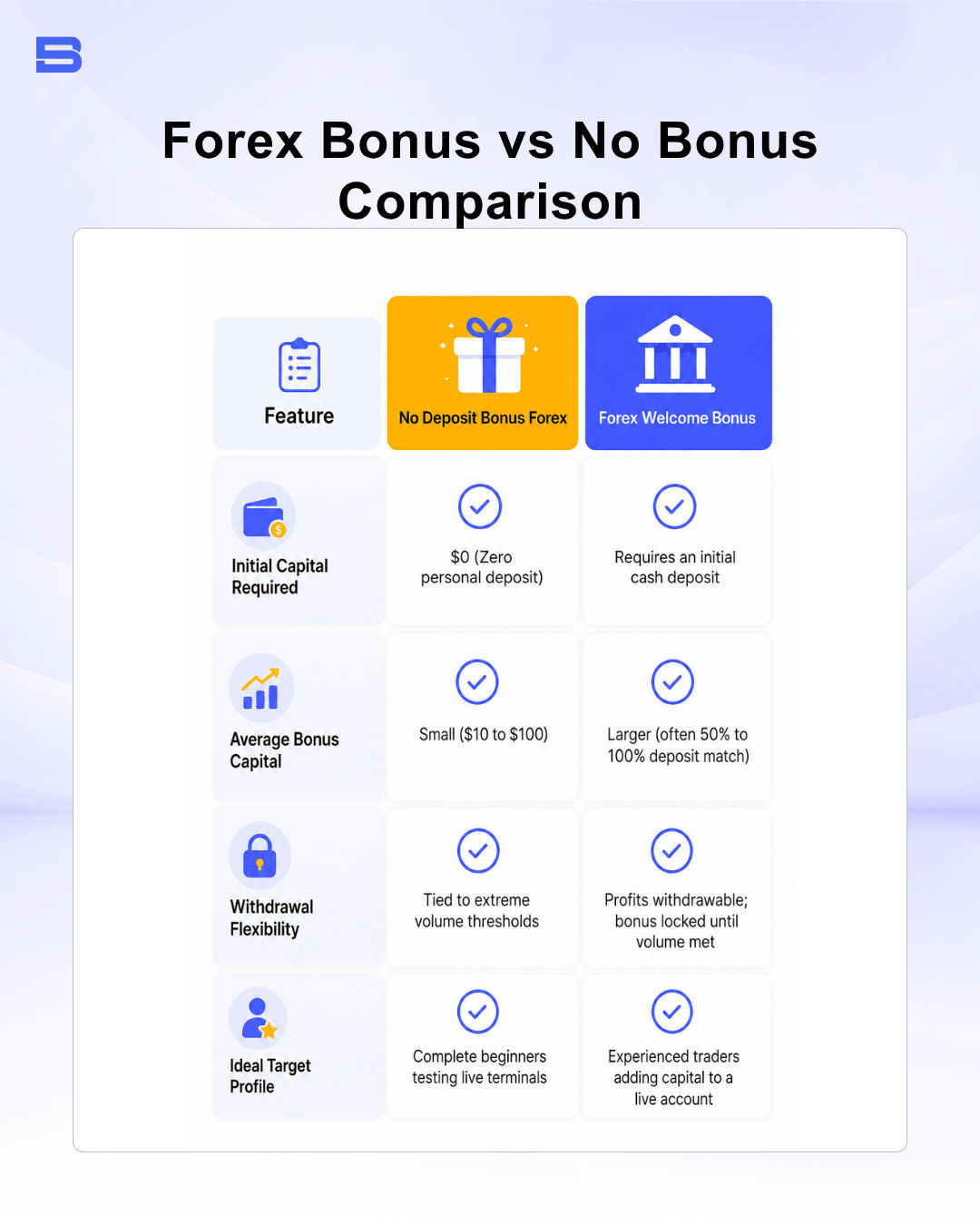
No Deposit Bonus Forex vs. Forex Deposit Bonus: Key Differences
A forex deposit bonus requires an initial cash deposit, matching your deposited equity by a specific percentage, such as 50% or 100%. Unlike zero-deposit promotions, your own real money is locked alongside the bonus equity during active trading.
A forex welcome bonus or deposit match increases your available margin, allowing you to hold larger positions. The core risk is that taking a drawback on a deposit bonus account can still consume your real cash equity first, leaving only non-withdrawable promotional credit behind.
Alternative Incentives: Forex Rebate and Cashback Forex Models
Experienced traders frequently avoid upfront promotional bonuses in favor of ongoing trading cost reductions. Promotional credits provide a one-time margin boost, whereas transaction fee reductions accumulate over time.
A forex rebate program returns a fraction of the spread or commission cost directly to your trading balance on every closed order. Similarly, a forex cashback model functions like a loyalty program, paying cash credits directly into your account balance based on monthly lot volume without restrictive withdrawal clauses.
Regulatory Risks: Spotting Unregulated Broker Bonus Scams
Promotional incentives are heavily influenced by jurisdiction. Strict financial oversight agencies restrict aggressive promotional credits to protect retail consumers from predatory marketing tactics.
Tier-1 regulatory bodies, such as the Financial Conduct Authority (FCA) in the UK and the Securities Commission Malaysia (SC) in Malaysia, prohibit or strictly restrict retail deposit bonuses. Consequently, brokers offering large no-deposit promotions are frequently registered in offshore jurisdictions with minimal regulatory oversight.
Entrusting personal data and official identification documents to unregulated entities carries significant data privacy and security risks. Always check official regulatory registries before opening an account or submitting KYC documentation to an online broker.
Is a No Deposit Bonus Forex Offer Actually Worth It?
A no deposit bonus forex promotion provides genuine value if viewed purely as an educational sandbox. It lets you test execution speeds, experience live order routing, and practice order entry without risking personal capital.
However, treating a bonus offer as a serious capital-building tool is unrealistic due to steep trading volume thresholds and strict profit caps. If your objective is to build long-term trading skills, opening a micro account or a regular trading account with regulated capital offers a far more sustainable path.
Disclaimer: The content on this page is intended for educational and informational purposes only. It does not constitute financial, investment, tax, or legal advice, and should not be interpreted as a recommendation to buy, sell, or hold any financial instrument or asset. Trading and investing involve significant risk, including the possible loss of your entire capital. Products such as forex, CFDs, and cryptocurrencies carry additional risks due to leverage, high volatility, and limited regulatory protection in some jurisdictions. Past performance of any financial instrument does not guarantee future results. Any market views, forecasts, or opinions expressed are those of the author at the time of writing and may not reflect current market conditions. Platform features, fees, and regulatory status are subject to change — always verify information directly with the relevant provider or regulator before making any financial decision. BrokerSpecs may receive compensation from third parties featured on this site. Always conduct your own due diligence and consider seeking advice from a licensed financial professional before investing.