


- How to Start Trading: A Step-by-Step Guide for Beginners
- Demo Trading Accounts: Safe Practice for Beginners
- Understanding How Much Capital You Need to Start Trading
- How to Set Realistic Trading Goals as a New Trader
- How to Open a Trading Account in Malaysia (Step-by-Step)
- How to Start Trading in Malaysia: A Guide for Beginners
- How to Create a Trading Plan Before You Start Trading
- What Is a Trading Account? Everything You Need to Know
- How to Learn Trading: Step-by-Step Beginner Roadmap
- What Is Stop Loss in Trading and How Does It Work?
- Why Every Trader Needs a Trading Journal
- Islamic Forex Account Explained: How Swap-Free Trading Works
- Funded Trading Account: Rules, Splits & Risks
- Master Money Management: Practical Capital Protection Rules
- Overtrading Explained: Common Causes, Signs, and How to Stop
- How Risk-Reward Ratio Works: A Guide to Trading Risk
- How to Open a Brokerage Account as a Beginner
- What Is a Cent Account Forex and How Does It Work?
- What Is an ECN Account and How Does It Work?
- What Is Cashback Forex and How Does It Work?
- Fixed Deposit vs Unit Trust: Key Differences for Investors
- Welcome Bonus Forex: What It Is and What to Watch For
- Forex Deposit Bonus: How It Works
- What Is Forex Rebate and How Does It Work?
- What Is Forex Free Credit and How Does It Work?
- Trading Webinars: Are They Worth Attending?
- Trading for Beginners PDF: What to Look For in a Good Guide
- Trading 101: How to Start Trading Safely and Effectively

Imagine opening your trading app on a Tuesday morning to find a position down $500. Your stomach drops, your chest tightens, and an immediate urge to sell everything—or double your position size to make it back quickly—takes over.
Every trader encounters market drawdowns, but how you react during these high-stress moments defines your long-term survival in the markets. Before placing your first real-money trade, you need to understand your personal risk tolerance and build a clear plan to protect both your capital and your peace of mind.
What Is Risk Tolerance and How Does It Work?
Risk tolerance is the degree of market volatility and potential financial loss an investor is comfortable enduring in exchange for potential returns. It represents your emotional resilience when your portfolio value fluctuates and market conditions turn unfavorable.
Think of market volatility like a theme park ride. Some investors prefer a gentle, steady train ride that offers low volatility and predictable outcomes. Others are comfortable riding a steep, high-speed roller coaster because they enjoy the higher growth potential despite the stomach-churning drops.
Understanding your emotional response to loss before you enter a live market prevents you from making impulse decisions during market panics.
Risk Tolerance vs. Risk Capacity: Crucial Differences
A common mistake among new traders is confusing emotional risk tolerance with financial risk capacity. While they sound similar, they measure completely different factors:
- Risk Tolerance is your psychological willingness to take on market risk and endure portfolio swings.
- Risk Capacity is your financial ability to absorb monetary losses without altering your daily lifestyle, long-term security, or financial goals.
For example, a 25-year-old trader with minimal living expenses might have a very high financial risk capacity because they have decades to recover from losses. However, if seeing a 10% portfolio dip causes them severe anxiety, their emotional risk tolerance is low.
Conversely, a 58-year-old trader nearing retirement might feel emotionally comfortable taking huge market risks, but their actual financial capacity is low because they need that capital intact for living expenses.
Risk Management vs. Risk Tolerance: What Is the Difference?
Your risk tolerance defines who you are as a trader—your mindset, emotional limits, and comfort zone. Risk management is the structured system you put in place to enforce those limits, using defined rules, position sizing, and mandatory order boundaries to protect your capital.
How to Assess Your Risk Tolerance Before You Trade
Before finalizing your trading plan, you should evaluate your current financial standing and emotional profile. Regulators such as the Securities Commission Malaysia (SC) and financial standard-setters like the CFA Institute emphasize that matching investment choices with your risk profile is critical for investor protection.
Conservative, Moderate, and Aggressive Profiles
Traders generally fall into three broad categories: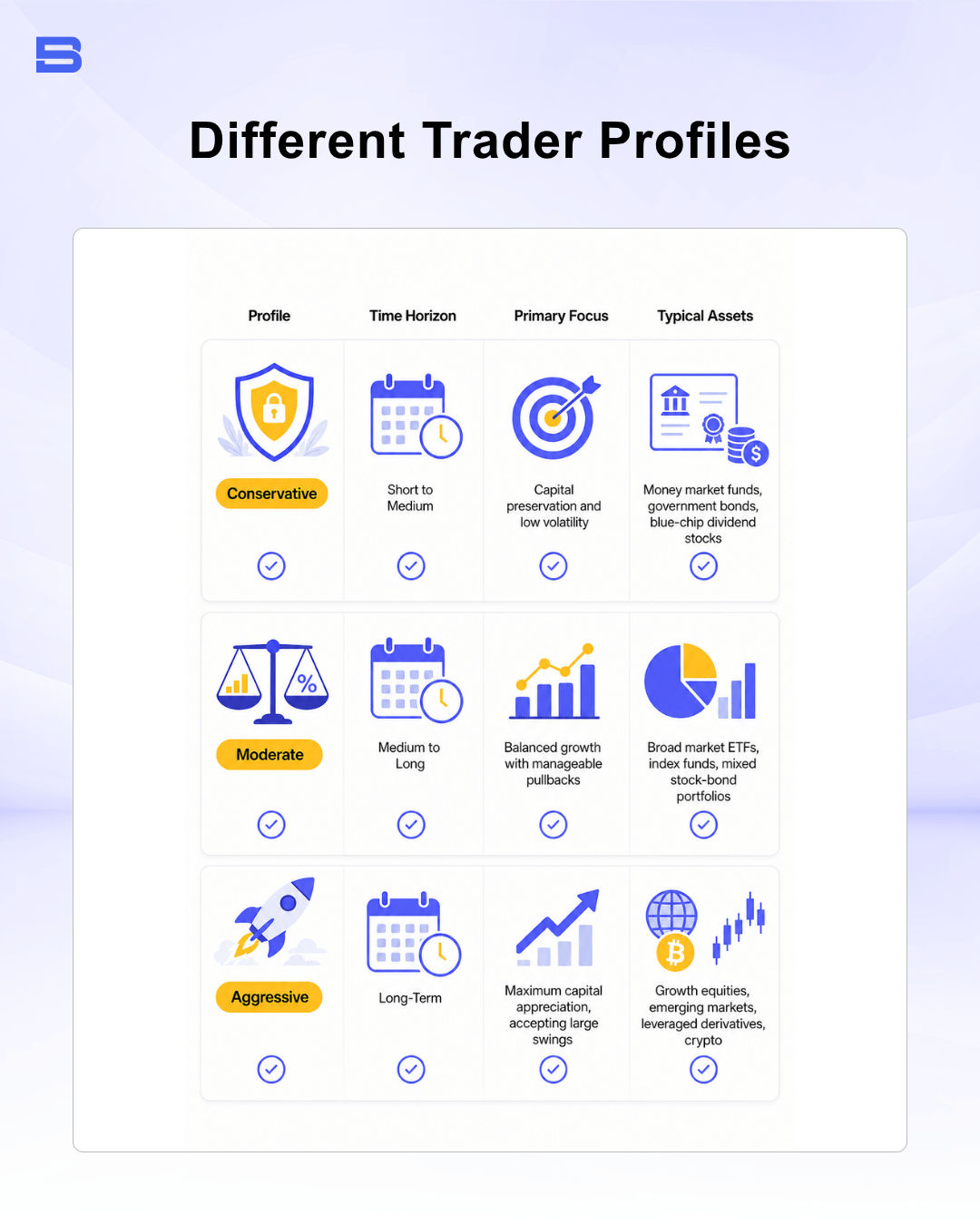 The Personal Risk Assessment Checklist
Ask yourself these three practical questions before funding an account:
- Time Horizon: How soon will you need access to this capital? Money needed within 12 months should never be placed in high-volatility assets.
- Liquidity & Capital Source: Are you trading with discretionary capital, or funds earmarked for rent, emergency savings, or essential bills?
- The Sleep Test: If your open positions fell by 15% overnight due to unexpected news, could you sleep soundly without obsessively checking your phone?
Testing Emotional Tolerance Against Portfolio Drawdowns
To understand risk tolerance realistically, you must convert percentages into physical cash numbers. High returns sound attractive in theory, but drawdown math shows how harsh losses can be in reality.
Mathematical Reality Check: If you deposit $10,000 into a trading account and suffer a 20% drawdown, your account balance falls to $8,000. To get back to your original $10,000 starting point, your remaining $8,000 balance must achieve a 25% gain just to break even.
When traders panic during drawdowns, they frequently fall into behavioral traps such as overtrading—taking rapid, high-risk positions to compensate for losses—or removing their risk limits mid-trade out of fear.
Money Management: Balancing Emotional Tolerance and Risk Capacity
Effective money management bridges the gap between how you feel about risk and how you manage your live capital. It ensures that your maximum downside on any single trade stays strictly within your emotional and financial boundaries.
Aligning Risk Tolerance with Your Risk-Reward Ratio
Every trade setup should feature two key boundaries: a defined exit level if the market moves against you, and a target profit level.
- Setting a tight stop loss protects your account from catastrophic drawdowns during sudden market shifts.
- Evaluating your risk-reward ratio ensures that the potential profit justifies the capital you are putting on the line.
For instance, risking $100 to make $200 establishes a 1:2 risk-to-reward ratio. This structure allows you to maintain account stability even if a portion of your trades end in losses.
Understanding Your Risk Tolerance
Understanding your risk tolerance is the cornerstone of sustainable trading. By aligning your emotional boundaries with your actual financial risk capacity, you establish a grounded framework that keeps fear and greed from dictating your execution in volatile markets.
Disclaimer: The content on this page is intended for educational and informational purposes only. It does not constitute financial, investment, tax, or legal advice, and should not be interpreted as a recommendation to buy, sell, or hold any financial instrument or asset. Trading and investing involve significant risk, including the possible loss of your entire capital. Products such as forex, CFDs, and cryptocurrencies carry additional risks due to leverage, high volatility, and limited regulatory protection in some jurisdictions. Past performance of any financial instrument does not guarantee future results. Any market views, forecasts, or opinions expressed are those of the author at the time of writing and may not reflect current market conditions. Platform features, fees, and regulatory status are subject to change — always verify information directly with the relevant provider or regulator before making any financial decision. BrokerSpecs may receive compensation from third parties featured on this site. Always conduct your own due diligence and consider seeking advice from a licensed financial professional before investing.