


Related Tags
Entering the options market with a bullish directional outlook often leads traders to consider buying a simple call option. However, high implied volatility and steep premium costs can make outright call purchases expensive, exposing your account to substantial capital loss if the underlying asset fails to rally quickly.
When you anticipate a moderate price increase rather than an explosive rally, a vertical debit spread offers a structured, risk-defined alternative. By combining long and short call options, you can reduce total capital outlay while maintaining exposure to upside market movements.
What Is a Bull Call Spread and How Does It Work?
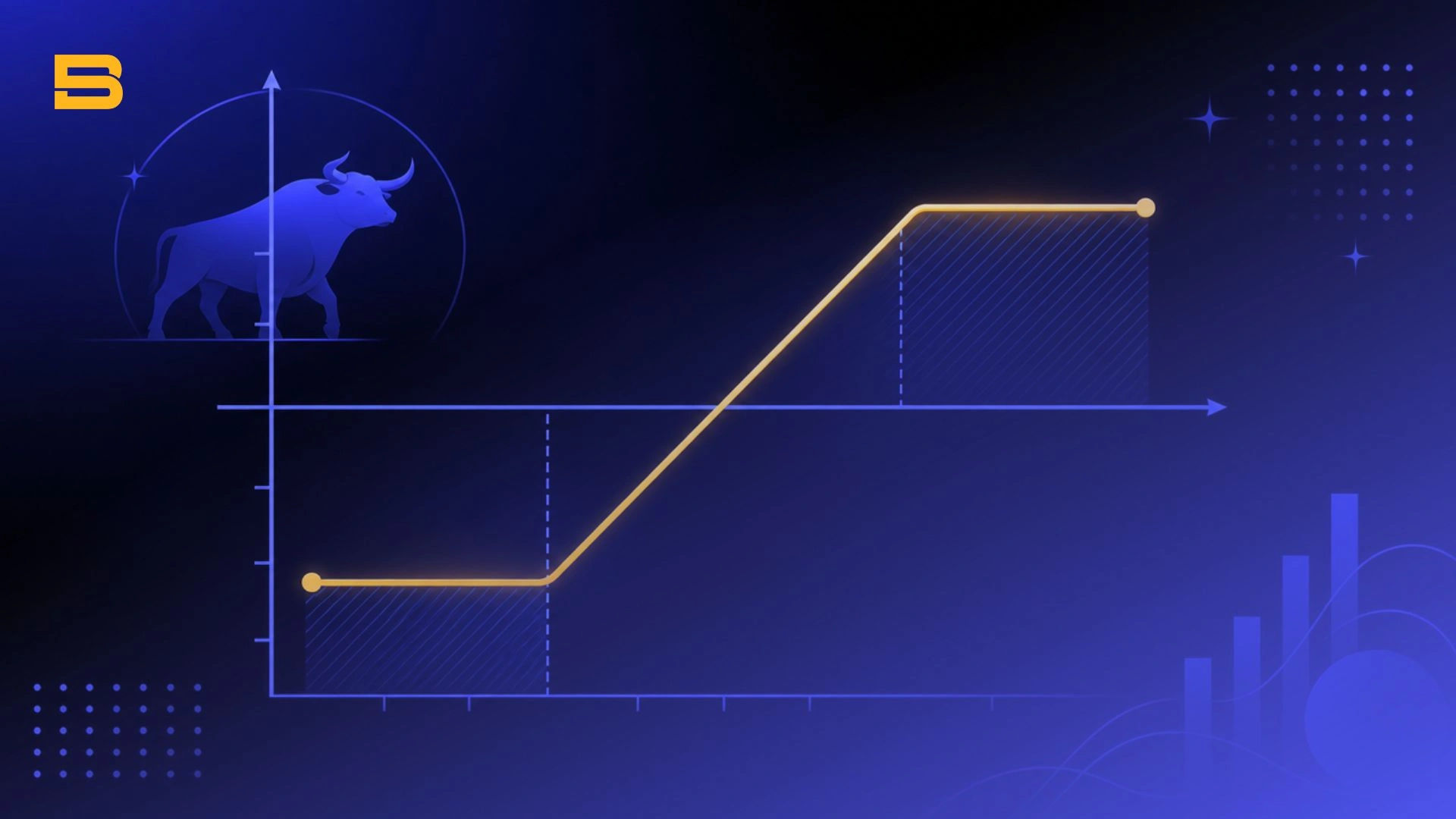
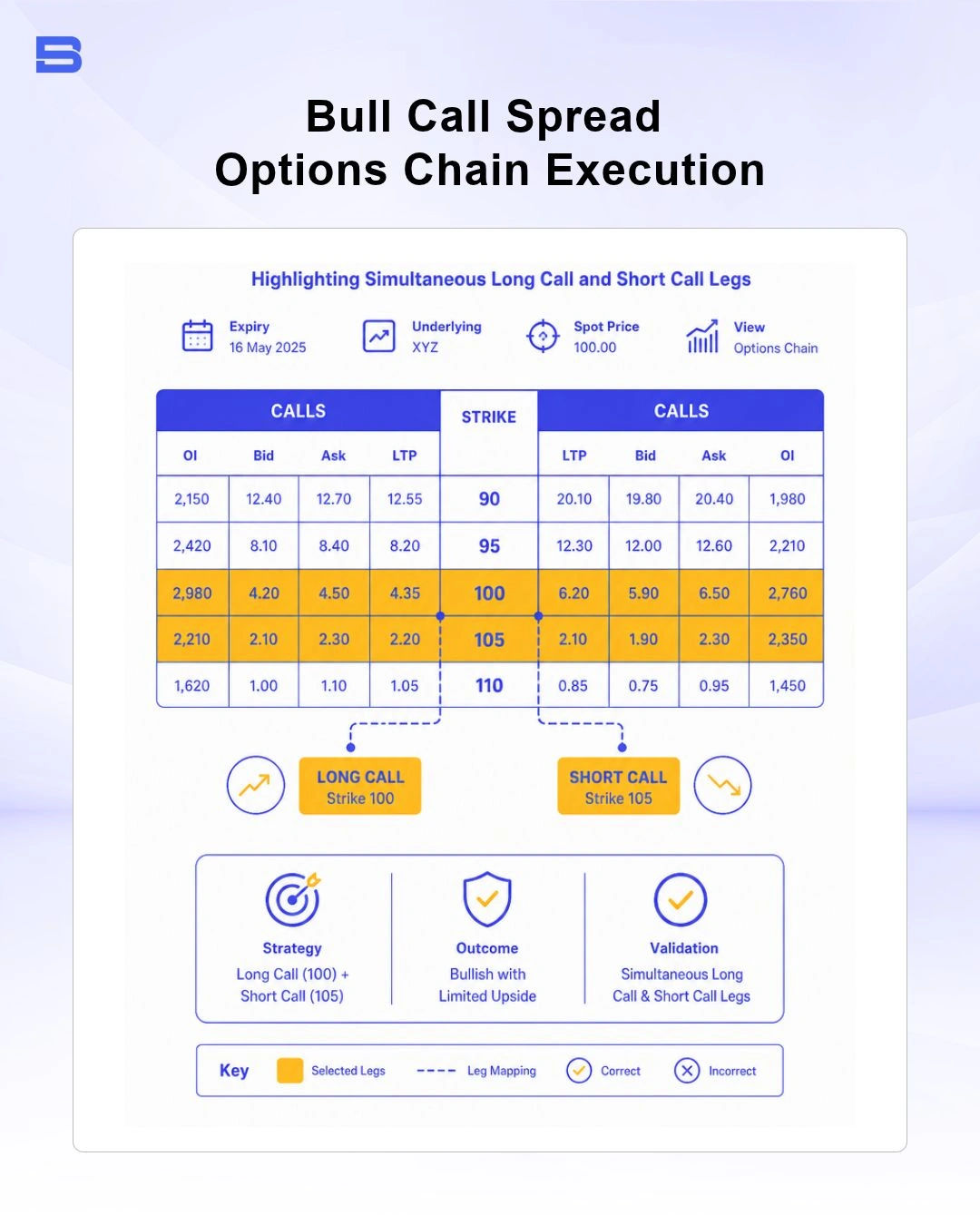
A bull call spread is a two-leg vertical debit options trading strategy used when a trader has a moderately bullish view. Executing the strategy requires selecting two strike prices. The strategy is constructed by purchasing an in-the-money (ITM) or at-the-money (ATM) call option while simultaneously selling an out-of-the-money (OTM) call option on the same asset, sharing the exact same expiration date.
Because lower strike calls cost more than higher strike calls, buying the lower strike option and selling the higher strike option results in a net cash debit to your trading account. This upfront net debit represents your total initial investment and serves as the absolute maximum financial loss you can incur on the trade.
In exchange for accepting a cap on your potential gains at the higher strike price, the short call option generates premium income that partially offsets the purchase price of the long call option. This structure drastically lowers your cost basis, mitigates time decay risk, and lowers the price level required for the underlying asset to reach profitability.
Mechanics and Setup of a Bull Call Spread
Executing this strategy requires selecting two strike prices that match your target price objective and time horizon. Option contracts are typically standard contracts governing 100 shares of the underlying asset. Standard specifications and execution rules for multi-leg vertical option spreads are regulated under exchange guidelines set by the Cboe (Chicago Board Options Exchange).
To set up the trade:
- Select an underlying asset expected to experience moderate upward price momentum.
- Buy a call option with a lower strike price (Strike_A, typically ITM or ATM).
- Sell a call option with a higher strike price (Strike_B, typically OTM) with the identical expiration date.
The difference between the premium paid for the long call and the premium collected from the short call is your net debit.
Calculating Break-Even, Max Profit, and Max Loss
Understanding the mathematical payoff profile of a bull call spread allows you to evaluate risk-to-reward metrics before entering an order.
Consider a worked scenario: A stock is trading at $100. You buy a 30-day $100 call option for $5.00 ($500 outlay) and simultaneously sell a 30-day $105 call option for $2.00 ($200 credit collected).
- Net Debit (Max Loss):
Net Debit = Long Call Premium - Short Call Premium = $5.00 - $2.00 = $3.00
For 1 contract (100 shares), your maximum risk is strictly capped at $300.00. - Maximum Profit:
Max Profit = (Higher Strike - Lower Strike) - Net Debit
Max Profit = ($105.00 - $100.00) - $3.00 = $2.00 per share (or $200.00 total) - Break-Even Point:
Break-Even = Lower Strike + Net Debit
Break-Even = $100.00 + $3.00 = $103.00
At any underlying stock price above $105.00 at expiration, the trade achieves its maximum return of $200. Conversely, if the stock drops below $100.00, your loss is capped at the initial $300 debit regardless of how low the stock price drops.
When Should You Use a Bull Call Spread? (Market Conditions & Timing)
Knowing when you should use this strategy depends heavily on evaluating market volatility and defining precise target levels for the underlying asset:
- Moderate Bullish Sentiment: The strategy is optimal when you expect a stock to rise up to a specific resistance level, but do not anticipate a massive, runaway surge beyond that point.
- High-Volatility Environments: Outright long call purchases suffer heavily when implied volatility is inflated. Because a bull call spread involves selling an OTM option, the short leg helps offset the expensive premium of the long leg, making debit spreads cheaper in high-volatility regimes.
- Capital Protection Priorities: If maintaining a strict risk ceiling is essential to your portfolio management, a bull call spread ensures that even severe overnight gap-downs will never result in losses beyond the net debit paid.
Impact of the Greeks: Theta (Time Decay) and Implied Volatility
Options pricing dynamics change constantly due to the Greeks:
- Theta (Time Decay): Time decay hurts long options positions. However, with this structure, the short option collects theta decay while the long option loses it. As long as the stock price rises toward or above the short strike, theta decay actually works in your favor as expiration approaches because the short option's extrinsic value — the portion of its price beyond intrinsic value, driven by time and volatility — erodes faster.
- Implied Volatility (Vega): Vega measures how sensitive an option's price is to changes in implied volatility. Since you are net long options value a general increase in implied volatility helps the trade slightly if the stock is near the lower strike. However, because the short leg offsets the long leg's vega, vertical spreads are far less vulnerable to "volatility crushes" than single-leg options.
Bull Call Spread vs. Bear Put Spread vs. Butterfly Spread
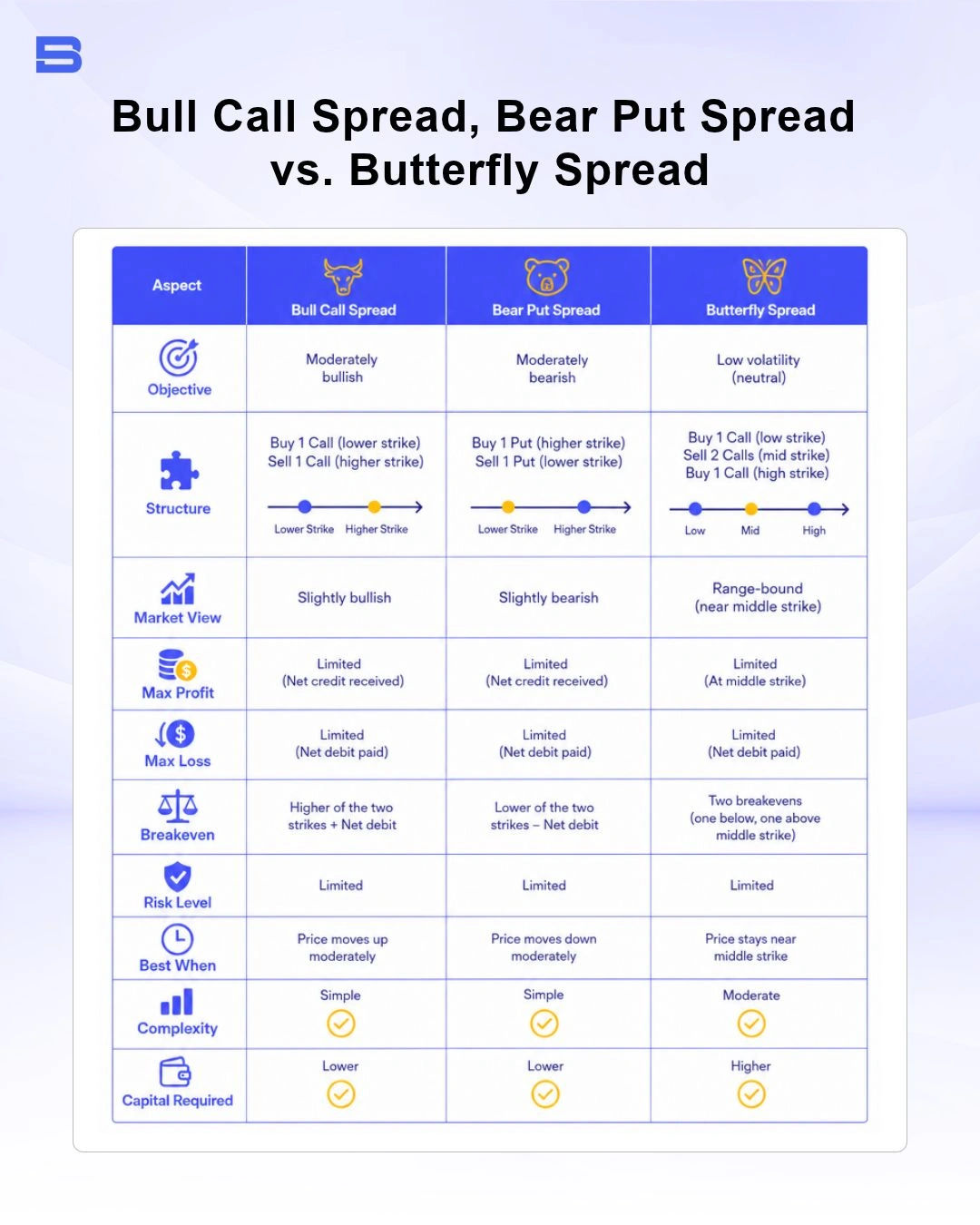
Selecting the right options structure requires matching your directional view and volatility expectations against alternative multi-leg strategies.
Traders evaluating vertical structures often compare them to other foundational options setups. For instance, holding underlying shares while writing calls generates income via a covered call, whereas purchasing a put option or establishing a protective put serves as downside insurance for equity positions.
When market conditions lean bearish, traders pivot from call debit spreads to a bear put spread structure. Alternatively, multi-leg volatility strategies such as a neutral butterfly spread, time-decay focused calendar spread, or wide range-bound iron condor offer distinct payoff curves tailored to non-directional or sideways environments.
Managing Risk and Expiration Outcomes
Managing vertical spreads near expiration requires active oversight to prevent execution risks and assignment issues. Rules governing investor safety and options margin disclosures are overseen by the US Financial Industry Regulatory Authority (FINRA).
- Expiring In-the-Money (ITM): If the stock closes above the higher short strike at expiration, both options will expire ITM. Most brokerages automatically exercise the long call and assign the short call, netting out the maximum profit automatically.
- Expiring Out-of-the-Money (OTM): If the stock closes below the lower long strike, both options expire worthless, resulting in the full loss of the net debit paid.
- Pin Risk and Early Closing: If the underlying asset closes between the lower and upper strikes at expiration, the long call will be exercised while the short call expires worthless. This leaves you holding 100 long shares of stock, exposing your capital to underlying gap risk over the weekend. To eliminate pin risk and avoid unplanned capital margin requirements, close the position entirely prior to the market closing bell on expiration day.
The Bottom Line
A bull call spread provides an efficient way to capture upside price movement while maintaining strict, pre-defined risk boundaries. By sacrificing uncapped upside potential through the sale of an OTM call option, you lower your net debit, reduce time decay exposure, and improve your break-even point. When traded with disciplined strike selection and proactive expiration management, it remains a widely used strategy among traders seeking directional exposure with defined risk.
- How to Build an Investment Plan That Actually Works for You?
- What Is the MACD Indicator and How to Use It
- What Is a Wedge Pattern in Trading?
- What Is Ichimoku Cloud Strategy? A Complete Trading System
- Mastering Elliott Wave Theory: Rules and Trading Strategies
- News Trading: Strategies, Execution Risks, and Risk Control
- What Is an Iron Condor Options Strategy?
- Backtesting Explained: What It Is and Why It Really Matters
- Grid Trading: Mechanics, Parameters, and Risk Strategies
- What Is Breakout Trading and How Does It Work?
- Mean Reversion: Technical Strategies and Risk Frameworks
- Momentum Trading: Indicators, Strategies, and Risk Control
- Hammer Candlestick: Structure, Meaning, and Strategy
- Doji Candlestick: Types, Signals, and Trading Strategies
- What Is the Sharpe Ratio and How to Calculate It
- What Is VWAP and How Do Traders Use It?
- Trade the Ascending Triangle: A Step-by-Step Practical Guide
- What Is the Stochastic Oscillator and How to Use It
- How to Trade the Descending Triangle Pattern
- High Frequency Trading: Speed, Algorithms, and Market Impact
- What Is Volume Profile and How to Use It in Trading
- What Is a Morning Star Pattern Candlestick?
- Trade with Parabolic SAR: A Practical Analysis Guide
- Evening Star Pattern: Structure, Rules, and Risk Controls
- Kelly Criterion: Formula, Position Sizing, and Risk
- What Is the NYSE Minimum Trading Price? Rules Explained
Disclaimer: The content on this page is intended for educational and informational purposes only. It does not constitute financial, investment, tax, or legal advice, and should not be interpreted as a recommendation to buy, sell, or hold any financial instrument or asset. Trading and investing involve significant risk, including the possible loss of your entire capital. Products such as forex, CFDs, and cryptocurrencies carry additional risks due to leverage, high volatility, and limited regulatory protection in some jurisdictions. Past performance of any financial instrument does not guarantee future results. Any market views, forecasts, or opinions expressed are those of the author at the time of writing and may not reflect current market conditions. Platform features, fees, and regulatory status are subject to change — always verify information directly with the relevant provider or regulator before making any financial decision. BrokerSpecs may receive compensation from third parties featured on this site. Always conduct your own due diligence and consider seeking advice from a licensed financial professional before investing. Portions of this article were prepared with the assistance of AI tools and reviewed by our editorial team before publication.