



Related Tags
Holding stock during periods when the market trades sideways can feel like capital sitting idle. While long-term equity positions build wealth over multi-year horizons, short-term price stagnation limits your immediate cash yield beyond periodic corporate dividends. Selling call options against shares you already own offers a structured framework to generate income directly from your equity holdings.
What Is a Covered Call Options Strategy and How Does It Work?
A covered call options strategy is an options approach where an investor holds a long position in a stock and sells a call option against those same shares to generate income. This monetization technique turns an equity holding into an income-generating asset.
To construct a basic covered call, you must own at least 100 shares of the underlying stock for every single call option contract you write. Equity option contracts represent standardized units of 100 shares.
The short call option is considered "covered" because your existing share position guarantees you can deliver the underlying asset if the option buyer exercises their right to purchase the stock at the strike price.
Buy-Write vs. Overwriting Mechanics
Traders execute this strategy through two primary transaction setups depending on whether they already own the underlying equity. A buy-write strategy involves purchasing 100 shares of stock and simultaneously selling a call option in a single combined order execution.
Overwriting refers to selling call options against stock shares already held inside your portfolio for weeks, months, or years. Long-term equities held in a position trading framework are frequent candidates for overwriting when near-term price momentum shifts from aggressive trending to neutral consolidation.
How Selling Call Options Generates Premium Income
When you write a call option contract, the option buyer pays you an immediate upfront cash payment known as the option premium. This cash deposits into your brokerage account immediately upon order execution. In exchange for this non-refundable premium, you accept the legal obligation to sell your 100 shares at the agreed strike price if the stock trades above that strike price before or at expiration.
The option premium received reduces your net cost basis in the underlying stock while establishing an absolute cap on your maximum prospective capital gain. If the stock remains below the strike price through expiration, the call option expires worthless. You retain the full cash premium alongside your original 100 shares, freeing you to write another call option for the subsequent expiration cycle.
Impact of Implied Volatility and Time Decay (Theta)
Option pricing dynamics respond continuously to market uncertainty and the passage of time. Higher implied volatility elevates option premiums across all strike prices because market participants anticipate wider price swings in the underlying stock.
Selling calls during periods of heightened market volatility allows option writers to capture larger upfront premium income. Market pricing data provided by exchange networks like Cboe reflects these changing volatility dynamics.
Time decay, represented by the options Greek known as Theta, accelerates as expiration approaches. Because option contracts possess a finite lifespan, their extrinsic value — the portion of an option's price beyond its intrinsic, in-the-money value — erodes at an increasing pace during the final 30 to 45 days before expiration.
This predictable erosion of extrinsic value works directly in favor of option sellers, who profit when option contract values decline toward zero.
Calculating Break-Even Point, Profit Caps, and Downside Loss
Understanding the exact financial boundaries of a covered call position requires calculating three core metrics: your break-even point, your maximum upside profit, and your maximum downside exposure.
The break-even point calculation reflects the net cash invested in the combined position:
Break-Even Point = Share Purchase Price − Option Premium Received
Maximum profit occurs if the stock price closes at or above the short call strike price at expiration. The formula accounts for both capital appreciation up to the strike price and the retained premium:
Maximum Profit = (Strike Price − Share Purchase Price) + Option Premium Received
Maximum loss occurs if the underlying stock drops to zero. Because the upfront option premium provides a fixed cash buffer, the maximum risk is slightly lower than owning the stock outright:
Maximum Loss = (Share Purchase Price − Option Premium Received) × 100 Shares
Worked Example: Standard Covered Call Trade
Assume you purchase 100 shares of Stock X at $50 per share, requiring a capital outlay of $5,000. Simultaneously, you sell a 30-day call option with a strike price of $55 for a premium of $2 per share ($200 total cash received).
- Net Cost Basis: $50 − $2 = $48 per share ($4,800 total capital at risk).
- Break-Even Point: $48 per share.
Scenario A (Stock rises to $60): The buyer exercises the option. You sell your 100 shares at the $55 strike price for $5,500. Adding the $200 initial premium yields $5,700 total proceeds, generating your maximum profit of $700 ($7 per share, or a 14% return on risk). You do not participate in gains above $55.
Scenario B (Stock stays at $52): The option expires worthless. You keep the $200 cash premium and retain your 100 shares now worth $5,200, resulting in an overall profit of $400.
Scenario C (Stock drops to $40): The option expires worthless. Your shares are worth $4,000, but your retained $200 premium offsets the loss partially, leaving a net position value of $4,200 (a loss of $800 compared to a $1,000 loss if holding shares without writing the call).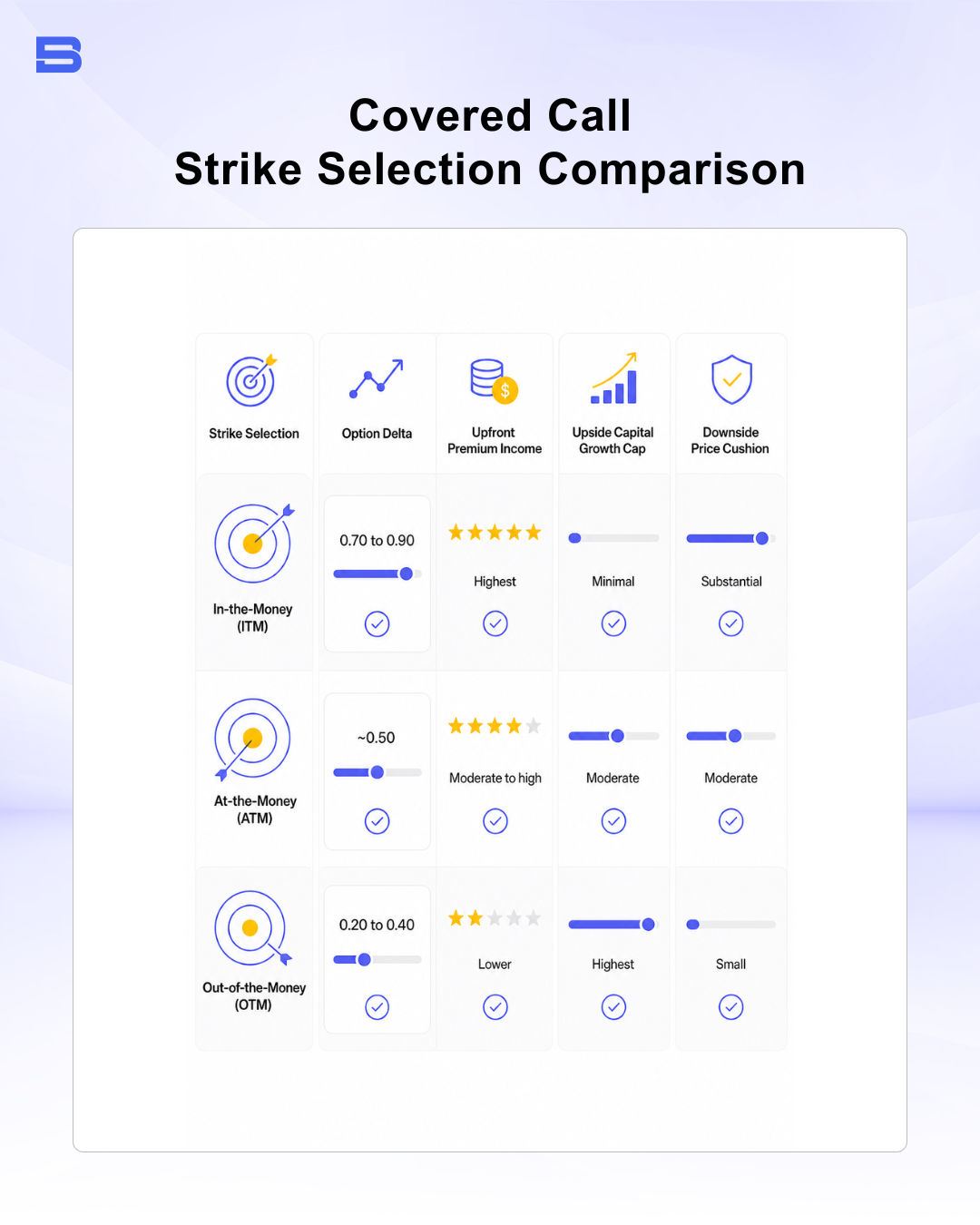
Using Covered Calls for Downside Income and Hedging
Investors often utilize covered call strategies to establish modest downside protection while extracting yield from stagnant positions. Premium collection creates an immediate cash margin of safety that reduces your effective acquisition cost.
However, selling call options offers only partial downside protection rather than comprehensive structural portfolio hedging. If the underlying company suffers a severe fundamental breakdown and the stock price plummets 30%, a 3% or 4% premium collection offers minimal insulation against the substantial capital loss incurred on the underlying equity holding.
What Happens at Expiration: Option Exercise and Stock Assignment
As an option contract reaches expiration, the final stock price determines whether option assignment occurs. If the stock trades above the call strike price by as little as $0.01 at expiration, the option contract will automatically be assigned.
Note that equity options are American-style, meaning assignment can also happen before expiration — most commonly around the underlying stock's ex-dividend date, when an in-the-money call's remaining time value is smaller than the upcoming dividend.
Your brokerage automatically transfers your 100 shares to the option purchaser at the strike price in exchange for cash proceeds. Regulatory operational details regarding option assignment mechanics can be reviewed at the US Securities and Exchange Commission (SEC).
If you prefer to retain your shares rather than have them called away, you must manage the contract before expiration. Traders frequently execute a maneuver called "rolling" the option. Rolling involves buying back the existing short call option to close the contract and simultaneously writing a new call option with a higher strike price or a later expiration date.
Comparing Options Strategies: Covered Call vs. Pairs Trading
While covered calls monetize individual stock holdings through single-stock options, market participants also evaluate relative-value strategies like pairs trading to handle choppy markets.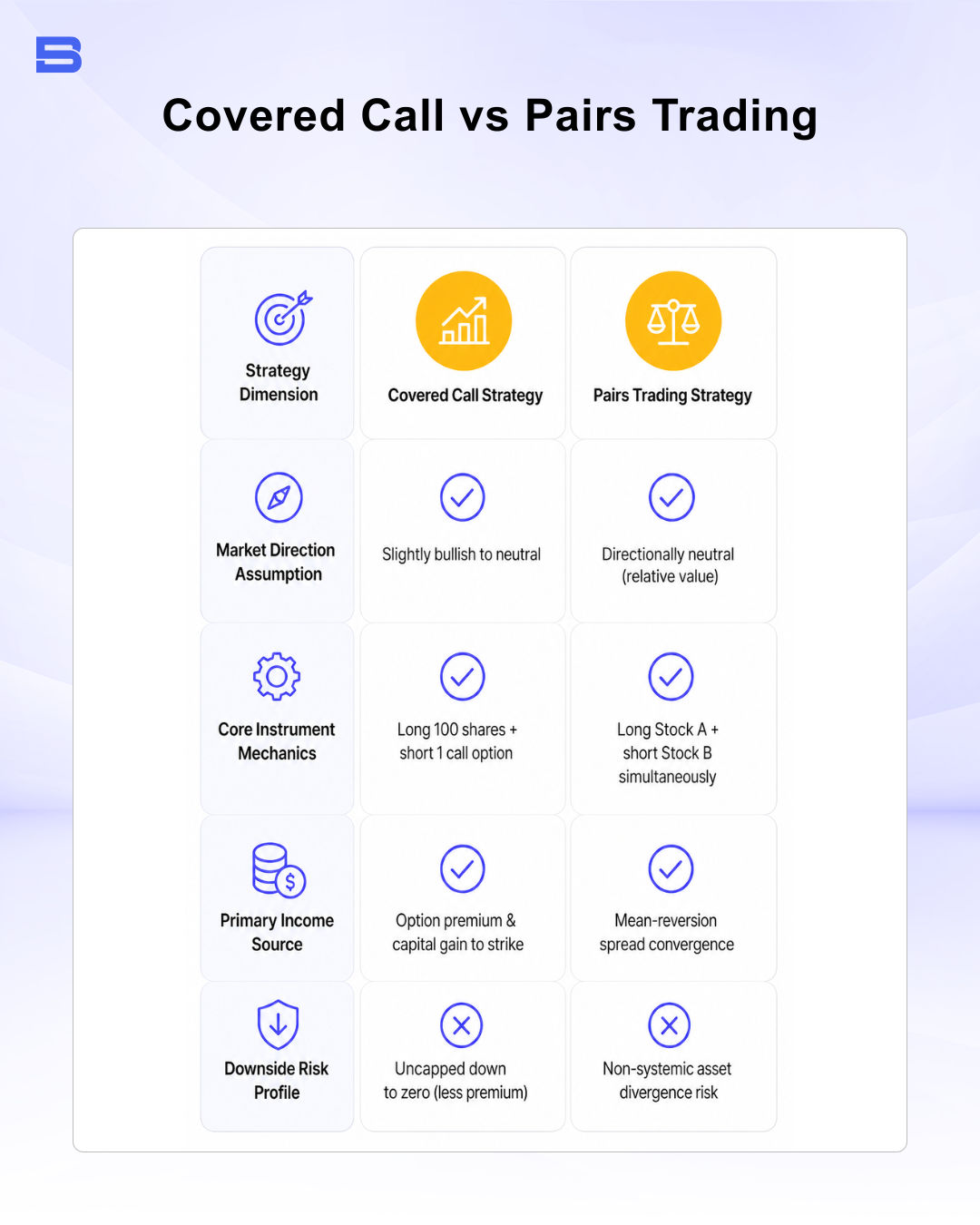
Covered call writing relies on holding single-stock long risk while selling volatility. In contrast, pairs trading eliminates broad market directional exposure entirely by taking offsetting long and short equity positions in two historically correlated assets.
Comparing Covered Calls to Put Option Strategies
Option sellers frequently weigh writing covered calls against alternative option structures with similar risk profiles, such as selling cash-secured put option contracts or constructing defined-risk spreads.
- Cash-Secured Puts: Selling an out-of-the-money put contract creates a risk/reward profile mathematically synthetic to a covered call. You collect upfront premium and agree to purchase 100 shares at the strike price if the stock declines.
- Protective Puts: Unlike covered calls, which limit upside to generate income, buying a protective put contract against long shares acts as an explicit insurance policy that caps maximum downside loss while leaving upside potential open.
- Defined-Risk Spreads: Strategies like a bull call spread or an iron condor utilize multiple option legs to strictly limit both maximum potential loss and capital requirements without requiring 100 shares of underlying stock ownership.
Lowering Your Cost Basis With Covered Calls
A covered call options strategy provides equity investors with a reliable methodology for generating yield from existing stock positions. By agreeing to cap your capital appreciation at a chosen strike price, you receive immediate cash income that lowers your overall cost basis.
While this strategy excels in sideways or moderately rising markets, disciplined traders must remain mindful that option premiums offer only partial protection against severe equity market downturns.
- How to Build an Investment Plan That Actually Works for You?
- What Is the MACD Indicator and How to Use It
- What Is a Wedge Pattern in Trading?
- What Is Ichimoku Cloud Strategy? A Complete Trading System
- Mastering Elliott Wave Theory: Rules and Trading Strategies
- News Trading: Strategies, Execution Risks, and Risk Control
- What Is an Iron Condor Options Strategy?
- Backtesting Explained: What It Is and Why It Really Matters
- Grid Trading: Mechanics, Parameters, and Risk Strategies
- What Is Breakout Trading and How Does It Work?
- Mean Reversion: Technical Strategies and Risk Frameworks
- Momentum Trading: Indicators, Strategies, and Risk Control
- Hammer Candlestick: Structure, Meaning, and Strategy
- Doji Candlestick: Types, Signals, and Trading Strategies
- What Is the Sharpe Ratio and How to Calculate It
- What Is VWAP and How Do Traders Use It?
- Trade the Ascending Triangle: A Step-by-Step Practical Guide
- What Is the Stochastic Oscillator and How to Use It
- How to Trade the Descending Triangle Pattern
- High Frequency Trading: Speed, Algorithms, and Market Impact
- What Is Volume Profile and How to Use It in Trading
- What Is a Morning Star Pattern Candlestick?
- Trade with Parabolic SAR: A Practical Analysis Guide
- Evening Star Pattern: Structure, Rules, and Risk Controls
- Kelly Criterion: Formula, Position Sizing, and Risk
- What Is the NYSE Minimum Trading Price? Rules Explained
Disclaimer: The content on this page is intended for educational and informational purposes only. It does not constitute financial, investment, tax, or legal advice, and should not be interpreted as a recommendation to buy, sell, or hold any financial instrument or asset. Trading and investing involve significant risk, including the possible loss of your entire capital. Products such as forex, CFDs, and cryptocurrencies carry additional risks due to leverage, high volatility, and limited regulatory protection in some jurisdictions. Past performance of any financial instrument does not guarantee future results. Any market views, forecasts, or opinions expressed are those of the author at the time of writing and may not reflect current market conditions. Platform features, fees, and regulatory status are subject to change — always verify information directly with the relevant provider or regulator before making any financial decision. BrokerSpecs may receive compensation from third parties featured on this site. Always conduct your own due diligence and consider seeking advice from a licensed financial professional before investing. Portions of this article were prepared with the assistance of AI tools and reviewed by our editorial team before publication.