


- How to Start Trading: A Step-by-Step Guide for Beginners
- Demo Trading Accounts: Safe Practice for Beginners
- Understanding How Much Capital You Need to Start Trading
- How to Set Realistic Trading Goals as a New Trader
- How to Open a Trading Account in Malaysia (Step-by-Step)
- How to Start Trading in Malaysia: A Guide for Beginners
- How to Create a Trading Plan Before You Start Trading
- What Is a Trading Account? Everything You Need to Know
- How to Learn Trading: Step-by-Step Beginner Roadmap
- What Is Stop Loss in Trading and How Does It Work?
- Why Every Trader Needs a Trading Journal
- Islamic Forex Account Explained: How Swap-Free Trading Works
- Funded Trading Account: Rules, Splits & Risks
- Master Money Management: Practical Capital Protection Rules
- Overtrading Explained: Common Causes, Signs, and How to Stop
- How Risk-Reward Ratio Works: A Guide to Trading Risk
- How to Open a Brokerage Account as a Beginner
- What Is a Cent Account Forex and How Does It Work?
- What Is an ECN Account and How Does It Work?
- What Is Cashback Forex and How Does It Work?
- Fixed Deposit vs Unit Trust: Key Differences for Investors
- Welcome Bonus Forex: What It Is and What to Watch For
- Forex Deposit Bonus: How It Works
- What Is Forex Rebate and How Does It Work?
- What Is Forex Free Credit and How Does It Work?
- Trading Webinars: Are They Worth Attending?
- Trading for Beginners PDF: What to Look For in a Good Guide
- Trading 101: How to Start Trading Safely and Effectively

You check your bank balance at the end of the month, hoping to set aside a slice of your earnings for long-term wealth building. You want a home for your money that offers steady growth, instant liquidity, and absolute compliance with Islamic principles—yet you dread the complexity of manually calculating Zakat or worrying about sudden market drops.
For millions of Malaysian Muslims, Lembaga Tabung Haji (TH) has long served as that effortless anchor.
While initially established to help citizens save for the Hajj pilgrimage, Tabung Haji has evolved into one of Malaysia's few capital-guaranteed investment vehicles, backed directly by a statutory government guarantee.
Understanding how it operates, how returns are calculated, and how it handles mandatory Zakat automatically can help you decide if it belongs in your personal portfolio.
What Is Tabung Haji and How Does It Work?
At its core, Lembaga Tabung Haji is a statutory body governed by the Tabung Haji Act 1995 . Unlike standard commercial banks or speculative equity unit trusts, TH operates under a strict Shariah framework, traditionally utilizing contracts such as Wakalah (agency) and Syarikah (partnership) to manage depositor funds.
When you deposit money into TH, your funds are pooled into a central investment portfolio managed by professional Islamic fund managers. These assets are diversified across equities, real estate, fixed-income instruments, and money market instruments.
The single most defining feature of Tabung Haji is its statutory capital guarantee. Under Section 24 of the Tabung Haji Act 1995, all deposits are fully guaranteed by the Government of Malaysia. This means that even during severe macroeconomic turbulence, your initial principal remains entirely safe from nominal loss.
Historical Performance and Return Calculations
When evaluating Tabung Haji returns, you must understand how annual profit distributions (Agihan Keuntungan) are calculated and distributed. Unlike fixed deposit accounts that lock in a guaranteed interest rate upfront, TH calculates profit based on the minimum monthly balance of your account throughout the calendar year.
According to Lembaga Tabung Haji's officially announced dividend rate for the 2025 financial year, TH distributed a rate of 3.50%—though this rate is reviewed annually and is not guaranteed to remain the same in future years.
While this yield may appear lower than equity unit trusts or direct stock investments during bull markets, it consistently competes with standard fixed deposits—with two crucial advantages: absolute capital security and automatic Zakat settlement.
To see how your balance earns returns over time, consider how TH tracks your eligible funds across the calendar year.
How Tabung Haji Automatically Handles Zakat
One of the most valuable benefits of Tabung Haji investments is its hassle-free approach to religious obligation.
Under standard Islamic financial planning, Muslim investors must calculate 2.5% Zakat on eligible wealth once it meets the required threshold (Nisab) and holding period (Haul). With many conventional investments, unit trusts, or direct equities, calculating this manually can become complex.
Tabung Haji solves this directly at the corporate level. Before distributing net profits to depositors, TH pays out 2.5% Zakat on its total commercial assets directly to state Islamic Religious Councils across Malaysia.
Because Zakat is deducted at the source, every Ringgit of profit credited into your account represents a "clean," net distribution. You do not need to deduct or pay additional Zakat on your TH savings balance, simplifying your overall financial management.
Pros and Cons of Tabung Haji Investments
Before committing a major portion of your capital to Tabung Haji, evaluate its balance of benefits and trade-offs.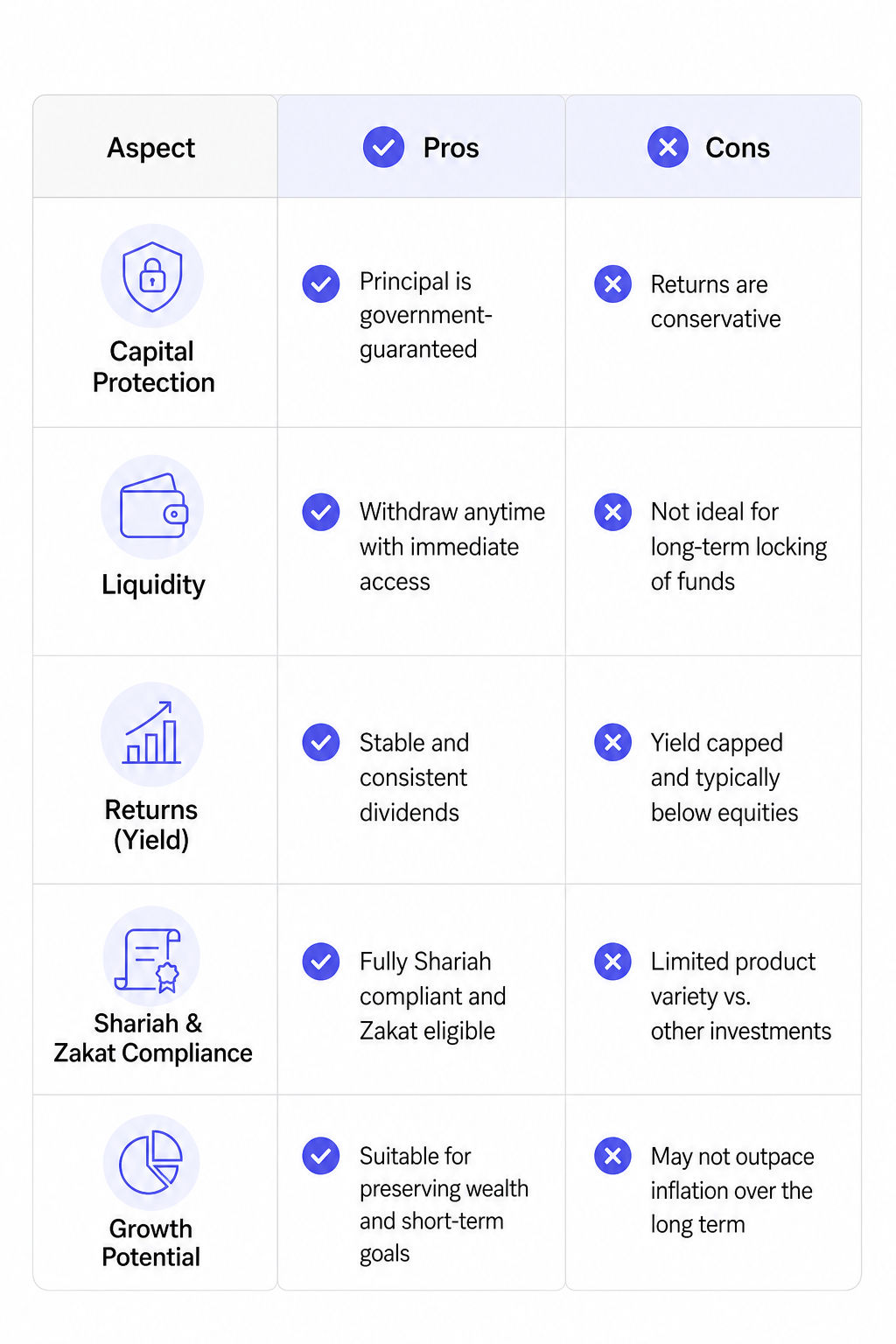
As highlighted in the comparison, Tabung Haji excels in capital protection, immediate liquidity, and ease of Shariah/Zakat compliance. However, for aggressive long-term growth aimed at significantly outpacing inflation, relying solely on TH may limit your overall wealth accumulation potential compared to equity-heavy assets.
Step-by-Step: How to Start Investing in Tabung Haji
Getting started with Tabung Haji is straightforward, with options ranging from mobile apps to physical counter service.
Step 1: Open Your Tabung Haji Account
You can initiate account opening digitally via the THiJARI mobile application or web portal. If you prefer in-person registration, visit any Tabung Haji branch, UTC center, or partner bank counter (such as Bank Islam or Bank Rakyat). The minimum initial deposit to open an account is only RM2.
Step 2: Link Your Account to Online Banking
To make ongoing deposits convenient, link your TH account to your preferred online banking platform (e.g., Maybank2u, CIMB Clicks, or RHB Online). This allows you to transfer funds directly from your regular savings account into TH within seconds.
Step 3: Set Up Automated Monthly Transfers
To build wealth consistently, set up a recurring standing instruction or automated transfer from your monthly salary account into Tabung Haji. Aim to schedule transfers a few days before the start of each month to ensure the funds count toward that month's minimum balance calculation.
Investing in Tabung Haji
Tabung Haji remains a cornerstone of Malaysian Islamic finance for good reason. By combining statutory capital protection, steady yields, full liquidity, and automated Zakat settlement, it provides a safe foundation for conservative wealth building.
While higher-risk instruments like equity unit trusts or direct stocks may offer greater upside over multi-year horizons, keeping your emergency reserves or conservative core savings in Tabung Haji ensures peace of mind while keeping your financial growth strictly Shariah-compliant.
Disclaimer: The content on this page is intended for educational and informational purposes only. It does not constitute financial, investment, tax, or legal advice, and should not be interpreted as a recommendation to buy, sell, or hold any financial instrument or asset. Trading and investing involve significant risk, including the possible loss of your entire capital. Products such as forex, CFDs, and cryptocurrencies carry additional risks due to leverage, high volatility, and limited regulatory protection in some jurisdictions. Past performance of any financial instrument does not guarantee future results. Any market views, forecasts, or opinions expressed are those of the author at the time of writing and may not reflect current market conditions. Platform features, fees, and regulatory status are subject to change — always verify information directly with the relevant provider or regulator before making any financial decision. BrokerSpecs may receive compensation from third parties featured on this site. Always conduct your own due diligence and consider seeking advice from a licensed financial professional before investing.