



Related Tags
Imagine buying a high-performing stock at $100 after months of thorough analysis. The business is expanding, quarterly earnings are approaching, and your position is comfortably in profit. However, macro headwinds or an unpredictable earnings report could easily trigger a sharp overnight gap down. You want to stay invested for the long-term upside, but you cannot afford a 20% portfolio drawdown if the market turns against you.
This is the exact dilemma that leads investors to hedge with options. Rather than selling your underlying stock and triggering a taxable event, you can purchase temporary insurance using a protective put option.
Protective Put Definition: How the Strategy Works
It’s a risk-management strategy where an investor holds a long position in an underlying asset—typically shares of stock—and simultaneously buys a long put option on that same asset.
The underlying objective is straightforward: you pay an upfront cash premium to establish a guaranteed price floor. If the stock price collapses below your put option's strike price, the value of the put option rises, offsetting your stock losses point-for-point below that level. If the stock price skyrockets instead, your downside risk remains strictly limited to the premium paid, allowing your shares to participate in the capital appreciation. Options contracts are standardized and strictly regulated by global bodies like the Chicago Board Options Exchange (Cboe) to ensure market integrity and reliable settlement.
Protective Put vs. Married Put: What Is the Difference?
While the terms are frequently used interchangeably across trading forums, the core difference lies entirely in execution timing:
- Married Put: You purchase the underlying stock shares and the option simultaneously on day one as a single combined trade.
- Protective Put: You already own the stock in your portfolio—perhaps for months or years—and choose to buy a long put option later to protect existing capital gains ahead of market uncertainty.
Both setups share identical risk profiles, formulas, and payoff diagrams at expiration.
Core Mechanics: How a Long Put Acts as Stock Insurance
To understand how a long put option acts as stock insurance, consider a traditional property insurance policy. You pay an annual, non-refundable premium to an insurance provider. If your property suffers major damage, the insurer covers the monetary loss beyond your deductible. If no damage occurs, the policy simply expires worthless, and your net loss is capped at the premium paid.
When applied to equities, the strike price of your put option acts as your insurance deductible. Regulatory guidelines from the US Securities and Exchange Commission (SEC) require full disclosure of options exercise mechanics, ensuring equity holders understand how options transfer risk across financial markets.
Payoff Profile: Capping Losses While Keeping Upside
The financial payoff structure of the mechanic breaks down into three fundamental formulas:
- Maximum Loss Formula:
Maximum Loss = (Stock Purchase Price - Strike Price) + Put Premium Paid - Maximum Profit Formula:
Maximum Profit = Unlimited - Put Premium Paid - Breakeven Price Formula:
Breakeven Price = Stock Purchase Price + Put Premium Paid
Step-by-Step Worked Scenario
Let's walk through a concrete numerical example using 100 shares of a hypothetical company:
- Initial Position: You purchase 100 shares of stock at $100 per share (total equity outlay = $10,000).
- Buying Protection: Fearing potential short-term downside, you buy a 90-day put option contract with a $95 strike price for a premium of $3 per share ($300 total cost).
- Calculating Your Maximum Loss: If the stock crashes to $60 following an unexpected earnings report, your stock shares drop by $40 per share ($4,000 equity loss). However, your $95 strike put option gives you the contractual right to sell your shares at $95. Your stock loss is capped at $5 per share ($100 - $95), plus the $3 premium paid. Your net loss is strictly capped at $8 per share ($800 total), preventing the remaining $3,200 loss you would have sustained without protection.
- Calculating Your Breakeven and Upside: If the stock rises to $120, your put option expires worthless. Your net profit is a $20 gain on the stock minus the $3 put option premium, resulting in a net profit of $17 per share ($1,700 total). Your breakeven point on the trade sits at $103 ($100 stock price + $3 premium).
While buying protection caps your maximum downside, paying the options premium raises your total cost basis, requiring a higher stock price to reach profitability.
When Should You Buy a Protective Put? Key Scenarios
Executing the mechanic makes practical tactical sense during specific high-volatility environments:
- Binary Earnings Events: Major corporate earnings announcements can trigger double-digit price moves overnight. Placing a put option ensures your capital remains shielded regardless of the market's initial knee-jerk reaction.
- Macroeconomic and Geopolitical Stress: Ahead of critical central bank rate decisions, inflation releases, or geopolitical conflict, it offers structural portfolio defense.
- Protecting Unrealized Capital Gains: If an asset has rallied significantly and you wish to lock in profits without selling the stock—which could trigger immediate taxable capital gains—the mechanic preserves your underlying gains through volatile periods.
Protective Put vs. Stop-Loss Order
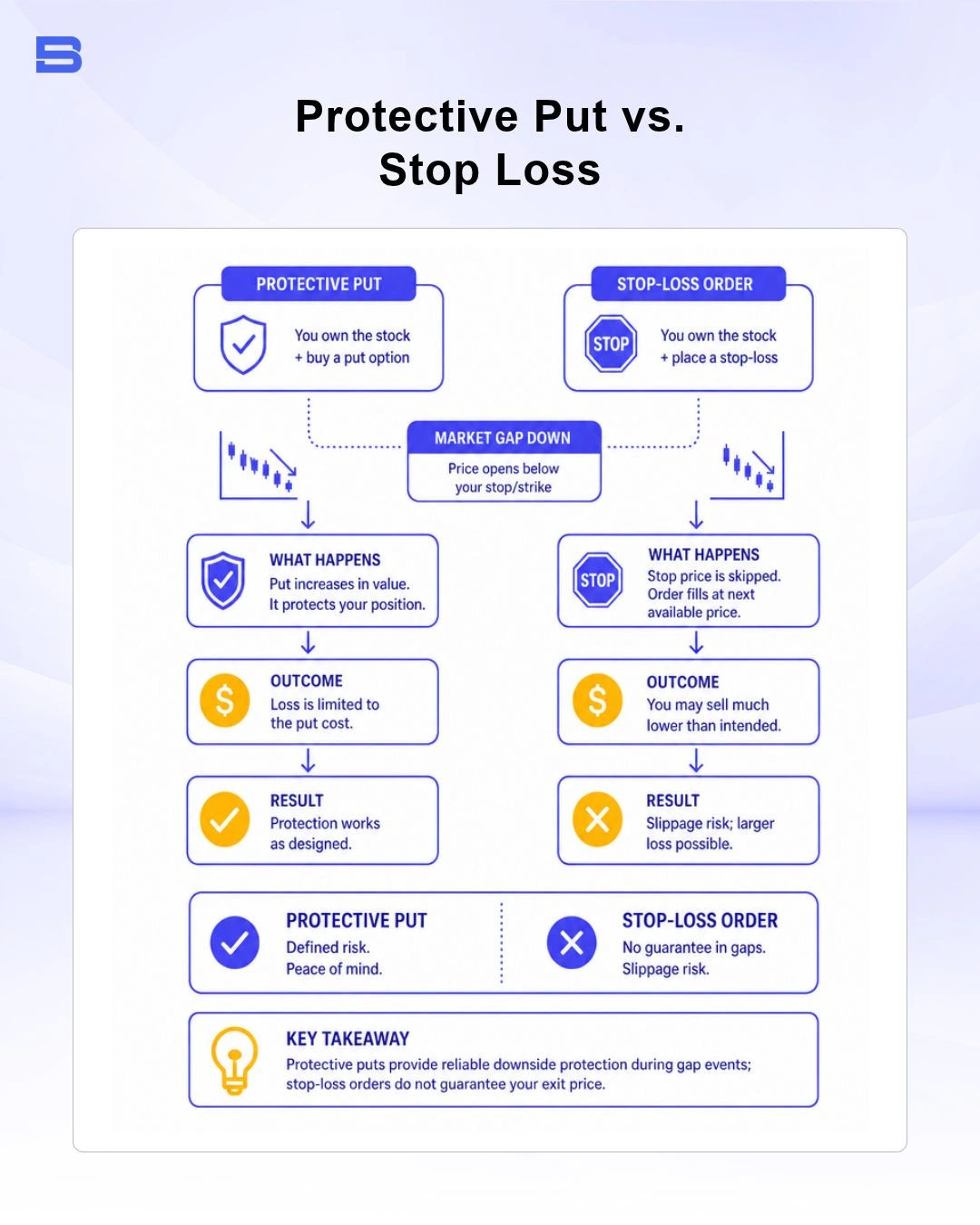
Many retail investors ask why they should pay upfront cash for the mechanic when a stop-loss order costs nothing to set on their broker platform. The distinction lies in execution mechanics during severe market gaps:
- Stop-Loss Order: Free to set, but functions as a market order once triggered. If a stock closes at $100 and gaps down to $70 overnight on devastating news, your $90 stop-loss will execute at the prevailing market price near $70, subjecting you to severe price slippage.
- Protective Put: Costs upfront capital (the premium), but acts as a hard contractual guarantee. Even if the stock gaps down to $50, your $95 put option guarantees you can exercise at $95, eliminating overnight gap execution risk.
Managing Risk, Time Decay (Theta), and Option Expiration
Holding it requires managing key option Greeks that continuously affect the pricing of your insurance policy.
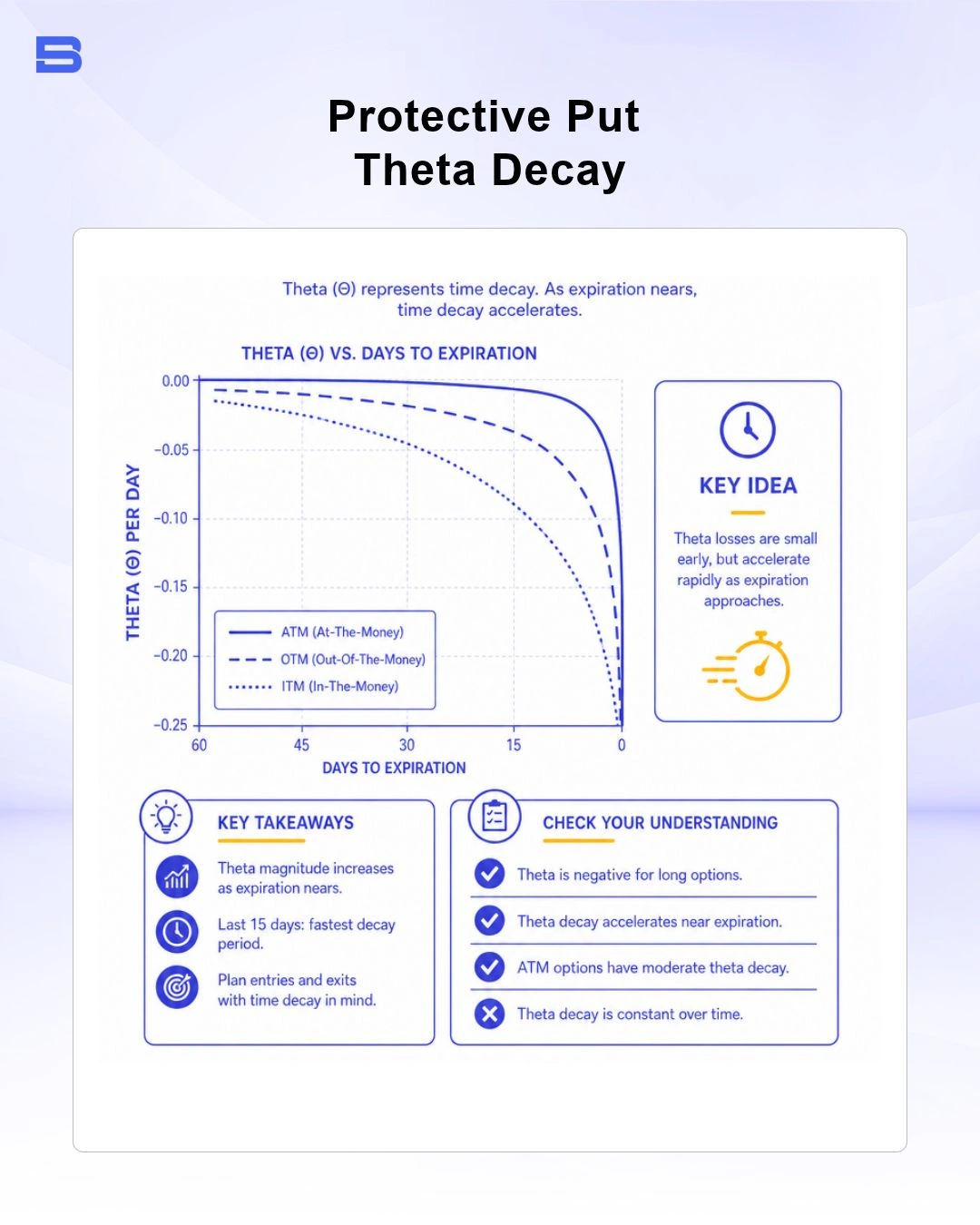
- Time Decay (Theta): Options lose extrinsic value as they approach expiration. Theta decay accelerates exponentially within the final 30 days to expiration (DTE). Purchasing longer-dated contracts (such as 60–90 DTE) significantly reduces daily theta erosion, making your stock insurance far more cost-effective.
- Implied Volatility (IV Crush): Buying the mechanic immediately before high-profile events often means paying inflated premiums due to elevated Implied Volatility (IV). Once the event passes, IV drops rapidly—a phenomenon known as IV crush. As a result, the option contract can lose value even if the underlying stock dips slightly.
If your stock continues to trade sideways or rise, you can manage an expiring protective put by closing the contract early to salvage residual extrinsic value or rolling the contract outward using a calendar spread structure.
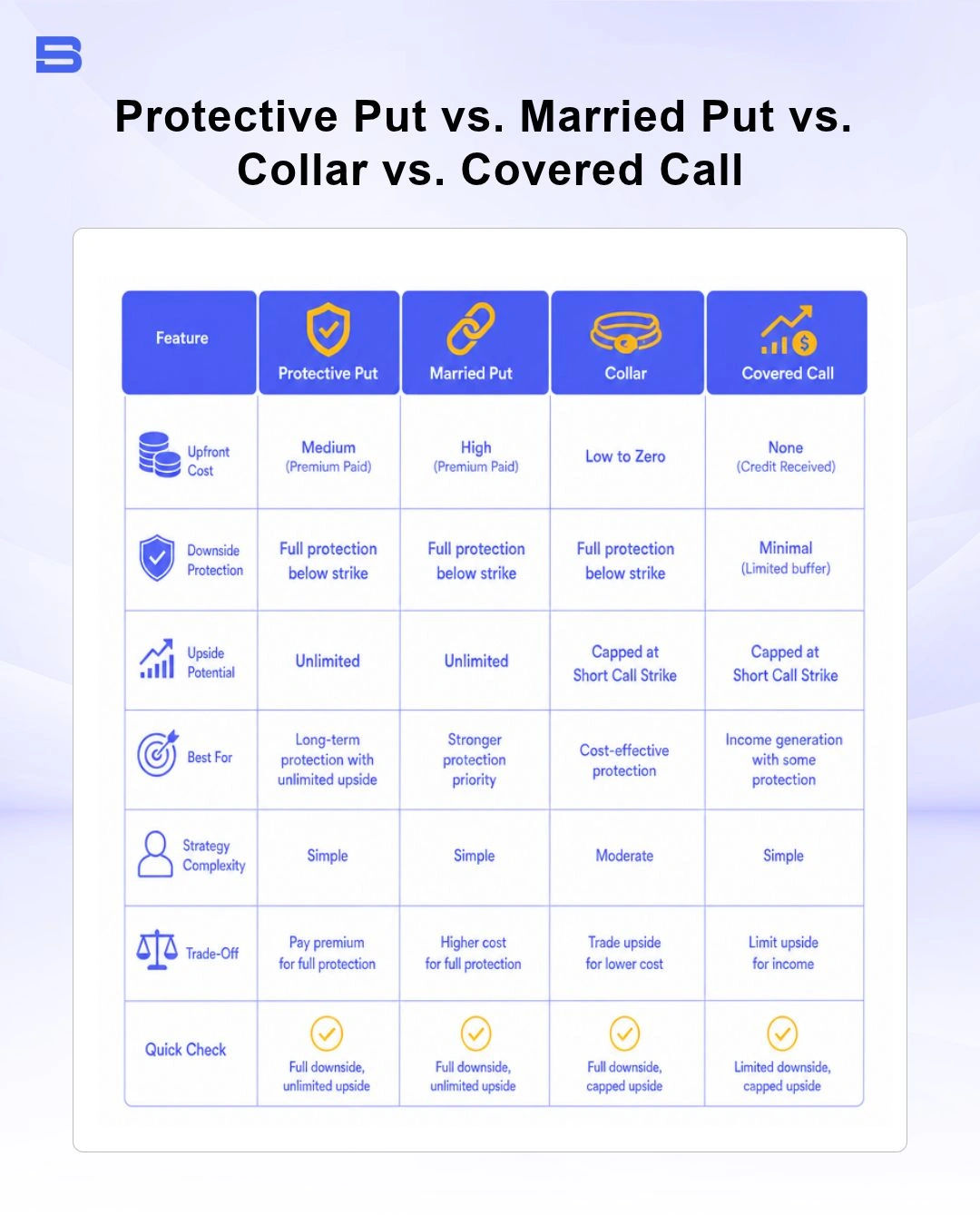
Protective Put Alternatives: Protective Put vs. Married Put vs. Collar vs. Covered Call
Depending on your capital, risk tolerance, and directional outlook, alternative hedging strategies may better suit your trading plan.
- Collar Strategy: You purchase it and simultaneously sell an out-of-the-money covered call on your stock. Premium collected from selling the call offsets or entirely funds the cost of buying the put option (a zero-cost collar). In exchange, your upside stock gains are capped at the call's strike price.
- Covered Call Strategy: Selling calls against shares generates recurring income, but offers only minor downside mitigation equal to the small premium collected.
- Defined-Risk Spreads: Strategies such as a bull call, bear put spread, or iron condor offer alternative directional or range-bound exposure with defined risk parameters without requiring full stock ownership.
Conclusion
A protective put options strategy helps investors limit the downside risk of holding an underlying asset while maintaining the potential to benefit if its price rises. By purchasing a put option alongside the asset, investors establish a minimum selling price for a defined period.
However, the protection comes at a cost, as the put premium reduces potential returns. Understanding the strike price, expiration date, and premium is essential when deciding whether it fits a particular risk-management approach.
- How to Build an Investment Plan That Actually Works for You?
- What Is the MACD Indicator and How to Use It
- What Is a Wedge Pattern in Trading?
- What Is Ichimoku Cloud Strategy? A Complete Trading System
- Mastering Elliott Wave Theory: Rules and Trading Strategies
- News Trading: Strategies, Execution Risks, and Risk Control
- What Is an Iron Condor Options Strategy?
- Backtesting Explained: What It Is and Why It Really Matters
- Grid Trading: Mechanics, Parameters, and Risk Strategies
- What Is Breakout Trading and How Does It Work?
- Mean Reversion: Technical Strategies and Risk Frameworks
- Momentum Trading: Indicators, Strategies, and Risk Control
- Hammer Candlestick: Structure, Meaning, and Strategy
- Doji Candlestick: Types, Signals, and Trading Strategies
- What Is the Sharpe Ratio and How to Calculate It
- What Is VWAP and How Do Traders Use It?
- Trade the Ascending Triangle: A Step-by-Step Practical Guide
- What Is the Stochastic Oscillator and How to Use It
- How to Trade the Descending Triangle Pattern
- High Frequency Trading: Speed, Algorithms, and Market Impact
- What Is Volume Profile and How to Use It in Trading
- What Is a Morning Star Pattern Candlestick?
- Trade with Parabolic SAR: A Practical Analysis Guide
- Evening Star Pattern: Structure, Rules, and Risk Controls
- Kelly Criterion: Formula, Position Sizing, and Risk
- What Is the NYSE Minimum Trading Price? Rules Explained
Disclaimer: The content on this page is intended for educational and informational purposes only. It does not constitute financial, investment, tax, or legal advice, and should not be interpreted as a recommendation to buy, sell, or hold any financial instrument or asset. Trading and investing involve significant risk, including the possible loss of your entire capital. Products such as forex, CFDs, and cryptocurrencies carry additional risks due to leverage, high volatility, and limited regulatory protection in some jurisdictions. Past performance of any financial instrument does not guarantee future results. Any market views, forecasts, or opinions expressed are those of the author at the time of writing and may not reflect current market conditions. Platform features, fees, and regulatory status are subject to change — always verify information directly with the relevant provider or regulator before making any financial decision. BrokerSpecs may receive compensation from third parties featured on this site. Always conduct your own due diligence and consider seeking advice from a licensed financial professional before investing. Portions of this article were prepared with the assistance of AI tools and reviewed by our editorial team before publication.