


- How to Start Trading: A Step-by-Step Guide for Beginners
- Demo Trading Accounts: Safe Practice for Beginners
- Understanding How Much Capital You Need to Start Trading
- How to Set Realistic Trading Goals as a New Trader
- How to Open a Trading Account in Malaysia (Step-by-Step)
- How to Start Trading in Malaysia: A Guide for Beginners
- How to Create a Trading Plan Before You Start Trading
- What Is a Trading Account? Everything You Need to Know
- How to Learn Trading: Step-by-Step Beginner Roadmap
- What Is Stop Loss in Trading and How Does It Work?
- Why Every Trader Needs a Trading Journal
- Islamic Forex Account Explained: How Swap-Free Trading Works
- Funded Trading Account: Rules, Splits & Risks
- Master Money Management: Practical Capital Protection Rules
- Overtrading Explained: Common Causes, Signs, and How to Stop
- How Risk-Reward Ratio Works: A Guide to Trading Risk
- How to Open a Brokerage Account as a Beginner
- What Is a Cent Account Forex and How Does It Work?
- What Is an ECN Account and How Does It Work?
- What Is Cashback Forex and How Does It Work?
- Fixed Deposit vs Unit Trust: Key Differences for Investors
- Welcome Bonus Forex: What It Is and What to Watch For
- Forex Deposit Bonus: How It Works
- What Is Forex Rebate and How Does It Work?
- What Is Forex Free Credit and How Does It Work?
- Trading Webinars: Are They Worth Attending?
- Trading for Beginners PDF: What to Look For in a Good Guide
- Trading 101: How to Start Trading Safely and Effectively

Building a meaningful portfolio used to require substantial upfront capital. For decades, traditional brokerages imposed high account minimums and minimum order sizes, effectively locking out individuals who could only set aside small amounts each month.
Modern financial technology has fundamentally altered this dynamic. Through fractional share ownership and automated clearing systems, retail investors can now deploy spare change or small, regular contributions directly into global capital markets.
However, entering the market with micro-deposits introduces unique structural considerations—particularly regarding platform fee models—that can either accelerate or quietly erode your capital growth.
What Is Micro Investing and How Does It Work?
Micro investing is an investment strategy that allows individuals to purchase financial assets using small, regular sums of money—often starting with as little as $1 or spare change from everyday purchases. Rather than waiting to accumulate a large lump sum, you allocate capital incrementally into diversified portfolios or individual securities.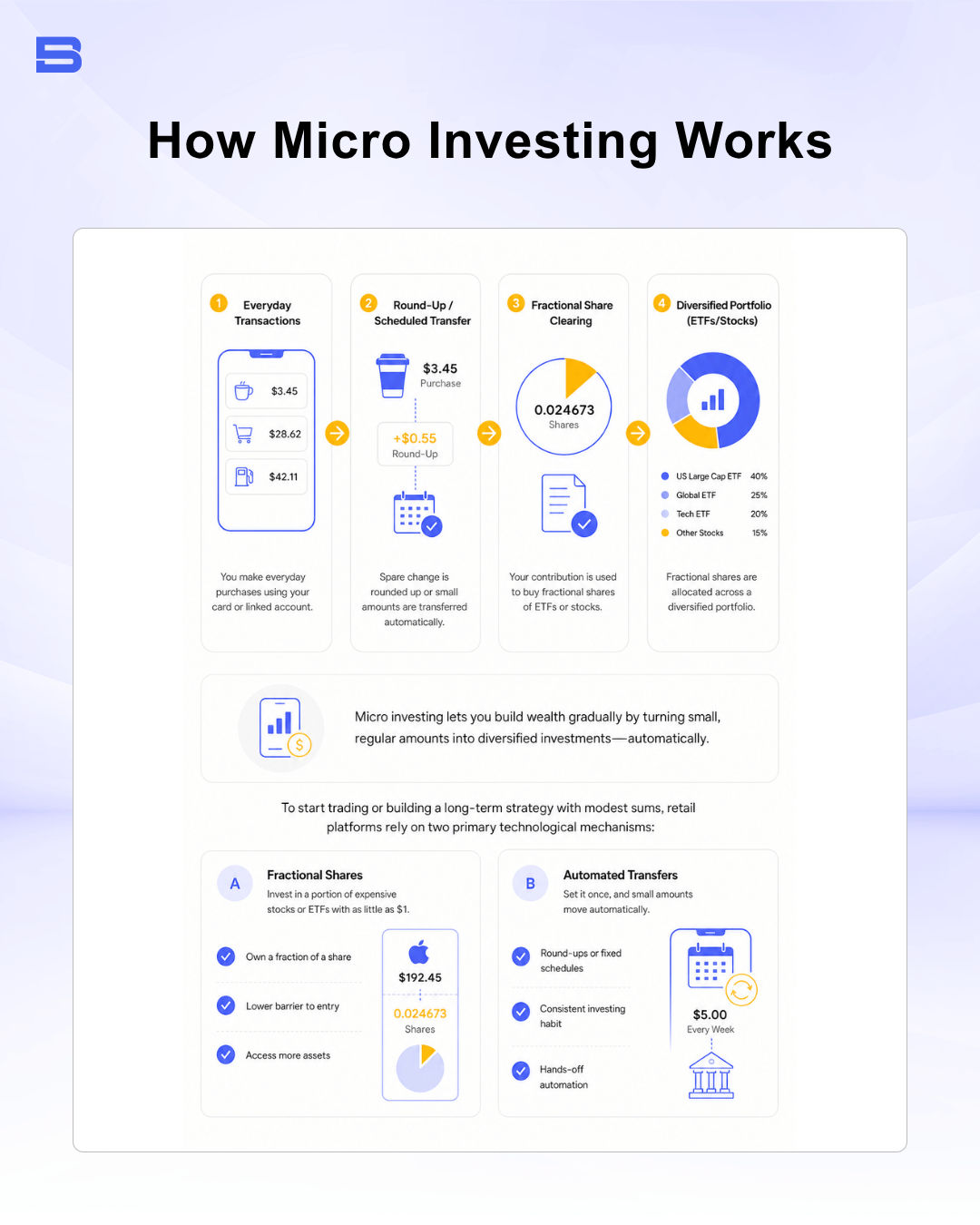 To start trading or building a long-term strategy with modest sums, retail platforms rely on two primary technological mechanisms: fractional shares and automated transfers.
How Fractional Shares Make Micro Investing Possible
Historically, if a single share of a major index ETF or corporate stock traded at $500, you needed at least $500 to buy into that asset. Fractional shares break this barrier by splitting single shares into micro-units (often down to 1/10,000th of a share).
When you invest $5 into a high-priced stock or ETF, the platform pools your capital with other retail orders and purchases the asset on the primary market, ledgering your precise fraction to your account. This allows even small balances to gain direct proportional exposure to underlying market movements and dividend distributions.
Spare Change Round-Ups vs. Scheduled Recurring Deposits
Micro-investing applications generally execute transfers using one of two methods:
- Round-Up Automation: The platform links to your everyday debit or credit card. When you make a transaction—such as buying a $3.40 coffee—the app rounds the charge up to $4.00 and routes the $0.60 difference into your investment portfolio.
- Scheduled Recurring Deposits: You set an automated transfer of a fixed dollar amount (e.g., $5 every day or $25 every week) from your bank account directly into your portfolio.
While round-ups offer a frictionless, habit-forming introduction to saving, scheduled recurring deposits provide more predictable cash flows, making it far easier to structure a disciplined financial plan.
Combining Micro Investing with Dollar-Cost Averaging
Micro investing is inherently an automated application of dollar cost averaging. Rather than trying to time market tops and bottoms—a practice that challenges even seasoned professionals—you allocate fixed amounts of capital at regular intervals regardless of asset prices.
When market prices decline, your fixed micro-deposit buys a higher quantity of fractional shares. When prices rise, your deposit buys fewer shares. Over extended horizons, this systematic purchasing structure smooths out your average cost per share and removes emotional bias from your execution.
Automated Portfolios and Robo-Advisors
For beginners who prefer not to manage individual share selections, micro investing frequently pairs with automated portfolio engines. Platforms operating under oversight from Tier 1 financial authorities—such as the US Securities and Exchange Commission (SEC)—frequently deploy algorithms to construct globally diversified ETF portfolios based on your assessed risk profile.
Advantages and Limitations of Micro Investing
Deploying capital in small increments offers distinct psychological and structural advantages, but it also carries operational constraints that must be managed realistically.
Advantages
- Behavioral Habit Formation: Automating small transfers shifts investing from an occasional, high-friction decision into an effortless daily habit.
- Immediate Market Participation: Capital is put to work immediately rather than idling in low-yield cash accounts while waiting to reach traditional brokerage minimums.
- Accessibility to Blue-Chip Assets: Fractional ownership lets small portfolios hold diversified exchange-traded funds or higher-priced shares that would otherwise be out of reach.
Limitations
- Slow Absolute Wealth Building: Investing spare change alone (e.g., $20 a month) will not build a complete retirement nest egg. Capital growth requires increasing your contributions over time.
- Structural Fee Vulnerability: As shown earlier, fixed-fee subscription tiers on small balances actively destroy capital.
- Psychological Overconfidence: Small-scale participation can create a false sense of security, leading some investors to neglect broader personal finance fundamentals, such as establishing an adequate liquid cash reserve before committing funds to volatile assets.
Capital Requirements: How Much Do You Actually Need?
To evaluate how much money you need for micro investing, it helps to distinguish between platform technical minimums and economically viable contribution levels.
Technically, many modern applications permit account opening and trade execution with as little as $1 to $10. However, to operate an account efficiently and ensure fees do not erode your capital:
- If using a platform with flat monthly fees ($3–$5/mo): Aim to scale your total balance above $2,000 as quickly as possible, or maintain monthly contributions of at least $150–$200 to reduce the relative drag of the fee.
- If using a percentage-based fee platform (e.g., 0.50% p.a.): You can start with as little as $10 to $50 without fee drag penalties, as your fee scales directly with your balance (e.g., $0.25 per year on a $50 balance).
Getting Started With Micro Investing
Micro investing eliminates the historic barriers that kept small savers out of global markets. By converting everyday spare change or modest daily transfers into fractional share ownership, it provides an accessible, low-friction entry point for beginners.
To maximize the strategy's benefits, pay strict attention to fee structures: avoid flat monthly subscription fees on small account balances, automate recurring contributions rather than relying solely on round-ups, and steadily scale your deposit amounts as your financial capacity grows.
Disclaimer: The content on this page is intended for educational and informational purposes only. It does not constitute financial, investment, tax, or legal advice, and should not be interpreted as a recommendation to buy, sell, or hold any financial instrument or asset. Trading and investing involve significant risk, including the possible loss of your entire capital. Products such as forex, CFDs, and cryptocurrencies carry additional risks due to leverage, high volatility, and limited regulatory protection in some jurisdictions. Past performance of any financial instrument does not guarantee future results. Any market views, forecasts, or opinions expressed are those of the author at the time of writing and may not reflect current market conditions. Platform features, fees, and regulatory status are subject to change — always verify information directly with the relevant provider or regulator before making any financial decision. BrokerSpecs may receive compensation from third parties featured on this site. Always conduct your own due diligence and consider seeking advice from a licensed financial professional before investing.