


Related Tags
Spotting Bitcoin listed at $64,200 on one exchange while trading at $64,500 on another feels like discovering free money on the sidewalk. Your immediate reaction is simple: buy where it is cheap, sell where it is expensive, and pocket the difference. Yet retail traders who rush into these apparent pricing anomalies often watch their expected profits disappear into unexpected friction before a single transaction settles.
What Is Crypto Arbitrage and How Does It Work?
Crypto arbitrage is the practice of purchasing a digital asset in one market and simultaneously selling it in another to profit from a price divergence.
To see how crypto arbitrage works, it helps to start with why prices differ between exchanges. Unlike traditional stock markets that route retail trades through consolidated national market systems, digital asset liquidity remains scattered across hundreds of independent centralized and decentralized venues.
Because crypto exchanges run private matching engines without a central clearing counterparty, prices reflect supply and demand within their own isolated systems. When a wave of aggressive market orders consumes buy quotes on Exchange A, its spot price climbs immediately. Exchange B might experience no such flow, creating a brief window where identical tokens trade at disparate valuations.
These pricing dislocations occur constantly, but capturing them requires interacting directly with an exchange’s order book. The theoretical spread between the highest bid on one platform and the lowest ask on another looks attractive on a comparison dashboard, yet that surface gap rarely represents actionable yield.
Primary Crypto Arbitrage Strategies: Cross-Exchange vs. Triangular
Traders deploy two primary strategies to capture price differences: routing capital across distinct venues or cycling through multiple currency pairs inside a single platform.
Cross-Exchange Arbitrage: Centralized and Decentralized Routes
Cross-exchange arbitrage involves monitoring price imbalances between two or more separate trading venues. In a centralized route, you buy on an exchange experiencing heavy sell volume and offload the coins on a venue with strong localized demand. On decentralized platforms, pricing depends on automated market makers where token reserves define valuations through mathematical formulas. Traders track liquidity depth across these protocols using on-chain analysis to anticipate when trade volume pushes automated pools out of line with centralized order books.
Executing cross-exchange trades by purchasing coins and manually transferring them over a blockchain introduces substantial transfer latency. By the time a blockchain network confirms your transaction, the price discrepancy has typically vanished. Serious participants bypass transfer times by maintaining balances of fiat, stablecoins, and volatile assets on both venues simultaneously, executing simultaneous offsetting trades the instant a spread appears.
Triangular Arbitrage: Exploiting Intra-Exchange Pair Inefficiencies
Triangular arbitrage occurs entirely within a single platform, eliminating the need to move funds across different networks. This approach exploits pricing inconsistencies between three linked trading pairs, such as BTC/USDT, ETH/BTC, and ETH/USDT, where USDT is a stablecoin pegged to the US dollar.
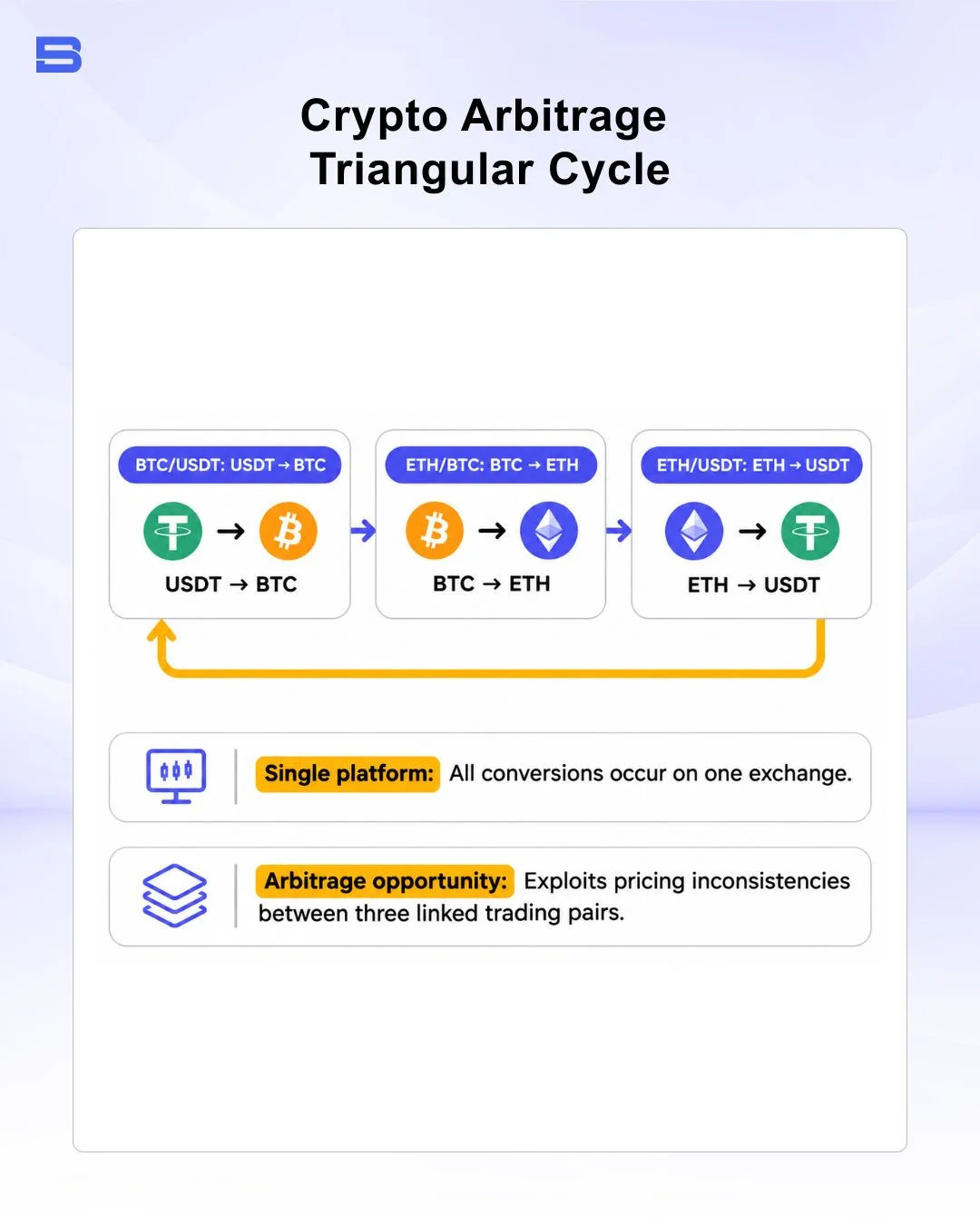
You start with a base balance of USDT, convert it to Bitcoin, exchange that Bitcoin for Ethereum, and immediately convert that Ethereum back to USDT. If the relative exchange rates between the three pairs drift out of mathematical alignment by more than the combined trading fees and slippage on all three legs, the final USDT balance can exceed your starting capital. Because all three legs execute on the same platform, you avoid withdrawal fees and blockchain confirmation delays.
However, you pay exchange trading commissions on three consecutive transactions, which rapidly eats into thin fractional gains.
A Worked Example: Gross Spread vs. Net Realized Gain
Evaluating crypto arbitrage requires looking past theoretical price differences and calculating total transaction friction. Consider an apparent $300 price spread on Ethereum between two centralized exchanges.
Suppose Exchange A quotes ETH at $3,000, while Exchange B quotes ETH at $3,300. You deploy $10,000 to purchase 3.333 ETH on Exchange A, intending to sell it immediately on Exchange B for an apparent gross profit of $1,000 (a 10% gross spread).
Here is how real-world friction dismantles that margin:
- Taker fees on Exchange A: Buying 3.333 ETH at a 0.40% taker fee incurs a direct cost of $40.00.
- On-chain withdrawal fee: Transferring ETH from Exchange A to Exchange B may involve an exchange withdrawal fee and an Ethereum network gas fee. The combined cost varies depending on the exchange’s withdrawal policy and prevailing network congestion, so traders should check both charges before initiating the transfer.
- Execution latency and slippage: During the 12-minute blockchain confirmation window, incoming sell volume on Exchange B pushes the bid price down from $3,300 to $3,120. Your 3.333 ETH is now worth $10,398.96 gross on Exchange B instead of the anticipated $11,000.
- Taker fees on Exchange B: Selling the 3.333 ETH at Exchange B’s 0.40% taker fee costs $41.60.
- Fiat/stablecoin withdrawal fee: Moving your final balance out of Exchange B incurs an additional fixed fee of $25.00.
Your fixed expenses across both legs reach $106.60 in fees before the variable on-chain withdrawal and gas costs, while adverse market movement during transfer costs $601.04 in lost spread. Your realized payout drops from an expected $1,000 gross gain to a modest net return of $292.36 before those on-chain costs. If network congestion spikes gas costs or liquidity thinness triggers deeper slippage on the order book, that remaining margin turns into an outright loss.
The Real Risks and Costs of Crypto Arbitrage
Chasing price disparities without an institutional infrastructure exposes your portfolio to severe operational hazards. As noted by the International Organization of Securities Commissions (IOSCO), crypto asset platforms present heightened counterparty risks, execution vulnerabilities, and structural volatility that retail participants frequently underestimate.
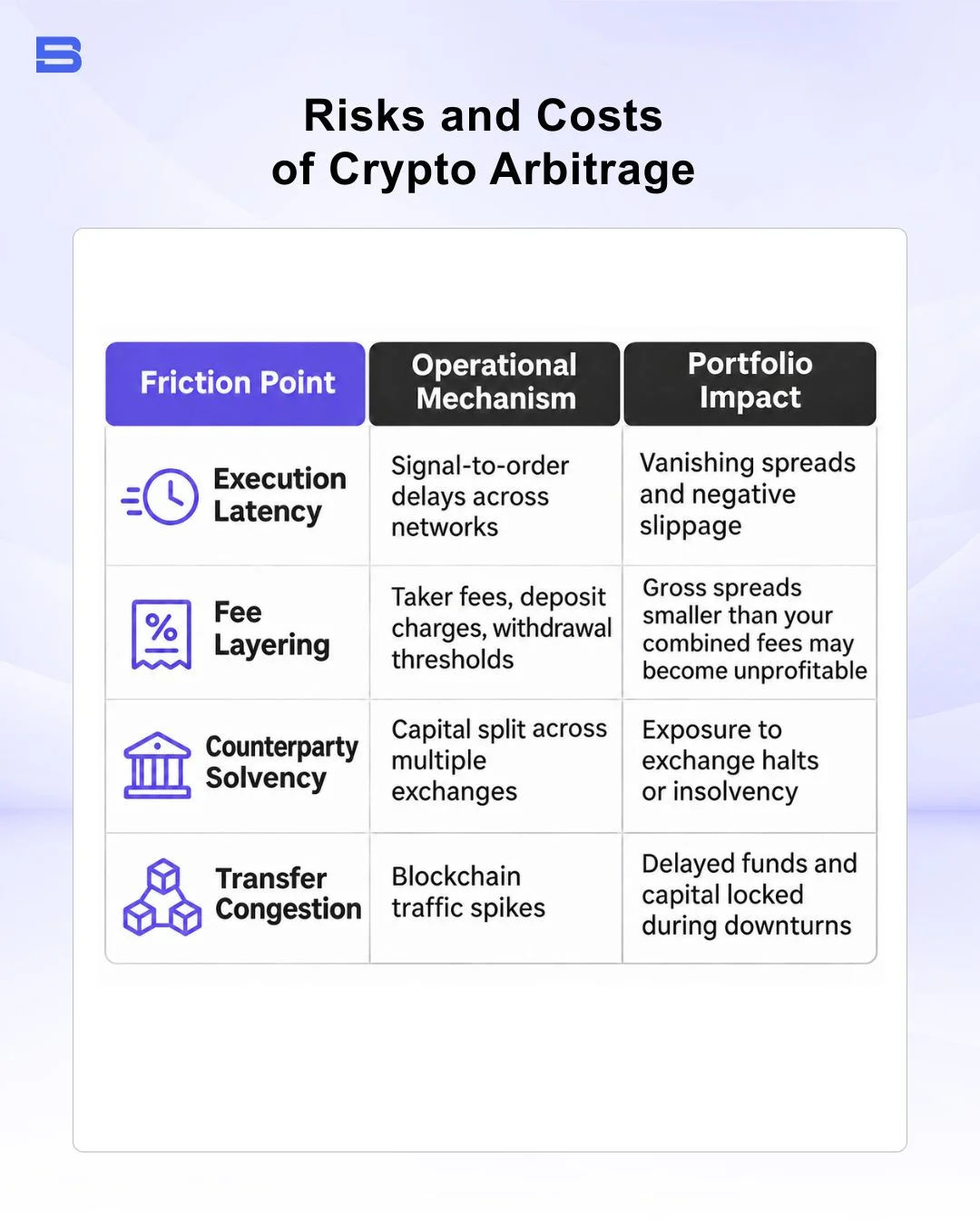
Holding pre-positioned capital across multiple secondary exchanges to eliminate transfer latency introduces acute balance-sheet risk. Splitting your funds means trusting multiple exchange operators with your custody. If one venue halts withdrawals or faces liquidity runs, the capital lost can wipe out months of accumulated arbitrage returns. A disciplined trader must weigh these operational realities against broader portfolio construction principles, as outlined in how to build an investment plan.
Before you deposit funds, check that each exchange is registered with the financial regulator in your jurisdiction, as an unregistered platform may offer limited investor protection if it fails. Be wary of any service or trading bot that promises fixed or guaranteed arbitrage profits, because such promises are a common red flag for fraud.
Beyond Simple Gaps: How Arbitrage Fits Into Quantitative Trading
In institutional markets, manual spatial arbitrage (buying and selling the same asset on different exchanges) is largely obsolete. Automated high-frequency algorithms connected directly to exchange Application Programming Interfaces (APIs) monitor order books simultaneously, executing balancing trades in milliseconds the instant a gap exceeds transaction costs.
Retail traders exploring quantitative finance often compare simple spatial price capture to statistical arbitrage, which uses econometric modeling to trade mean-reverting relationships between correlated assets. Rather than requiring speed to capture a temporary exchange discrepancy, statistical approaches rely on mathematical convergence over longer timeframes.
These quantitative systems differ substantially from directional methods like momentum investing, where traders ride existing trend strength, or rule-based trend-following models like the turtle trading strategy. While momentum strategies accept directional market risk to capture larger price expansions, arbitrage aims to remain market-neutral, deriving its edge entirely from execution speed and structural cost advantages.
Key Takeaways on Crypto Arbitrage
Crypto arbitrage offers a clear window into how digital asset liquidity functions, but it is not a shortcut to effortless gains. Sustainable execution demands precise fee accounting, sophisticated latency management, and an honest assessment of counterparty risks. Before allocating capital across fragmented venues, ensure your strategy accounts for every layer of network friction, exchange commission, and execution delay.
- How to Build an Investment Plan That Actually Works for You?
- What Is the MACD Indicator and How to Use It
- What Is a Wedge Pattern in Trading?
- What Is Ichimoku Cloud Strategy? A Complete Trading System
- Mastering Elliott Wave Theory: Rules and Trading Strategies
- News Trading: Strategies, Execution Risks, and Risk Control
- What Is an Iron Condor Options Strategy?
- Backtesting Explained: What It Is and Why It Really Matters
- Grid Trading: Mechanics, Parameters, and Risk Strategies
- What Is Breakout Trading and How Does It Work?
- Mean Reversion: Technical Strategies and Risk Frameworks
- Momentum Trading: Indicators, Strategies, and Risk Control
- Hammer Candlestick: Structure, Meaning, and Strategy
- Doji Candlestick: Types, Signals, and Trading Strategies
- What Is the Sharpe Ratio and How to Calculate It
- What Is VWAP and How Do Traders Use It?
- Trade the Ascending Triangle: A Step-by-Step Practical Guide
- What Is the Stochastic Oscillator and How to Use It
- How to Trade the Descending Triangle Pattern
- High Frequency Trading: Speed, Algorithms, and Market Impact
- What Is Volume Profile and How to Use It in Trading
- What Is a Morning Star Pattern Candlestick?
- Trade with Parabolic SAR: A Practical Analysis Guide
- Evening Star Pattern: Structure, Rules, and Risk Controls
- Kelly Criterion: Formula, Position Sizing, and Risk
- What Is the NYSE Minimum Trading Price? Rules Explained
Disclaimer: The content on this page is intended for educational and informational purposes only. It does not constitute financial, investment, tax, or legal advice, and should not be interpreted as a recommendation to buy, sell, or hold any financial instrument or asset. Trading and investing involve significant risk, including the possible loss of your entire capital. Products such as forex, CFDs, and cryptocurrencies carry additional risks due to leverage, high volatility, and limited regulatory protection in some jurisdictions. Past performance of any financial instrument does not guarantee future results. Any market views, forecasts, or opinions expressed are those of the author at the time of writing and may not reflect current market conditions. Platform features, fees, and regulatory status are subject to change — always verify information directly with the relevant provider or regulator before making any financial decision. BrokerSpecs may receive compensation from third parties featured on this site. Always conduct your own due diligence and consider seeking advice from a licensed financial professional before investing. Portions of this article were prepared with the assistance of AI tools and reviewed by our editorial team before publication.