


Related Tags
Imagine sitting in front of your trading screen, watching the price of gold fluctuate second by second. A pop-up asks a simple question: "Will gold be higher than $2,500 in sixty seconds? Click Yes for an 80% return, or No to pass."
This simple Yes/No interface is the primary draw of binary options trading. While the fixed outcomes look straightforward on the surface, underlying mathematical odds and severe risk dynamics make this financial instrument far more complex than it first appears.
What Are Binary Options? Definition and Core Concept
Binary options are fixed-payoff financial derivative contracts where you predict whether an underlying asset's price will settle above or below a specified benchmark at a precise expiry time. The word "binary" reflects the two mutually exclusive outcomes: you either earn a predetermined fixed profit or forfeit your entire invested capital.
These instruments are widely categorized as all or nothing options because there is no middle ground. Unlike conventional stock or currency trading, you do not purchase or take ownership of the underlying asset itself. Instead, you are placing a financial proposition on short-term price movement.
If your prediction proves correct when the contract expires, you receive a payout ranging from 60% to 90% of your stake. If your prediction is wrong by even a single penny, your initial stake is completely wiped out.
Have you ever wondered why financial regulators around the globe scrutinize these fixed-payout structures so strictly? The answer lies in how contracts are calculated behind the scenes.
How Do Binary Options Work? Key Mechanics
Trading binary contracts involves three fundamental steps: selecting an asset, choosing an expiry time, and choosing a direction. You select a "Call" (or Up) option if you expect the price to rise above the strike price, or a "Put" (or Down) option if you expect it to fall.
Contract Components: Strike Price, Expiry Time, and Payout
Every binary contract relies on four core parameters that determine your trade setup:
- Underlying Asset: The underlying market instrument, such as currency pairs, equities, or market indices.
- Strike Price: The target price level that the underlying asset must exceed or fall below at expiry.
- Expiry Time in Binary Options: The exact timeframe for the trade, ranging from 60 seconds to several weeks.
- Fixed Return: The percentage profit paid by the platform if the trade closes in your favor.
Forex, Stocks, and Indices Trading in Binary Options
Brokers typically offer binary contracts across major financial markets. You can speculate on currency pairs like EUR/USD, global equity shares, or indices trading like the S&P 500 or FTSE 100.
What Is Commodity Trading in Binary Contracts?
Brokers also allow binary contract speculation on raw materials. What is commodity trading in this environment? It allows you to place short-term directional bets on crude oil, silver, or gold prices without dealing with physical futures contracts or spot margin.
The Math Behind Binary Options: Why the Odds Favor the House
To evaluate whether binary options fit your trading goals, you must examine the underlying mathematical expectancy. Consider a common trade scenario where you risk $100 on a market contract with a promised 80% payout.
If your prediction is correct, you gain $80 in profit. If your prediction is wrong, you lose your full $100 stake. This creates an asymmetrical risk-reward profile where your maximum loss (100) exceeds your maximum potential gain (80).
To break even over time with an 80% payout, you cannot simply win 50% of your trades. The formula for break-even win rate requires dividing your stake by your total payout ($100 / $180), which equals a required win rate of 55.56%. If platform payouts drop to 70%, your required win rate jumps to nearly 58.82% just to avoid losing capital over a series of trades.
Binary Options vs. Forex Trading: Key Differences
Many beginners mistake binary options for simplified spot forex trading. While both involve currency markets, their operational mechanics and risk profiles differ substantially.
In the forex market, profits and losses depend on how far the price moves in your favor, and positions can remain open indefinitely. In binary options, price movement distance does not alter your payout; closing one pip in your favor yields the exact same return as closing one hundred pips in your favor.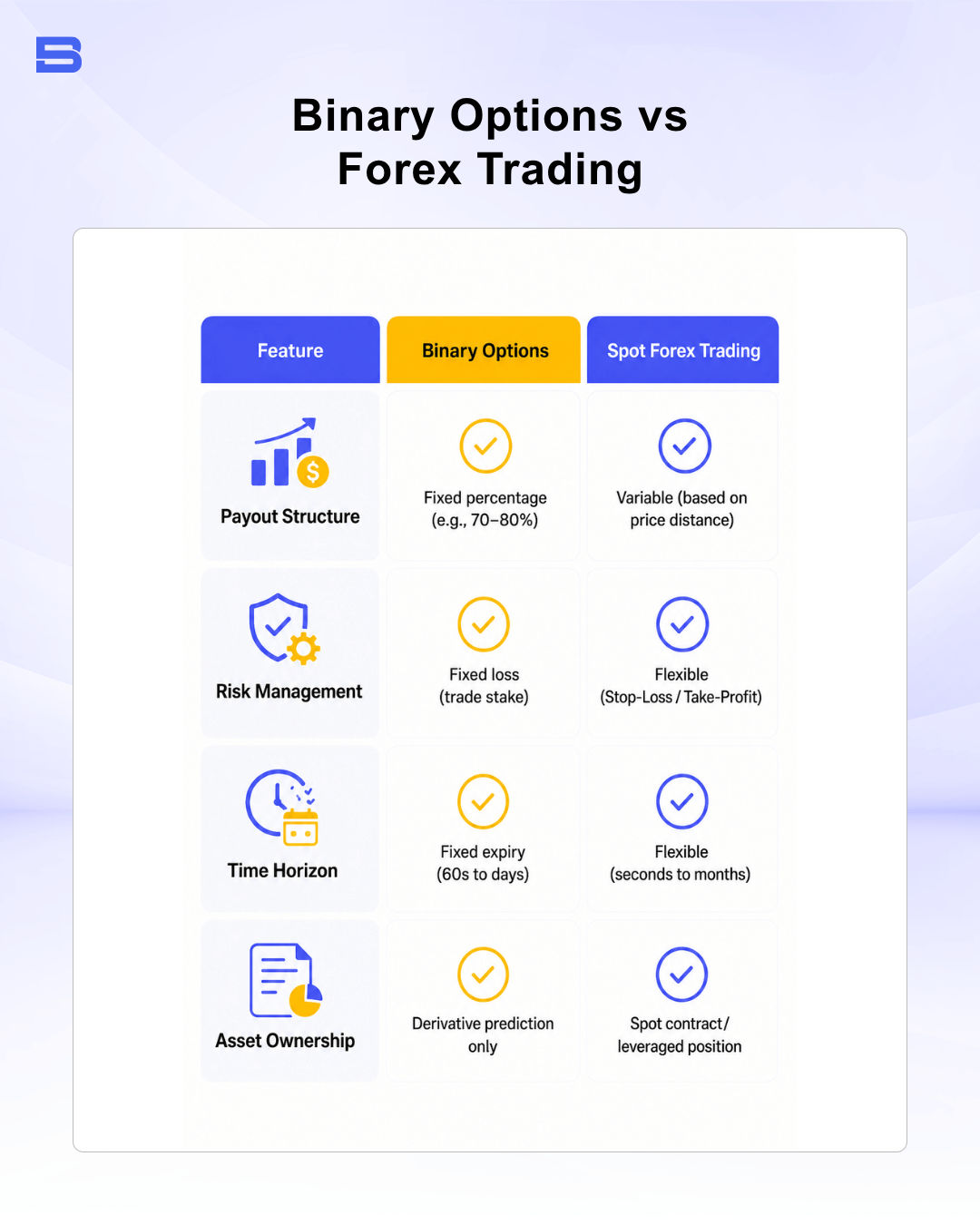 Spot forex traders manage downside exposure using customizable stop-loss orders and position sizing. In contrast, binary option contracts lock in your loss duration and cap your upside potential from the moment the trade opens.
Are Binary Options Legal in Malaysia? Regulatory Status
Regulatory status is a critical consideration for any retail investor evaluating financial instruments. Are binary options legal in Malaysia? Regulatory agencies maintain strict oversight and clear warnings regarding these platforms.
The Securities Commission Malaysia (SC) and Bank Negara Malaysia (BNM) do not license or authorize retail binary option platforms for public operation. Operating or trading through unlicensed offshore binary brokers exposes investors to significant financial risks, including frozen withdrawal requests and non-existent dispute resolution mechanisms.
Globally, regulatory bodies take a similar firm stance. The US Securities and Exchange Commission (SEC) has issued public alerts regarding binary options fraud, while the UK's Financial Conduct Authority (FCA) banned retail binary options sales altogether.
Before depositing funds on any online trading platform, always verify the provider's legal status against the Securities Commission Malaysia Investor Alert List. Protecting your investment capital begins with regulatory verification.
Safer Regulated Alternatives: Structured Warrants and Unit Trusts
If you are looking for regulated investment tools with controlled risk profiles, local markets offer several authorized alternatives. Investors seeking defined-risk derivative exposure can explore structured warrants traded directly on Bursa Malaysia under established regulatory oversight.
For traders interested in equity exposure or broader market indices, exchange-traded products like indices trading or commodity trading via regulated brokers offer standardized transparency.
If your primary goal is sustainable wealth creation rather than short-term price speculation, consider institutional options like a unit trust or index funds. These vehicles offer professional management and diversification without the negative expectancy inherent in binary contracts.
Binary Options in a Nutshell
Binary options attract retail traders through simple Yes/No choices and fast-paced payouts, but the underlying mechanics heavily favor platform providers. The requirement for a win rate exceeding 55–60% combined with widespread regulatory warnings makes them a risky choice for serious investors. Prioritizing regulated exchange-traded alternatives remains the safest path toward long-term trading success.
- What Can You Trade? A Guide to Forex, Stocks, and More
- CFD Trading for Beginners
- What is CFD Trading and How Does It Work?
- Forex vs. Stocks: Which Market Suits You Best?
- How to Diversify a Portfolio Across Asset Classes
- How Dividend Stocks Work: Yields, Risks, and Strategies
- Silver Trading Explained: A Guide for Retail Investors
- Precious Metals Trading: A Complete Guide for Beginners
- Natural Gas Trading: A Guide to the Market
- Structured Warrants Malaysia: How They Work and Risks
- What Is the KLCI Index and How to Trade It
- Gold Investment in Malaysia: A Complete Guide for Beginners
- What Is Kijang Emas and How to Invest in It
- Value Investing Explained: How to Find Undervalued Stocks
- How to Trade Bitcoin Safely: A Complete Market Guide
- Growth Investing Explained: Strategies, Metrics, and Risks
- What Is Digital Gold Malaysia and How to Invest
- Crypto Trading Strategies for Beginners
- Gold vs Bitcoin: Key Differences, Risks, and Strategies
- Sukuk: A Guide for Beginners to Islamic Bonds
- What Is FCPO (Crude Palm Oil Futures) and How to Trade It
- How to Identify and Invest in Shariah-Compliant Stocks
- Timber Investment: Is It Worth It?
- Gold ETF Malaysia: A Guide for Beginners
- What Are Malaysian Government Securities (MGS)?
- Corporate Bonds Malaysia: A Guide for Beginners
- China A-Shares Trading Guide for Malaysian Investors
- What Is a Silver ETF and How to Invest in It?
- How to Trade XRP: A Practical Guide for Retail Investors
- How to Trade Solana (SOL): A Guide for Beginners
- What Are Gold Futures and How Do They Work?
- Money Market Fund in Malaysia: A Guide for Beginners
- Property Investment Malaysia: Direct Real Estate or M-REITs?
- What Is Binance Coin and How Does It Work?
- Green Sukuk: A Guide for Beginners to Islamic ESG Investing
- What Is Shiba Inu (SHIB) and How to Trade It
- What Is USDT? A Complete Guide to Tether for Beginners
- What Is Dogecoin and How to Trade It Safely for Beginners
- Cardano: A Guide for Beginners to Trade This Cryptocurrency
- Polkadot: A Guide to Trading This Cryptocurrency
- Tron: A Guide for Beginners to Trading This Cryptocurrency
- What Is Litecoin (LTC)? A Guide to Trading Digital Silver
- What Is Chainlink (LINK) and How to Trade It
- How to Trade Pepe Coin: Spot, Leverage, and Risk Management
- Near Protocol: A Guide to Trading This Cryptocurrency
- Trading Polygon Crypto: A Practical Guide for Beginners
- Trade Toncoin: Understanding the TON Ecosystem and Risks
- Cosmos Crypto: Ecosystem Architecture, Tokenomics, and Risks
- Stellar Crypto: A Guide to Trading This Cryptocurrency
- Avalanche Crypto Explained: A Practical Guide for Traders
- What Is Worldcoin? How to Trade WLD and Manage Risk
- Aptos: A Guide for Beginners to Trading This Cryptocurrency
- Sui Crypto Explained: Tokenomics and Trading Guide
- Celestia: A Guide to Trading This Cryptocurrency
- Decentraland: A Guide to Trading This Cryptocurrency
- What Is Arbitrum? How to Trade the Leading Layer 2 Network
- Sei Crypto: A Guide to Trading This Cryptocurrency
- What Is Injective Protocol and How to Trade INJ Safely
Disclaimer: The content on this page is intended for educational and informational purposes only. It does not constitute financial, investment, tax, or legal advice, and should not be interpreted as a recommendation to buy, sell, or hold any financial instrument or asset. Trading and investing involve significant risk, including the possible loss of your entire capital. Products such as forex, CFDs, and cryptocurrencies carry additional risks due to leverage, high volatility, and limited regulatory protection in some jurisdictions. Past performance of any financial instrument does not guarantee future results. Any market views, forecasts, or opinions expressed are those of the author at the time of writing and may not reflect current market conditions. Platform features, fees, and regulatory status are subject to change — always verify information directly with the relevant provider or regulator before making any financial decision. BrokerSpecs may receive compensation from third parties featured on this site. Always conduct your own due diligence and consider seeking advice from a licensed financial professional before investing. Portions of this article were prepared with the assistance of AI tools and reviewed by our editorial team before publication.