


Related Tags
Imagine watching the evening news as crude oil prices spike following a global supply disruption, or hearing about gold hitting new highs as market uncertainty grows. These raw economic inputs drive our daily life, and for retail traders, they represent a distinct financial market.
Understanding commodity trading allows you to participate in price movements across energy, metals, and agricultural products without ever taking delivery of physical goods.
What Is Commodity Trading and How Does It Work?
At its core, commodity trading is the buying and selling of raw materials and primary agricultural products. Rather than owning shares in a corporation, commodity traders speculate on the price movements of physical assets like gold, crude oil, and wheat.
In traditional physical markets, commercial producers and buyers exchange real goods, such as a farm selling corn to a food manufacturer. However, retail traders access these markets through financial derivatives. This means you trade contracts that track underlying asset prices, allowing you to speculate on price increases or decreases without storing physical barrels of oil.
Understanding the difference between cash markets and derivative exposure is essential. If you want to trade instant cash market prices, learning about spot trading provides useful context on how assets are priced for immediate settlement.
Hard vs. Soft Commodities: Key Asset Categories
Commodities are divided into two main categories: hard commodities and soft commodities. Hard commodities are natural resources that must be mined or extracted from the earth, such as crude oil, natural gas, gold, and copper. Soft commodities are agricultural products or livestock that are grown and harvested, including coffee, sugar, soybeans, and wheat.
Each category responds to unique market drivers. Hard commodities are heavily influenced by global macroeconomic trends and industrial demand, whereas soft commodities are affected by weather conditions and seasonal supply cycles.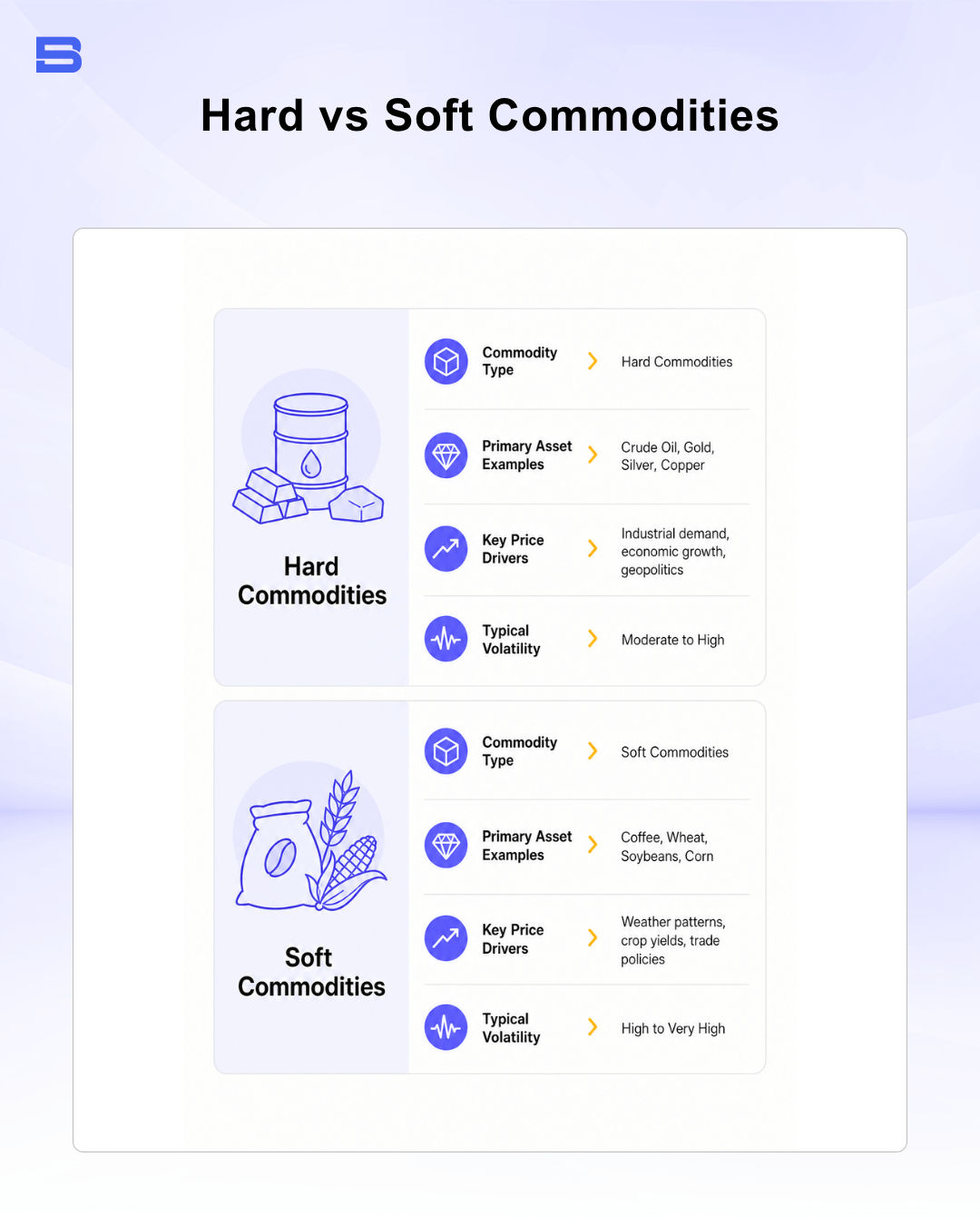
Key Ways to Trade Commodities
Retail traders can access commodity markets through several standardized instruments depending on their capital size and trading style.
Commodity Futures Contracts: The Institutional Benchmark
A commodity futures contract is a legally binding agreement to buy or sell a specific quantity of a commodity at a predetermined price on a specified future date. These contracts are traded on centralized exchanges and serve as global benchmark prices.
In regulated markets, institutional oversight is provided by authorities such as the U.S. Commodity Futures Trading Commission (CFTC). Standardized contract sizes and expiration dates govern these markets. To understand how standardized contracts function, exploring futures trading will help clarify margin requirements and settlement rules.
Commodity CFDs and ETFs: Accessible Entry Points for Retail Investors
For many retail investors, trading standardized futures contracts requires significant capital upfront. Contracts for Difference (CFDs) and Exchange-Traded Funds (ETFs) offer more flexible alternatives.
Commodity CFDs allow you to speculate on price changes without taking ownership of the contract or managing physical expiration dates. Meanwhile, commodity ETFs pool investor funds to track an underlying commodity index or physical asset reserve, making them accessible directly through standard equity brokerage accounts.
Agricultural Commodities and FCPO Regional Context
Regional exchanges also offer specialized commodity instruments tailored to local production hubs. In Southeast Asia, crude palm oil is one of the most vital agricultural commodities.
Traders in the region frequently utilize the (FCPO) Crude Palm Oil Futures contract on Bursa Malaysia. Learning how to analyze FCPO contract specifications offers a clear example of how regional supply chains create liquid trading opportunities.
What Drives Commodity Market Prices?
Commodity prices fluctuate based on the basic economic principle of supply and demand. When unexpected supply shortages occur due to extreme weather or geopolitical tensions, prices tend to rise rapidly. Conversely, economic slowdowns reduce industrial consumption, driving prices lower.
Because major commodities are priced globally in US Dollars, currency movements also exert significant influence. A weaker US Dollar typically makes commodities less expensive for international buyers, driving up global demand and prices.
To visualize price impacts, consider a practical scenario with crude oil trading at $70 per barrel. If you open a leveraged position with $2,500 of margin at 10:1 leverage, your total market exposure equals $25,000 (roughly 357 barrels).
Keep in mind that leverage cuts both ways—a 5% move against your position would produce an equally significant loss on your margin capital.
Risks and Risk Management in Commodity Trading
While commodity price swings create profit potential, they also introduce substantial risk. Geopolitical events or sudden weather shifts can lead to sharp overnight price gaps that breach stop levels.
Leverage amplifies your potential returns when the market moves in your favor, but it accelerates capital losses just as rapidly when price trends reverse against your expectations.
For example, using 10:1 leverage means a 10% market move against your position will completely deplete your allocated margin capital, leading to an immediate margin call. To protect your capital against severe drawdown, disciplined risk management is essential:
- Set automated stop-loss orders on every trade to cap maximum acceptable losses.
- Limit your capital risk on any single position to 1% or 2% of your overall portfolio using proper position sizing.
- Monitor rollover costs and overnight swap rates when holding CFD positions across multiple days.
Navigating Commodities Markets
Commodity trading provides an accessible way to diversify your portfolio and capitalize on global economic trends across energy, metals, and agriculture. By building a solid understanding of market drivers, selecting appropriate trading instruments, and enforcing strict risk controls, you can navigate commodity price movements with confidence.
- What Can You Trade? A Guide to Forex, Stocks, and More
- CFD Trading for Beginners
- What is CFD Trading and How Does It Work?
- Forex vs. Stocks: Which Market Suits You Best?
- How to Diversify a Portfolio Across Asset Classes
- How Dividend Stocks Work: Yields, Risks, and Strategies
- Silver Trading Explained: A Guide for Retail Investors
- Precious Metals Trading: A Complete Guide for Beginners
- Natural Gas Trading: A Guide to the Market
- Structured Warrants Malaysia: How They Work and Risks
- What Is the KLCI Index and How to Trade It
- Gold Investment in Malaysia: A Complete Guide for Beginners
- What Is Kijang Emas and How to Invest in It
- Value Investing Explained: How to Find Undervalued Stocks
- How to Trade Bitcoin Safely: A Complete Market Guide
- Growth Investing Explained: Strategies, Metrics, and Risks
- What Is Digital Gold Malaysia and How to Invest
- Crypto Trading Strategies for Beginners
- Gold vs Bitcoin: Key Differences, Risks, and Strategies
- Sukuk: A Guide for Beginners to Islamic Bonds
- What Is FCPO (Crude Palm Oil Futures) and How to Trade It
- How to Identify and Invest in Shariah-Compliant Stocks
- Timber Investment: Is It Worth It?
- Gold ETF Malaysia: A Guide for Beginners
- What Are Malaysian Government Securities (MGS)?
- Corporate Bonds Malaysia: A Guide for Beginners
- China A-Shares Trading Guide for Malaysian Investors
- What Is a Silver ETF and How to Invest in It?
- How to Trade XRP: A Practical Guide for Retail Investors
- How to Trade Solana (SOL): A Guide for Beginners
- What Are Gold Futures and How Do They Work?
- Money Market Fund in Malaysia: A Guide for Beginners
- Property Investment Malaysia: Direct Real Estate or M-REITs?
- What Is Binance Coin and How Does It Work?
- Green Sukuk: A Guide for Beginners to Islamic ESG Investing
- What Is Shiba Inu (SHIB) and How to Trade It
- What Is USDT? A Complete Guide to Tether for Beginners
- What Is Dogecoin and How to Trade It Safely for Beginners
- Cardano: A Guide for Beginners to Trade This Cryptocurrency
- Polkadot: A Guide to Trading This Cryptocurrency
- Tron: A Guide for Beginners to Trading This Cryptocurrency
- What Is Litecoin (LTC)? A Guide to Trading Digital Silver
- What Is Chainlink (LINK) and How to Trade It
- How to Trade Pepe Coin: Spot, Leverage, and Risk Management
- Near Protocol: A Guide to Trading This Cryptocurrency
- Trading Polygon Crypto: A Practical Guide for Beginners
- Trade Toncoin: Understanding the TON Ecosystem and Risks
- Cosmos Crypto: Ecosystem Architecture, Tokenomics, and Risks
- Stellar Crypto: A Guide to Trading This Cryptocurrency
- Avalanche Crypto Explained: A Practical Guide for Traders
- What Is Worldcoin? How to Trade WLD and Manage Risk
- Aptos: A Guide for Beginners to Trading This Cryptocurrency
- Sui Crypto Explained: Tokenomics and Trading Guide
- Celestia: A Guide to Trading This Cryptocurrency
- Decentraland: A Guide to Trading This Cryptocurrency
- What Is Arbitrum? How to Trade the Leading Layer 2 Network
- Sei Crypto: A Guide to Trading This Cryptocurrency
- What Is Injective Protocol and How to Trade INJ Safely
Disclaimer: The content on this page is intended for educational and informational purposes only. It does not constitute financial, investment, tax, or legal advice, and should not be interpreted as a recommendation to buy, sell, or hold any financial instrument or asset. Trading and investing involve significant risk, including the possible loss of your entire capital. Products such as forex, CFDs, and cryptocurrencies carry additional risks due to leverage, high volatility, and limited regulatory protection in some jurisdictions. Past performance of any financial instrument does not guarantee future results. Any market views, forecasts, or opinions expressed are those of the author at the time of writing and may not reflect current market conditions. Platform features, fees, and regulatory status are subject to change — always verify information directly with the relevant provider or regulator before making any financial decision. BrokerSpecs may receive compensation from third parties featured on this site. Always conduct your own due diligence and consider seeking advice from a licensed financial professional before investing. Portions of this article were prepared with the assistance of AI tools and reviewed by our editorial team before publication.