



Related Tags
Imagine sitting in front of your trading monitor, staring at thousands of publicly listed companies across global exchanges. Picking a single winning stock requires hours of financial audit, quarterly earnings analysis, and constant vigilance against unexpected management blunders.
Indices trading offers an efficient alternative by allowing you to take a position on an entire market segment or national economy through a single trade.
What Are Indices in Trading and How Does It Work?
Instead of betting on the fortunes of a single corporate entity, index trading lets you speculate on the collective price performance of a group of stocks. A stock market index acts as a financial thermometer, measuring the price movements of a curated basket of equities that represent a specific sector, market, or national economy.
Consider a practical portfolio scenario to understand how index diversification impacts your capital risk. If you allocate USD 10,000 into a single tech company's stock and that company suffers a major regulatory penalty, a 30% collapse in share price wipes out USD 3,000 of your principal instantly.
Conversely, if you spread that same USD 10,000 across a benchmark index containing 500 companies, a single constituent's severe drop is absorbed by the broader market basket, reducing your single-stock concentration risk dramatically.
When you engage in indices trading, you do not take physical ownership of individual equity shares. Instead, you trade derivative contracts or fund units that mirror the cash value of the index itself.
What Are Indices in Trading vs. Individual Stocks?
Trading individual stocks exposes your portfolio to company-specific risks, including earnings surprises, management changes, and localized scandals. Stock indices smooth out this uncompensated volatility by grouping companies together, reflecting broad macroeconomic health rather than isolated corporate events.
While single equities can deliver explosive gains, they also carry total loss risks if a company faces insolvency. Stock indices periodically rebalance, removing underperforming companies and replacing them with growing businesses to maintain benchmark health over time.
Market Capitalization-Weighted Indices
In a market capitalization-weighted index, companies with larger total market values exert a greater influence on the index's overall price movement. Mega-cap tech giants like Apple or NVIDIA carry significantly higher percentage weights than smaller constituents in benchmarks such as the S&P 500.
If a top-weighted constituent moves by 3%, it impacts the index price far more than a 3% move from twenty smaller constituents combined. This weighting method accurately reflects overall economic size, though it can create concentration risk during market bubbles.
Price-Weighted Indices
Price-weighted indices determine constituent influence based solely on each company's individual stock price per share, regardless of firm size. The Dow Jones Industrial Average (DJIA) is a primary example of this calculation method.
A company trading at USD 300 per share carries three times the weight of a firm trading at USD 100, even if the lower-priced firm has a larger total market capitalization. This structural bias means high-priced stocks exert disproportionate control over daily index swings.
What Are the Most Traded Indices Globally?
Global equity markets feature several flagship benchmark indices that attract the vast majority of trading volume. Understanding their constituent profiles, operating currency, and trading characteristics helps you choose the instrument that fits your active trading strategy.
- S&P 500 (US500): Tracks 500 large-cap US equities and serves as the primary benchmark for American economic health.
- NASDAQ 100 (US100): Heavily weighted toward top technology firms, offering high volatility and strong growth exposure.
- Dow Jones Industrial Average (US30): Tracks 30 premier blue-chip US industrial companies using a price-weighted model.
- FTSE 100 (UK100): Measures the 100 largest companies listed on the London Stock Exchange, heavily weighted toward energy, mining, and finance.
- DAX 40 (GER40): Comprises 40 major blue-chip German corporate giants, serving as a primary gauge for European industrial production.
- Nikkei 225 (JP225): The key price-weighted benchmark for Japan's equity market, offering unique Asian session liquidity.
Trading these global benchmarks allows active traders to rotate capital across European, American, and Asian market hours seamlessly, alongside broader asset classes like commodities.
Regional Spotlight: What Is the KLCI Index and FKLI?
For Southeast Asian traders seeking localized exposure, the FTSE Bursa Malaysia Kuala Lumpur Composite Index (KLCI) represents the primary equity benchmark in Malaysia. The KLCI index tracks the top 30 companies listed on Bursa Malaysia's Main Market by market capitalization, dominated by banking institutions, utilities, and telecommunication conglomerates.
Retail and institutional traders access this market benchmark dynamically through FTSE Bursa Malaysia KLCI Futures (FKLI) futures, which are Ringgit-denominated index futures contracts traded on Bursa Malaysia Derivatives.
Trading derivative contracts on the KLCI allows local market participants to hedge domestic equity portfolios or speculate on national economic trends without purchasing thirty individual stock allocations directly.
How to Trade Indices: CFDs, Futures, and ETFs
Traders access global indices through three primary vehicles, each possessing distinct fee structures, capital requirements, and leverage mechanisms. Selecting the right structure depends on your investment horizon and capital preservation goals.
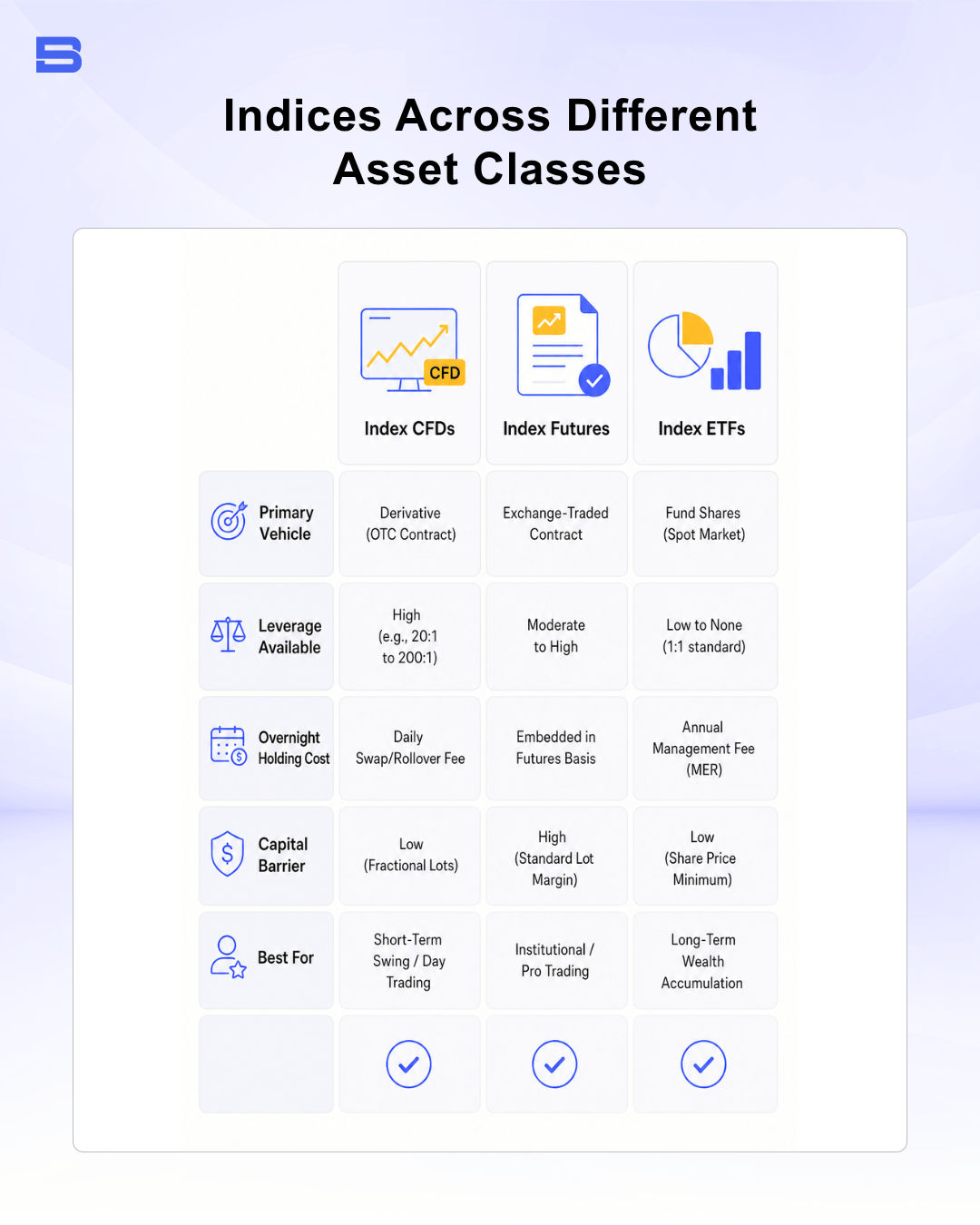
Trading Index Futures vs. Index CFDs
Index Contract for Differences (CFDs) allow retail traders to trade index price movements with flexible contract sizes and lower initial deposit requirements. However, trading CFDs off-exchange means executing against a broker market maker, incurring spread markups and daily overnight financing fees if positions are held past market close.
In contrast, index futures trade on centralized exchanges like the CME Group or Bursa Malaysia Derivatives with fixed expiration dates. While futures eliminate daily overnight swap charges, they demand larger initial capital allocations and involve periodic contract rollover procedures.
Key Factors and Economic Indicators Driving Index Movements
Stock indices do not move in isolation; their price action responds directly to macroeconomic shifts and systematic capital flows. Monitoring macroeconomic updates published by official institutions like the International Monetary Fund (IMF) provides valuable context for long-term index trends.
- Central Bank Policy Decisions: Interest rate shifts by the Federal Reserve, European Central Bank, or Bank Negara Malaysia immediately impact corporate borrowing costs and equity valuations.
- Inflation & (Consumer Price Index) CPI Releases: High CPI readings raise expectations of monetary tightening, which historically exerts downward pressure on stock market indices.
- Corporate Earnings Seasons: Quarterly results from high-weighted index constituents can trigger sharp benchmark movements across entire trading sessions.
- Gross Domestic Product (GDP) Data: GDP announcements provide broad confirmation of economic expansion or contraction, influencing overall institutional sentiment.
Essential Risk Management and Index Trading Strategies
Capital preservation must serve as the foundation of any sustainable indices trading approach. Because indices aggregate multiple equities, traders sometimes falsely assume that index positions carry minimal risk.
Leverage magnifies your returns when market moves align with your position, but it accelerates capital destruction just as quickly when prices move against you. A 2% sudden gap down on a 20:1 leveraged position wipes out 40% of your account margin in seconds.
To protect your trading capital, always implement these foundational risk management controls:
- Set guaranteed stop-loss orders to protect positions against unexpected news events or weekend gap risks.
- Limit your risk exposure to no more than 1% to 2% of your total account equity on any single index trade.
- Account for index trading hours and market open volatility when placing tight stop-loss thresholds.
- Avoid over-leveraging positions during high-impact economic announcements or corporate earnings releases.
Mastering Indices Trading
Indices trading offers an effective path to participate in broad equity market movements without the burden of picking individual corporate winners. By mastering index calculation mechanics, selecting the appropriate financial vehicle, and enforcing strict position-sizing rules, you can navigate global market benchmarks with confidence.
- What Can You Trade? A Guide to Forex, Stocks, and More
- CFD Trading for Beginners
- What is CFD Trading and How Does It Work?
- Forex vs. Stocks: Which Market Suits You Best?
- How to Diversify a Portfolio Across Asset Classes
- How Dividend Stocks Work: Yields, Risks, and Strategies
- Silver Trading Explained: A Guide for Retail Investors
- Precious Metals Trading: A Complete Guide for Beginners
- Natural Gas Trading: A Guide to the Market
- Structured Warrants Malaysia: How They Work and Risks
- What Is the KLCI Index and How to Trade It
- Gold Investment in Malaysia: A Complete Guide for Beginners
- What Is Kijang Emas and How to Invest in It
- Value Investing Explained: How to Find Undervalued Stocks
- How to Trade Bitcoin Safely: A Complete Market Guide
- Growth Investing Explained: Strategies, Metrics, and Risks
- What Is Digital Gold Malaysia and How to Invest
- Crypto Trading Strategies for Beginners
- Gold vs Bitcoin: Key Differences, Risks, and Strategies
- Sukuk: A Guide for Beginners to Islamic Bonds
- What Is FCPO (Crude Palm Oil Futures) and How to Trade It
- How to Identify and Invest in Shariah-Compliant Stocks
- Timber Investment: Is It Worth It?
- Gold ETF Malaysia: A Guide for Beginners
- What Are Malaysian Government Securities (MGS)?
- Corporate Bonds Malaysia: A Guide for Beginners
- China A-Shares Trading Guide for Malaysian Investors
- What Is a Silver ETF and How to Invest in It?
- How to Trade XRP: A Practical Guide for Retail Investors
- How to Trade Solana (SOL): A Guide for Beginners
- What Are Gold Futures and How Do They Work?
- Money Market Fund in Malaysia: A Guide for Beginners
- Property Investment Malaysia: Direct Real Estate or M-REITs?
- What Is Binance Coin and How Does It Work?
- Green Sukuk: A Guide for Beginners to Islamic ESG Investing
- What Is Shiba Inu (SHIB) and How to Trade It
- What Is USDT? A Complete Guide to Tether for Beginners
- What Is Dogecoin and How to Trade It Safely for Beginners
- Cardano: A Guide for Beginners to Trade This Cryptocurrency
- Polkadot: A Guide to Trading This Cryptocurrency
- Tron: A Guide for Beginners to Trading This Cryptocurrency
- What Is Litecoin (LTC)? A Guide to Trading Digital Silver
- What Is Chainlink (LINK) and How to Trade It
- How to Trade Pepe Coin: Spot, Leverage, and Risk Management
- Near Protocol: A Guide to Trading This Cryptocurrency
- Trading Polygon Crypto: A Practical Guide for Beginners
- Trade Toncoin: Understanding the TON Ecosystem and Risks
- Cosmos Crypto: Ecosystem Architecture, Tokenomics, and Risks
- Stellar Crypto: A Guide to Trading This Cryptocurrency
- Avalanche Crypto Explained: A Practical Guide for Traders
- What Is Worldcoin? How to Trade WLD and Manage Risk
- Aptos: A Guide for Beginners to Trading This Cryptocurrency
- Sui Crypto Explained: Tokenomics and Trading Guide
- Celestia: A Guide to Trading This Cryptocurrency
- Decentraland: A Guide to Trading This Cryptocurrency
- What Is Arbitrum? How to Trade the Leading Layer 2 Network
- Sei Crypto: A Guide to Trading This Cryptocurrency
- What Is Injective Protocol and How to Trade INJ Safely
Disclaimer: The content on this page is intended for educational and informational purposes only. It does not constitute financial, investment, tax, or legal advice, and should not be interpreted as a recommendation to buy, sell, or hold any financial instrument or asset. Trading and investing involve significant risk, including the possible loss of your entire capital. Products such as forex, CFDs, and cryptocurrencies carry additional risks due to leverage, high volatility, and limited regulatory protection in some jurisdictions. Past performance of any financial instrument does not guarantee future results. Any market views, forecasts, or opinions expressed are those of the author at the time of writing and may not reflect current market conditions. Platform features, fees, and regulatory status are subject to change — always verify information directly with the relevant provider or regulator before making any financial decision. BrokerSpecs may receive compensation from third parties featured on this site. Always conduct your own due diligence and consider seeking advice from a licensed financial professional before investing. Portions of this article were prepared with the assistance of AI tools and reviewed by our editorial team before publication.